Introduction
For Indian fans starting their tactics journey, “overload” is one of the easiest ideas to spot once you know what to look for: a team deliberately sends extra players to one zone of the pitch to create a numerical advantage, force defenders into uncomfortable decisions, and open space elsewhere. Australia, especially in the modern era under managers like Graham Arnold, uses overloads as a practical solution to two realities of international football: limited training time and varied opponent quality. Rather than relying only on long spells of intricate possession like Pep Guardiola’s Manchester City in the Premier League, Australia often builds repeatable patterns—simple rotations, clear running lanes, and strong crossing or cut-back targets. The goal is not to keep the ball for its own sake; it is to tilt the local numbers, win the second ball, and arrive in the penalty area with support. This article breaks down how Australia executes overloads, where they prefer to create them, and how those movements translate into chances against different opponent styles in competitions like the AFC Asian Cup and FIFA World Cup.
How It Works
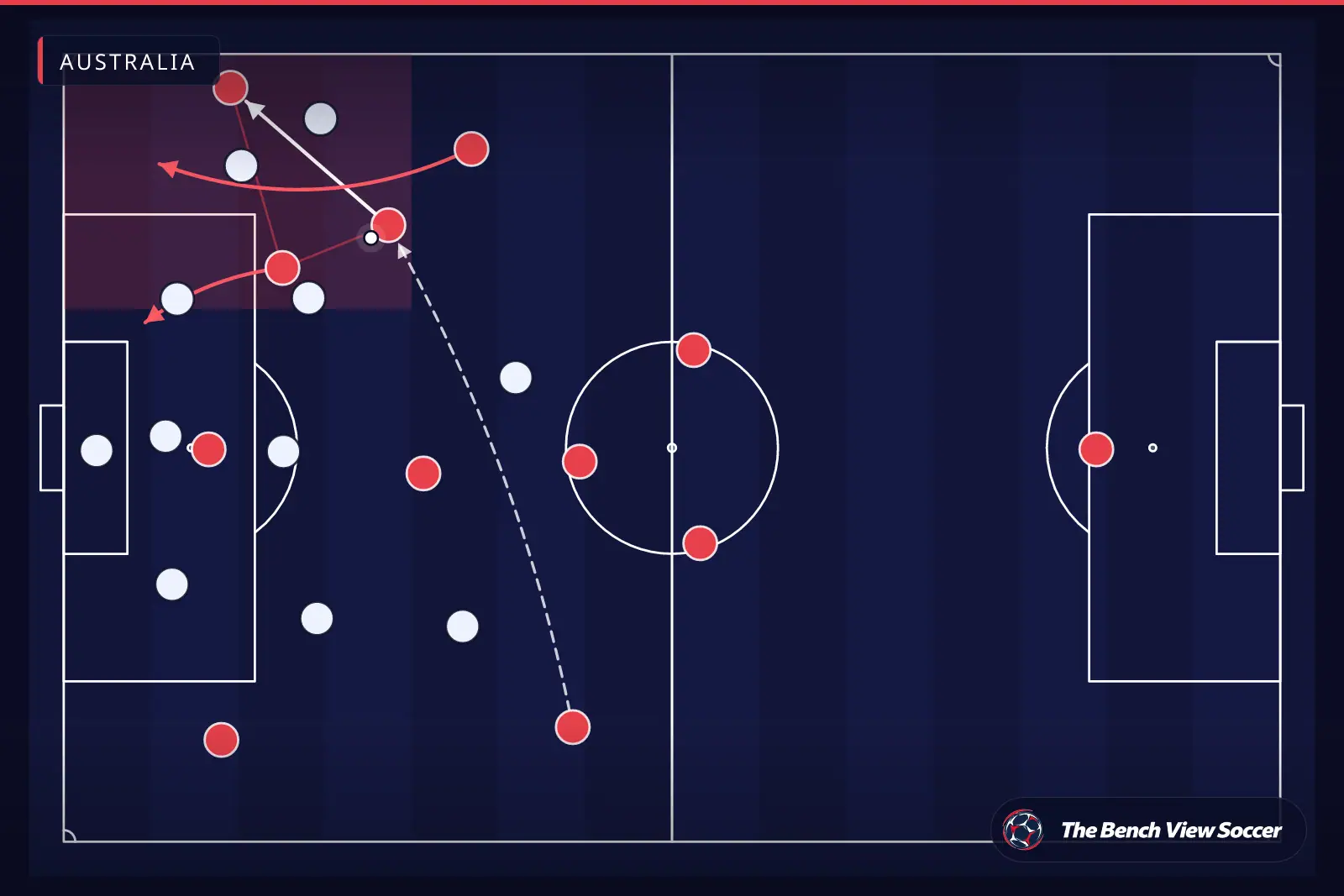
Australia executes overloads through three main “locations”: wide corridors near the touchline, the half-space just inside the fullback, and the central lane around the opponent’s midfield line. The most common is a wide overload on one flank: the fullback steps high, the winger holds width to pin the opposing fullback, and a midfielder (often a No. 8) slides across to become a third man. That creates a 3v2 or 3v1 on the side, letting Australia progress with short passes or a quick wall pass (one-two). The key detail is timing: the third man arrives late so the opponent cannot mark everyone early. When the opponent shifts across to protect that flank, Australia uses the “free” player on the far side: a switch of play to the opposite winger, or a far-side fullback sprinting into space. Another pattern is an overload-to-cross: once three players combine to reach the byline, Australia floods the box with a striker plus at least two runners (near-post, penalty spot, far-post) to turn the earlier overload into a finishing advantage. When opponents defend deep, Australia also overloads the central lane by pushing a midfielder higher between lines, so the ball carrier has two short options: one to feet and one in behind. These are straightforward, repeatable mechanisms that suit national-team football.
Match Examples
A clear reference point is the 2022 FIFA World Cup group stage win against Denmark (Qatar 2022). Australia defends compact for long phases, but when they break, the decisive moment starts with a local overload on the right: the wide player holds the touchline to stretch, a supporting runner arrives inside, and Denmark’s defenders get drawn toward the ball. The key is that the “extra” runner is not static; he moves at speed, so the overload becomes a transition advantage rather than slow possession. Another useful example is the 2023 AFC Asian Cup (played in early 2024) quarter-final versus South Korea. Australia spends long periods managing waves of pressure, but when they get controlled possession, they often create temporary overloads wide to relieve pressure—fullback and winger combine, and a midfielder steps in to offer a third passing lane. Even when the final action is a cross or a cut-back that does not immediately become a goal, the overload helps Australia move the opponent’s block and win territory. For a different opponent profile, look at Australia’s World Cup qualification matches in the AFC third round (2021–22 cycle), where they face deeper blocks more regularly: the wide overloads are used to pull a low defensive line sideways, after which Australia looks for early deliveries into the box with multiple runners attacking different zones. Across these matches, the repeated theme is simple: overload to escape pressure, overload to reach the byline, or overload to create a switch into open space.
Related Concepts & Skills
Training Implications
To coach overloads in a practical, repeatable way, build sessions around recognisable pictures. Start with a 3v2 wide-channel game: mark a channel from the touchline to the edge of the box, place an attacker fullback, winger, and central midfielder against an opposing fullback and winger. The attacking objective is either (a) reach the byline and cut back, or (b) play into a target player at the top of the box. Coach the “third man” to arrive late, not stand next to the ball—use a rule that the midfielder cannot enter the channel until the first pass goes wide. Next, add a switch condition: if the defending team stops the byline, the attackers must recycle and switch to a second channel on the opposite side within three passes. This teaches the overload-to-switch logic. Then progress to an 8v8 or 10v10 with two goals where one team earns double points if a goal comes from a cut-back after an overload on the flank. Finally, include a “rest defence” constraint: when the team attacks, at least two players must stay connected behind the ball in central zones; if they fail and concede a counterattack goal within 10 seconds, it counts double. This creates the real international-football trade-off Australia faces: commit enough players to overload, but keep enough structure to survive transitions.
The Bench View app
Don’t just read football — train it
Everything you read here, turned into training you can follow step by step.
Physical training at home
AI daily sessions adapted to your level and position. No equipment needed.
Tactical training courses
Step-by-step courses on positioning, pressing, build-up and decision making.
- 7 days free
- No commitment
- Cancel anytime
Free account: 2 physical sessions + the first tactical course. PRO: 7-day free trial — cancel before day 8 and you pay nothing.