Introduction
Inside forwards are one of the easiest tactical ideas to “see” once you know what to look for: a wide attacker who starts near the touchline but then drives into central areas to threaten goal. Coaches use this movement not only to create shots, but to stretch a defence in two directions at once—horizontally (across the pitch) and vertically (behind the back line). For fans watching the Premier League or Champions League, this explains why a winger sometimes looks “missing” on the wing: the plan is often to move defenders, open passing lanes, and create space for overlapping full-backs or advancing midfielders. This article breaks down how two elite teams use inside forwards in different ways: Mikel Arteta’s Arsenal in the Premier League and Carlo Ancelotti’s Real Madrid in La Liga and the UEFA Champions League. We focus on what the inside forward’s run does to the opposing full-back and centre-back, how the ball circulation supports it, and why this can make a compact defensive block feel “stretched” and uncomfortable.
How It Works
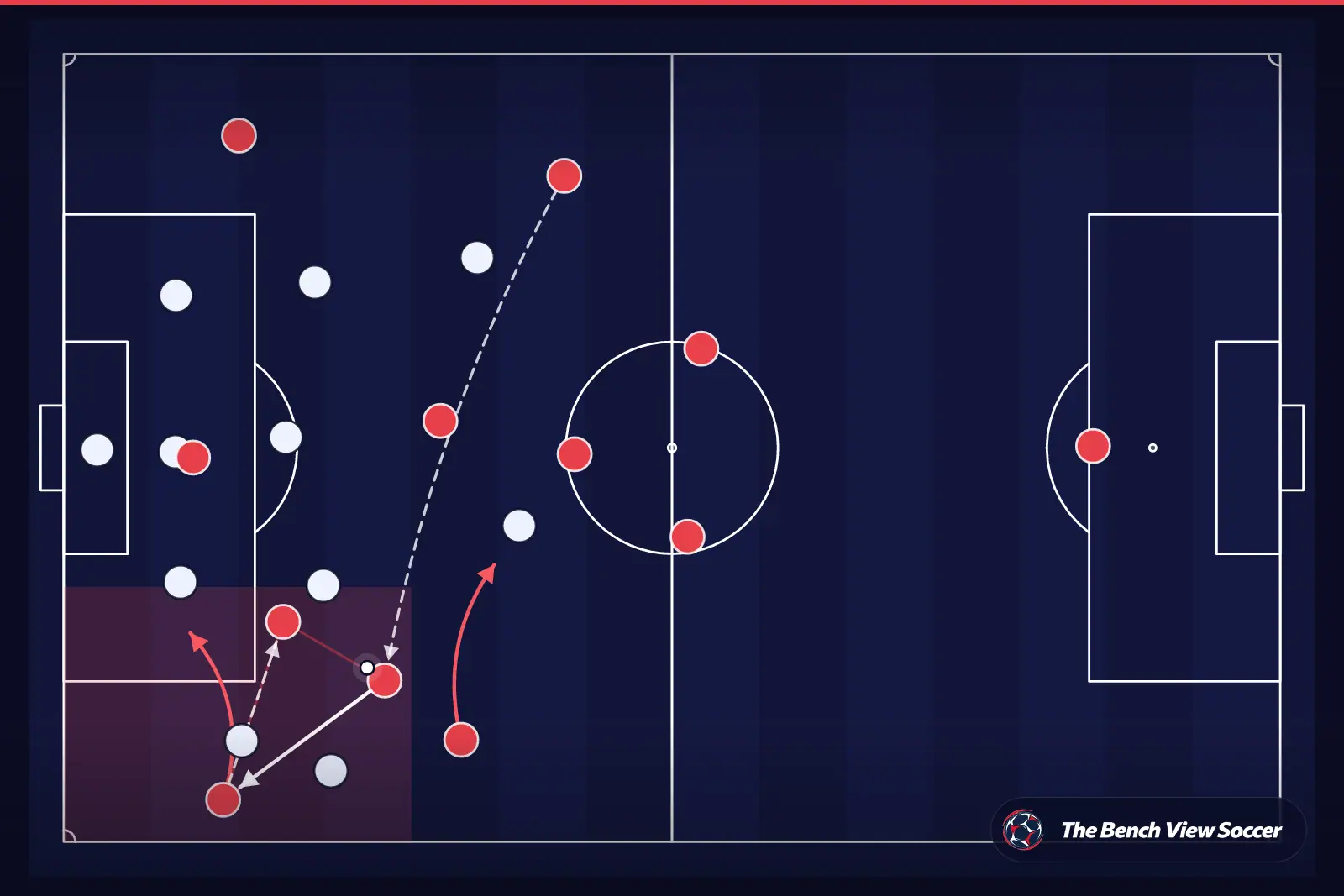
Coaches use inside forwards to stretch defences by creating a constant dilemma: should the opponent’s full-back follow inside and leave the flank open, or stay wide and allow the inside forward to receive between the lines? “Between the lines” means the space between the opponent’s midfield line and defensive line—dangerous because a player can turn and attack the back line. The inside forward typically begins wide to pin (fix) the full-back near the touchline, then times a diagonal movement into the half-space, the channel between the wing and the centre. As the inside forward comes in, the team often keeps width with an overlapping full-back (like Ben White at Arsenal) or a high winger on the other side. This creates a stretched back four: the far-side defenders must cover more ground, while the near-side centre-back is pulled out to protect the half-space. Coaches also pair this with “third-man” patterns: Player A passes to Player B, and Player C (the inside forward) receives next, benefiting from defenders shifting toward the ball. The key is that the inside forward’s movement changes the opponent’s spacing even when he does not touch the ball—he forces marking decisions, opens an outside lane for overlaps, and creates central gaps for cut-backs and through balls.
Match Examples
Arsenal under Mikel Arteta (2022-23 and 2023-24 Premier League) often uses Bukayo Saka as a right-sided inside forward who begins wide and then attacks the right half-space. In the 2022-23 Premier League match Arsenal vs Manchester United (3-2 at the Emirates), Saka’s inward positioning frequently pins Luke Shaw and creates room for Ben White’s overlap. When Shaw stays tight to Saka, White’s run becomes a clean outlet; when Shaw passes Saka inside to a centre-back, Arsenal look for quick combinations that let Saka receive on the turn. Another clear illustration appears in Arsenal vs Liverpool (3-1, Premier League 2023-24): Saka and Martin Ødegaard combine on the right as Saka comes inside, and Liverpool’s left-side defenders are forced to compress centrally, which opens the outside lane and also creates space for cut-backs toward the penalty spot. Real Madrid under Carlo Ancelotti uses inside forwards in a more transitional, vertical way, especially with Vinícius Júnior starting left but attacking inside as soon as Madrid find space. In the UEFA Champions League 2021-22 semi-final second leg vs Manchester City (3-1 after extra time at the Bernabéu), Vinícius repeatedly threatens the inside channel, which forces City’s right side to narrow and protect the centre, leaving Madrid opportunities to switch play and attack the far side. In La Liga 2023-24, with Jude Bellingham operating as an advanced runner and Rodrygo often starting right but moving inside, Ancelotti’s Madrid use inside-forward movements to crowd central zones for quick finishes while still stretching the back line because full-backs must respect the starting width. In the Champions League 2023-24 quarter-final tie vs Manchester City (notably the second leg at the Etihad), Vinícius’ inside runs and Rodrygo’s central arrivals help Madrid threaten the space behind City’s midfield, even when Madrid defend deep and attack quickly. Across these examples, the theme stays consistent: inside forwards manipulate defender spacing, and the rest of the team—full-backs, midfielders, and ball circulation—supports the stretching effect.
Related Concepts & Skills
Training Implications
To train inside-forward stretching in a practical way, design sessions that reward the movement and the space created, not just the final shot. First, run a 6v6 or 7v7 “lane game” with marked wide lanes and half-spaces: require wingers to start in the wide lane, then allow them to enter the half-space only after a pass goes into midfield. This teaches timing—arriving inside as defenders shift. Second, add a full-back and mandate one overlap or underlap every attack on that side. Coach the decision: if the opponent full-back follows the inside forward, the pass goes outside to the overlapping full-back; if the full-back stays wide, the inside forward receives in the half-space. Third, include a finishing rule: goals count double if they come from a cut-back (a pass pulled back from near the byline to the edge of the box), because inside-forward systems often aim for these high-quality chances. Fourth, coach scanning and body shape: before receiving, the inside forward checks over both shoulders, receives on the back foot (the foot furthest from pressure), and attacks the gap between full-back and centre-back. Finally, use video clips from Arsenal and Real Madrid to set “if-then” cues for players: if the near centre-back steps out, run behind; if the midfield line is compact, drift wider to pin and free the full-back. These constraints make the tactical idea repeatable at grassroots level.
The Bench View app
Don’t just read football — train it
Everything you read here, turned into training you can follow step by step.
Physical training at home
AI daily sessions adapted to your level and position. No equipment needed.
Tactical training courses
Step-by-step courses on positioning, pressing, build-up and decision making.
- 7 days free
- No commitment
- Cancel anytime
Free account: 2 physical sessions + the first tactical course. PRO: 7-day free trial — cancel before day 8 and you pay nothing.