Introduction
For many fans, the winger is still imagined as a classic touchline sprinter: hug the line, beat the full-back, cross early. Modern European football often flips that picture. The “inverted winger” starts wide but prefers to dribble or run inside onto their stronger foot (for example, a left-footed player on the right wing). This small positional twist changes the entire defending team’s shape, not just the full-back’s duel. When a winger drives infield, the defender must decide: follow inside and open the flank, or hold the line and allow a shot or through pass from a central area. Either choice creates a chain reaction—centre-backs shift, midfielders tuck in, and the far-side winger may drop deeper to protect the box. You see this repeatedly in the Premier League, UEFA Champions League, La Liga, and Serie A. Understanding how inverted wingers pull, pin, and distort defensive lines is one of the quickest ways to “read” tactics on TV.
How It Works
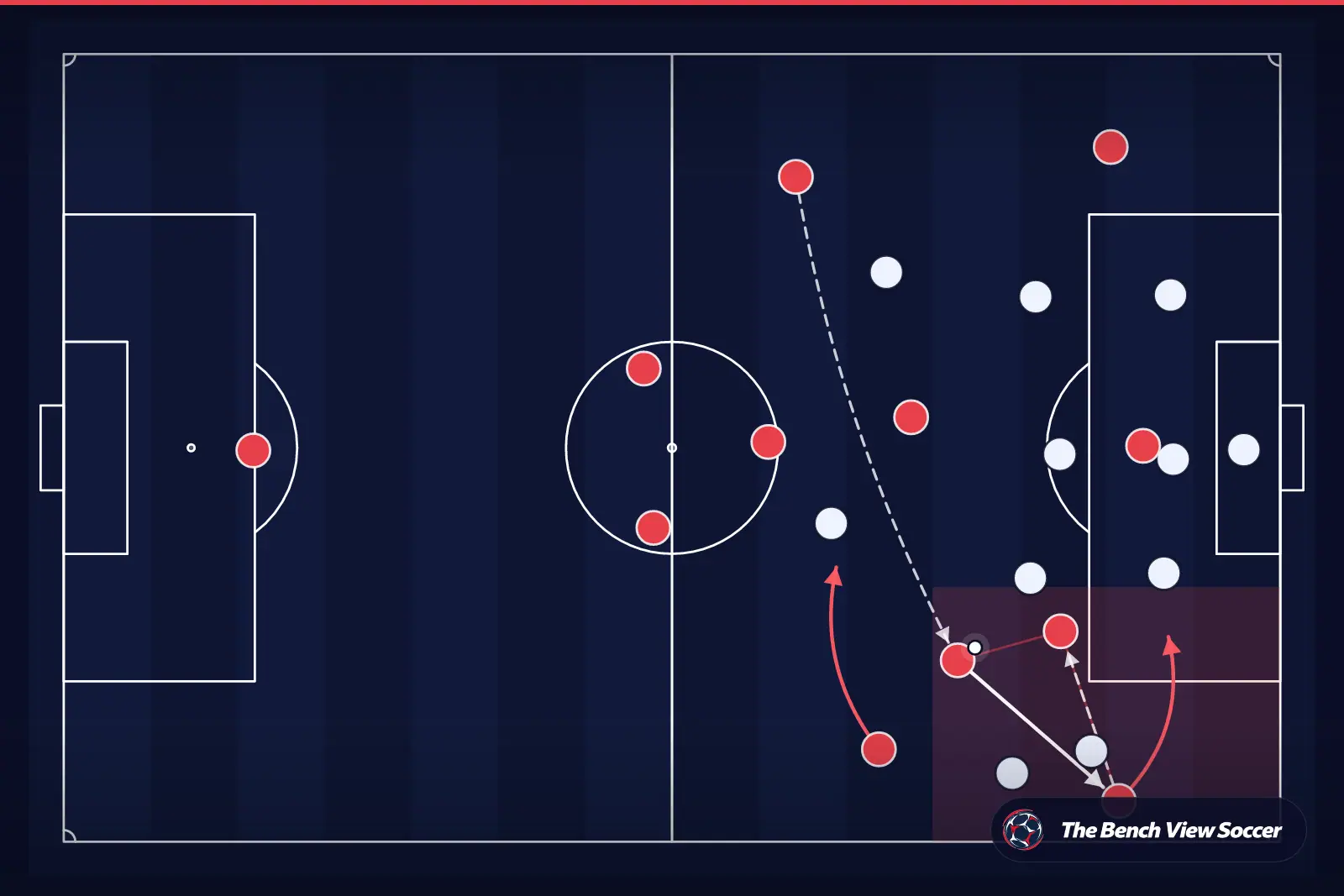
An inverted winger alters defensive shapes because they attack the most protected zones: the half-space and the edge of the penalty area. When the winger receives wide, the defending full-back initially marks them as usual. The moment the winger turns inside, the defending team faces a dilemma about reference points (who marks whom) and spacing (how far apart defenders stay). If the full-back follows inside, the defending back line often becomes uneven: the full-back steps into midfield height, while the centre-back slides wider to cover the channel, and the far-side full-back tucks in to protect the far post. This creates a “compressed” back four, leaving the touchline open for an overlapping run from the attacker’s full-back—think of how Liverpool use overlaps for Mohamed Salah or how Arsenal create wide pressure for Bukayo Saka. If the full-back does not follow inside, the defending team needs a midfielder to “hand over” the winger—usually the nearest central midfielder or defensive midfielder steps out. That movement breaks the midfield line, opening a passing lane behind the stepping midfielder. Managers like Pep Guardiola and Mikel Arteta aim for exactly this: the inverted winger drags a marker, then a quick wall pass, third-man run, or through ball attacks the gap. In defensive terms, inverted wingers force either (1) a wider back line with more 1v1 exposure in central lanes, or (2) a narrower block with vulnerable wide spaces. Either way, the defending shape loses its ideal symmetry and distances, which is why these wingers are so valuable in positional play systems.
Match Examples
1) UEFA Champions League 2018–19, Tottenham Hotspur vs Manchester City (Quarter-final, Second Leg at the Etihad). Pep Guardiola’s City use Riyad Mahrez on the right as a left-footed inverted winger. When Mahrez receives, Tottenham’s left side must choose: follow inside to stop the shot/pass, or hold width to block the overlap. City’s circulation repeatedly tries to draw Spurs into narrow positions, then switch quickly to isolate Mahrez for an inside dribble and a far-post delivery. The defensive line becomes compact, and City search for that moment when the covering midfielder is late and the centre-back has to step out. 2) Premier League 2022–23, Arsenal vs Manchester United (at the Emirates). Mikel Arteta uses Bukayo Saka on the right as a classic inverted winger profile (left-footed, cutting in). Arsenal keep Saka wide to pin Luke Shaw, then Saka comes inside to combine with Martin Ødegaard. United’s defensive shape responds by narrowing: a midfielder shifts across to block the inside lane, and the back line tucks in to protect the box. That narrowing leaves space for Ben White’s overlap or for quick switches to the left side, showing how one inverted winger can influence the entire width of the defending team. 3) Premier League 2017–18, Liverpool vs Manchester City (at Anfield). Jürgen Klopp’s Liverpool use Mohamed Salah on the right, cutting inside to attack the space between City’s left-back and left centre-back. City’s defenders cannot simply show him down the line because Salah’s inside runs threaten shots and through balls. As City’s block narrows to protect central lanes, Liverpool’s opposite side stays ready for transitions and far-post runs. This match is a clear example of how an inverted winger does not only “create chances,” but also forces the defending team’s back four to shuffle and compress, affecting their ability to press and cover wide areas.
Related Concepts & Skills
Training Implications
For players and coaches, training an inverted winger is not only about “cut inside and shoot.” It is about decision-making that manipulates the defence. First, build a scanning habit: before receiving, the winger checks (a) the full-back’s distance, (b) the nearest midfielder’s position, and (c) the centre-back’s covering angle. A simple drill is a 6v6+2 neutrals in a wide channel: the winger must receive on the flank and has three scoring options within 6 seconds—inside dribble to shoot, slip pass to an overlapping full-back, or bounce pass to a midfielder who plays a third-man pass. Rotate defenders so the winger learns different responses. Second, coach the “trigger to invert.” The winger inverts when the full-back is square and the nearest midfielder is far; they stay wide when the full-back is tight and the overlap is on. Use a constraint game: award double points if the goal comes from an action that forces a defender to leave the back line (full-back follows inside or midfielder steps out). Third, train defensive consequences: when the winger moves inside, the team must keep balance. Run a pattern where the winger inverts, the full-back overlaps, and the far-side winger tucks in as a temporary back-post defender. Finish with a transition rule: if the defending team wins it, they counter immediately into the space left by the overlapping full-back, teaching the attacking side to protect against counters with a holding midfielder and a “rest defence” line of at least three players.
The Bench View app
Don’t just read football — train it
Everything you read here, turned into training you can follow step by step.
Physical training at home
AI daily sessions adapted to your level and position. No equipment needed.
Tactical training courses
Step-by-step courses on positioning, pressing, build-up and decision making.
- 7 days free
- No commitment
- Cancel anytime
Free account: 2 physical sessions + the first tactical course. PRO: 7-day free trial — cancel before day 8 and you pay nothing.