Introduction
Liverpool’s defending is not only about tackling or “wanting it more”. Under Jürgen Klopp, and now evolving under Arne Slot, Liverpool stop attacks by controlling where the opponent can play, then attacking those moments with coordinated pressure. For fans new to tactics, the key idea is the “pressing trigger”: a specific cue that tells the whole team, “Now we go.” Without triggers, pressing becomes random running; with triggers, it becomes a system that wins the ball in dangerous areas and prevents clean progression through midfield. Liverpool’s best defensive sequences often start before the opponent even crosses the halfway line, because the forwards and midfielders shape the opponent’s choices. In competitions like the Premier League and UEFA Champions League, you regularly see Liverpool force rushed passes, guide play toward the touchline, and then collapse with multiple players to recover the ball. This article breaks down the triggers, the defensive shape behind them, and why the system works even when Liverpool’s back line is high.
How It Works
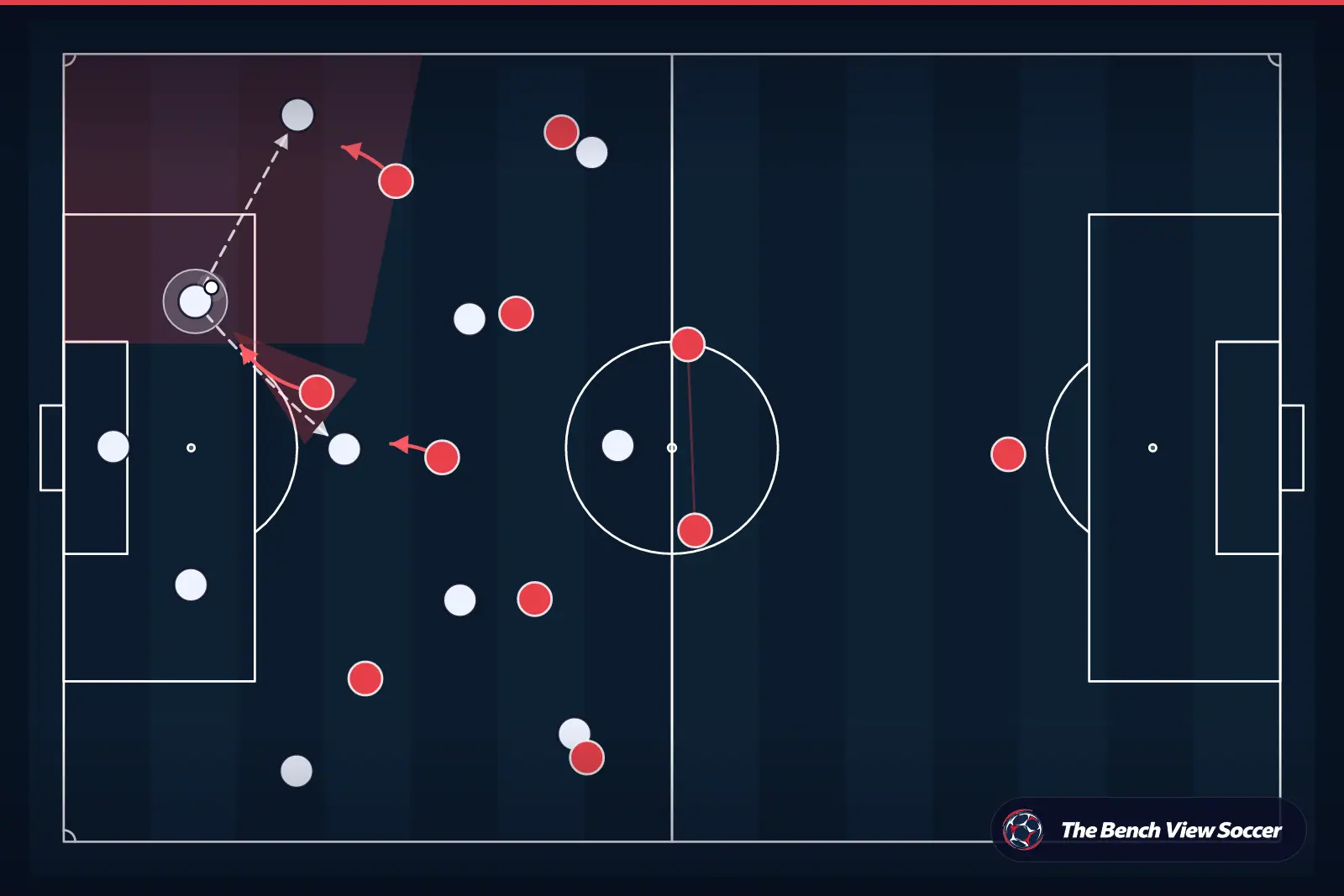
A pressing trigger is a repeatable signal that launches pressure at the same time from several players. Liverpool use triggers to create “predictability” in the opponent’s build-up: they allow a pass that looks safe, then swarm it because the next action becomes limited. Common triggers in Liverpool’s scheme include: (1) a backward pass to a centre-back or goalkeeper, because the receiver often opens up facing their own goal and needs an extra touch; (2) a poor first touch or bouncing ball, because the ball carrier cannot scan and protect the ball at the same time; (3) a pass into a wide full-back near the touchline, because the sideline becomes an extra defender and reduces escape routes; and (4) a vertical pass into a tightly marked pivot (defensive midfielder), because that player becomes the “trap” and Liverpool’s nearest midfielder jumps to intercept while the forward blocks the return pass. Behind the press, Liverpool’s defensive shape matters. The front line usually curves their runs rather than sprinting straight: the striker presses to force the ball one way, while the winger positions to block the inside passing lane. This is why Liverpool often “show” opponents toward the flank. The midfield stays connected, often in a compact line that is ready to step up when the trigger occurs, but also ready to drop if the press is beaten. The defence holds a relatively high line to shrink space between lines, making it harder for opponents to receive between midfield and defence. When the trigger fires, it is not one player chasing; it is a chain reaction: the ball-near winger closes, the striker blocks the back pass, a midfielder locks onto the nearest option, and the full-back steps in to prevent an easy outlet down the line. The goal is either a regain (winning the ball) or a forced clearance that Liverpool can contest and collect.
Match Examples
A clear example appears in the 2018-19 UEFA Champions League semi-final second leg: Liverpool vs Barcelona at Anfield. Barcelona try to build through Sergio Busquets, but Liverpool’s forwards and midfielders use him as a pressing reference point. When the ball travels back to Gerard Piqué or into a slightly awkward reception in midfield, Liverpool’s nearest player jumps, while the next presser blocks the obvious release pass. This creates repeated moments where Barcelona cannot settle into long possession phases, even with elite passers on the pitch. Liverpool’s defensive shape stays compact, so when the press forces a loose ball, the second ball is immediately contested. Another strong case is Liverpool vs Manchester City in the 2019-20 Premier League at Anfield (November 2019). City under Pep Guardiola are one of Europe’s best build-up teams, but Liverpool choose moments to press rather than pressing constantly. When City play into a full-back close to the touchline, Liverpool’s winger and full-back compress that zone, while the striker positions to discourage the return pass inside. The trigger is often a pass that arrives slightly behind the receiver or a touch that pulls the ball toward the line; Liverpool treat that as permission to lock the area and force hurried balls forward. A more recent illustration is Liverpool vs Manchester United in the 2023-24 Premier League at Anfield (December 2023). United try to escape by playing direct, but Liverpool’s pressing triggers still appear on second balls: when a clearance drops awkwardly or a receiver takes a heavy touch, Liverpool collapse with multiple players to win possession and restart attacks. Even without a perfect high press every minute, the triggers keep Liverpool in control because they dictate when pressure becomes aggressive and coordinated.
Related Concepts & Skills
Training Implications
For coaches, analysts, or even fans running local training in India, the most practical lesson is: pressing must be coached as a group decision, not an individual sprint. Start with a simple rule-set of 2–3 triggers and drill them repeatedly. Session idea 1 (15 minutes): a 6v6 plus 2 neutral players in a rectangle. The defending team earns double points if they win the ball within five seconds after a trigger occurs (back pass, poor touch, pass to wide player). Stop play when the press is late and ask: “What was the trigger? Who jumps first? Who blocks the inside pass?” Session idea 2 (20 minutes): build-up vs press on half a pitch (GK + back four + pivot vs three forwards + three midfielders). Coach the curved pressing run: the striker approaches the centre-back to force play wide, while the near winger starts narrow to block the pass into the pivot, then accelerates when the ball goes wide. Add a constraint: the build-up team must play through the full-back once every three passes, encouraging the exact wide trigger Liverpool like. Actionable player cues help. Teach the first presser to shout the trigger (“Back!” or “Wide!”), so teammates step up together. Teach midfielders to mark “ball-near” first, not “their man somewhere else”: when the trigger fires, they lock the closest passing lane and anticipate the second ball. For defenders, rehearse stepping in aggressively only when the press is connected; if the front line is late, defenders drop two steps to avoid being exposed. Finally, measure success: record how many regains happen in the attacking half, and how many times the opponent is forced into a long clearance. Improvement is visible when the team wins more second balls and the opponent’s passes forward become rushed and predictable.
The Bench View app
Don’t just read football — train it
Everything you read here, turned into training you can follow step by step.
Physical training at home
AI daily sessions adapted to your level and position. No equipment needed.
Tactical training courses
Step-by-step courses on positioning, pressing, build-up and decision making.
- 7 days free
- No commitment
- Cancel anytime
Free account: 2 physical sessions + the first tactical course. PRO: 7-day free trial — cancel before day 8 and you pay nothing.