Introduction
Real Madrid’s most feared attacking moments often arrive not through slow build-up, but through rapid transitions: the few seconds after they win the ball and immediately attack the space behind a defensive line. For fans learning European tactics, this is one of the clearest ways to understand why pace, timing, and decision-making matter as much as “possession.” Under Carlo Ancelotti, Madrid consistently create chaos by turning defence into attack before opponents can reset their shape. The key idea is simple: many teams push their back line higher to press or compress space; Madrid invite that, then punish it with direct carries, early forward passes, and well-timed runs. Players like Vinícius Júnior, Rodrygo, Jude Bellingham, and Federico Valverde thrive because they combine speed with awareness—knowing when to run in behind, when to hold to drag a defender, and when to attack the second ball. This article breaks down the mechanisms behind Madrid’s transition game and why it works in LaLiga and the UEFA Champions League.
How It Works
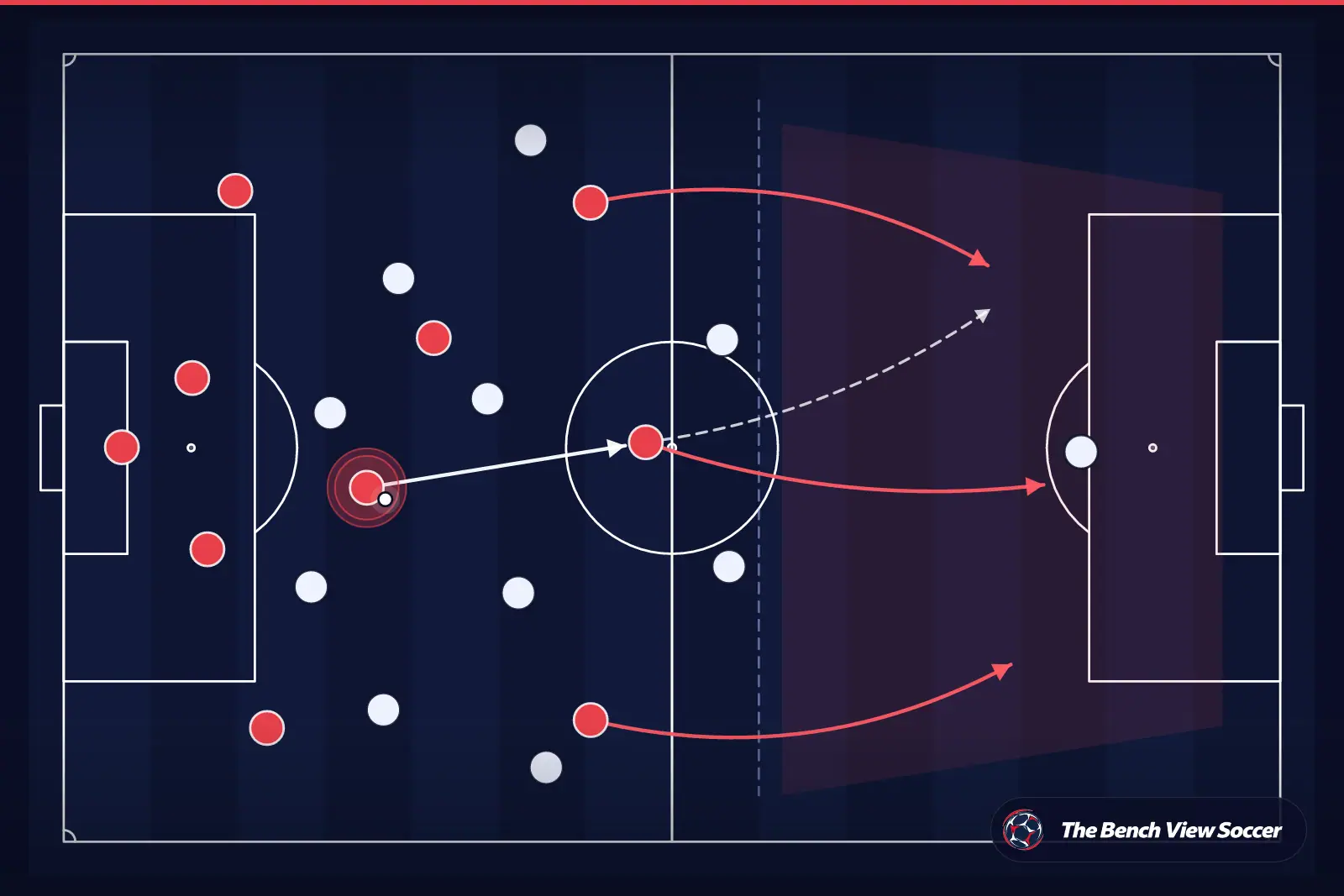
Real Madrid’s transition threat starts with how they defend and where they win the ball. They do not need constant high pressing like Jürgen Klopp’s Liverpool; instead, Ancelotti often sets a compact mid-block where the distances between lines are small, making passes into midfield risky. When Madrid recover possession—through an interception by Aurélien Tchouaméni, a tackle by Eduardo Camavinga, or a loose touch forced by pressure—they immediately look forward. The first action is scanning: the ball-winner and nearest midfielder look for runners behind the opponent’s defence. If the opponent’s full-backs are high, the channels (spaces outside the centre-backs) open up; Vinícius or Rodrygo attacks these channels at speed. If the centre-backs step up, Madrid exploit the space behind them with a direct pass or a carry. The transition often uses three roles. First, a “launcher” plays the early pass—Toni Kroos (previously), Luka Modrić, Valverde, or Bellingham. Second, a “fixer” pins defenders—Joselu in 2023–24, or Bellingham arriving late—so centre-backs cannot freely cover wide runs. Third, a “sprinter” threatens depth—Vinícius, Rodrygo, or sometimes Valverde from the right half. Madrid also use diagonal switches: if the opponent collapses toward Vinícius on the left, a quick switch finds Rodrygo or an overlapping Dani Carvajal on the far side. Importantly, Madrid do not always force the final ball immediately; if the pass behind is blocked, they take a controlled touch, wait for support, and then attack the penalty box with 3–4 runners. That balance—direct when space is open, patient when it closes—keeps transitions efficient rather than reckless.
Match Examples
A clear example comes from the 2023–24 UEFA Champions League quarter-final against Manchester City (managed by Pep Guardiola). Across both legs, City often push their defensive line high to keep Madrid away from Ederson’s box. Madrid’s response is to threaten the space behind through Vinícius Júnior’s left-channel runs and Rodrygo’s movement on the weak side. When Madrid win the ball and City’s full-backs are advanced, the first forward pass becomes a weapon: even if it does not become a shot, it forces City’s centre-backs to turn and sprint toward their own goal, which is exactly what high-line teams want to avoid. Another strong case is the 2021–22 Champions League knockout run under Ancelotti, especially the semi-final tie against Manchester City. Madrid repeatedly look for quick forward actions after regaining possession, using Vinícius to attack the space outside the right centre-back and using Modrić’s passing to access runners early. Even when City dominate the ball, Madrid’s best moments come from the “reset seconds” after a turnover—those moments when City’s attacking structure leaves space to counter. In LaLiga, the 2023–24 season shows a similar pattern against teams that push numbers forward (for example, big away matches where opponents press to start fast). Madrid’s transitional threat is not only about a long ball; it is also about Valverde carrying the ball 30–40 metres to commit defenders, then releasing Vinícius or Bellingham at the right moment. These games highlight that transitions are repeatable patterns, not just individual speed: the same triggers (a turnover, an exposed full-back zone, a high line) produce the same types of runs and passes.
Related Concepts & Skills
Training Implications
If you coach a local team or even organise a college game, you can train “Madrid-style” transitions with simple, repeatable exercises. First, build a habit: the first look after winning the ball is forward. Run a 6v6+2 drill in a 40x30 metre area with two mini-goals on each end. Rule: after a turnover, the team has 6 seconds to create a shot or enter a marked “behind-the-line” zone. This forces players to recognise space early and rewards speed of decision. Second, train the timing of runs. Set up mannequins or cones as a defensive line and practice three run types: wide channel run (like Vinícius), inside-to-out run (Rodrygo style to the wing), and late central run (Bellingham arriving). Coach one key detail: runners start slightly later than the pass, so they stay onside and arrive at full speed. Third, train the “launcher” pass. Do a pattern: win ball (coach serves a loose ball), one touch to control, second touch to play forward. Alternate between a driven pass into feet and a clipped pass into space. Demand scanning: the passer must call the runner’s name before releasing. Fourth, include a rest-defence rule to keep transitions realistic. When your team attacks, require two players to stay behind the ball (often a centre-back and a midfielder). This teaches balance—Madrid counter well partly because they do not lose structure completely. Finally, review video clips (even phone recordings) and track three measurable outcomes: time to first forward pass, number of forward runs made within 3 seconds, and whether the ball reaches the final third within two passes. Those metrics make transition improvement visible week to week.
The Bench View app
Don’t just read football — train it
Everything you read here, turned into training you can follow step by step.
Physical training at home
AI daily sessions adapted to your level and position. No equipment needed.
Tactical training courses
Step-by-step courses on positioning, pressing, build-up and decision making.
- 7 days free
- No commitment
- Cancel anytime
Free account: 2 physical sessions + the first tactical course. PRO: 7-day free trial — cancel before day 8 and you pay nothing.