Introduction
Real Madrid have a simple-looking weapon that keeps deciding big European nights: the long diagonal pass. For fans learning tactics, it helps to think of this as a switch of play hit from one side of the pitch to the far side, usually 35–60 metres, often in the air. The aim is not “Hollywood passing” for style points; it is about moving the defensive block faster than it can shuffle. In modern football, teams defend in compact shapes, squeezing the middle and protecting the penalty box. When those defenders get tired—late in halves, after repeated pressing, or after long spells without the ball—their sideways movement slows. Real Madrid, under managers like Carlo Ancelotti and previously Zinedine Zidane, repeatedly target that moment. They use diagonals to isolate a winger, create a 1v1, or force a full-back to defend huge space. This article breaks down how the pattern works, what cues trigger it, and why it becomes even more potent against fatigued opponents in UEFA Champions League and La Liga matches.
How It Works
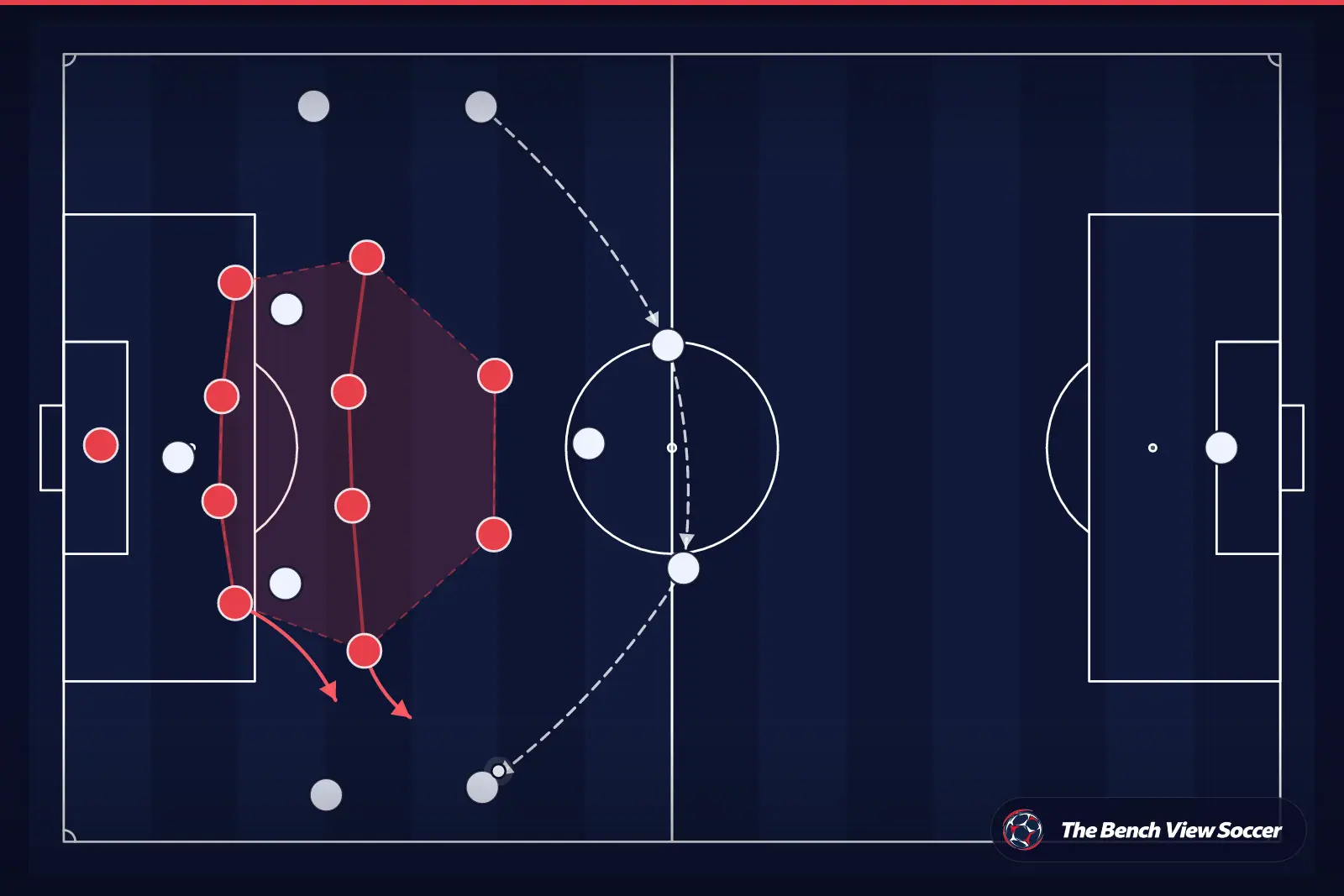
Real Madrid’s long diagonal is built on three ideas: drawing pressure, creating a far-side advantage, and attacking quickly before the defense resets. First, Madrid often invite the opponent to tilt (shift) their block to one side. This happens when Madrid circulate the ball with a centre-back, a deep midfielder like Toni Kroos (in recent seasons), or a full-back stepping inside. As the opponent squeezes toward the ball, the far-side winger holds width, sometimes even staying on the touchline to “pin” the opposite full-back. Second, Madrid create a clear passing lane. The passer scans early, and teammates help by keeping distance between lines: one player offers a short option to tempt pressure, another stays higher to occupy midfield markers, and the far winger stays free. Third, the diagonal arrives with timing. It is played when the opponent’s near-side press commits and their back line is moving across. The ball travels faster than defenders can shuffle, so the far-side receiver gets a cleaner first touch and faces a defender who is either late, isolated, or forced to defend while backpedalling. From there, Madrid attack with a quick decision: drive inside, combine with an overlapping full-back, or cross early. The key is not the long pass alone; it is the coordinated spacing that makes the far side open, and the speed of the next action that prevents the defense from recovering.
Match Examples
A clear example appears in the UEFA Champions League 2021–22 knockouts, when Real Madrid repeatedly use switches to escape pressure and find their wide forwards in space. Against Chelsea in the quarter-final second leg at the Santiago Bernabéu (April 2022), Madrid face an intense press and long phases without control. When Chelsea’s block shifts toward Madrid’s build-up side, Madrid look for the far winger or far full-back with a longer switch, helping them break the wave and attack the exposed side before Chelsea can re-form. In the same 2021–22 Champions League run, Madrid also use diagonals to reach Vinícius Júnior in advantageous 1v1 situations, especially when opponents overload the ball-near side to stop central combinations. In La Liga 2023–24 under Carlo Ancelotti, Madrid’s structure often includes Jude Bellingham arriving between lines while the wide players maintain width at key moments; this makes opponents compress centrally, and the diagonal becomes a natural release valve to the far side. Another pattern is visible in big Clásico contexts in recent seasons, when Barcelona’s aggressive ball-side pressure leaves space on the weak side (the side away from the ball). Madrid’s long diagonal does not always create an instant goal, but it repeatedly creates “the next advantage”: a clean first touch wide, a late-arriving runner into the box, or a cross delivered before the defense is set. The common thread across these matches is fatigue and repeated shifting—after 60–70 minutes of constant lateral movement, the far side opens up more frequently and the diagonal becomes increasingly damaging.
Related Concepts & Skills
Training Implications
To train long diagonals like Real Madrid, build sessions around scanning, body shape, and the “next action” after the switch. 1) Passing Technique Block (15–20 minutes): set two wide targets 45–55 metres apart. Coach the passer to open their hips (body facing slightly toward the far side), strike through the middle-lower half of the ball for a driven flight, and aim for the receiver’s back shoulder so they can face forward. Rotate passers from centre-back and deep midfielder positions. 2) Timing & Cue Drill (20 minutes): create an 8v6 build-up where the defending team must shift toward the ball side. The rule: the switch is only allowed after at least three short passes on one flank, forcing players to “invite” the press. Reward points if the far-side receiver gets a first touch forward. 3) First Touch & Decision (20 minutes): on receiving the diagonal, the wide player must choose one of three coached outcomes within three seconds—drive inside, combine with an overlapping full-back, or cross early. This trains speed of play, which is what punishes tired defenses. 4) Conditioning With Tactical Purpose (10–15 minutes): finish with repeat-shift defending (defenders slide side-to-side on coach’s signal) and then immediately face a diagonal. This simulates fatigue and teaches attackers to recognize when the far-side defender is late. Key coaching language: “scan before you receive,” “hold width to stretch,” “switch when they jump,” and “play the next pass quickly.”
The Bench View app
Don’t just read football — train it
Everything you read here, turned into training you can follow step by step.
Physical training at home
AI daily sessions adapted to your level and position. No equipment needed.
Tactical training courses
Step-by-step courses on positioning, pressing, build-up and decision making.
- 7 days free
- No commitment
- Cancel anytime
Free account: 2 physical sessions + the first tactical course. PRO: 7-day free trial — cancel before day 8 and you pay nothing.