Introduction
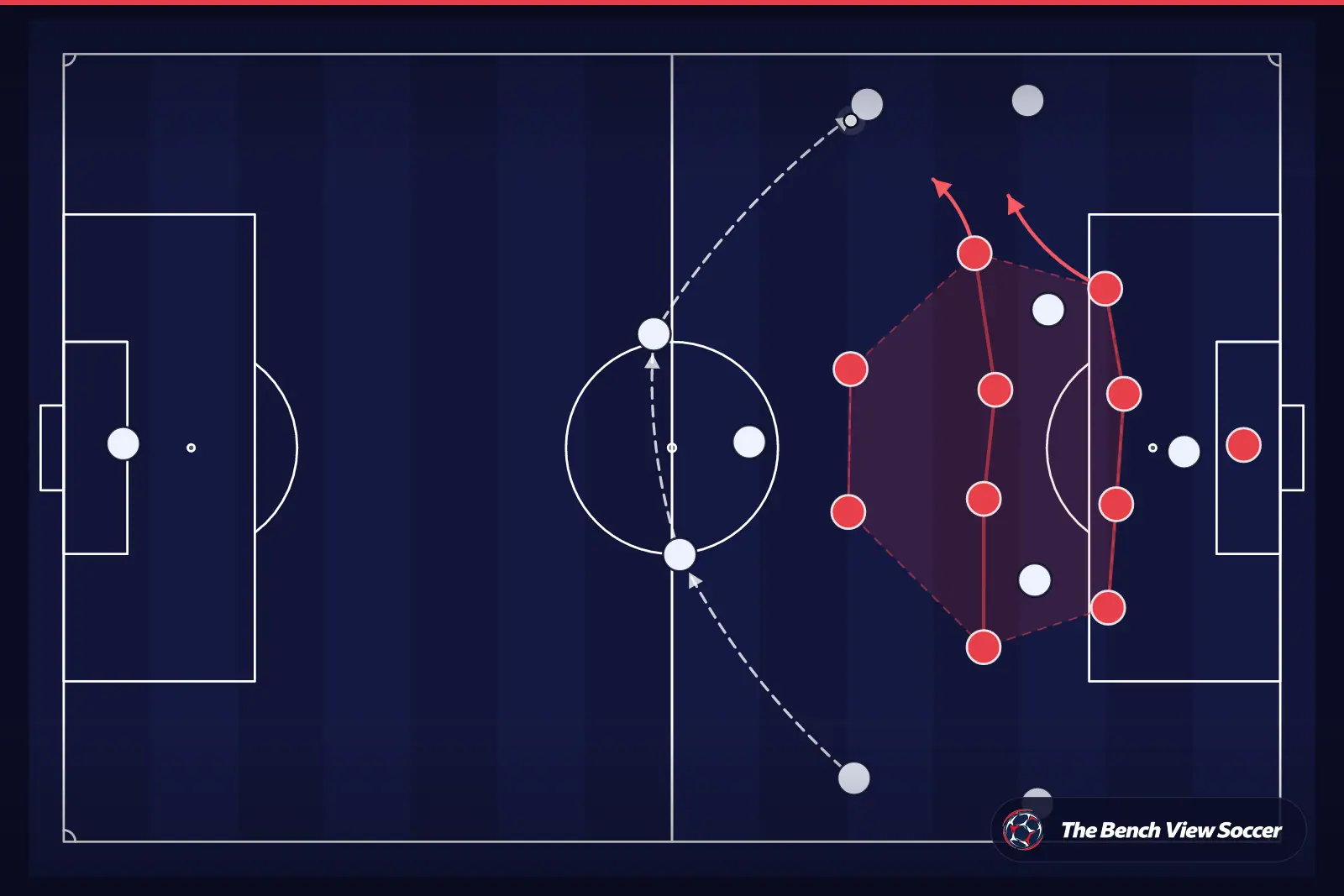
A “low block” is when a team defends deep, close to its own penalty area, usually with many players behind the ball. For fans watching the Premier League, La Liga, Serie A, or the UEFA Champions League, this is the moment when a match can look slow: one side has the ball, the other side refuses to chase, and the space to attack disappears. Low blocks are not just “parking the bus”; they are organised, coordinated, and designed to protect the middle of the pitch. Teams like Atlético Madrid under Diego Simeone or José Mourinho’s Chelsea (in certain phases) show how compact defending can frustrate even elite attacks. To break it, top sides rely on three big ideas: move defenders out of shape with rotations, keep patience without losing speed of play, and treat set pieces as a planned weapon rather than a bonus. This article breaks down how those solutions work in real matches and how fans can spot them.
How It Works
Breaking a low block starts with understanding what the defending team protects. A low block aims to close the central corridor (the space straight in front of goal) and force you wide, where crosses can be defended. So the attacking team tries to create “new” central access by manipulating the defenders. First, movement: attackers rotate positions to confuse marking responsibilities. For example, a winger moves inside while a full-back overlaps outside; if the wide defender follows inside, the overlap becomes free, and if he stays, the inside player receives between lines. Second, patience with purpose: the ball circulates side to side to shift the block, but the key is the timing of the “speed-up” pass. Teams like Manchester City under Pep Guardiola use several short passes to attract pressure, then play a quick vertical pass into a forward’s feet or a cut-back after reaching the byline. Third, use the half-spaces (the channels between the winger and central midfielder). They are hard to defend because the full-back and centre-back both feel responsible. Attacking midfielders like Kevin De Bruyne or Martin Ødegaard often receive there to play a disguised through ball or a low cross. Fourth, third-man runs: Player A passes to Player B, but the real target is Player C who runs as the “third man” into space created by defenders stepping out. This is a common Guardiola pattern and also appears in Mikel Arteta’s Arsenal. Finally, set-piece solutions: when open play becomes crowded, corners and wide free-kicks become a planned route to goals. Modern teams rehearse blocking runs, near-post flicks, and second-ball positioning. Against a low block, set pieces are not luck; they are a way to punish teams for conceding territory and repeated corners.
Match Examples
A clear Premier League example is Manchester City vs Tottenham Hotspur at the Etihad in 2022–23 (City win 4–2). Spurs under Antonio Conte defend in a deep 5-4-1/5-3-2 shape for long spells. City break it not by constant hopeful crosses, but by using rotations: Riyad Mahrez and Julián Álvarez move inside while the full-backs hold width, stretching Tottenham’s wing-backs. City’s equaliser comes from sustained pressure and quick combinations that shift Spurs’ line before the decisive action, showing how patience sets up the moment to attack. You also see City target cut-backs rather than high crosses, because low blocks pack the six-yard box and win aerial duels. In La Liga, Barcelona vs Cádiz in 2022–23 (0–0 at Spotify Camp Nou) shows the opposite: a low block that survives. Cádiz sit extremely deep and central, allowing Barca wide possession but blocking central entries. Barcelona create shots but struggle to open the “locked door” because the final pass arrives a fraction late and movements do not disorganise the back line enough. For learners, this match is useful because it shows that possession alone is not the same as chance creation. In the UEFA Champions League, Real Madrid vs Chelsea (second leg, 2021–22 quarter-final at the Bernabéu, Real win 5–4 on aggregate) includes a phase where Real face a compact Chelsea after transitions settle. Madrid’s solution is not endless crossing; it is timing and individual quality combined with structural ideas: wide areas are used to draw defenders, then quick central access appears through combinations and second-ball attacks. Across these matches, the pattern is consistent: you need coordinated movement to shift the block, controlled circulation to create openings, and set pieces or second balls to finish the job when space is minimal.
Related Concepts & Skills
Training Implications
For coaches, analysts, or even fan groups running small-sided games in India, training to break a low block should be intentional and repeatable. First, build a “wide-to-inside” pattern: set up an 8v6 or 10v8 in the final third with the defending team locked inside a compact area (mark it with cones). Condition the attacking team to score only from cut-backs or passes into the central zone after the ball reaches the wide channel. This teaches players to use width to move the block and then attack the box with timing. Second, rehearse rotations on one flank: winger comes inside, full-back overlaps, central midfielder shifts to cover. Run it as a scripted pattern for 5 minutes, then make it live with defenders. The coaching point is decision-making: if the defender follows inside, play outside; if he stays, play inside. Third, train third-man runs with a simple triangle: A to B, B one-touch to C running beyond. Add a passive defender, then an active one, so players learn to recognise when the low block steps out. Fourth, set-piece practice must be specific. Choose two corner routines: one near-post flick and one far-post overload. Track success rate over 20 repetitions, and coach “second ball” reactions—who protects the edge of the box, who counters the counter, and who attacks rebounds. Finally, add a patience constraint: in a 7v7, require the attacking team to complete at least five passes before shooting, but reward a goal more if it comes after a switch of play. This builds calm circulation while still encouraging the decisive moment that breaks compact defences.
The Bench View app
Don’t just read football — train it
Everything you read here, turned into training you can follow step by step.
Physical training at home
AI daily sessions adapted to your level and position. No equipment needed.
Tactical training courses
Step-by-step courses on positioning, pressing, build-up and decision making.
- 7 days free
- No commitment
- Cancel anytime
Free account: 2 physical sessions + the first tactical course. PRO: 7-day free trial — cancel before day 8 and you pay nothing.