Introduction
If you watch European football every weekend, you quickly notice a modern problem for teams that defend deep: the winger who does not stay wide. An “inverted winger” starts near the touchline but carries the ball inside onto their stronger foot (right-footed player on the left, or left-footed player on the right). Think of Mohamed Salah at Liverpool, Bukayo Saka at Arsenal, or Vinícius Júnior when he attacks from the left but looks for central lanes. For a low block (a team defending close to its own penalty area with many players behind the ball), this is tricky because the most dangerous actions happen between the full-back and centre-back, or just outside the box where shots and through balls are easiest. Fans often ask, “Should the full-back follow inside or stay wide?” The real answer is: it depends on your structure, your midfield help, and how you protect the top of the box. This guide explains practical, repeatable methods to survive those inside dribbles and cut-backs, especially when your plan is to sit deep and counter.
How It Works
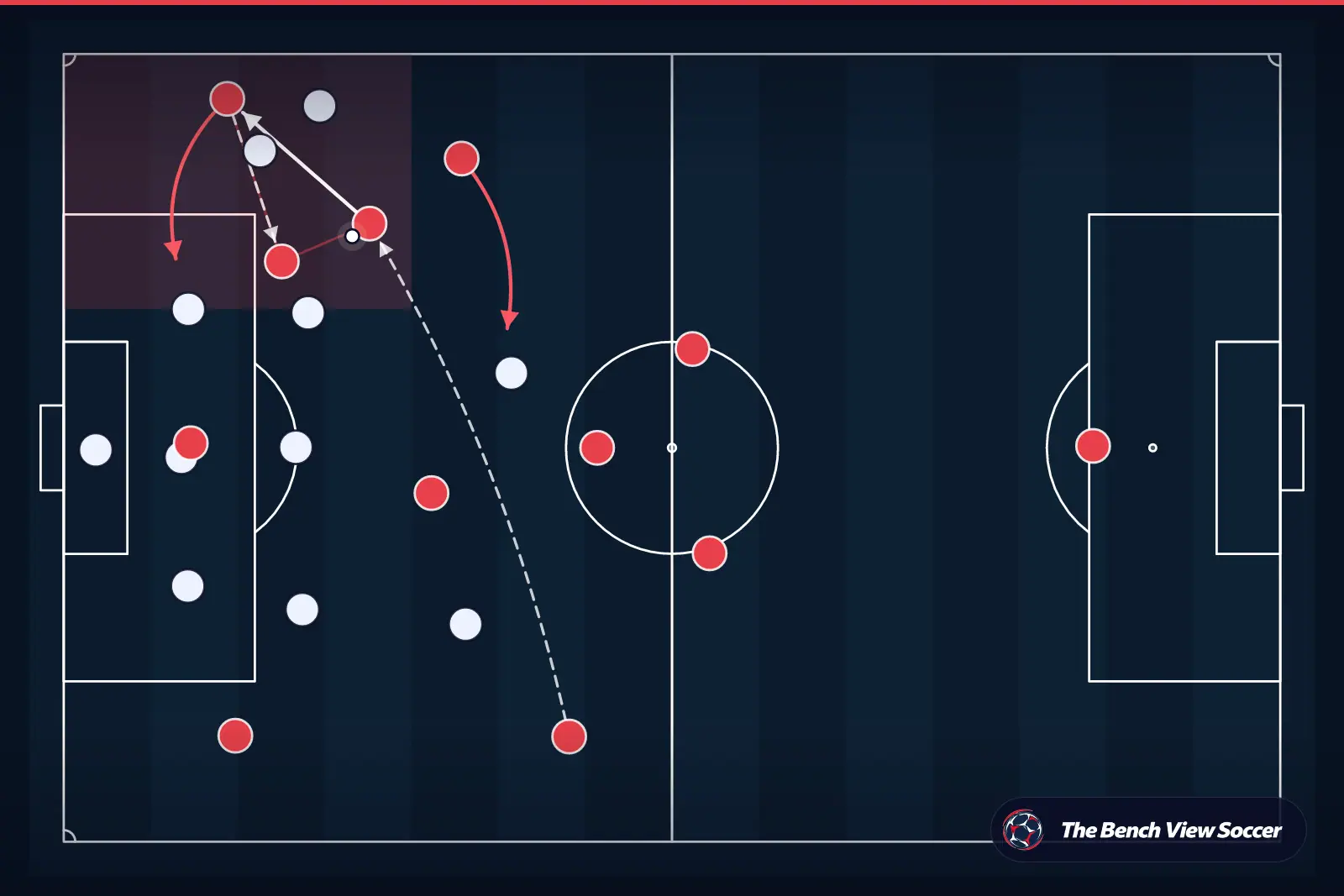
To defend inverted wingers while playing deep, you first identify what they want: access to the half-space (the channel between wing and centre), a shooting lane to the far corner, or a combination with an overlapping full-back. Your defence must remove at least one of these options. The base rule for deep teams is “protect the box first, then the touchline.” So your full-back does not dive in early; he delays, stays side-on, and shows the winger away from the central corridor. Behind him, the nearest centre-back provides cover at a slightly deeper angle, ready to step if the winger enters the box. The key midfielder (often the near-side central midfielder in a 4-4-2 or the near-side ‘6/8’ in a 4-1-4-1) becomes the ‘inside shield’: he blocks the lane into the top of the box and prevents the easy one-two. This creates a 2v1 trap: full-back engages from outside, midfielder closes from inside, and the winger is squeezed toward the sideline or forced to play backward. Meanwhile, your far-side winger tucks in to protect the far-post zone because inverted wingers love the cut-back to a late runner arriving at the edge of the area. Communication matters: if the winger dribbles inside beyond your full-back, the centre-back steps decisively and your full-back immediately recovers to mark the overlapping runner. The aim is not constant tackling; it is controlling space, forcing low-percentage shots, and preventing the cut-back and the square pass across the box.
Match Examples
A clear reference point is Liverpool vs Tottenham Hotspur in the 2018-19 UEFA Champions League final. Liverpool’s right-sided threat (Salah) often drifts inside, and Tottenham defend for long spells in a deeper shape. Spurs’ best moments come when their wide midfielder helps the full-back and blocks the inside lane, forcing Liverpool to circulate rather than penetrate centrally; when that help disappears, Liverpool access cut-back zones quickly. Another strong example is Manchester City vs Chelsea in the 2020-21 Champions League final. City’s wide attackers frequently move inside under Pep Guardiola, but Chelsea under Thomas Tuchel defend in a compact 3-4-2-1/5-4-1 look. Chelsea’s wing-backs do not chase too high; the outside centre-back supports, and the near central midfielder screens the half-space. This structure reduces central shooting lanes and makes City play in front of the block. In the Premier League 2022-23 season, Arsenal’s right side shows the inverted winger dilemma from the attacker’s point of view: Bukayo Saka receives wide, then attacks inside to shoot or combine with Martin Ødegaard in the right half-space. Teams that suffer most are those whose left-back steps out without inside cover; teams that cope better keep the winger outside and block the cut-back to the edge of the box. Finally, Real Madrid’s 2021-22 Champions League run features Vinícius Júnior starting wide but attacking inside when defenders overprotect the line; opponents who fail to protect the top of the box concede either the inside dribble or the pass across goal. These matches show the same lesson: deep defending works only when the full-back has an inside partner and the central zone stays protected.
Related Concepts & Skills
Training Implications
To coach this effectively, design sessions that repeat the same pictures your defenders see in matches. Start with a 2v2+1 drill on the flank: attacker (inverted winger) and overlapping full-back vs your full-back and near-side midfielder, with a neutral server acting as the attacker’s passing option. Set a scoring rule: attackers score by either (a) dribbling inside into a marked “shooting lane” zone or (b) reaching the byline for a cut-back. Defenders score by forcing the ball backward or winning it and playing a first pass into a target mini-goal to simulate a counter. Coach specific cues: full-back delays and stays side-on; midfielder’s first job is to block the inside lane, not chase the ball; communication word like “Inside!” or “Hold!” is mandatory before the winger’s first touch. Next, add the centre-back as a third defender in a 3v3 channel leading into the box. Train the handover: when the winger beats the full-back inside, the centre-back steps and the full-back immediately tracks the overlapping runner—no hesitation. Add a “cut-back zone” cone area around the penalty spot and edge of the box; require one defender to protect it at all times. Finally, integrate it into an 11v11 or 9v9 low-block phase: freeze play when the winger receives, check distances (full-back not too tight, midfielder within 5–8 metres inside), and rehearse the trap toward the line. Make video feedback simple: count how many times you concede a cut-back or a shot from the top of the box, and set weekly targets to reduce them.
The Bench View app
Don’t just read football — train it
Everything you read here, turned into training you can follow step by step.
Physical training at home
AI daily sessions adapted to your level and position. No equipment needed.
Tactical training courses
Step-by-step courses on positioning, pressing, build-up and decision making.
- 7 days free
- No commitment
- Cancel anytime
Free account: 2 physical sessions + the first tactical course. PRO: 7-day free trial — cancel before day 8 and you pay nothing.