

Introduction
Why scanning and spatial awareness matter: The best central midfielders don’t just move — they see. Scanning (brief head and body checks before receiving the ball) and spatial awareness (understanding where space will open and where pressure will arrive) compress decision time. That lets a playmaker act faster, choose higher-percentage passes, and escape pressure. For coaches working with intermediate central midfielders, training scanning habits is as crucial as passing range or fitness.
This article unpacks the technical and tactical demands of scanning for a central midfielder and playmaker. We’ll explain how scanning changes body shape, influences touch, and directs teammates’ movements. Then we’ll illustrate with elite-team examples — match moments from Manchester City, Barcelona and Real Madrid — and finish with concrete coaching principles and session ideas designed to make scanning instinctive under pressure.
Tactical Breakdown
What scanning actually does on the pitch: Scanning is a pre-receive routine — quick head turns, awareness of shoulder-checks and reading of opponent eyes — that creates time. Spatial awareness is the mental map built from those scans: where the nearest pressure will come from, which passing lanes exist, where the next support run will arrive. Together they reduce processing time and improve execution.
Positional details matter. A central number 8 or 10 must learn three layers of scanning: immediate (first 2–3m around the receiver), intermediate (the half-space corridors and full-back channels), and strategic (opponent block shape and transition counters). Body shape on the ball becomes an extension of scanning: open shoulder positions align the torso to multiple targets, while a side-on shape prepares for a fast pass or turn. Touch control is the bridge — a deliberate first touch that either carries the ball into space or sets up a weighted forward pass.
In structured build-up, the playmaker’s scanning informs teammate movement. If the 10 scans early and shows a body-open position, wingers and full-backs can make penetrating runs into vacated channels. Defensively, scanning triggers pressing triggers and cover rotations: a midfielder who sees the opponent’s weak side shifting can pre-emptively occupy passing lanes and force predictable recycling to the flanks.
Real Match Examples
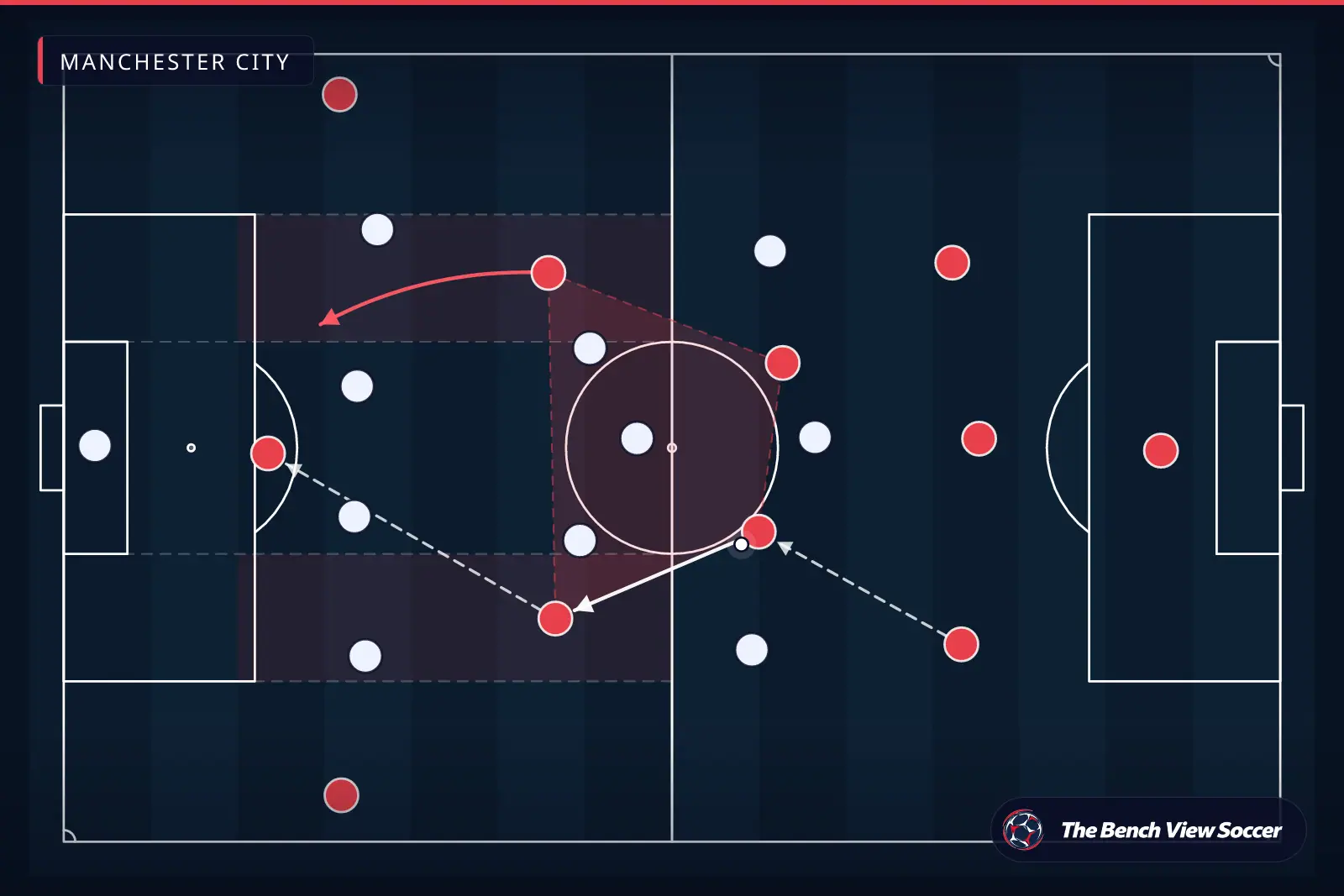
1) Manchester City (Pep Guardiola) — Kevin De Bruyne: De Bruyne’s magic is as much about scanning as it is about technique. In build-up, De Bruyne routinely scans the lines of pressing and the movements of centre-backs. By receiving half-turned and with a short, forward-biased first touch, he quickly exploits half-space gaps between defenders with incisive through-balls. These moments show how early visual checks create split-second passing windows.
2) Barcelona (Xavi / Guardiola era) — Sergio Busquets: Busquets is a textbook case of spatial awareness. His lateral scans and anticipation allow him to occupy the pivot, pull opposition midfielders out of position, and release possession into the full-back / winger corridor. Busquets’ minimal, precise touches and timing of passes are founded on constant information gathering before the ball arrives.
3) Real Madrid (Carlo Ancelotti) — Luka Modrić: In transition, Modrić’s scanning lets him identify counter-attacking lanes and decide between vertical drives or clipped passes into the box. In Champions League moments, his peripheral vision and body orientation have repeatedly enabled quick switches and late runs from team-mates to exploit disorganized defensive shapes.
Key Principles
Key principles coaches should remember
- Prioritise pre-receive checks: Teach a two-step scan before every touch — quick look for pressure, then look for forward targets. Repetition builds the habit.
- Train body language: Use open shoulder positions and side-on stances in drills so players can present multiple passing options quickly.
- Link scanning to first touch: Practice controlling the ball into the space you saw while scanning. A bad first touch negates good scanning.
- Contextualise with teammates: Scanning is meaningful only when teammates act on what they see. Combine scanning drills with coordinated off-the-ball movements and trigger cues.
Training Implications
How to train scanning and spatial awareness
Design short, repeated drills that force pre-receive decisions under pressure. Start with a head-up rondo: 5v2 rondo where the receiving player must scan for 1 second before their two-touch pass. Add a progressive element: after a successful pass sequence, the third pass must be a forward line-breaking ball into a target man to reward scanning that looks beyond immediate pressure.
Use constrained possession grids with directional goals to emphasise half-space recognition — limit touches to two for attackers and allow the coach to call a color or number that forces the receiver to scan and choose the correct channel. Integrate video review: show short clips of Busquets/De Bruyne/Modrić and pause before the receiving moment; ask players to identify dangers and options. Finally, increase realism with conditioned 8v8 games where midfielders are scored for successful progressive passes and for losing possession under pressure. Consistency and reflection turn scanning from instruction into instinct.
Apply This in Your Game
Reading about tactics is one thing. Our training units teach you to execute these concepts in real match situations.