Introduction
If you grew up watching traditional wingers, you expect them to hug the touchline, beat the full-back, and cross. The inverted winger flips that idea. Instead of staying wide, a right-footed attacker on the left (or a left-footer on the right) uses the wide starting position to attack the middle. This role becomes central to modern elite football because it creates goals from better shooting zones and overloads the most valuable areas near the box. In La Liga, Real Madrid under Carlo Ancelotti use inverted wide players to connect transitions to central finishing actions, often turning a counter-attack into a shot within seconds. In the Premier League, Arsenal under Mikel Arteta use inverted wingers to combine in tight spaces, pull defenders away, and open channels for underlaps and cutbacks. For fans learning tactics, the key takeaway is simple: the “wing” is often just a starting point. The real objective is to arrive in central pockets with time to shoot, slip a pass, or create a 2v1. This article breaks down how inverted wingers work, what they demand from full-backs and midfielders, and why the best teams in the UEFA Champions League and domestic leagues keep investing in wide players who think like playmakers and finish like strikers.
How It Works
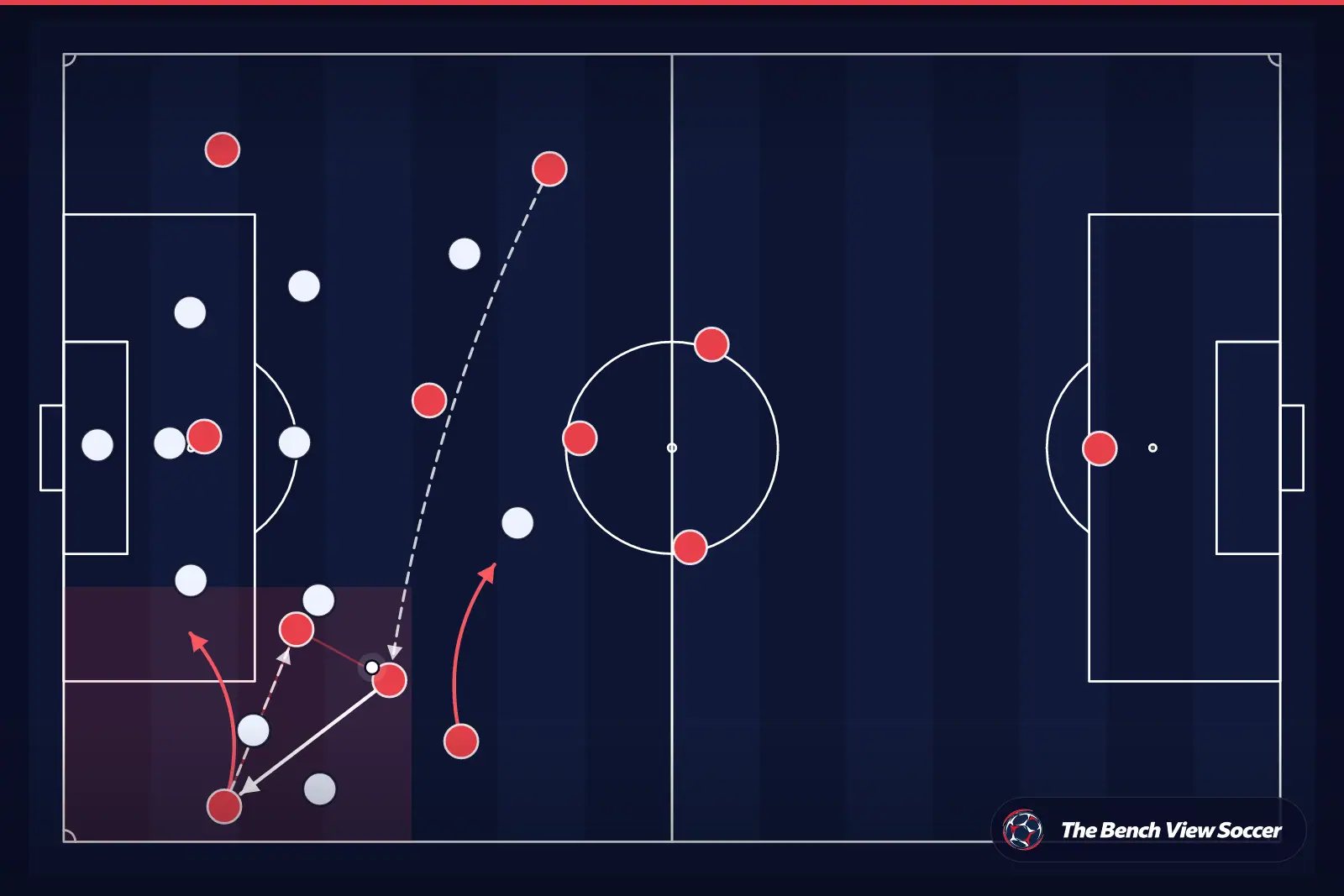
An inverted winger is a wide forward who is naturally stronger on the opposite foot to the flank they start on: a right-footer on the left or a left-footer on the right. The main advantage is angle. When the winger dribbles inside, their stronger foot faces the goal and central passing lanes, so shots, through balls, and combinations become easier. In possession, the inverted winger usually occupies the “half-space” (the channel between the full-back and centre-back) or drifts into Zone 14 (the central area just outside the penalty box). This movement forces a defensive choice: does the full-back follow inside and leave the outside lane free, or does the centre-back step out and risk creating space behind? Real Madrid often use inverted wingers to turn transitions into central attacks. The wide player starts near the touchline to stretch the back line, then receives and drives diagonally toward the box. When the winger comes inside, the full-back on that side often provides the width (overlapping to the outside) to keep the defence stretched. Arsenal use a more structured version within Arteta’s positional play: the winger holds width early to pin the full-back, then under the right cue (a switch, a third-man run, or a midfield bounce pass) steps inside to combine with the No. 8 and the striker. Importantly, inverted wingers are not just dribblers. They must scan before receiving, protect the ball under pressure, and decide quickly: shoot, slip a through pass, or recycle to maintain control. The role thrives when the team creates a stable platform behind them—usually a double pivot or an inverting full-back—so losing the ball does not lead to immediate counter-attacks.
Match Examples
Real Madrid, 2023–24 UEFA Champions League (quarter-final) vs Manchester City: Across the two legs, Madrid’s wide forwards repeatedly start outside and then attack the centre as soon as City’s shape shifts. When Madrid break, the wide player’s first touch often goes forward-and-in, not down the line. The purpose is to arrive in the box-facing channel for a shot or a cutback rather than a hopeful cross. Even when City compress space centrally, Madrid keep using the same logic: stretch wide to move defenders, then enter the half-space at speed. Ancelotti’s team also benefit from the fact that their wide players are comfortable receiving under pressure, which lets them carry the ball into central areas before City can set a pressing trap. Arsenal, 2022–23 Premier League vs Liverpool at Anfield (2–2): Arsenal’s wide attackers repeatedly start wide to pin Liverpool’s full-backs, then step inside to connect with central runners. The key pattern is that the winger’s inside movement attracts a defender, which frees either an overlapping full-back or a midfielder arriving on the outside lane for a cross or cutback. Even when Arsenal face intense pressure, the inverted winger movement gives them a safer outlet: a diagonal carry inside is harder to press than a straight-line dribble down the touchline because it opens more passing angles. Arsenal, 2023–24 Premier League vs Liverpool at the Emirates (3–1): Arsenal’s wide players attack centrally more aggressively, especially once the ball progresses into the final third. The inverted winger’s positioning helps Arsenal create finishing moments from the top of the box and from the inside channels, rather than relying on early crosses. The match also shows the defensive side of the role: when the inverted winger moves inside, Arsenal are ready to counter-press (immediately press after losing the ball) because their attackers are closer to the centre where most second balls land. Real Madrid, 2023–24 La Liga vs Barcelona (El Clásico at the Bernabéu, 3–2): In the biggest domestic fixture, Madrid’s wide attackers keep looking to enter central lanes when the moment is right, especially on transitions. The inverted movement forces Barcelona’s defenders to defend the box-facing channel rather than simply shepherding play toward the touchline. That small change—defending toward your own goal instead of toward the sideline—creates higher stress and more last-ditch defending, which is exactly what inverted wingers aim to produce.
Related Concepts & Skills
Training Implications
To train inverted wingers effectively, you need exercises that build three things: receiving skills under pressure, decision-making in the half-space, and coordination with the full-back and central midfielder. Start with a “receive-and-turn” circuit: place a mannequin or passive defender as a full-back, have the winger receive on the flank, take a scanning look over the inside shoulder, and then drive diagonally inside for 8–12 metres before choosing one of three actions (shot, slip pass to striker, or bounce pass back to the No. 8). Make the coach call the action late so the player must keep the head up. Second, run a 3v3+2 possession game in a channel that represents the half-space and central zone. Condition it so goals count double if the final pass comes from the half-space after an inside dribble. This rewards the exact behaviour you want: carry inside, commit a defender, release at the right time. For team coordination, use a pattern drill with clear timing: winger starts wide; full-back begins behind; central midfielder starts inside. On the coach’s whistle, the winger receives wide and drives inside; the full-back either overlaps outside (to pull the full-back away) or holds position depending on the cue; the midfielder becomes the “third man,” arriving to receive a layoff and play a through ball. Rotate roles so players understand each other’s pictures. Add a defensive constraint: if the winger loses the ball, the nearest two players must counter-press for five seconds. This builds the habit seen in Arsenal—being inside means you are close enough to win it back. Finally, measure success with simple KPIs: number of carries from wide to half-space, number of box entries created from diagonal dribbles, and shot quality (shots from central zones rather than tight angles). These metrics keep training honest and help Indian grassroots coaches copy elite patterns without needing complex technology.
The Bench View app
Don’t just read football — train it
Everything you read here, turned into training you can follow step by step.
Physical training at home
AI daily sessions adapted to your level and position. No equipment needed.
Tactical training courses
Step-by-step courses on positioning, pressing, build-up and decision making.
- 7 days free
- No commitment
- Cancel anytime
Free account: 2 physical sessions + the first tactical course. PRO: 7-day free trial — cancel before day 8 and you pay nothing.