Introduction
Switching play quickly is one of the simplest ideas in football, but at the top level it becomes a weapon that decides games. A “switch” means moving the ball from one side of the pitch to the other—often in one to three passes—so the defending team has to rotate (shuffle across) to protect the far side. When that rotation is slow or disorganised, elite attacks create time, space, and clear passing lanes to attack the back line. Fans often hear commentators say “they need to switch it!” without explaining why it works. The key is that modern defences defend as a unit: full-backs, centre-backs, midfielders, and wingers move together to close space. If the ball moves faster than that unit can move, gaps open—especially around the far-side full-back and the space between full-back and centre-back. Managers like Pep Guardiola (Manchester City), Mikel Arteta (Arsenal), and Xabi Alonso (Bayer Leverkusen) build attacking structures that bait pressure on one side, then punish the weak side instantly. This article breaks down how that trap works, what to watch for on TV, and how teams train it.
How It Works
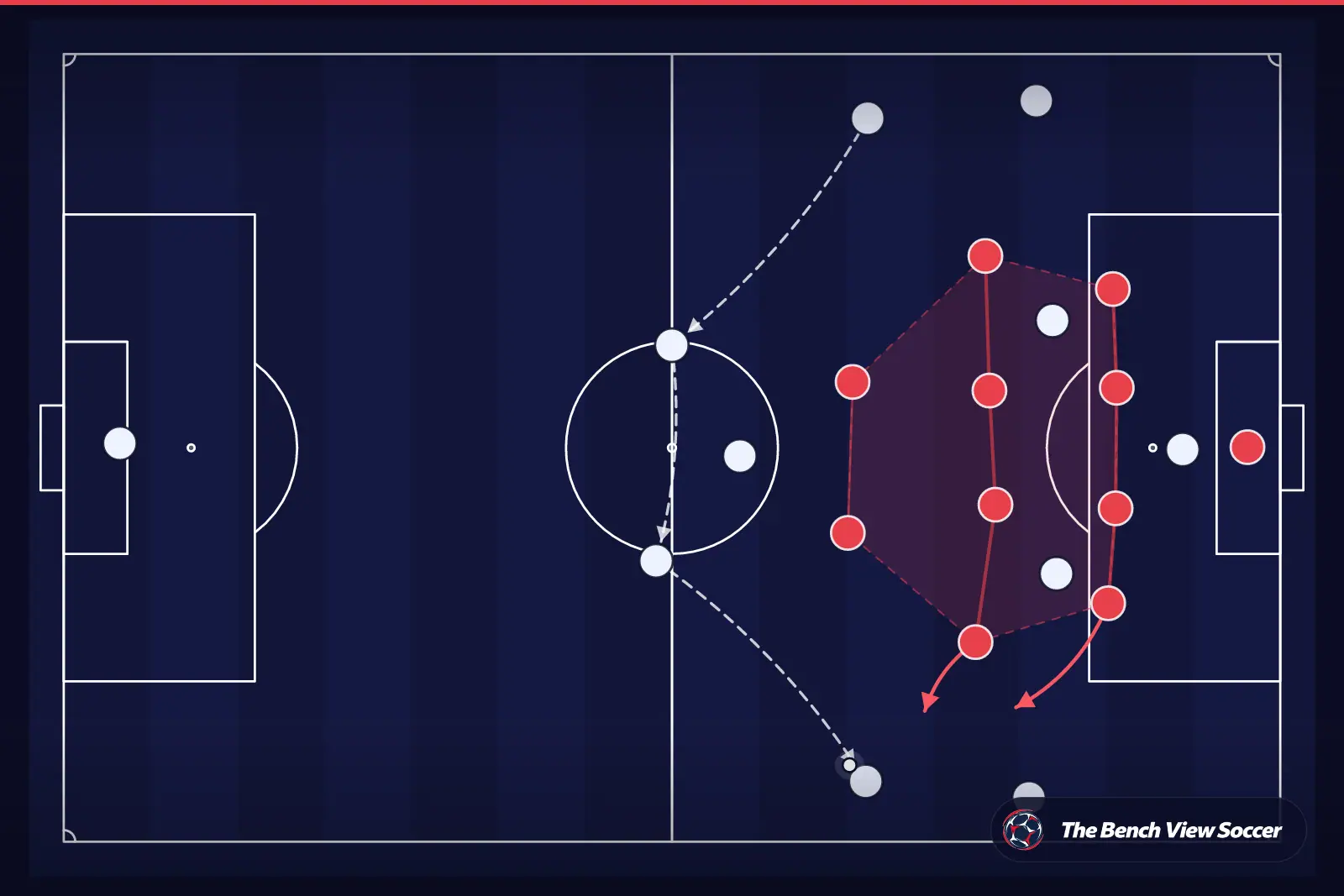
A fast switch hurts a defence because defensive shape depends on compactness: staying close enough to cover each other. When the ball is on the left, the defending block slides left; the far-side winger and full-back often tuck in, prioritising the centre. Top teams exploit this by “overloading” one side (sending extra players there) to attract pressure, then “switching” to the far side where a player waits in space. The switch can be a long diagonal pass (for example, from a left centre-back to a right winger), or a short combination that travels through the middle quickly. The best versions are not random crosses; they are pre-planned patterns. Watch the roles: (1) the ball-side winger stays wide to pin the full-back, (2) an interior midfielder (often called an “eight”) shows for a bounce pass, (3) a deep midfielder stays available to recycle if the first attempt fails, and (4) the far-side winger holds width and checks his shoulder early. The moment the defence jumps to press on one flank, the passer looks for a “third-man” option—pass to one player who immediately lays it off to a teammate facing forward—so the ball escapes pressure. If the switch arrives early, the receiver attacks a shifting back line: the far-side full-back arrives late, the nearest centre-back steps out, and the gaps between defenders widen. That is when cutbacks (low passes pulled back from the byline) and shots from the edge of the box become high-quality chances.
Match Examples
1) UEFA Champions League 2022–23, Manchester City vs Real Madrid (Semi-final second leg at the Etihad). Guardiola’s City repeatedly attracts Madrid’s midfield press to one side, then moves the ball quickly to the opposite winger. With Jack Grealish and İlkay Gündoğan often loading the left, Madrid’s block slides across; City then finds the far side where Bernardo Silva or the right-sided receiver attacks the space before Ferland Mendy and the near centre-back can re-balance. The important detail is tempo: City does not switch after five safe passes; they switch immediately after Madrid’s jump, using a quick bounce pass through Rodri or John Stones stepping into midfield. 2) Premier League 2023–24, Arsenal vs Liverpool at the Emirates (Arsenal’s 3–1 win). Arteta’s Arsenal uses wide players to stretch the pitch and invites Liverpool’s press toward one flank. When Liverpool’s midfield shifts over, Arsenal changes the point of attack quickly, often via William Saliba or Declan Rice. The switch is not just to “keep possession”; it targets the moment Liverpool’s far-side winger tucks inside to protect central space, leaving the full-back exposed. Arsenal then attacks with a wide receiver plus an underlapping run (a run inside the winger) to force a centre-back decision. 3) Bundesliga 2023–24, Bayer Leverkusen under Xabi Alonso (title-winning season). Leverkusen consistently uses one-side attraction and fast switches to release the opposite wing-back. Because wing-backs provide natural width, the far-side player is already positioned high and wide. When opponents press Leverkusen’s build-up near the touchline, Leverkusen often plays out through the centre and fires a diagonal to the opposite wing-back, creating immediate 1v1s. The recurring pattern is: draw pressure → fix defenders with a wide player → switch early → attack the recovering back line with a cutback rather than a hopeful cross. Across these examples, the common theme is timing. The switch is most damaging right after the defence commits bodies to one side. If the attacking team delays, the defence completes its rotation and the advantage disappears.
Related Concepts & Skills
Training Implications
For coaches, amateur teams, and even small-sided groups, switching play quickly is trainable if you design sessions that reward speed, scanning, and width. Start with a simple rule: goals only count if the team completes a switch (ball travels from one wide channel to the other) in the build-up. In a 6v6 or 7v7, mark two wide corridors with cones. Encourage your wingers/full-backs to stay in those corridors to “hold width” and make the switch meaningful. Actionable coaching points: 1) Teach scanning: before receiving, players quickly look over both shoulders to identify the far-side option. Use a constraint like “receiver must call the far-side player’s name before the first touch.” 2) Build the bounce pass habit: train a triangle on the flank (full-back, winger, central midfielder). The winger receives under pressure and sets the ball back one-touch to the midfielder, who then plays the switch. This creates the third-man pathway and increases tempo. 3) Use a timer: after the ball reaches the wing, the team has 6–8 seconds to either attack or switch. This simulates the real moment when a defence is mid-rotation. 4) Coach the far-side starting position: the far-side wide player stays wide and slightly higher than the ball to receive on the front foot (body open to the pitch). If he stands flat, the switch arrives and he has to take extra touches, allowing the defence to recover. 5) Finish the switch with purpose: add a final-zone rule—after a switch, the next action must be either a dribble at the full-back, a cutback, or a shot within 10 seconds. Players learn that switching is not an end, it is a chance-creation tool. Film your session with a phone from the side. Review two things: how quickly the ball moves after the opponent presses, and whether the far-side player is ready early. Those two details separate “possession for possession” from a truly punishing switch.
The Bench View app
Don’t just read football — train it
Everything you read here, turned into training you can follow step by step.
Physical training at home
AI daily sessions adapted to your level and position. No equipment needed.
Tactical training courses
Step-by-step courses on positioning, pressing, build-up and decision making.
- 7 days free
- No commitment
- Cancel anytime
Free account: 2 physical sessions + the first tactical course. PRO: 7-day free trial — cancel before day 8 and you pay nothing.