Introduction
Switching play quickly is one of the simplest ideas in football to understand and one of the hardest to execute under pressure: you draw opponents to one side, then move the ball fast to the other side where space opens up. For fans watching European football, this is a key “why” behind many dominant attacks—especially from clubs like Real Madrid and Manchester City. In La Liga and the UEFA Champions League, Carlo Ancelotti’s Madrid often look like they are waiting, almost quiet, and then explode with a fast diagonal that isolates a winger. In the Premier League and Champions League, Pep Guardiola’s City use switches to keep control, stretch the pitch, and create high-quality cutbacks. This article breaks down what a “switch” really is (it is not just a long pass), why it hurts modern defences that press aggressively, and how two elite teams create the angles, body positions, and supporting movements to make the switch both safe and dangerous. If you learn to spot the cues—who attracts pressure, who holds width, who scans before receiving—you start reading matches like a coach, not just a fan.
How It Works
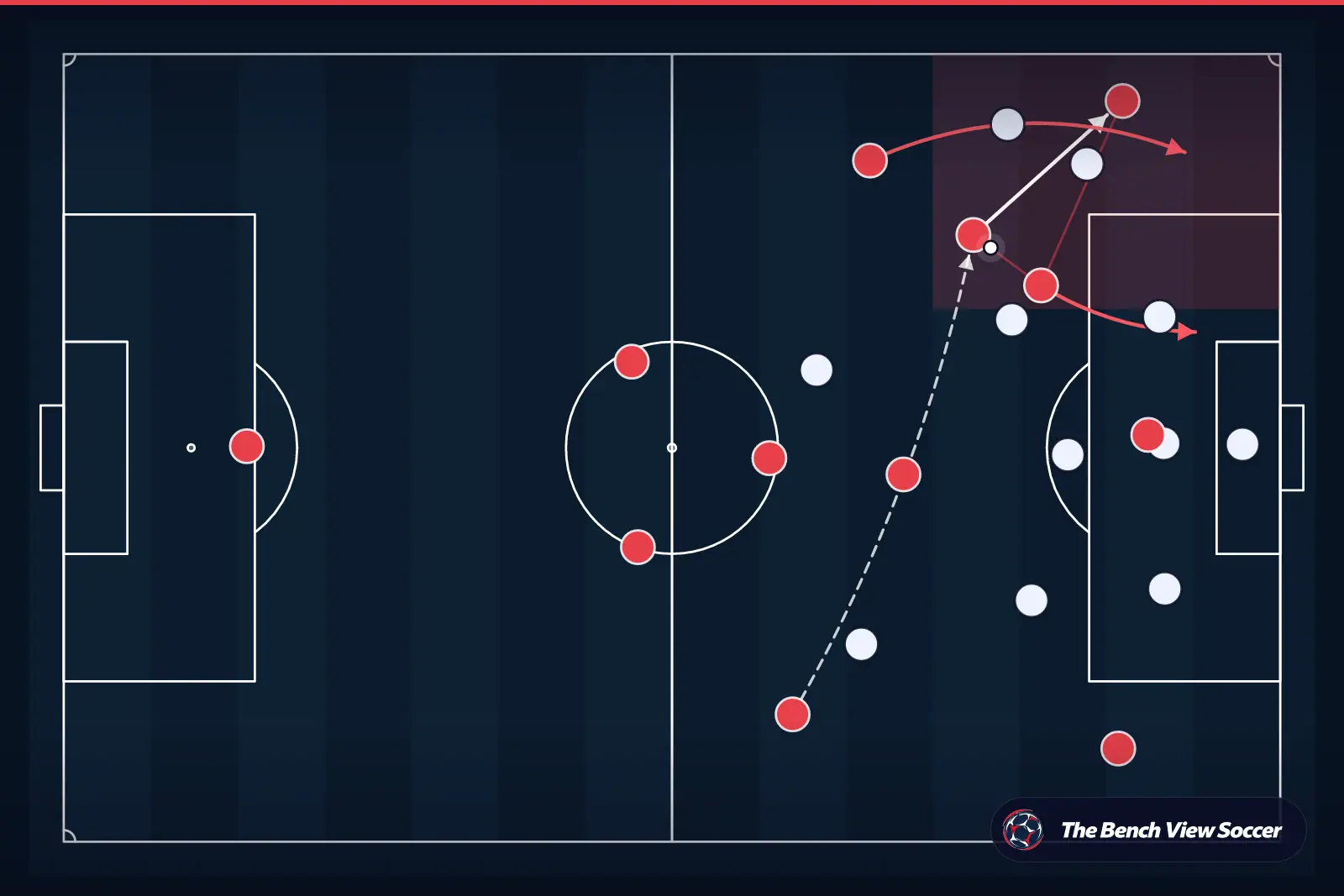
A quick switch of play is a deliberate change of the ball’s location from one side of the pitch to the other, usually in 2–4 passes or one decisive diagonal. The goal is to exploit the opponent’s “ball-side overload”: when a team presses, many players shift toward the ball to close space. That movement creates the opposite problem—space on the far side. Real Madrid and Manchester City both target that far-side space, but they arrive there in different ways. Manchester City build the switch through structure. Guardiola’s team often starts with a wide fullback or winger holding the touchline, while a midfielder (like Kevin De Bruyne in past seasons or Bernardo Silva) positions in the half-space (the channel between the wing and the centre). City circulate the ball to attract pressure, then play through a “pivot” (Rodri is the classic example) or a centre-back who has time to hit a diagonal. City’s key detail is body shape: players receive “open,” meaning their hips face the far side so they can pass forward quickly rather than needing extra touches. Real Madrid, under Ancelotti, switch with more freedom and speed, often after provoking pressure with a dribble or a short combination. Madrid’s midfielders and fullbacks look for the early diagonal behind the opponent’s shifting line, and their wide forwards stay ready to attack 1v1 the moment the ball arrives. The switch is dangerous not just because it changes sides, but because it changes the defender’s problem: from pressing a compact zone to defending big distances, then dealing with a winger running at you. In both teams, the best switches happen when the far-side player starts wide, waits until the last moment, and then attacks the space as the pass travels—so the receiver meets the ball with momentum, not standing still.
Match Examples
In the 2022–23 UEFA Champions League semi-final second leg (Manchester City vs Real Madrid at the Etihad), Guardiola’s City repeatedly move Madrid’s block toward one side and then find the opposite side with speed. When City circulate from a centre-back into Rodri and back out, Madrid’s midfield shifts to protect central space. That shifting opens the far flank, and City’s wide players receive with time to drive forward or combine for a cutback. The most telling moments come when City keep the ball long enough to attract Madrid’s press, then switch before Madrid can “reset” their shape. The switch itself is not always the final pass; it is the pass that creates the final pass by changing the angle of attack. In the 2023–24 UEFA Champions League quarter-final (Real Madrid vs Manchester City at the Santiago Bernabéu), Madrid’s threat often comes from quick escapes and immediate diagonals. When City commit numbers to counter-press (pressing right after losing the ball), Madrid look to release the far side early, especially when City’s fullbacks step high. The switch becomes a transition weapon: instead of slowly building, Madrid aim to reach the winger or advancing fullback on the weak side before City can trap them again. A domestic example is Manchester City’s 2022–23 Premier League performances where they frequently use wide-to-wide movement to unlock compact defences. Against low blocks, City move the ball patiently on one wing, then switch quickly to the other side to force a fullback to sprint out, creating a gap for an underlapping run (a run inside the winger) or a late arrival from midfield. Meanwhile, Real Madrid in the 2021–22 Champions League run show a pattern of switching after pressure: they lure opponents into the near side, then find the opposite flank with a diagonal that turns defence into emergency recovery. In each of these cases, the switch is not a “random long ball”—it is timed to the opponent’s movement, and that timing is what makes it elite.
Related Concepts & Skills
Training Implications
To train switching play quickly, you need more than “hit diagonals.” You must build habits: scanning, body shape, timing, and receiving wide with intent. Start with a simple 6v6+2 neutral possession game in a rectangle split into three vertical lanes (left, centre, right). Rule: a goal is scored only if the team completes a switch from left lane to right lane (or vice versa) within three passes after entering a side lane. This forces players to recognise when the defence shifts and to act fast. Add a coaching point: the “switch passer” (often the pivot or centre-back in real teams like Rodri for Manchester City) must receive on the half-turn—one touch to set, one touch to play. If they need three or four touches, the window closes. Next, train the receiver on the far side: place a winger/far-side player on the touchline and demand that they check their shoulder (look inside and behind) before the pass travels. Their first touch must go forward or inside, not backwards, replicating how Real Madrid’s wide players attack immediately after a switch. For realism, progress into an 8v8 with fullbacks and wingers. Condition the defending team to “overload ball-side” by awarding them points for trapping play near the touchline. The attacking team then learns the exact moment to escape: when two defenders jump to press, the far-side fullback stays high and wide, and the pivot opens their hips to play the diagonal. Finish with a measurable target: in a 20-minute block, aim for 8–10 successful switches that lead to an entry pass into the final third. Track not just completion, but outcome: does the switch create a 1v1, a crossing angle, or a cutback lane? That is the difference between a pretty pass and a match-winning pattern.
The Bench View app
Don’t just read football — train it
Everything you read here, turned into training you can follow step by step.
Physical training at home
AI daily sessions adapted to your level and position. No equipment needed.
Tactical training courses
Step-by-step courses on positioning, pressing, build-up and decision making.
- 7 days free
- No commitment
- Cancel anytime
Free account: 2 physical sessions + the first tactical course. PRO: 7-day free trial — cancel before day 8 and you pay nothing.