Introduction
At Arsenal under Mikel Arteta, the winger is rarely a classic “hug the touchline and cross” player for 90 minutes. Instead, modern wide forwards like Bukayo Saka and Gabriel Martinelli often start wide, then cut inside toward the penalty area or the central channels. For fans used to older Premier League images of touchline dribblers, this feels like a deliberate change—and it is. Cutting inside is not just about shooting on the stronger foot; it is a structural choice that shapes where Arsenal overload, how they protect the ball after losing it, and how they create higher-quality chances. It also links to how Arsenal build attacks in the Premier League and UEFA Champions League against compact, well-coached blocks. Arteta’s Arsenal wants stable possession, good spacing, and multiple players between the opponent’s defensive lines. The winger’s inward movement becomes a key tool to connect midfield and attack, pull defenders out of position, and open a lane for an overlapping full-back.
How It Works
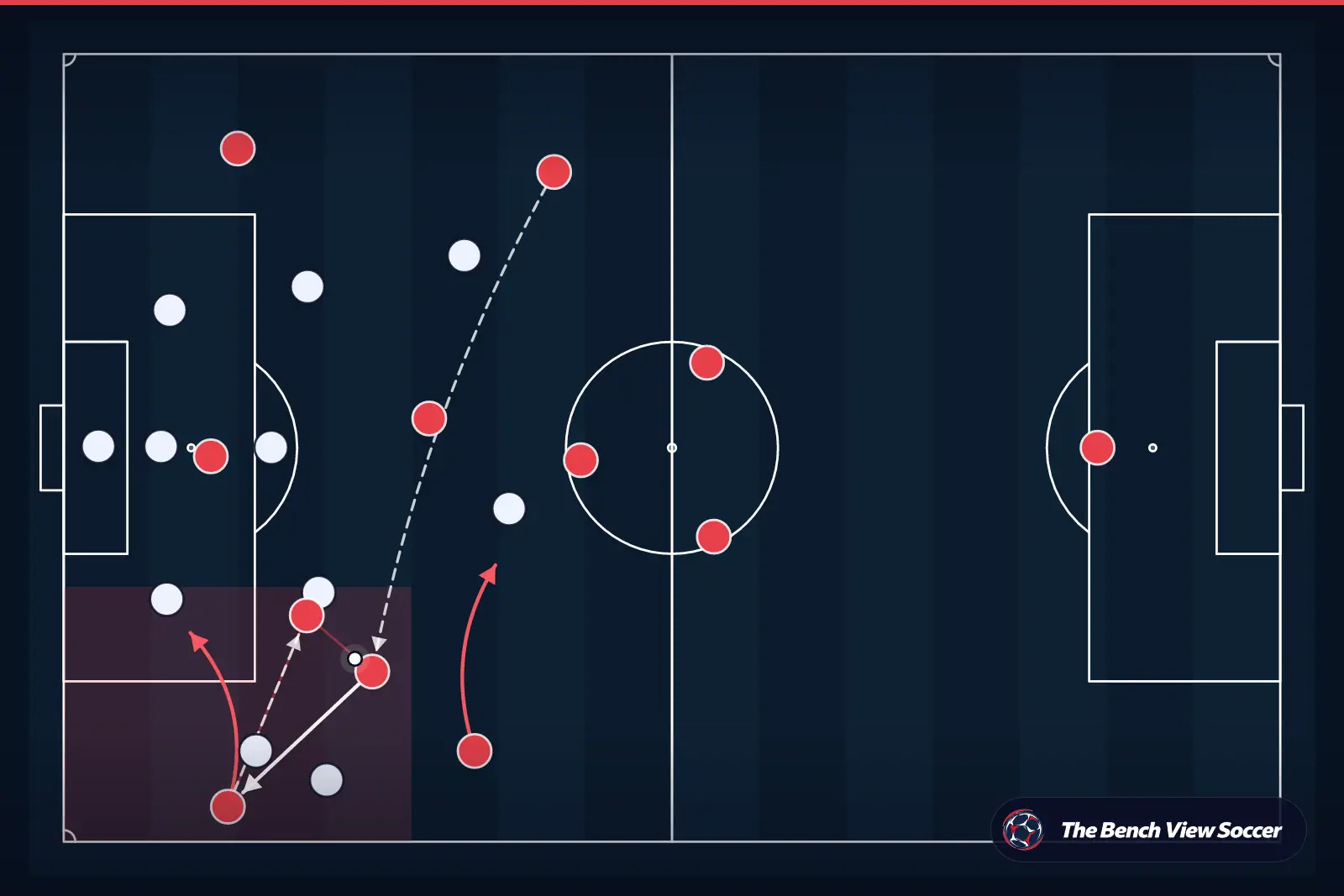
Arsenal’s wingers cut inside because it creates advantages in three important areas: chance quality, spacing, and control after turnovers. First, when Saka (right side) or Martinelli (left side) drives inside, they move closer to the most valuable zone—the area between the posts around the penalty spot—where shots are statistically more dangerous than from wide angles. Second, the inward run changes the opponent’s defensive decisions. A full-back usually wants to defend outside, toward the touchline, because the sideline acts like an extra defender. When the winger comes inside, the full-back must either follow into central areas (opening the wing) or pass the winger to a centre-back or midfielder (risking confusion). Arsenal actively exploits this moment. Third, cutting inside supports Arteta’s preference for controlling the game through “rest defence” (the shape behind the attack that protects against counterattacks). When the winger is inside, Arsenal often has more players near the ball, which helps them counter-press immediately after losing possession. At the same time, the wide space is not wasted: it is often filled by the full-back (Ben White on the right, or Oleksandr Zinchenko/Jurrien Timber depending on fitness and selection) or by the winger temporarily holding width before darting in. This creates a recurring pattern: winger receives wide to attract the full-back, then either dribbles inside to combine, plays a short pass into a midfielder like Martin Ødegaard or Declan Rice, or releases the overlapping full-back into space for a cutback. The final detail is timing: the winger does not cut inside too early. Arsenal uses “stretch then squeeze”—first stretch the defence with width, then squeeze into the half-space and box when the opponent shifts.
Match Examples
A clear Premier League example appears in Arsenal vs Liverpool at the Emirates in 2023–24 (4 February 2024). Arsenal targets the right side where Saka starts wide, draws Liverpool’s left-back, and then attacks the inside channel to link with Ødegaard. Even when the final action is not a clean shot, the inward run forces Liverpool’s midfield line to collapse, which opens lanes for third-man combinations and creates better access to cutbacks. Another strong reference is Arsenal vs Manchester City at the Emirates in 2023–24 (Premier League, 8 October 2023). City under Pep Guardiola defends with excellent spacing, so pure wing play often gets trapped near the touchline. Arsenal’s solution is to keep Saka wide to pin the full-back, then use inside movement and short passing to get into the right half-space. When Saka steps inside, Ben White can advance on the outside, and Ødegaard can receive between City’s midfield and defence. The match shows why “cut inside” is not only a shooting idea; it is a method to access central zones against elite opponents. In the UEFA Champions League, Arsenal vs Porto in 2023–24 (round of 16, second leg at the Emirates, 12 March 2024) shows a different challenge: a deep, compact block that denies space behind. Here, the winger’s inward movement becomes a tool to overload central pockets and create combination play near the box. Instead of endless crosses, Arsenal tries to use quick inside touches to pull Porto’s wide defenders inward, then threaten the wing with overlaps and low deliveries. Across these matches, the repeated theme is consistent: the inside movement manipulates the defender’s choices and improves Arsenal’s access to high-value shooting and passing zones.
Related Concepts & Skills
Training Implications
For coaches and players trying to copy this role, train the winger to make inside runs with purpose, not habit. Start with a simple pattern drill: place a winger on the touchline, a midfielder in the half-space, a full-back outside, and a striker between centre-backs. The winger receives wide, takes two controlled touches, then chooses one of three actions based on a defender’s angle: (1) dribble inside and slip a pass to the striker, (2) pass inside to the midfielder and spin for a return, or (3) release the overlapping full-back for a low cutback. Rotate defenders so the winger reads pressure from different body shapes. Add a finishing component that mirrors Arsenal’s chance creation: instead of crossing high, require the final ball to be a cutback or a square pass across the box. Give points for shots taken from central zones (around the penalty spot) and fewer points for wide-angle shots. To build decision-making, use constraints in small-sided games (5v5 or 7v7): award an extra point if a goal comes after the winger receives wide and then enters the half-space before the shot. Also coach defensive transition: the moment the winger loses the ball while cutting inside, the nearest three players must counter-press for five seconds to win it back or force a backward pass. This links the attacking choice (coming inside) to the team’s ability to sustain pressure—one of Arteta’s biggest advantages.
The Bench View app
Don’t just read football — train it
Everything you read here, turned into training you can follow step by step.
Physical training at home
AI daily sessions adapted to your level and position. No equipment needed.
Tactical training courses
Step-by-step courses on positioning, pressing, build-up and decision making.
- 7 days free
- No commitment
- Cancel anytime
Free account: 2 physical sessions + the first tactical course. PRO: 7-day free trial — cancel before day 8 and you pay nothing.