Introduction
If you watch Arsenal under Mikel Arteta or Liverpool under Jürgen Klopp (and now Arne Slot), you often see a “winger” start wide but then drive into the middle instead of crossing early. Fans sometimes ask: why does a wide player keep coming inside, where midfielders already exist? The modern answer is that the winger is no longer only a touchline dribbler; he is also a creator, a scorer, and a pressing weapon. When a right-footed player plays on the left (or a left-footer on the right), he can receive wide, threaten the full-back, and then cut inside onto his stronger foot to shoot, slip through-balls, or combine in tight spaces. This article explains inverted wingers using Arsenal and Liverpool as reference points from the Premier League and UEFA competitions, showing what problems the role solves and what it demands from teammates around him.
How It Works
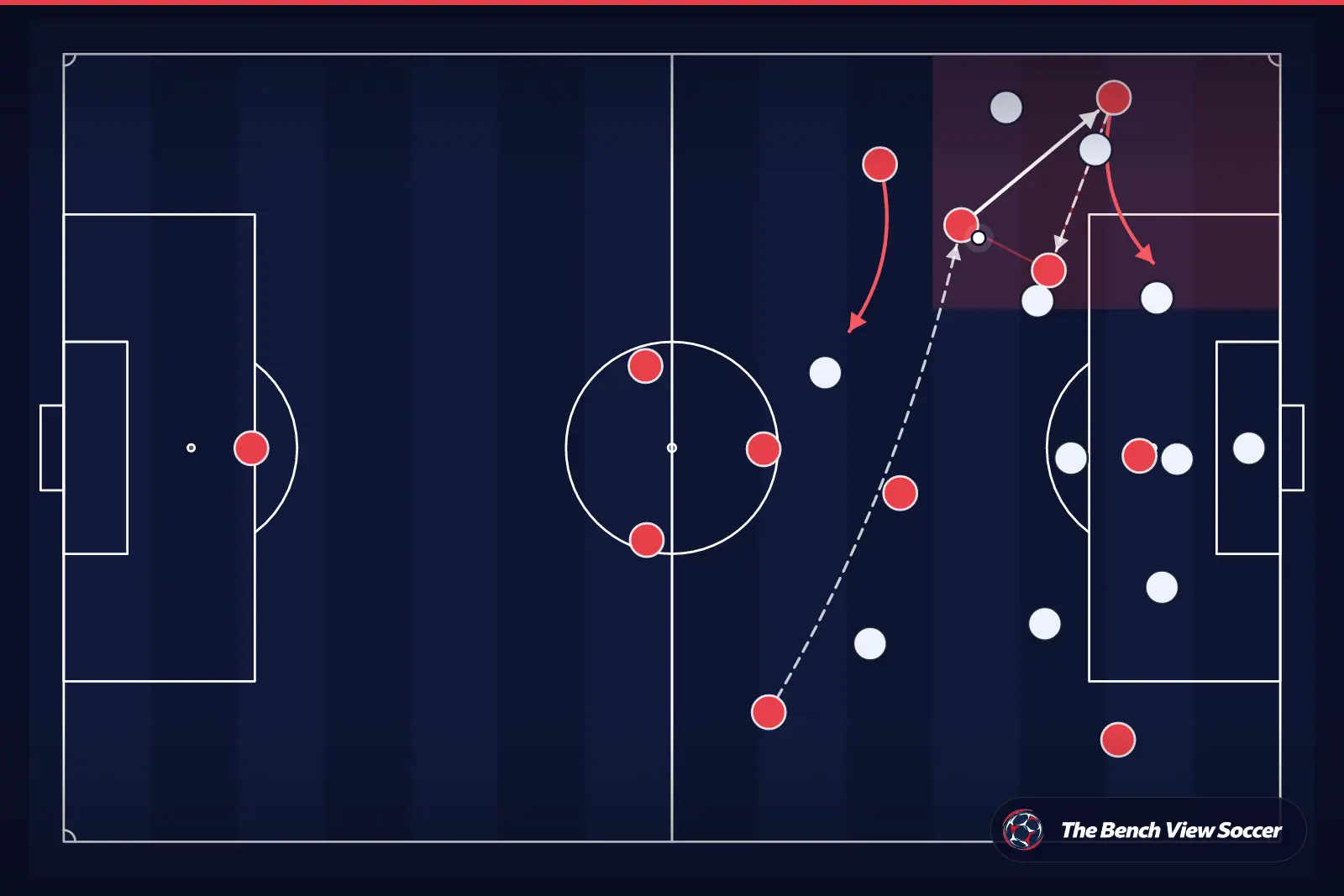
An inverted winger means the player attacks from the “opposite” side of his stronger foot: a right-footer on the left, or a left-footer on the right. The big tactical gain is angle and access to goal. When Bukayo Saka (left-footed) plays on Arsenal’s right, he receives near the touchline to stretch the defence, then cuts inside to open a shooting lane or a diagonal pass into the box. This inside move also creates a dilemma for the opposing full-back: step out wide and risk being beaten inside, or stay compact and give space for a cross or an underlap (an inside run by a full-back). At Liverpool, Mohamed Salah (left-footed) starts wide on the right to isolate the left-back, then drifts into the right half-space (the channel between full-back and centre-back) to shoot or combine. Cutting inside also connects the winger to central “zones of value” where most goals are created: the edge of the box, the penalty spot area, and the corridor between centre-back and full-back. But it only works if the team maintains width elsewhere. Arsenal often uses an overlapping full-back like Ben White or an advanced wide role from a full-back/wing-back to keep the opponent pinned. Liverpool frequently gets width from the full-back (Trent Alexander-Arnold in many Klopp phases) or from the opposite winger staying wide, so the defence cannot simply crowd the middle. Finally, inverted wingers help pressing: when possession is lost, the winger’s inside position is closer to central passing lanes, so he can block the opponent’s first pass into midfield and force play wide, where pressing traps are easier to set.
Match Examples
Arsenal’s 2022–23 Premier League run offers a clear picture of why Arteta values inverted wide players. In Arsenal 3–2 Manchester United (Premier League, 22 January 2023), Saka repeatedly receives wide right, tempts Luke Shaw to engage, then carries inside to threaten the far corner or slide passes into Eddie Nketiah and Martin Ødegaard. Because Saka’s first touch often moves diagonally inward, United’s midfield has to collapse toward him, which opens space for Ben White to overlap on the outside and for Ødegaard to receive between lines. Another strong reference is Arsenal 2–0 Newcastle United (Premier League, 4 March 2023), where Arsenal’s wide players frequently come inside to combine, while the full-backs provide the width that stops Newcastle’s back line from staying narrow. For Liverpool, Klopp’s model is visible in UEFA Champions League nights as well as the league. In Liverpool 2–0 Manchester City (Champions League quarter-final second leg, 10 April 2018), Salah starts from the right but quickly attacks inside pockets after turnovers, turning City’s aggressive full-backs into a weakness. His inside positioning also shortens the distance to goal in transitions, so Liverpool can counter with fewer passes. A domestic example is Liverpool 2–0 Manchester United (Premier League, 19 April 2022): Salah and Sadio Mané constantly move into the half-spaces, with the team using quick switches and third-man runs (a pass to one player who sets for a third runner) to break United’s midfield screen. Across these examples, the pattern is consistent: inverted wingers create central danger, but they rely on team structure—overlaps, supportive midfield angles, and fast counter-pressing—to make that danger sustainable across 90 minutes.
Related Concepts & Skills
Training Implications
To train inverted winger behaviour, you need repetition with clear decisions, not just dribbling drills. Start with a 15x20 metre channel plus a central “half-space” lane marked with cones. Run a 2v2+1: winger and full-back/overlap partner versus defender and covering midfielder, with a neutral player in the half-space. Coaching points: the winger receives wide, checks his shoulder, then chooses one of three actions within two touches—(a) cut inside to shoot into mini-goals placed at the D-top angle, (b) combine with the half-space neutral for a return pass, or (c) release the overlap with a pass into the full-back’s path. Keep score for correct decision-making, not only goals. Add an “opponent full-back rule”: if the defender steps tight, the winger must attack inside; if the defender stays narrow, the winger must drive outside and cross—this forces reading body shape. For finishing, practice the signature inverted-winger shot: receive on the outside foot, carry diagonally, then strike across goal with the stronger foot. Use 6–8 reps per side, then switch to the weaker foot for balance. Finally, include transition work. Play a 5v5 in a 40x30 area: whenever a team loses the ball, the nearest three players have five seconds to win it back (counter-press). Coach the winger to recover inside first, blocking the pass into central midfield, then press outward. This builds the modern requirement: inverted wingers are attackers, but they are also the first line of defence in teams competing in the Premier League, UEFA Champions League, and Europa League.
The Bench View app
Don’t just read football — train it
Everything you read here, turned into training you can follow step by step.
Physical training at home
AI daily sessions adapted to your level and position. No equipment needed.
Tactical training courses
Step-by-step courses on positioning, pressing, build-up and decision making.
- 7 days free
- No commitment
- Cancel anytime
Free account: 2 physical sessions + the first tactical course. PRO: 7-day free trial — cancel before day 8 and you pay nothing.