Introduction
Modern wingers invert because the game now rewards central control more than touchline repetition. Instead of staying wide to cross, many top wide attackers start outside and then move inside toward goal, often onto their stronger foot (a left-footer on the right, or a right-footer on the left). This is not only about shooting; it is about creating better passing angles, overloading midfield zones, and protecting the ball during high pressing phases. In the Premier League and UEFA Champions League, Manchester City under Pep Guardiola and Real Madrid under Carlo Ancelotti show two elite but different versions of this idea. City use inverted wingers to support structured possession and to lock opponents in. Madrid use inverted wingers to turn quick transitions into direct goal threats. For fans watching European football, understanding inversion helps you read why a “winger” sometimes looks like a No.10, why full-backs behave like midfielders, and why many goals start with a winger moving away from the touchline rather than running down it.
How It Works
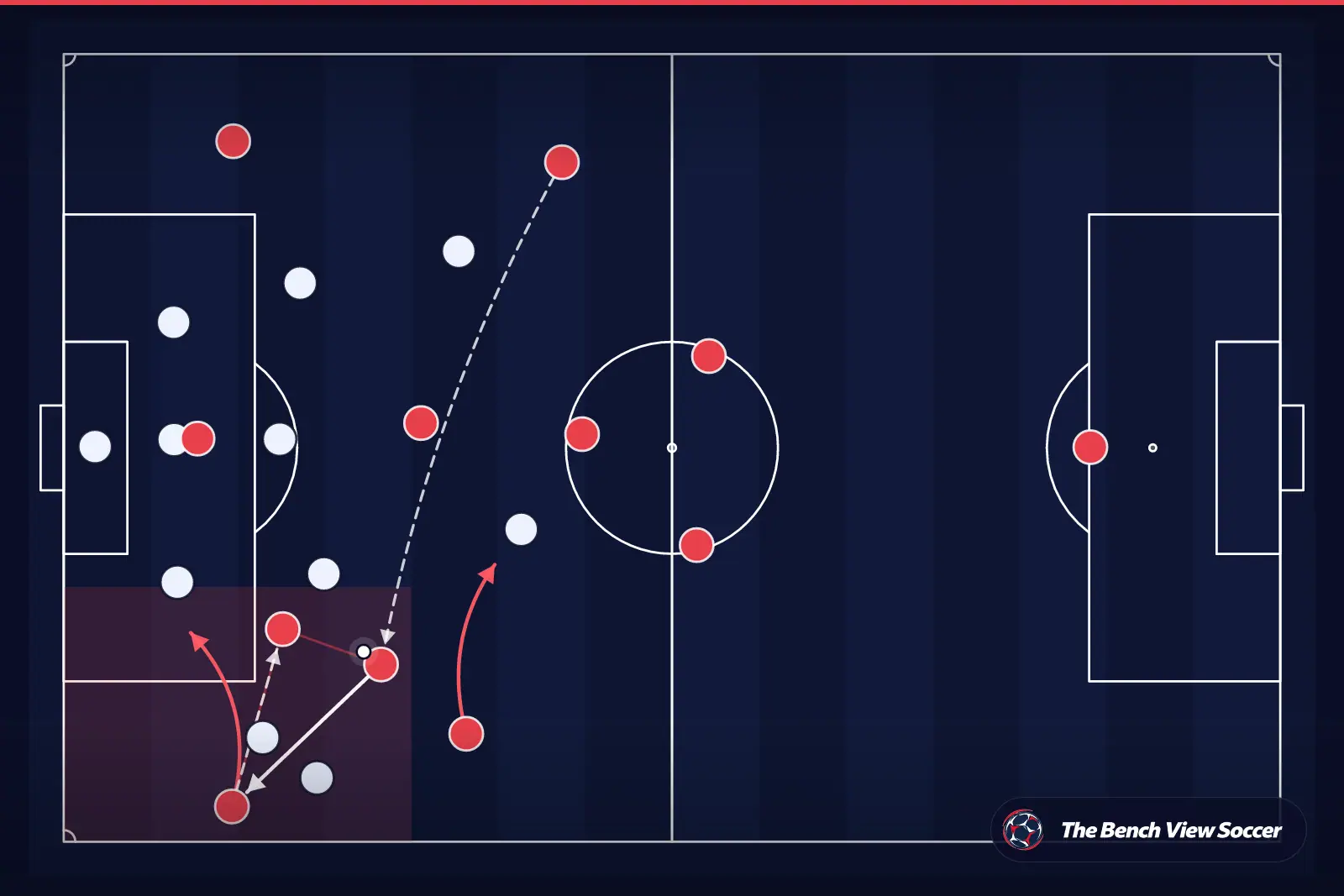
A winger “inverts” when he receives wide but then carries or passes inside into central lanes, usually the half-space (the channel between the wing and the centre). The main tactical reason is simple: central areas offer shorter distances to goal, more passing options, and better access to the striker. When a winger drifts inside, the opposition full-back faces a dilemma: follow inside and leave the flank open, or stay wide and allow the winger to turn centrally. Coaches build entire structures around this. Manchester City often keep width with an overlapping full-back or a very wide winger on the far side, while the inverted winger becomes an extra midfielder to help circulate the ball and create a free man. This supports Guardiola’s control-first approach in the Premier League and Champions League, where City try to sustain attacks for long periods. Real Madrid invert in a more elastic way: Vinícius Júnior and Rodrygo often start wide to stretch the defence, then attack inside once space opens, especially after a turnover. Under Ancelotti, the inverted winger is also a counter-attacking weapon: the inside run pins centre-backs, creates space for Jude Bellingham arriving, and sets up quick combinations with Kylian Mbappé or the striker profile Madrid use in that phase. In both models, inversion is not random dribbling; it is a positional decision that changes marking references and shapes the next pass.
Match Examples
Manchester City’s 2022–23 UEFA Champions League semi-final second leg against Real Madrid at the Etihad is a clear example of inversion supporting control. City’s wide players frequently come inside to crowd Madrid’s midfield line, allowing City to keep Madrid defending narrow and deep. With the winger stepping into interior lanes, City’s near-side full-back and/or wide support maintain width so Madrid cannot simply collapse centrally without consequence. The inside occupation also helps City counterpress immediately after losing the ball, because more bodies are already near the ball. A contrasting pattern appears in Real Madrid’s 2023–24 UEFA Champions League quarter-final tie versus Manchester City, especially the first leg at the Santiago Bernabéu. Madrid’s wide forwards often receive near the touchline first to invite City’s press, then attack inside quickly when the passing lane or dribble window opens. When the winger drives into the inside channel, it forces City’s midfielders to run back toward their own goal, which is a different kind of pressure than defending sideways circulation. For a Premier League reference, Manchester City’s 2023–24 league matches against Arsenal show another reason for inversion: it helps create “five lanes” in attack without losing central stability. City’s winger moving inside can free the half-space for a midfielder to arrive, while the wide lane stays occupied by a full-back or the opposite winger. Arsenal’s compact 4-4-2/4-4-1-1 defensive blocks often try to protect the centre; City’s inversion aims to break that compactness by creating a spare man between the lines and forcing Arsenal’s wide midfielder to choose between tracking inside or protecting the flank.
Related Concepts & Skills
Training Implications
To train inversion, you must coach decisions, not just dribbling. Start with a 6v6 or 7v7 small-sided game on a medium pitch and mark two inside channels (half-spaces) with cones. Give wingers a rule: they must start in the wide lane on the touchline, but at least once per attack they must receive and then either drive into the half-space or play a pass into it. This builds the habit of starting wide to stretch the defence before coming inside. Add a second rule for full-backs: if the winger inverts, the full-back must provide width by overlapping or holding the wide lane. This teaches the real match relationship seen at Manchester City. For technical detail, run a pattern drill: winger receives wide on the back foot, takes the first touch inside, and immediately has two options—(a) a diagonal pass into the striker/No.10, or (b) a slip pass outside to an overlapping full-back. Coach scanning: the winger looks over the shoulder before receiving so the first touch is purposeful. For decision-making under pressure, add a defender who can tackle after the first touch; the winger must protect the ball with the body and choose between driving inside or recycling to a midfielder. Finally, train the defensive side: after any lost ball in the inside channel, the nearest three players press for five seconds (a simple counterpress rule). This recreates the benefit of inverted positions: quick regains because your team is already compact around the ball.
The Bench View app
Don’t just read football — train it
Everything you read here, turned into training you can follow step by step.
Physical training at home
AI daily sessions adapted to your level and position. No equipment needed.
Tactical training courses
Step-by-step courses on positioning, pressing, build-up and decision making.
- 7 days free
- No commitment
- Cancel anytime
Free account: 2 physical sessions + the first tactical course. PRO: 7-day free trial — cancel before day 8 and you pay nothing.