Introduction
Real Madrid’s history is full of iconic number 9s, but in the modern game they often look most dangerous when the centre-forward is mobile rather than fixed between the centre-backs. A “mobile centre-forward” is not just a striker who runs a lot. It is a forward who constantly changes lanes: dropping into midfield to connect play, drifting wide to create 2v1s, and sprinting beyond the defence to stretch the pitch. This movement suits Real Madrid’s squad profile across recent seasons: elite ball-carriers like Vinícius Júnior and Rodrygo, midfielders who can pass and arrive late like Luka Modrić, Toni Kroos, Federico Valverde and Jude Bellingham, and full-backs who can provide width when needed. Under managers like Carlo Ancelotti, Madrid’s attack often thrives on reading moments rather than rehearsed patterns, and a mobile forward gives them more moments to exploit. For fans watching La Liga and the UEFA Champions League, this is a great case study in how one role can unlock multiple teammates at once.
How It Works
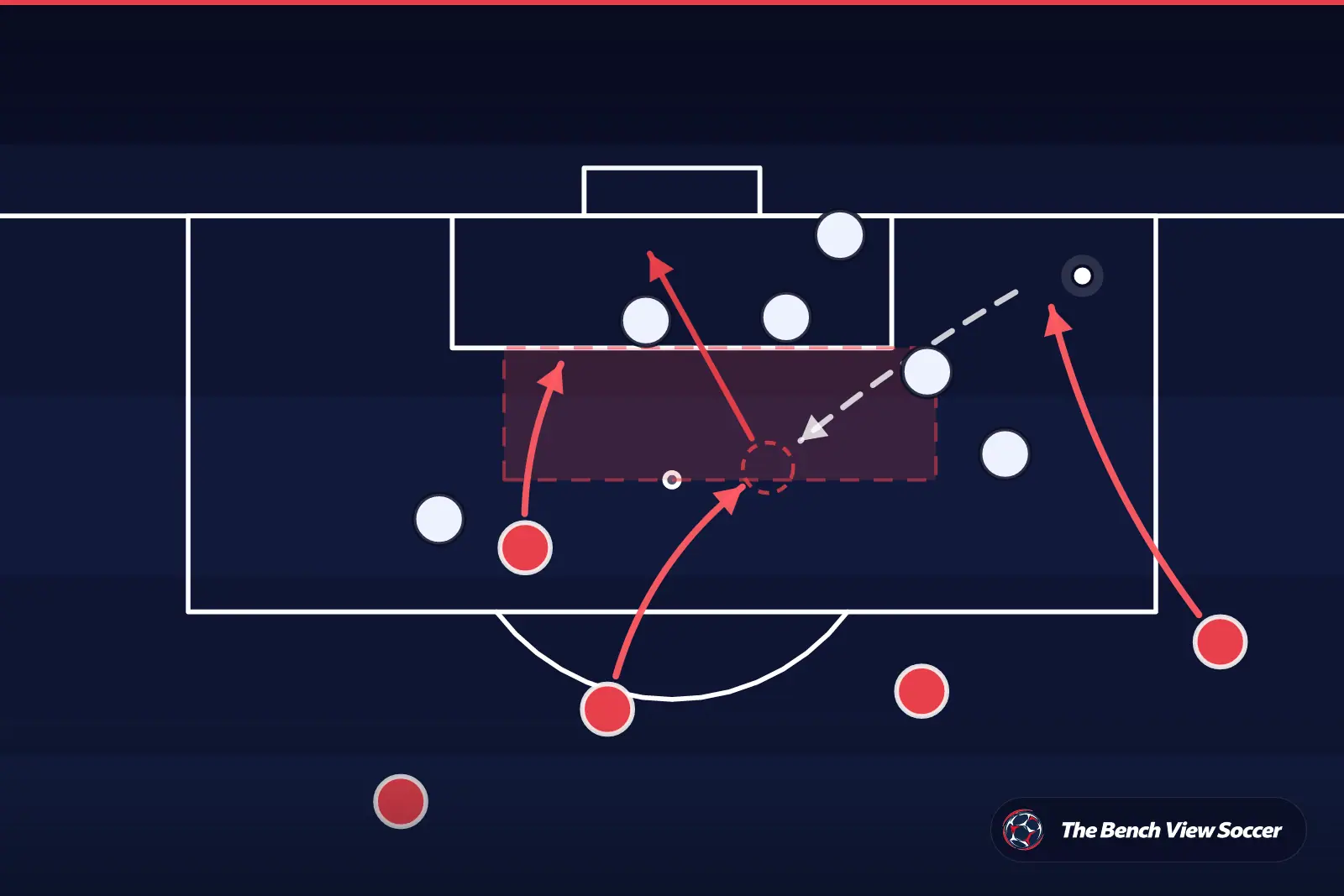
Real Madrid thrive with a mobile centre-forward because it manipulates the opponent’s defensive structure in three key ways: it creates space, it improves connections, and it strengthens the counter-attack. First, space: when the forward drops off the centre-backs into the area in front of them (often called the “between the lines” zone), the defenders face a choice. If a centre-back follows, he opens a channel behind him for a winger like Vinícius to attack. If nobody follows, the forward receives with time, turns, and links the next pass. Second, connections: Madrid’s best attacks often start with short combinations that pull defenders out of shape. A mobile 9 acts as a bounce-pass option (a quick layoff) to midfield runners like Bellingham or Valverde, turning a slow possession into a sudden penetration. Third, transitions: Madrid are one of Europe’s most feared counter-attacking teams, especially in the Champions League. A mobile forward helps here by running diagonally into the “outside channels” (the space between full-back and centre-back), giving the ball-carrier a clear passing lane. Even when he does not touch the ball, his run forces defenders to retreat, which gives Madrid’s midfield more room to carry forward. The overall effect is that Madrid do not rely on constant crossing to a static target; instead, they use movement to create high-quality chances from cutbacks, through balls, and late runs into the box.
Match Examples
A clear reference point is Real Madrid’s 2023–24 UEFA Champions League run under Carlo Ancelotti, where Jude Bellingham frequently acts like a roaming forward in possession, and the nominal striker role is flexible. In the 2023–24 Champions League semi-final second leg against Bayern Munich at the Santiago Bernabéu (2–1), Madrid’s attacking line rotates constantly: the forward zone is not a single player standing still, and Bayern’s centre-backs are repeatedly tempted to step out. This stepping creates space for runners and second-ball situations near the penalty area, which becomes decisive late in the match. Another useful example comes from the 2021–22 Champions League campaign, where Karim Benzema’s movement is central to Madrid’s comebacks. In the 2021–22 Round of 16 second leg versus Paris Saint-Germain (3–1), Benzema does not simply pin defenders; he drops to connect with midfield, presses aggressively to force errors, and then bursts into the box at the right moment. That blend of link play and timing changes PSG’s comfort in buildup and helps Madrid sustain pressure in waves. In La Liga 2023–24, Madrid often face opponents who defend deep in a compact block (for example, teams like Getafe or Cádiz in that season’s league). In such matches, a mobile centre-forward helps Madrid avoid predictable crosses: by vacating the centre, he drags markers away and opens cutback lanes for wide dribblers, while midfielders arrive late for shots around the penalty spot. Across these competitions, the repeating theme is that mobility creates decision-making problems for defenders, and Madrid’s talent punishes hesitation.
Related Concepts & Skills
Training Implications
For coaches and players (including amateur teams in India) who want to copy the benefits of a mobile centre-forward, train the role with clear rules and repeatable pictures. First, build a “drop-and-spin” drill: set up a 30x25m area with a back line (2 defenders), a midfielder, two wingers, and a striker. The striker checks short to receive (drop), plays a one-touch layoff, then immediately spins in behind for a through ball. Rotate roles every 3–4 minutes and coach the striker’s body shape: open hips, scan before receiving, and protect the ball with the far foot. Second, rehearse diagonal runs into the outside channels: start with the winger carrying the ball, and the striker begins centrally, then curves his run between full-back and centre-back. The key coaching point is timing—run when the ball-carrier’s head lifts, not too early. Third, add a decision constraint game (6v6+2 neutrals): the striker’s team scores double if a goal comes after the striker receives between the lines or after a third-man run. This rewards the behaviours Madrid use. Fourth, pressing practice: in an 8v6 buildup exercise, define triggers (back pass, square pass, bouncing ball). The striker initiates the press by cutting the passing lane to the pivot (defensive midfielder) rather than sprinting straight at the centre-back. Finally, teach communication: simple calls like “set” (layoff), “turn” (face goal), and “spin” (run behind) help teammates read the striker’s movement and play faster, which is the real advantage of a mobile 9.
The Bench View app
Don’t just read football — train it
Everything you read here, turned into training you can follow step by step.
Physical training at home
AI daily sessions adapted to your level and position. No equipment needed.
Tactical training courses
Step-by-step courses on positioning, pressing, build-up and decision making.
- 7 days free
- No commitment
- Cancel anytime
Free account: 2 physical sessions + the first tactical course. PRO: 7-day free trial — cancel before day 8 and you pay nothing.