Introduction
Arsenal under Mikel Arteta often looks “wide” even when the final shot comes from the middle. That is not accidental: it is a planned way to move defenders, create passing lanes, and generate higher-quality chances. For fans new to tactics, one simple idea explains a lot of modern European football: teams build overloads on the flank. An overload means you place more attackers than defenders in a small area, usually near the touchline, so the defending team has a dilemma—either send extra players and leave space elsewhere, or stay compact and allow progression down the side. In the Premier League, where teams defend aggressively and transitions are fast, creating a safe route to advance the ball matters. Arsenal’s wide play is also tied to the Champions League trend: elite sides like Manchester City under Pep Guardiola and Bayern München under Thomas Tuchel also use wide “problem areas” to open the central “solution area.” This article breaks down how and why Arsenal creates flank overloads, what it achieves, and how you can spot it live.
How It Works
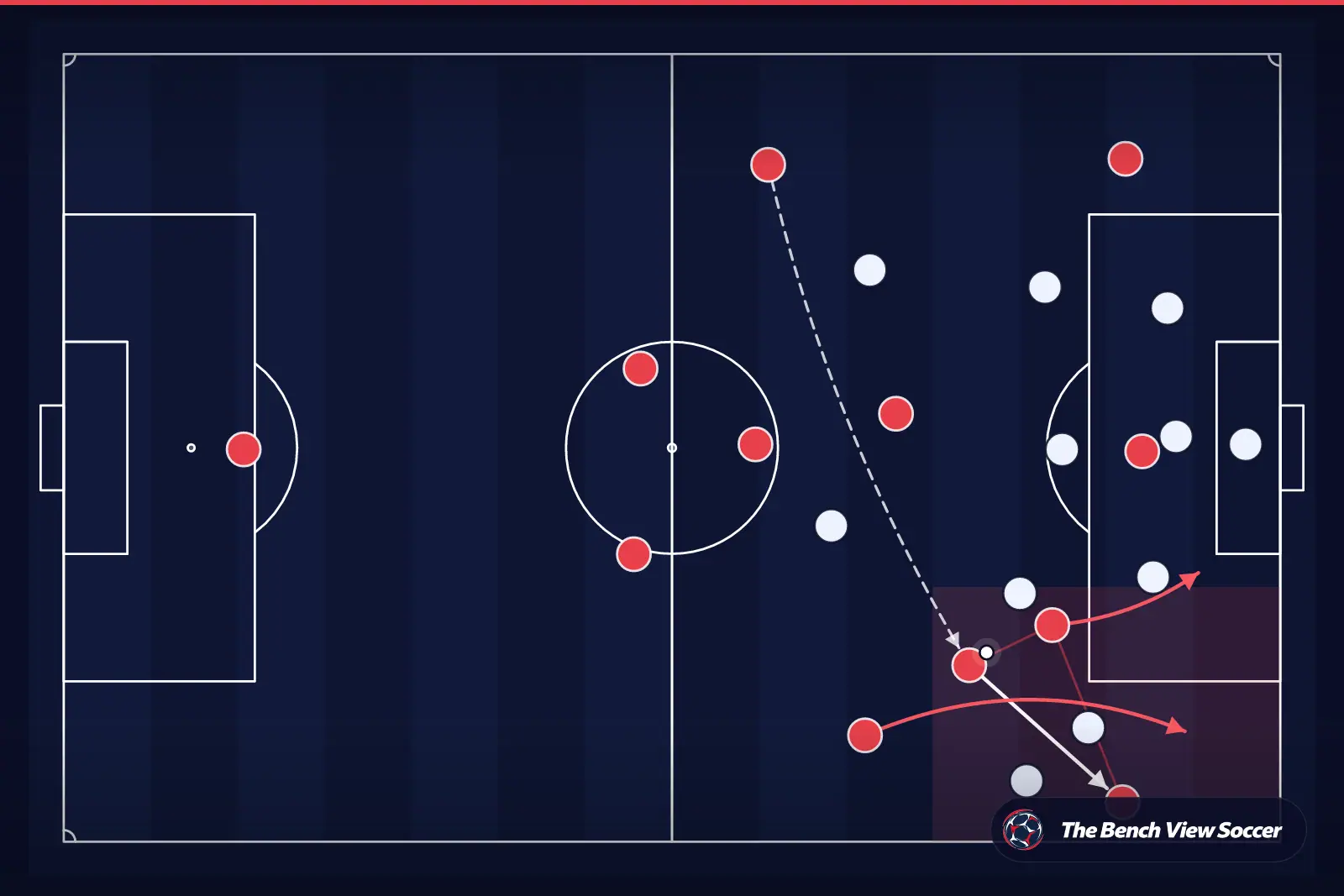
Arsenal builds flank overloads by arranging three or four players on one side at different heights and angles so the ball carrier always has at least two options. Typically, a winger (like Bukayo Saka) stays wide to pin the opposition full-back. The right-sided midfielder or advanced midfielder (often Martin Ødegaard) positions inside but close enough to combine. The right-back (Ben White) either overlaps outside or underlaps into the inside lane depending on the defender’s body shape. Behind them, the holding midfielder (Declan Rice, or previously Thomas Partey) provides a “reset” pass that prevents risky turnovers. This structure creates triangles and diamonds: the ball can bounce forward, back, and inside without losing control. The key purpose is to force a second defender to help on the flank. When that happens, Arsenal uses the free man: either Ødegaard receives between lines, Saka isolates 1v1, or a quick switch goes to the far side where Gabriel Martinelli or Leandro Trossard attacks space. Arsenal also uses the flank to manipulate the opponent’s midfield. When the ball stays wide, the opponent’s nearest central midfielder often shifts across. That movement opens a central passing lane for a cut-back, a “third-man run” (pass to player A, who sets to player B running beyond), or a pass into the striker dropping short (Gabriel Jesus or Kai Havertz) who can lay it off. In present tense, the pattern looks simple: Arsenal attracts pressure wide, plays one-touch combinations, and then either penetrates down the line or enters the box via the half-space. The overload is not just to cross—it is to make defenders turn, sprint, and make choices, which increases the chance of a mistake.
Match Examples
A clear example appears in the Premier League 2022–23 season, Arsenal vs Manchester United at the Emirates (3–2, January 2023). Arsenal repeatedly loads the right flank with Saka wide, Ødegaard inside-right, and White supporting. United’s left side has to choose: Luke Shaw steps out to Saka, while a midfielder slides across to cover Ødegaard. That shift creates moments where Arsenal can play inside quickly or deliver from a better angle. Even when the final action is central, the “work” happens on the flank first. Another strong reference is Arsenal vs Liverpool in the Premier League 2023–24 at the Emirates (3–1, February 2024). Arsenal’s wide-to-inside sequences draw Liverpool’s press toward the touchline, then Arsenal uses quick lay-offs and second balls to attack the space behind the first pressing line. When Liverpool commits numbers to stop Saka and Ødegaard combinations, Arsenal finds central access or a far-side opportunity. In the UEFA Champions League 2023–24 knockouts, Arsenal vs Bayern München (quarter-final, April 2024) highlights the risk and reward of flank overloads. Arsenal seeks to create right-side advantages, but Bayern’s experience shows the defensive counter: they match numbers on the flank and stay ready to counter into the space left by advanced full-backs. The lesson for readers is important—overloads generate chances, but they also shape your rest-defence (the players positioned to stop counters). Arsenal’s best wide overloads include a secure “back platform” so losing the ball does not immediately become a transition against William Saliba and Gabriel Magalhães.
Related Concepts & Skills
Training Implications
To train flank overloads, you need exercises that teach spacing, timing, and decision-making—not just crossing. Start with a 4v3 wide-channel game: mark a channel from the touchline to the edge of the box (or a 20x12 metre zone). Attackers form a diamond (wide winger, inside midfielder, full-back, and a pivot behind). The rule: you score by either dribbling out of the end line under control or playing a cut-back pass to a teammate arriving at the top of the box. This forces players to recognise when to go down the line versus when to bounce inside. Add a “third-man” constraint: the attacker who passes into the inside midfielder cannot receive the next pass. This builds the habit of quick lay-offs and timed runs. Coach key cues in simple language: if the defender’s hips face the touchline, attack inside; if the defender shows inside, go outside and overlap. Next, train the switch: play 6v6 with two wide channels and a rule that after three passes in one channel, the team must attempt a switch to the opposite side within five seconds. Players learn to attract pressure then exploit the far side. Finally, include rest-defence habits. In every drill, require two players to stay behind the ball when attacking (for example, centre-back plus pivot). If the ball is lost, they must delay the counter for three seconds (no diving in), allowing teammates to recover. This makes your overloads realistic: you learn how to attack with numbers without becoming easy to counter.
The Bench View app
Don’t just read football — train it
Everything you read here, turned into training you can follow step by step.
Physical training at home
AI daily sessions adapted to your level and position. No equipment needed.
Tactical training courses
Step-by-step courses on positioning, pressing, build-up and decision making.
- 7 days free
- No commitment
- Cancel anytime
Free account: 2 physical sessions + the first tactical course. PRO: 7-day free trial — cancel before day 8 and you pay nothing.