Introduction
Arsenal under Mikel Arteta build from the back as a deliberate attacking phase, not just a safe way to restart play. For fans new to tactics, “build-up” simply means how a team moves the ball from goalkeeper and defenders into midfield and then into attack while keeping control. Arsenal’s version is especially structured: the goalkeeper acts like an extra passer, the centre-backs split to stretch the first line of pressure, and the midfield rotates to create free passing lanes. This matters because in the Premier League, opponents press aggressively—teams like Manchester City (Pep Guardiola), Liverpool (Jürgen Klopp era) and Newcastle United (Eddie Howe) all try to win the ball high. Arsenal’s build-up aims to either play through that press with short passes or tempt the press and then play around it into space. Understanding these patterns helps you read matches beyond goals and highlights: you start noticing why one pass “opens” the pitch, why another invites pressure, and why certain players (like William Saliba, Gabriel Magalhães, Declan Rice, or Martin Ødegaard) look calm under stress—they are following a plan, not improvising every touch.
How It Works
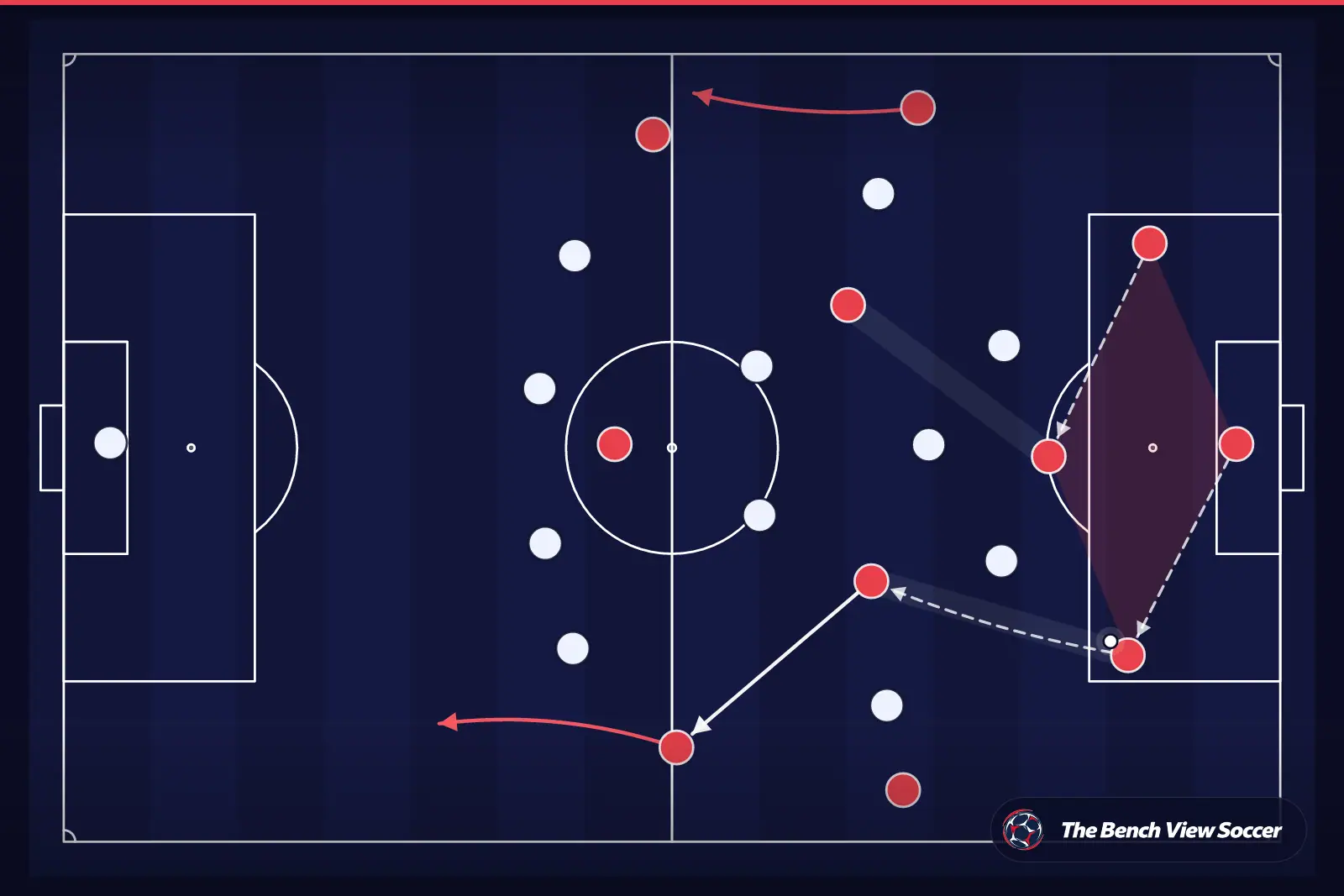
Arsenal’s build-up usually begins with the goalkeeper (David Raya in 2023–24, previously Aaron Ramsdale) positioning to offer a clear passing angle. Raya often stands slightly off his line and centrally to attract the opponent’s first presser, then plays into one centre-back or directly into a midfielder. The centre-backs, typically Saliba on the right and Gabriel on the left, split wider to stretch the press horizontally. This creates a bigger gap between the opponent’s forwards and makes it harder to cover both sides at once. The key detail is midfield rotation: one midfielder drops to help (often Rice), while another occupies a higher pocket (often Ødegaard) and a full-back may step inside. When a full-back inverts—meaning he moves into central midfield zones instead of staying wide—Arsenal create an extra “central outlet” to escape pressure. In 2023–24, Oleksandr Zinchenko often performs this role; in other matches Arteta uses Ben White or even Jurrïen Timber when fit. The structure commonly resembles a 3-2 shape in early build-up: three players form the first line (two centre-backs plus an inverted full-back or a dropping midfielder), and two midfielders sit ahead as passing options. The aim is to create triangles: keeper-centre-back-midfielder or centre-back-inverted full-back-Ødegaard. If the opponent presses man-to-man, Arsenal use quick one-touch combinations to free a player facing forward. If the opponent blocks the centre, Arsenal switch the ball side-to-side until a winger like Bukayo Saka or Gabriel Martinelli receives with space. The “tell” that Arsenal are winning build-up is when the receiver can turn and face the opponent’s goal; the moment they do, the press is beaten and Arsenal accelerate into the next phase.
Match Examples
A clear example appears in the Premier League 2023–24 match against Liverpool at the Emirates (4 February 2024). Liverpool press high and try to lock Arsenal on one side, but Arsenal’s centre-backs split and Raya stays available for the recycle pass. When pressure arrives, Arsenal often reset to Raya, then switch the point of attack to escape Liverpool’s “pressing trap” near the touchline. Another strong reference is Arsenal vs Manchester City in the Premier League 2023–24 at the Emirates (8 October 2023). City’s first line presses with discipline, so Arsenal use shorter connections: Saliba and Gabriel stay calm, Rice shows to receive under pressure, and Zinchenko steps inside to add an extra central passing option. The build-up is less risky and more controlled because losing the ball centrally against City is dangerous; Arsenal therefore prioritise secure angles and “third-man” patterns (pass to one player, who sets it to a third player facing forward). For a European competition example, look at Arsenal vs Porto in the UEFA Champions League 2023–24 Round of 16 second leg at the Emirates (12 March 2024). Porto sit in a compact block and press selectively. Arsenal’s build-up is patient: Raya and the centre-backs circulate the ball to draw Porto out, then Arsenal try to find Rice or Ødegaard between lines. When Porto step up, Arsenal use the keeper and centre-backs to invite pressure and then play into wide areas to progress. These matches show three different problems—an intense press (Liverpool), a highly organised press (Man City), and a selective mid-block (Porto)—and how Arsenal’s build-up adjusts without changing its core principles.
Related Concepts & Skills
Training Implications
If you coach, play, or even just do structured kickarounds, you can train Arsenal-style build-up habits with simple, actionable drills. First, rehearse goalkeeper involvement: set up a 6v4 in your defensive third (keeper + back four + one midfielder vs four pressers). The keeper must complete a certain number of passes and is encouraged to play with both feet; rotate who presses so the keeper learns to read angles under different pressures. Second, train centre-back “splitting” and scanning: place two cones wide to mark their starting positions and require each centre-back to check over both shoulders before receiving; award extra points when the first touch opens the body to play forward. Third, build the midfield rotation: run a 7v7 with zones where one midfielder must drop into the first line while another stays higher; swap roles every two minutes so players learn timing, not just position. Fourth, practise the inverted full-back: in a rondo (keep-away) like 5v2, instruct the full-back to start wide and then step inside after the first pass; the team must find him as the “free man” at least once before switching play wide. Fifth, add a rule that mirrors real matches: if the press forces a back pass to the goalkeeper, the next pass must break a line (into midfield or to the far full-back) within three touches—this teaches calm speed under pressure. Finally, teach decision-making: after each repetition, ask one player to explain why the safe reset to the keeper is sometimes the best option; this reflection builds tactical understanding, not just technique.
The Bench View app
Don’t just read football — train it
Everything you read here, turned into training you can follow step by step.
Physical training at home
AI daily sessions adapted to your level and position. No equipment needed.
Tactical training courses
Step-by-step courses on positioning, pressing, build-up and decision making.
- 7 days free
- No commitment
- Cancel anytime
Free account: 2 physical sessions + the first tactical course. PRO: 7-day free trial — cancel before day 8 and you pay nothing.