Introduction
Manchester City under Pep Guardiola build their dominance on two connected ideas: controlling the ball and controlling what happens the moment they lose it. For fans watching the Premier League or UEFA Champions League, City’s pressing can feel like a “swarm”—the opponent receives the ball and instantly faces two or three blue shirts. But this pressure is not random. It is organised around press triggers: specific cues that tell City when to jump forward, when to lock the ball near a touchline, and when to stay compact. Understanding these triggers explains why City win possession so high up the pitch, and also why certain opponents—especially strong counter-attacking sides—create big chances against them. The key learning is this: pressing is a trade-off. City gain territory and turnovers, but they also accept risk behind the press. In this article, we break down what City’s triggers are, how teams like Real Madrid or Liverpool exploit the spaces they leave, and what it teaches you about modern elite football.
How It Works
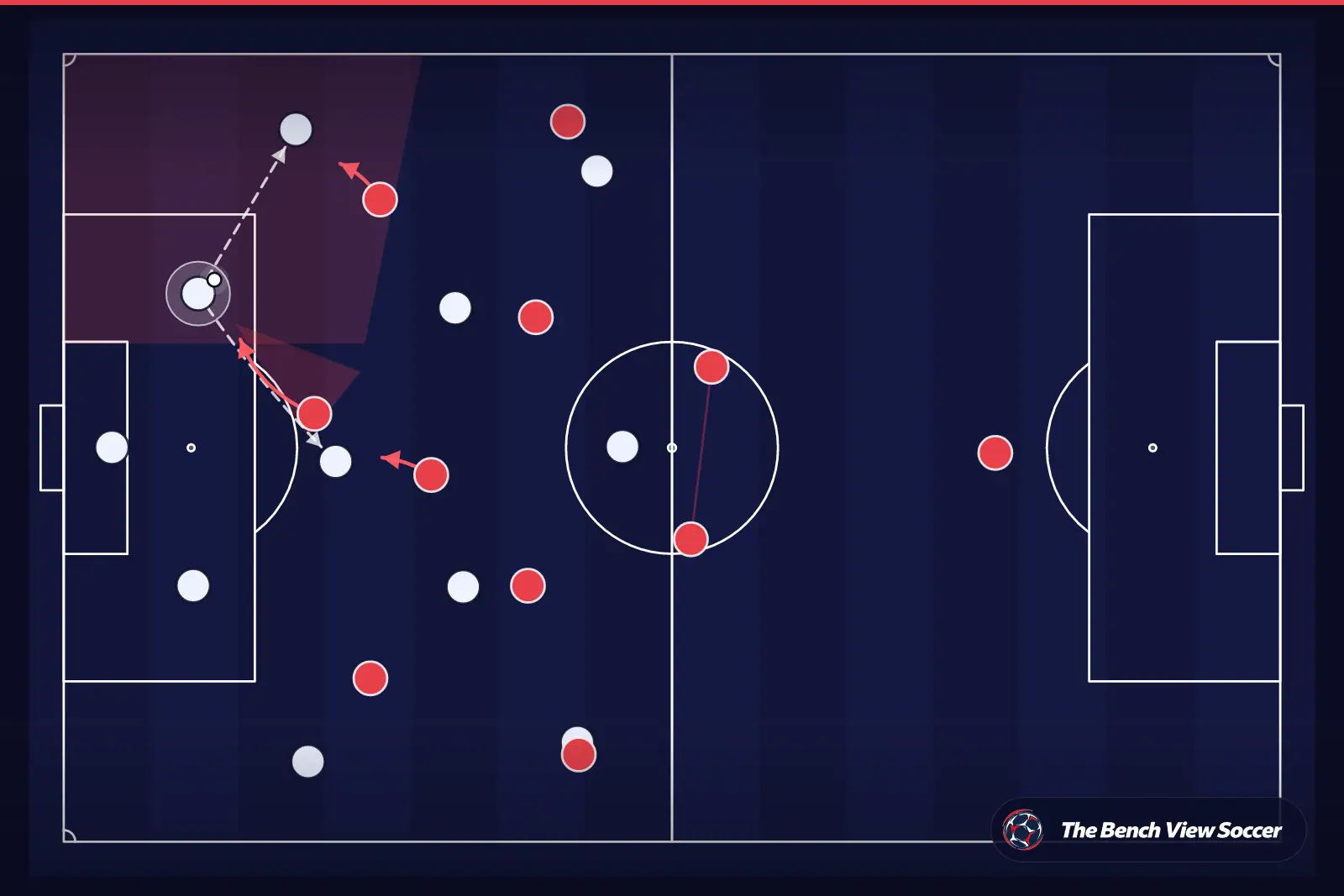
City’s press starts from their shape in possession. When they attack, Guardiola’s teams often use a 3-2 structure behind the ball (three defenders plus two midfielders) to prepare for “counter-pressing” (pressing immediately after losing the ball). A press trigger is usually a moment when the opponent is least able to play forward cleanly. Common City triggers include: (1) a backwards pass to a centre-back or goalkeeper, because the receiver faces their own goal and needs an extra touch; (2) a sideways pass to a full-back near the touchline, because the sideline acts like an extra defender and reduces passing angles; (3) a poor first touch or bouncing ball, because the receiver cannot play quickly; (4) a pass into a player with their back to goal (often a striker dropping in), because City can press from behind and from the front at the same time; and (5) a delayed switch of play, when the ball travels slowly and City’s far-side winger can sprint to arrive as the ball lands. When the trigger appears, City jump in coordinated waves. The nearest player presses the ball-carrier, the next players mark the closest passing lanes, and the back line steps up to squeeze space. This is why it feels like the opponent has “no options”: City do not only press the man, they press the choices. However, these choices create vulnerabilities. City’s full-backs or advanced midfielders often step high to block passes inside. If the opponent escapes with one clean pass through the centre (a “line-breaking pass”), City’s midfield can be temporarily outnumbered, because several players have already committed forward. Another weakness is the space behind City’s high defensive line. Because they defend high, a single accurate through ball or early diagonal can turn City’s press into a foot race. The most reliable way to exploit City is not to take many touches under pressure, but to play one- and two-touch combinations, use a third-man run (pass to A, layoff to B, then B plays to the runner), or go direct into a strong forward who can set the ball and release runners into the channels.
Match Examples
1) Real Madrid vs Manchester City, UEFA Champions League semi-final second leg, 2021–22 (Santiago Bernabéu). City’s press works for long spells because Madrid struggle to build through the middle, often going long. But Madrid’s exploitation is ruthless when City’s pressure is bypassed. When City commit numbers to press high, the space behind their line becomes valuable. Madrid’s equalising moments come from quick, direct actions rather than long possession sequences: the ball reaches the box fast, and City’s defenders have to turn and face their own goal. The lesson for opponents is clear: you do not need to “out-pass” City for 90 minutes; you need a few high-quality escapes from the press and fast arrival into the penalty area. 2) Liverpool vs Manchester City, Premier League 2022–23 at Anfield. Jürgen Klopp’s Liverpool target the space behind City’s high line with early passes and runs, especially when City’s press steps up after a turnover. Liverpool avoid slow circulation in their own third when City lock onto them. Instead, they draw City in and then play quickly into the channels for runners like Mohamed Salah. This approach punishes City’s aggressive squeezing of space: the moment City’s full-backs or midfielders jump to press, Liverpool look for the first forward pass that breaks the first wave. 3) Manchester City vs Chelsea, UEFA Champions League final 2020–21 (Porto). Thomas Tuchel’s Chelsea show a different method: they use structure to create safe outlets under pressure. Chelsea’s build-up uses a back three and midfield positioning to form passing triangles, so City’s trigger-based jumps do not create easy traps. When City’s press is attracted to one side, Chelsea play through the nearest midfielder and then find a runner beyond City’s midfield line. The winning goal comes from a vertical access pass that defeats City’s midfield pressure, followed by a run into the space City leave when their press is aggressive. Across these examples, the pattern is consistent: City’s triggers produce control, but the best opponents prepare “escape routes” before the press even arrives—either via direct balls into space, a forward who can hold and lay off, or a stable build-up structure that always offers a free man.
Related Concepts & Skills
Training Implications
If you coach, play, or analyse at any level, you can translate City’s pressing ideas into simple training habits. First, train recognition of triggers with a “call-and-jump” rule: in a 6v6+2 possession game, the defending team is only allowed to press aggressively after specific cues (back pass, poor touch, pass to a wide player near the line). This teaches players to press together instead of one player sprinting alone. Second, build an opponent-escape routine: in an 8v6 build-up drill (8 building out vs 6 pressing), require the build-up team to find a third-man combination at least once per sequence—pass into a marked player, bounce it, then play forward. This directly rehearses how teams beat City. Third, coach body shape and scanning. Under a high press, receiving with an open body (hips facing the next pass) saves a touch. Add a constraint: every receiver must check their shoulder before the pass arrives; if not, possession turns over. Fourth, practice “first forward pass” decision-making. In a transition game, when you win the ball you have five seconds to attempt a forward pass or a switch; if you play sideways, the goal is worth less. This simulates the moment City’s press is bypassed and encourages vertical play. Finally, design a rest-defence habit even in small-sided games: whenever your team attacks, always keep two players behind the ball and one central screen in front of them. Rotate the roles so everyone learns it. This is actionable for Indian grassroots teams because it reduces the fear of counterattacks while still allowing aggressive pressing, and it mirrors how elite sides balance risk and control.
The Bench View app
Don’t just read football — train it
Everything you read here, turned into training you can follow step by step.
Physical training at home
AI daily sessions adapted to your level and position. No equipment needed.
Tactical training courses
Step-by-step courses on positioning, pressing, build-up and decision making.
- 7 days free
- No commitment
- Cancel anytime
Free account: 2 physical sessions + the first tactical course. PRO: 7-day free trial — cancel before day 8 and you pay nothing.