Introduction
Pressing can feel like “just running,” but elite teams treat it like a set of planned decisions. A press trigger is the signal that tells the whole team: now we jump, now we squeeze space, now we force the opponent into a mistake. Real Madrid—under Carlo Ancelotti across the 2021–22 and 2023–24 UEFA Champions League runs and in La Liga—often look calm without the ball, but they do not press randomly. They wait for moments that tilt the odds in their favour: a risky back pass, a receiver facing his own goal, a touchline trap, or a midfielder receiving with no clear forward option. For fans learning tactics, the key lesson is simple: pressing is about coordination and timing, not constant intensity. Madrid’s best pressing moments are short, sharp, and collective—three to five seconds of chaos that create either a turnover or a forced long ball. This article breaks down those triggers in a clear way and shows how Madrid use them to protect their defensive shape while still winning the ball high at the right time.
How It Works
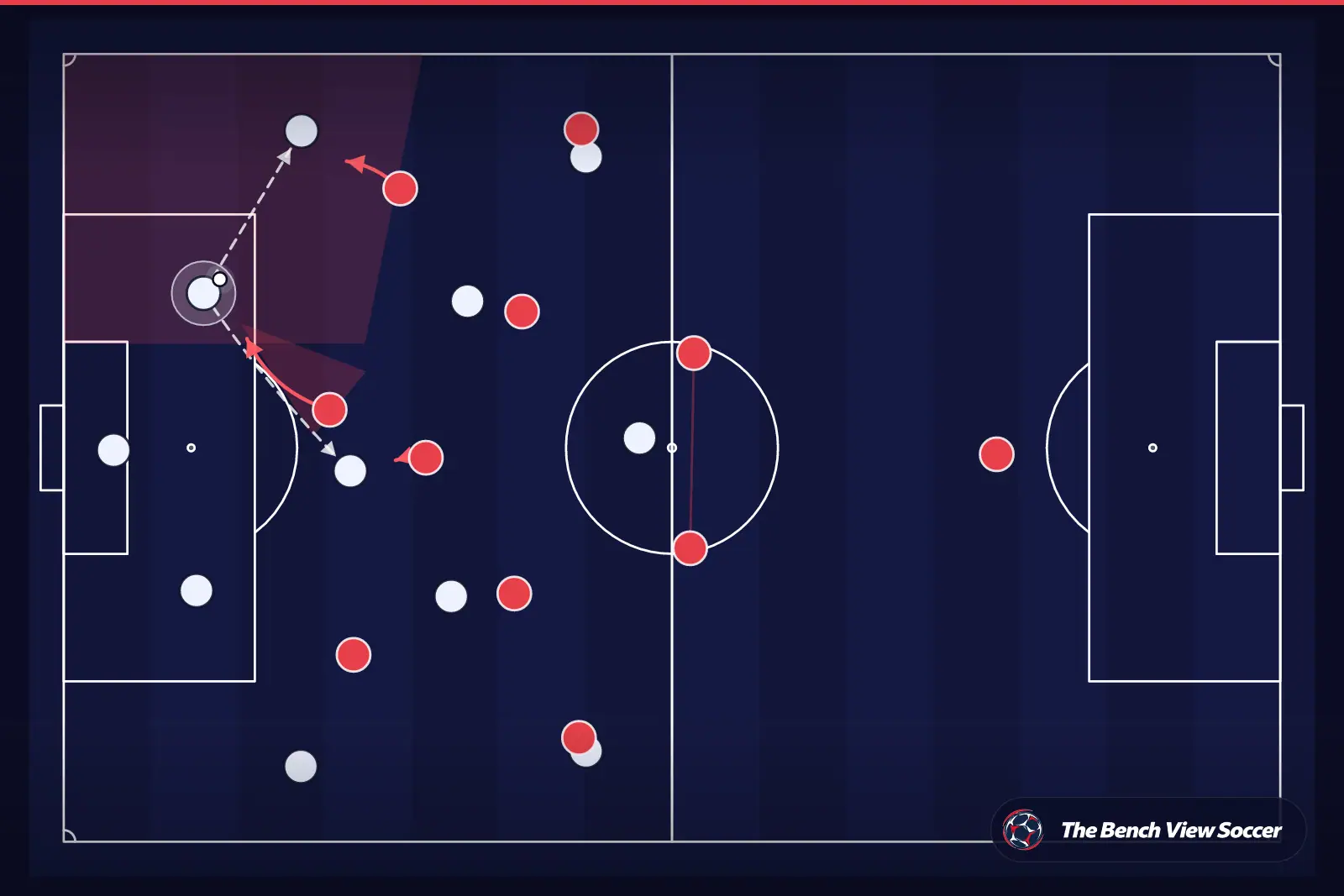
Real Madrid’s press usually starts from a compact mid-block rather than a nonstop high press. A “block” is the team’s defensive shape; a mid-block means Madrid set up around the middle third, keeping distances small between lines. From there, they press when a trigger appears. Trigger 1: a backward pass to a centre-back or goalkeeper. When the ball goes back, Madrid’s front players step up together: the striker curves his run to block the easiest pass into midfield, while the nearest winger jumps to the full-back. Trigger 2: a poor body orientation—when an opponent receives facing his own goal. Madrid treat that as a green light to go shoulder-to-shoulder, because the receiver’s next pass options are limited. Trigger 3: a touchline situation. The touchline acts like an extra defender, so Madrid try to “lock” the ball wide by covering inside lanes and pressing from outside-in. Trigger 4: a slow or bouncing first touch. The moment the ball is not under clean control, the nearest midfielder steps in and the back line squeezes up to reduce space behind. The common thread is collective movement: one player pressing alone is not a plan; Madrid’s value comes when the second and third players arrive to close passing lanes, forcing either a rushed long ball or a dangerous pass into pressure.
Match Examples
In the 2023–24 UEFA Champions League semi-final second leg at the Santiago Bernabéu (Real Madrid vs Bayern Munich), Madrid do not press every build-up. They often hold a mid-block, but when Bayern play a back pass into a centre-back under slight pressure, Madrid’s front line accelerates. Vinícius Júnior and Jude Bellingham angle their runs to block central options, pushing Bayern toward the sideline. That “angled run” matters: it is not just chasing, it is steering. A second example comes from the 2021–22 UEFA Champions League Round of 16 second leg (Real Madrid vs Paris Saint-Germain). Madrid’s famous turnaround begins with a press trigger: PSG attempt to play out under pressure, and a heavy touch/backward pass sequence invites Karim Benzema to jump. The press is not only Benzema running; midfielders step higher to prevent the simple escape pass, and the defensive line squeezes to keep the team compact. Even when Madrid do not win the ball directly, they often force a hurried clearance, which becomes a 50–50 duel—another mini-trigger—where Luka Modrić and Toni Kroos position themselves to collect second balls. In La Liga, against teams like Girona (2023–24 season), Madrid’s wide trap is visible: they allow the pass to the full-back, then the winger presses aggressively while the nearest midfielder blocks the inside passing lane, turning the touchline into a cage. These examples show Madrid’s pattern: wait, identify the trigger, press in a coordinated burst, and then immediately attack the space left by the opponent’s disorganisation.
Related Concepts & Skills
Training Implications
To apply Madrid-style press triggers in your local team or academy session, train the decisions, not just the running. Start with a simple rule-based game: 7v7 in a 40x30 metre area, with two mini-goals. Give the defending team three triggers they must recognise: (1) any back pass, (2) any receive facing own goal, (3) any first touch that pops up or goes wide. When a trigger happens, the nearest player must press, and two teammates must immediately “support” by closing the nearest passing lanes (one blocks inside, one covers the next option). If they do it within three seconds, award 1 point even if the ball is only forced long. This teaches that a forced long ball is a pressing win. Add a second drill: touchline trap rondo. Use a 12x18 metre rectangle near a sideline. Play 5v3 with the rule that the attacking team must complete one pass to the wide player every four passes. The defending trio practises locking the ball wide: first defender presses from outside-in, second defender blocks the inside lane, third defender stays slightly behind to intercept the escape pass. Coaching cues: “arrive on the touch” (press on the receiver’s first touch), “show the line” (force play toward the sideline), and “squeeze together” (back line steps up two metres on the trigger). Finally, review video clips (even phone recordings) and count: how many times does your team press on a trigger together vs one player going alone? Track that number weekly—the habit of collective response is the real improvement.
The Bench View app
Don’t just read football — train it
Everything you read here, turned into training you can follow step by step.
Physical training at home
AI daily sessions adapted to your level and position. No equipment needed.
Tactical training courses
Step-by-step courses on positioning, pressing, build-up and decision making.
- 7 days free
- No commitment
- Cancel anytime
Free account: 2 physical sessions + the first tactical course. PRO: 7-day free trial — cancel before day 8 and you pay nothing.