Introduction
Transitions are the moments when a team switches from defending to attacking (or the other way around). In European football, these seconds often decide matches more than long spells of possession, because opponents are disorganised and spaces appear suddenly. For fans learning tactics, the key idea is simple: a “defensive shape” is not just for stopping goals; it is also a launchpad for fast attacks. Managers build habits so that when the ball is won, players already know where the next pass goes, which runs are automatic, and how many players commit forward without losing protection behind the ball. Think of Jürgen Klopp’s Liverpool in the UEFA Champions League, Carlo Ancelotti’s Real Madrid in La Liga, or Mikel Arteta’s Arsenal in the Premier League: their transitions look different, but all are planned. This article breaks down how managers engineer these patterns, what to watch for on TV, and how you can train similar principles in a grassroots setting.
How It Works
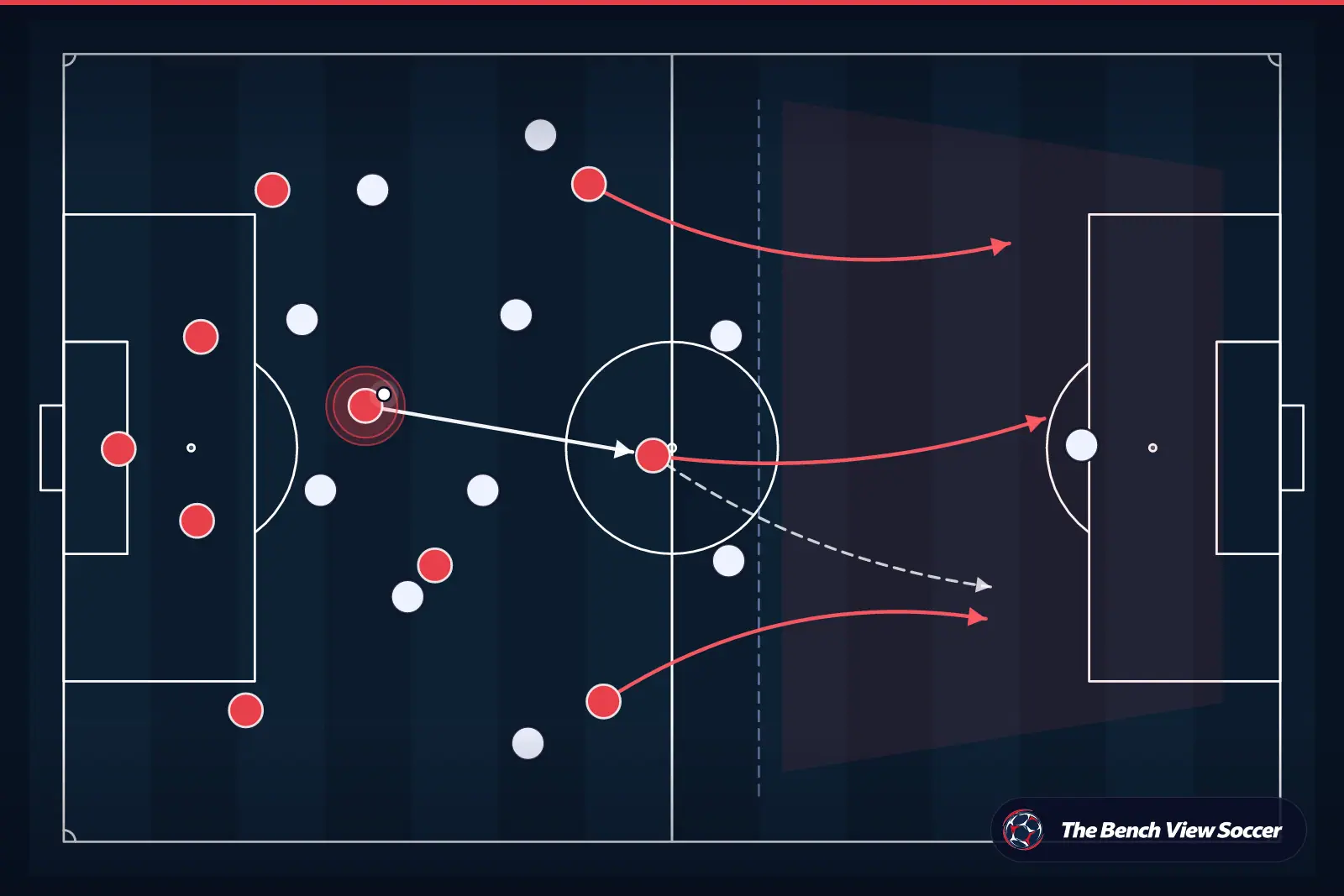
A good defensive-to-attack transition usually has three phases: the win, the first decision, and the acceleration. First, the “win” is not only a tackle; it can be a forced long ball, an interception, or a second-ball recovery after a clearance. Managers design the defensive shape so that the ball tends to be won in predictable zones. For example, a mid-block (defending in the middle third) invites certain passes, then collapses to intercept. Second, the first decision after winning the ball is everything. Teams either play the immediate forward pass (to exploit space), or they “secure” the ball with a short pass to reset. Coaches like Klopp encourage the forward option when the opponent’s back line is open; coaches like Pep Guardiola often prioritise securing possession unless the counter is clearly on. Third, acceleration means coordinated movement: one player carries the ball, two or three run beyond, and one stays connected behind to prevent an instant counter against them. Wide players sprint to stretch the pitch, a striker pins centre-backs by staying high, and a midfielder supports at an angle so the ball-carrier always has a safe outlet. Watch the body shape: players open their hips to receive facing forward, and the first touch pushes into space. This is why transitions look “fast” even without frantic passing—because the team’s spacing is pre-built in the defensive phase.
Match Examples
Real Madrid under Carlo Ancelotti show a classic “absorb then strike” transition in the 2021–22 UEFA Champions League, especially in the semi-final second leg vs Manchester City at the Santiago Bernabéu. Madrid often defend deeper for spells, but when they win the ball they immediately look for Vinícius Júnior’s outlet on the left or Karim Benzema between centre-backs and midfield. The first pass is vertical or diagonally forward, and Luka Modrić/Toni Kroos support underneath to connect if the direct route is blocked. Liverpool under Jürgen Klopp demonstrate a different model in the 2018–19 Premier League and Champions League seasons: their transitions begin with counter-pressing (winning the ball back quickly after losing it). A clear reference is the 2018–19 UCL semi-final second leg vs Barcelona at Anfield, where Liverpool’s intensity after turnovers creates repeated waves; even when the first counter is stopped, the next regain restarts the attack before Barcelona can set their shape. Another strong example is Arsenal under Mikel Arteta in the 2022–23 Premier League, where they often build a compact rest-defence (players positioned to stop counters) and then explode in transition when they intercept. Against teams that commit full-backs forward, Arsenal’s wide-to-wide switches after a regain are crucial: the first pass secures, the second pass attacks the far side, and runners arrive into the box. These matches show that “fast attack” does not mean the same pattern every time; it means a rehearsed reaction to a specific defensive situation.
Related Concepts & Skills
Training Implications
To train defensive-to-attack transitions, you need exercises that recreate the emotional and physical reality: ball wins, chaos, and quick choices. 1) “Win and Go” Game (7v7+2 neutrals): Set a 40x30m pitch. Each team defends a mid-block. When a team wins the ball, they get 6 seconds to create a shot or enter a marked end zone. Coach the first pass: demand either (a) a vertical pass to a forward checking into space, or (b) a secure bounce pass to a supporting midfielder if the vertical lane is blocked. 2) Counter-Press to Counter-Attack Drill: Start with 5 attackers keeping the ball vs 4 defenders in a box. On a turnover, the team that lost the ball has 5 seconds to win it back; if they regain, they immediately attack two mini-goals. This teaches the link between counter-pressing and fast attacks. 3) Role Rules for Structure: Give simple jobs that players remember: one “runner beyond” (stretches depth), one “wide outlet” (stretches width), one “connector” (shows for the safe pass), and one “anchor” (stays behind the ball). Rotate roles so everyone learns. 4) Coaching Points you repeat every session: body open to play forward, first touch into space, support at angles (not flat), and decision-making based on numbers (if you have 3v2, go direct; if it’s 2v3, secure first). 5) Video habit: record 10 minutes of your game and count how many seconds it takes from winning the ball to the first forward action (pass, carry, or shot). Set a team target, like “forward action within 3 seconds,” and track improvement weekly.
The Bench View app
Don’t just read football — train it
Everything you read here, turned into training you can follow step by step.
Physical training at home
AI daily sessions adapted to your level and position. No equipment needed.
Tactical training courses
Step-by-step courses on positioning, pressing, build-up and decision making.
- 7 days free
- No commitment
- Cancel anytime
Free account: 2 physical sessions + the first tactical course. PRO: 7-day free trial — cancel before day 8 and you pay nothing.