Introduction
Manchester City under Pep Guardiola turns “structure” into a weapon. Many teams attack with fixed roles: the right-back stays wide, the winger hugs the line, the striker stays central. City often does the opposite. They keep the team shape, but rotate the players inside that shape, so defenders lose reference points. This is what fans often notice as “players popping up everywhere,” but it is not random. It is planned positional rotation: a right-back steps into midfield, a winger moves inside, a midfielder drifts wide, and the team still covers every lane. The reward is space—especially around the half-spaces (the channels between the centre and the wing) where many goals are created. In the Premier League and UEFA Champions League, this rotation helps City progress the ball, pull opponents out of their defensive line, and create high-quality chances without needing constant long balls or individual dribbling. For fans learning tactics, it is useful because it shows how movement can create advantage even when the opponent sits deep.
How It Works
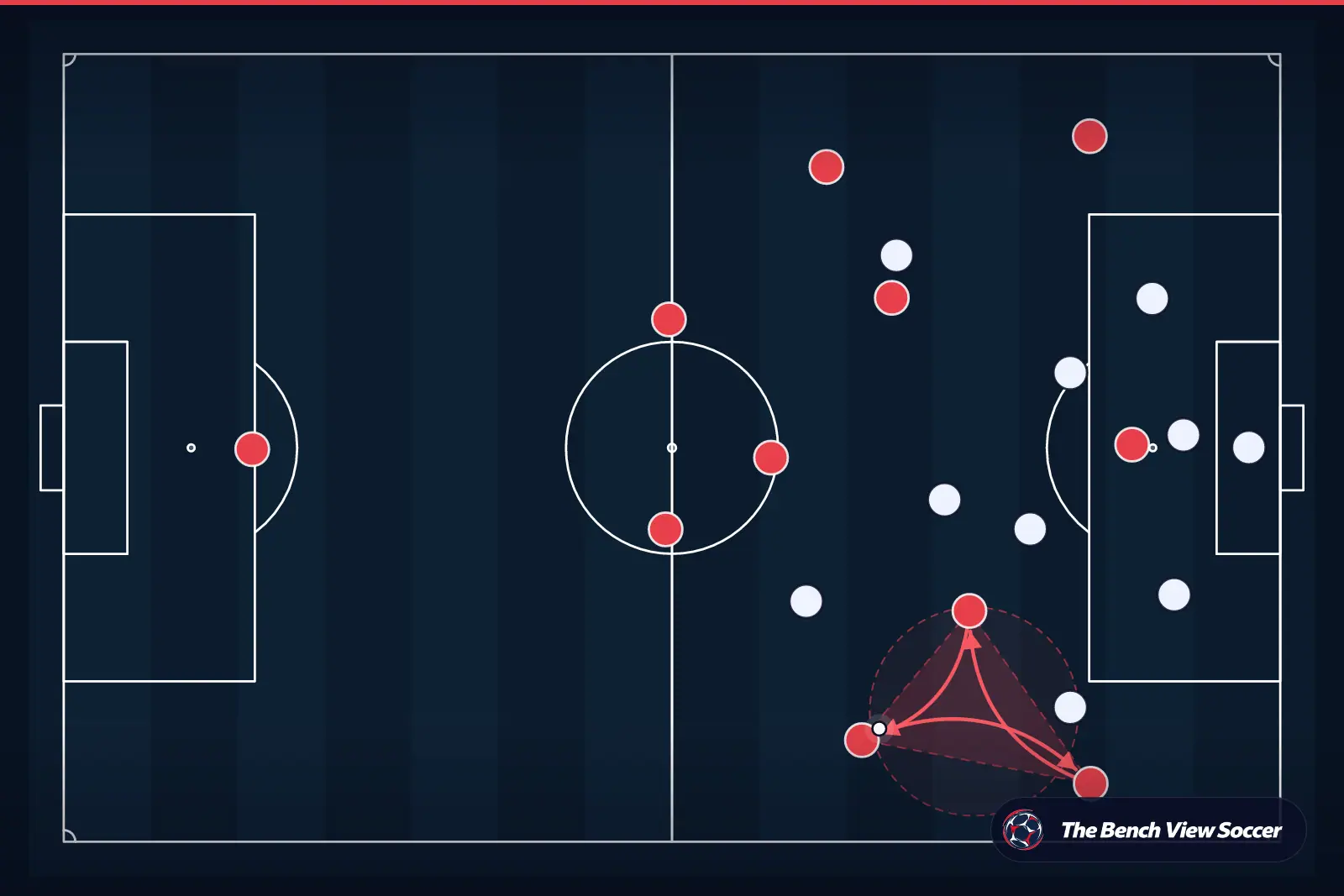
City’s rotations usually start from a stable base: a back line plus a “rest defence” (players positioned to stop counters) while others interchange ahead. In possession, City often forms a 3-2 or 2-3 build-up shape. For example, a full-back like John Stones (in 2022–23) steps into midfield next to Rodri, creating an extra passer in the centre. This draws an opposing forward or midfielder inside, which opens a pass to the wing or into the half-space. At the same time, Kevin De Bruyne, Bernardo Silva, or Phil Foden rotates into pockets behind the opponent’s midfield line. The key is timing: one player vacates a zone, another fills it quickly, so City keeps width and central presence. Rotations also manipulate marking styles. Against man-marking, switching positions forces defenders to either follow and break their shape or pass the mark on, which creates momentary confusion. Against zonal defending, rotations overload one side: City stacks two or three players in one channel, then releases a runner into the space created on the far side. Importantly, City’s wide player is not always a touchline winger; sometimes the “width” comes from a full-back (Kyle Walker) or a high-and-wide winger (Jack Grealish), while the other side tucks in. This constant reshuffling creates passing triangles everywhere, making it hard to block all routes at once.
Match Examples
A clear reference point is the 2022–23 Premier League season, when Guardiola regularly uses the Stones-inversion. In the 4–1 win over Arsenal at the Etihad (Premier League, April 2023), City’s rotations between Stones, Rodri, De Bruyne and Bernardo repeatedly open central lanes. Stones steps into midfield, Rodri holds, and De Bruyne drifts off Arsenal’s midfield shoulder; Arsenal’s press loses clarity about who jumps to the ball. The result is City finding vertical passes earlier, especially into De Bruyne and then into Erling Haaland’s runs. Another strong example is the UEFA Champions League semi-final second leg vs Real Madrid (May 2023, 4–0). City’s positional exchanges on the right side—Bernardo coming inside, De Bruyne moving between lines, and the right-sided defender supporting—pull Madrid’s midfield across. When Madrid collapses centrally, City switches to the far side to attack the space. The first two goals come from pressure and positioning that begins with City’s ability to occupy multiple lanes at once. A different stylistic test appears in the Champions League final vs Inter (June 2023). Inter defends in a compact 5-3-2, so City’s rotations aim less at “breaking a press” and more at creating tiny dismarks near the box. Ilkay Gündogan and Bernardo interchange to pull midfielders out, while wide players pin Inter’s wing-backs. Even when chances are fewer, City’s rotations keep them in control and eventually open the decisive passing lane for the goal.
Related Concepts & Skills
Training Implications
To train positional rotation like Manchester City, start with simple, repeatable movements. 1) Build a 5v5+2 possession game (two neutral players) in a rectangular grid. Assign roles: one “6” (Rodri role), two “8s,” two “wide players,” and a back-two. Rule: every 5th pass must be a pass into the central lane or half-space pocket. Coaching point: when one midfielder drops to receive, the other must push higher immediately to keep depth. 2) Add an “inverted full-back” trigger. In an 8v8 half-pitch game, instruct the right-back to step into midfield only after the centre-back has the ball and the winger stays wide. The objective is to create a 3-2 base and find a forward pass within three touches. Freeze play when spacing collapses and reset the distances: wide player on the touchline, one midfielder between lines, striker pinning centre-backs. 3) Practice third-man patterns with cones: CB to inverted FB, lay-off to CM, then a through pass to the winger or striker. Repeat on both sides so players learn mirrored rotations. 4) Add transition accountability: if the attacking team loses the ball, the nearest three players press for five seconds while the rest recover into a 2–3 rest-defence shape. This teaches why rotation must be paired with counter-pressing discipline. Keep language simple in sessions: “vacate,” “fill,” “pin,” and “switch,” and measure success by how often the team finds a free receiver facing forward.
The Bench View app
Don’t just read football — train it
Everything you read here, turned into training you can follow step by step.
Physical training at home
AI daily sessions adapted to your level and position. No equipment needed.
Tactical training courses
Step-by-step courses on positioning, pressing, build-up and decision making.
- 7 days free
- No commitment
- Cancel anytime
Free account: 2 physical sessions + the first tactical course. PRO: 7-day free trial — cancel before day 8 and you pay nothing.