Introduction
Real Madrid’s counter-attacking is not just “running fast”; it is a repeatable pattern built on structure, timing, and ruthless finishing. Under Carlo Ancelotti, especially in the Champions League years when Madrid often faces elite pressing teams, the counter becomes a way to punish opponents for committing numbers forward. Fans who watch La Liga or UEFA Champions League nights will notice three recurring scenes: a quick regain, one early forward pass (often long), and multiple runners arriving at different speeds. The goal is simple: reach the opponent’s box before their defensive shape resets. Madrid’s counters also feel calm rather than chaotic—players know which lanes to occupy, who attacks the space behind the full-back, and who holds a central position for the final pass. This article breaks down how Madrid triggers the counter, the roles of key profiles (like Vinícius Júnior, Rodrygo, Federico Valverde, Jude Bellingham and Toni Kroos), and why their finishing looks so “inevitable” when the transition is executed well.
How It Works
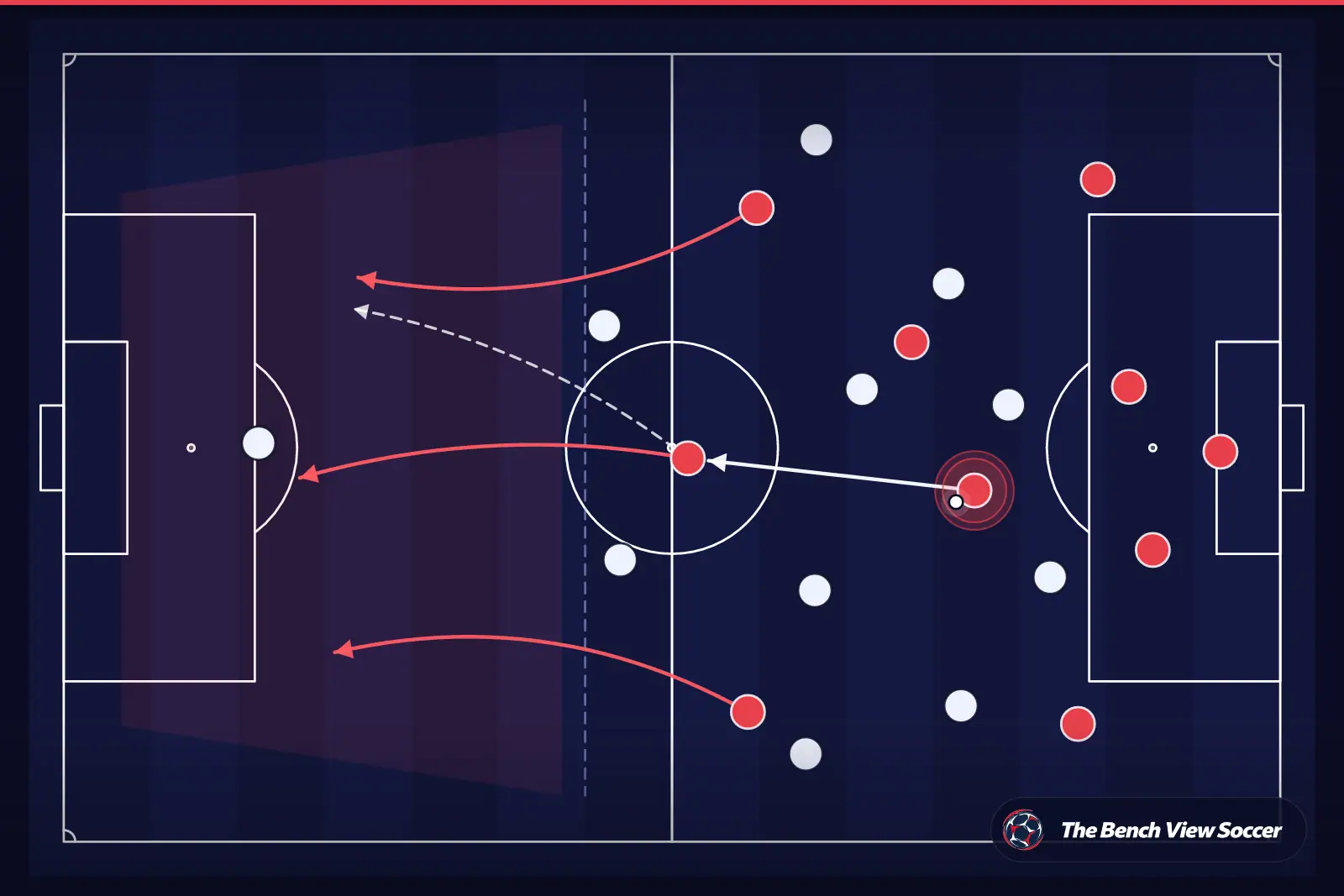
Real Madrid’s counter starts with the moment of transition: when they win the ball, they immediately look forward, not sideways. The first key idea is “verticality” (progressing quickly towards goal). If the opponent’s midfield line is open, Madrid plays a fast pass into the striker’s feet or into the space behind. If the opponent squeezes central areas, Madrid switches to long diagonal balls toward the wings—especially to the left side where Vinícius attacks the channel outside the centre-back and inside the full-back. The second idea is coordinated transition runs. One runner stretches depth (Vinícius or Rodrygo), one runner supports underneath for a layoff (Bellingham, Brahim Díaz, or a midfielder), and one runner arrives late to finish (often Valverde or Bellingham). This creates different “arrival times” in the box, making it hard for defenders to mark. Ancelotti’s Madrid also uses a deliberate first pass choice. If Toni Kroos plays, he often acts as the counter’s launchpad with long, accurate diagonals. If Kroos is not on the pitch, Madrid still looks for the same outcome through Aurélien Tchouaméni, Luka Modrić, or even a centre-back stepping in. The third idea is spacing: the wide player holds width early to pull the opponent’s full-back away, while the central attacker occupies the nearest centre-back to prevent easy covering. The final part is finishing behaviour: Madrid prefers high-value shots after the defence is unbalanced—cutbacks to the penalty spot, low crosses across the six-yard box, or a simple square pass for a tap-in. When the counter is not “on,” Madrid slows down and recycles, but when they see an opponent’s rest-defence (the players left behind to stop counters) is weak, they accelerate instantly.
Match Examples
A clear example comes from the 2021–22 UEFA Champions League semi-final second leg: Real Madrid vs Manchester City at the Santiago Bernabéu (May 2022). Pep Guardiola’s City pushes numbers high to control the game, but Madrid’s best moments come when they break City’s structure. Vinícius repeatedly threatens the space behind the right side, and Madrid’s midfield looks for early forward passes rather than long possessions. Even when City seems in control, Madrid’s transition threat forces City’s back line to defend facing their own goal, which is a nightmare against fast wingers. Another strong reference is the 2023–24 UEFA Champions League semi-final first leg: Real Madrid vs Bayern Munich (April 2024), when Bayern under Thomas Tuchel attacks aggressively and uses advanced full-backs. Madrid’s counter pattern shows up through quick releases into the channels and runners arriving into central finishing zones. Vinícius’ ability to sprint into depth and then finish or square the ball highlights how Madrid turns one regained ball into a high-quality chance. In La Liga 2023–24, Real Madrid vs Barcelona at the Bernabéu (El Clásico, October 2023) also illustrates the idea. Barcelona under Xavi often builds with many players ahead of the ball, and Madrid looks to exploit the space behind. Jude Bellingham’s role is important: he does not only run in behind; he also arrives late at the edge of the box, which is a classic counter-attacking finishing zone because defenders are retreating and lose track of runners. Across these matches and seasons, the common thread is consistent: Madrid uses the opponent’s attacking commitment as an invitation to attack the open grass, and they rely on elite decision-making in the final pass rather than taking low-percentage shots early.
Related Concepts & Skills
Training Implications
To train counter-attacking like Real Madrid, focus on repeatable patterns rather than just sprinting. Start with a 6v4 transition game: six attackers build an attack, and when the four defenders win the ball, they have 8 seconds to score on a mini-goal or full goal. Coaching point: the first pass must be forward unless clearly blocked. Next, add “lane rules” to teach spacing: one wide runner must stay outside the touchline channel, one central runner stays between the centre-backs, and one late runner starts behind the ball and arrives at the top of the box. This recreates Madrid’s different arrival times. For long-ball counters, run a drill where a deep playmaker (your “Kroos role”) receives under light pressure and must hit a diagonal to a winger making a curved run. The winger has two touches maximum before either shooting or cutting back. Coaching point: the run starts when the passer’s head lifts, not when the ball is kicked. For finishing, include a “cutback zone” finishing circuit: wingers reach the byline and cut back to the penalty spot, where two players attack different depths (one near-post, one penalty spot). Score only counts if the shot is first-time, forcing quicker decisions like in real transitions. Finally, teach decision-making with video feedback: after training, clip five counters and ask players to label the moment they should accelerate versus recycle. The key actionable habit is scanning—before receiving, players check where the opponent’s full-back and nearest midfielder are, so the first touch already points toward the open space. Over time, this builds the calm, clinical transition play that Madrid shows in big games.
The Bench View app
Don’t just read football — train it
Everything you read here, turned into training you can follow step by step.
Physical training at home
AI daily sessions adapted to your level and position. No equipment needed.
Tactical training courses
Step-by-step courses on positioning, pressing, build-up and decision making.
- 7 days free
- No commitment
- Cancel anytime
Free account: 2 physical sessions + the first tactical course. PRO: 7-day free trial — cancel before day 8 and you pay nothing.