Introduction
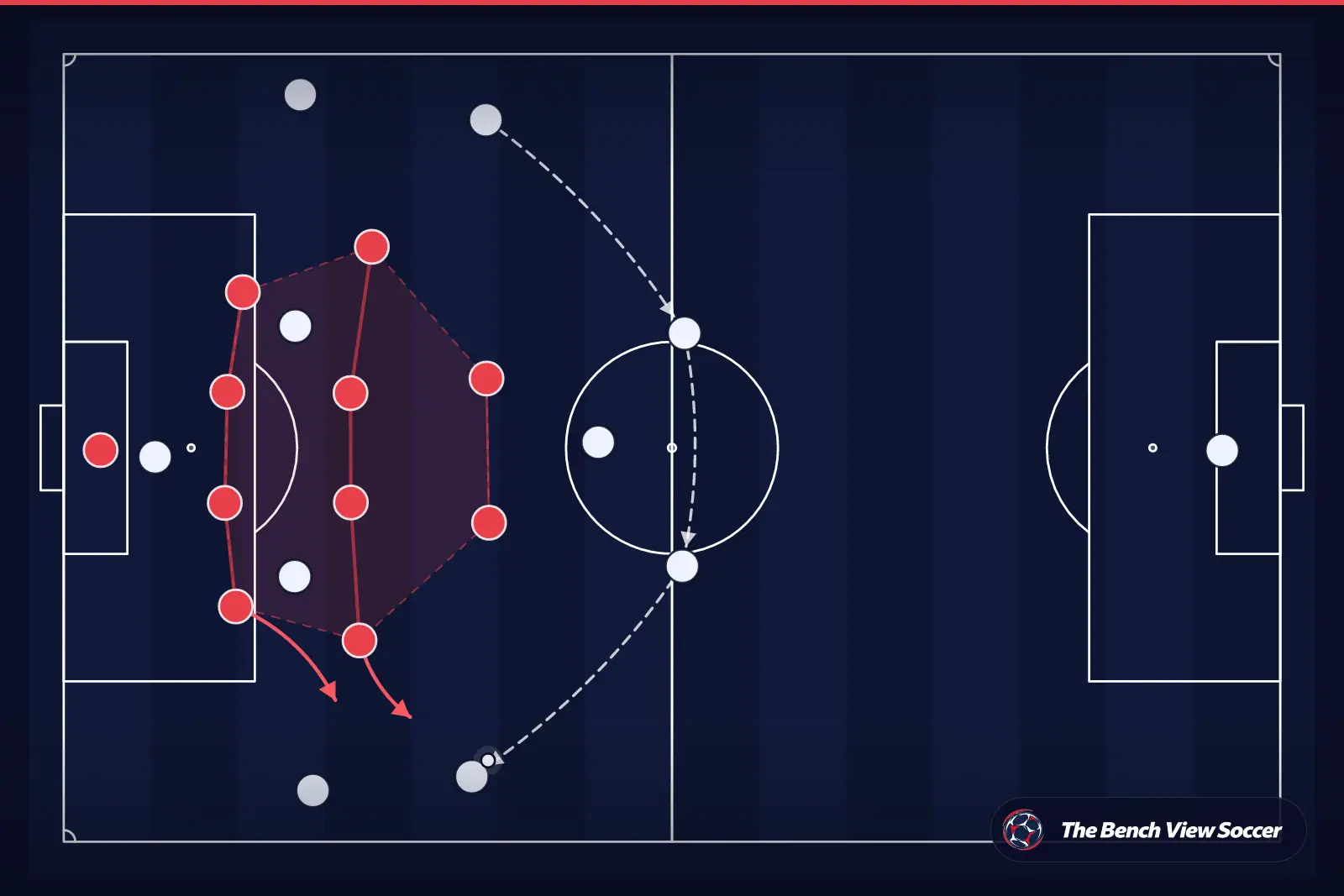
When teams face Real Madrid, especially in the UEFA Champions League or high-stakes La Liga games, the default defensive response is often the same: sit deep, crowd the centre, and protect the penalty box. Fans watching these matches will recognise the “packed defence” look—two tight lines, minimal space between players, and very few gaps to pass through. Real Madrid’s solution under Carlo Ancelotti is not only about individual brilliance from Vinícius Júnior, Jude Bellingham, or Rodrygo. A key collective method is the third-man run: a coordinated movement where the player who ultimately receives the ball is neither the passer nor the initial target, but a third teammate who arrives at the right time. This matters because deep blocks are designed to stop direct passes into the striker or the attacking midfielder. Third-man patterns create a new passing lane by using a quick bounce pass, drawing out a defender for a split second, and then exploiting the space that opens. It is a simple idea that becomes deadly when executed at Madrid’s tempo.
How It Works
A third-man run works like this: Player A has the ball, Player B shows to receive (often with his back to goal), and Player C makes a timed run into the space that appears once defenders react to B. Importantly, A often cannot pass directly to C because the lane is blocked by the packed defence. So A plays into B, B “sets” the ball (a short return or sideways touch) to release A or another passer, and then C attacks the gap. Real Madrid use this in several zones. In the half-space (the channel between the wing and the centre), Bellingham or Rodrygo acts as Player B, taking a defender’s attention. Vinícius or a full-back like Dani Carvajal becomes Player C, sprinting beyond the line. Madrid also do it centrally: the striker (often Joselu in 2023–24 or a rotating forward) pins centre-backs as Player B, while Bellingham arrives late as Player C into the “second line” space around the penalty spot. The key tactical detail is timing: C moves as the ball travels into B, not earlier. If C runs too soon, the defence simply passes him on. If he runs too late, the window closes. Ancelotti’s Madrid also vary the “set” pass: sometimes B plays one-touch back to A; sometimes B cushions sideways to Toni Kroos or Luka Modrić to change the angle. That angle change is crucial because a compact block is strongest when the ball stays on one vertical line. The third-man pattern forces defenders to turn their body, shift laterally, and briefly lose their perfect spacing.
Match Examples
In the 2023–24 UEFA Champions League semi-final second leg (Real Madrid vs Bayern Munich at the Santiago Bernabéu), Madrid repeatedly target Bayern’s compact shape by using bounce passes around the right half-space. When Bayern protect the centre and delay transitions, Madrid still generate entry moments by having a forward check short to receive while a runner attacks the space behind. Even when the final goal action comes from chaos and second balls, the underlying method Madrid keep returning to is the same: create a receiver who is not the obvious first target, then enter the box with runners arriving after the defence has shifted. Another clear reference is the 2023–24 La Liga Clásico (Real Madrid vs Barcelona at the Bernabéu, Madrid’s 3–2 win). Barcelona defend with aggressive midfield pressure but still collapse into the box when Madrid reach crossing zones. Madrid’s equalising and winning moments come from late arrivals and delayed runs—classic third-man behaviour—where the runner is not the first pass option but appears at the decisive moment in the area. Finally, look at the 2021–22 UEFA Champions League run under Ancelotti, especially the knockout ties where opponents defend deep after taking a lead. Madrid’s comebacks feature patterns where Karim Benzema drops to link (as the “second man”), and runners from wide or midfield attack the newly opened lane (the “third man”). Across these seasons, the repeated lesson is that Madrid do not rely only on dribbling past set lines; they use coordinated, timed movements to make the block move first, then exploit the movement.
Related Concepts & Skills
Training Implications
To train third-man runs in an actionable way, start with simple, repeatable patterns and add defenders gradually. Drill 1 (Triangle Set-and-Go): set up three cones in a triangle (A, B, C) about 10–15 metres apart. A passes to B, B plays one-touch back to A, and C starts his run as the ball travels to B, then receives A’s next pass in stride. Rotate roles every 2 minutes and insist on scanning—C must look over his shoulder before running so he knows which side to receive on. Drill 2 (Half-space Channel Game): mark a wide channel and a half-space channel on each side using cones. Play 5v5 with two neutral midfielders. A goal counts only if it comes from a third-man action: pass into a checking player, set pass, then a runner receives beyond a line of cones. This forces players to recognise timing rather than forcing dribbles. Drill 3 (Box Arrival Finishing): use a wide server (like a winger), a “link” player at the top of the box, and two runners starting outside the area. The server plays into the link, the link sets, and one runner attacks the penalty spot while the other attacks the far post—finish first time. Coach the key detail: the runner moves on the pass into the link, not after the set. For teams in India training on smaller pitches, reduce distances but keep the principle: quick set, angle change, and late arrival. Finally, add a rule in your small-sided games: every attack must include one bounce pass before a shot. That single constraint increases players’ habit of using the second man to release the third man.
The Bench View app
Don’t just read football — train it
Everything you read here, turned into training you can follow step by step.
Physical training at home
AI daily sessions adapted to your level and position. No equipment needed.
Tactical training courses
Step-by-step courses on positioning, pressing, build-up and decision making.
- 7 days free
- No commitment
- Cancel anytime
Free account: 2 physical sessions + the first tactical course. PRO: 7-day free trial — cancel before day 8 and you pay nothing.