Introduction
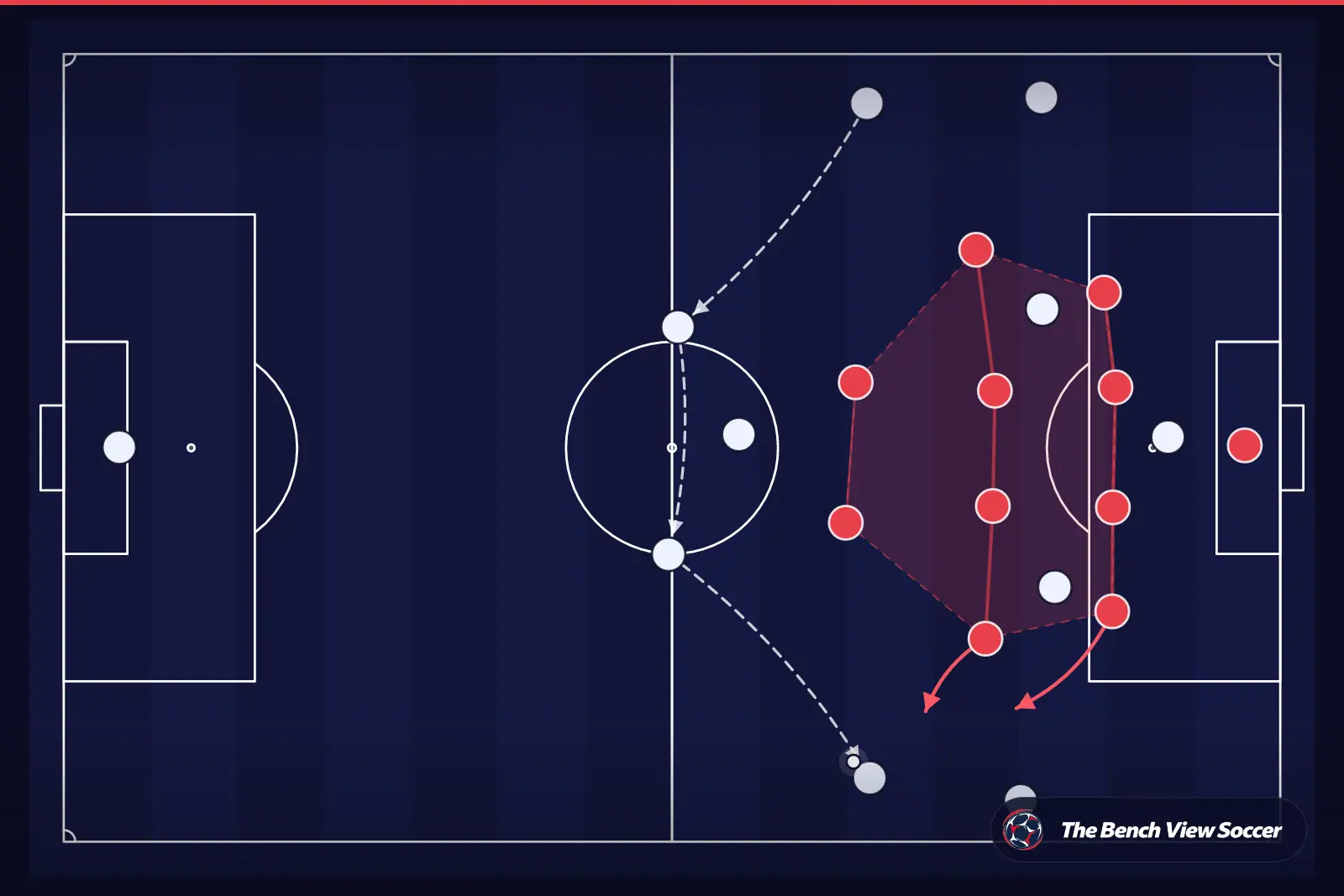
A “deep block” is when a team defends very close to its own penalty box, often with 9–10 players behind the ball. For fans new to European tactics, it can look like the attacking team is “just passing around” with no end product. But breaking a deep block is one of the hardest problems in football because space disappears: the centre is crowded, shooting lanes are blocked, and counter-attacks become the defender’s main weapon. This is why elite coaches spend so much time designing patterns to move defenders, not just the ball. Two great modern references are Mikel Arteta’s Arsenal in the Premier League and Carlo Ancelotti’s Real Madrid in La Liga and the UEFA Champions League. They solve the same problem in different ways: Arsenal often uses structured positioning and repeated rotations to create high-quality chances, while Real Madrid often uses individual “fixing” (drawing defenders) plus sudden accelerations from world-class dribblers and passers. Understanding these methods helps you read matches better and see the hidden battles in tight games.
How It Works
To break a deep block, an attacking team must do three things at the same time: stretch the defence horizontally (make it wide), pin it vertically (keep defenders worried about runs behind), and create a free player between lines. Arsenal under Mikel Arteta typically builds with a stable “rest defence” (players positioned to stop counters) and then attacks with controlled spacing. The full-backs may invert into midfield or hold wide depending on the opponent. Arsenal’s wingers stay high to pin the opposition full-backs, while a midfielder (often Martin Ødegaard) occupies the right half-space, receiving on the turn or playing quick one-twos. A key idea is “third-man” play: Player A passes to Player B, who lays it off, and Player C runs onto it—this avoids a defender who is tight to the receiver. Arsenal also uses cut-backs: instead of crossing high into tall centre-backs, they reach the byline and pass backwards to a shooter arriving late. Real Madrid under Carlo Ancelotti often keeps structure but allows more freedom in the final third. When the opponent sits deep, Madrid tries to create isolation on a wing: Vinícius Júnior or Rodrygo faces a defender 1v1, while Jude Bellingham or Federico Valverde makes a late run into the box. Madrid’s deep-block solution frequently combines “fix and release”: one player dribbles to attract two defenders (fix), then releases the ball to a teammate now free. Luka Modrić and Toni Kroos (especially in recent seasons) manipulate the block with disguised passes and switches of play—moving the ball from one side to the other quickly so the defensive line shifts and gaps appear. Both clubs also use set plays as a deep-block tool: corners and free-kicks punish teams that defend deep but concede many dead-ball situations.
Match Examples
Arsenal’s 2023–24 Premier League home match vs Liverpool (2–1, February 2024) is a useful example of how Arteta’s side attacks a compact opponent. Liverpool does not sit in a pure low block for 90 minutes, but when they drop into a deeper shape, Arsenal still shows the key principles: wingers stay high to stretch the back line, Ødegaard operates between the lines to connect, and Arsenal targets the space around the penalty spot with cut-backs and second-phase attacks. The winning moments also underline another deep-block lesson: even structured teams benefit from pressing to create “broken” defensive moments, because a deep block is hardest to break when the opponent is perfectly set. For Real Madrid, the 2023–24 UEFA Champions League semi-final second leg vs Bayern Munich at the Santiago Bernabéu (2–1, May 2024) illustrates how Ancelotti’s team handles late-game deep defending. Bayern protects the box and tries to defend crosses and central entries. Madrid responds by increasing box occupation (more runners), sustaining pressure through quick recoveries, and attacking the goalmouth with repeated deliveries and rebounds. Joselu’s late goals come from persistence in the area, showing that against a deep block you often need second balls, not just “perfect” shots. Another clean reference is Real Madrid vs RB Leipzig in the 2023–24 Champions League round of 16 (both legs). Leipzig defends deep for stretches, and Madrid relies on Vinícius’s ability to fix defenders and create a free teammate, plus midfield control to keep the opponent pinned. These matches show two pathways: Arsenal prefers rehearsed combinations to open lanes; Madrid mixes structure with individual unpredictability and relentless penalty-box pressure.
Related Concepts & Skills
Training Implications
For coaches, amateur players, and fans who play weekend football in India, you can train deep-block solutions with simple, repeatable constraints. First, run a 7v7 or 8v8 game where the defending team must keep all players inside a marked “low block” zone (for example, the width of the box and 10–15 metres outside it). The attacking team scores only from cut-backs or shots from the edge of the box, forcing players to value byline access and late arrivals rather than hopeful crosses. Second, add a rule that one attacker must stay wide on each side until the ball enters the final third; this teaches horizontal stretching like Arsenal’s wingers. Third, coach “fix and release” by setting up 2v2 + 2 neutral players on the wing: the dribbler must attract a second defender before passing to the free neutral—this replicates Real Madrid’s isolation attacks. Fourth, dedicate 15 minutes to switch-of-play practice: two-touch passes from one flank to the other through a central pivot, then an immediate forward action (cross, cut-back, or through pass). Time the switch and the next action; don’t let it become slow circulation. Finally, rehearse set-piece routines: one near-post run, one screen, and one edge-of-box shooter. Against a deep block, dead balls are not “extra”—they are a main route to goals.
The Bench View app
Don’t just read football — train it
Everything you read here, turned into training you can follow step by step.
Physical training at home
AI daily sessions adapted to your level and position. No equipment needed.
Tactical training courses
Step-by-step courses on positioning, pressing, build-up and decision making.
- 7 days free
- No commitment
- Cancel anytime
Free account: 2 physical sessions + the first tactical course. PRO: 7-day free trial — cancel before day 8 and you pay nothing.