Introduction
Vertical pass lanes are the “highways” that let a team move the ball forward through the middle, not just around the outside. When Manchester City under Pep Guardiola dominates matches in the Premier League or the UEFA Champions League, it is not only because they keep possession, but because they repeatedly create clear, safe forward passing options that break lines. For many fans, it can look like City simply pass a lot—yet the real story is structure: where players stand, how they move defenders, and how they prepare the next pass before they even receive the ball. A vertical lane is created when the player on the ball can see a teammate between opposition lines (for example, between midfield and defence) with a pass that is not easily intercepted. City’s patterns are a useful teaching tool because they are consistent across seasons and opponents, whether it is against Liverpool under Jürgen Klopp, Arsenal under Mikel Arteta, or Real Madrid in the Champions League.
How It Works
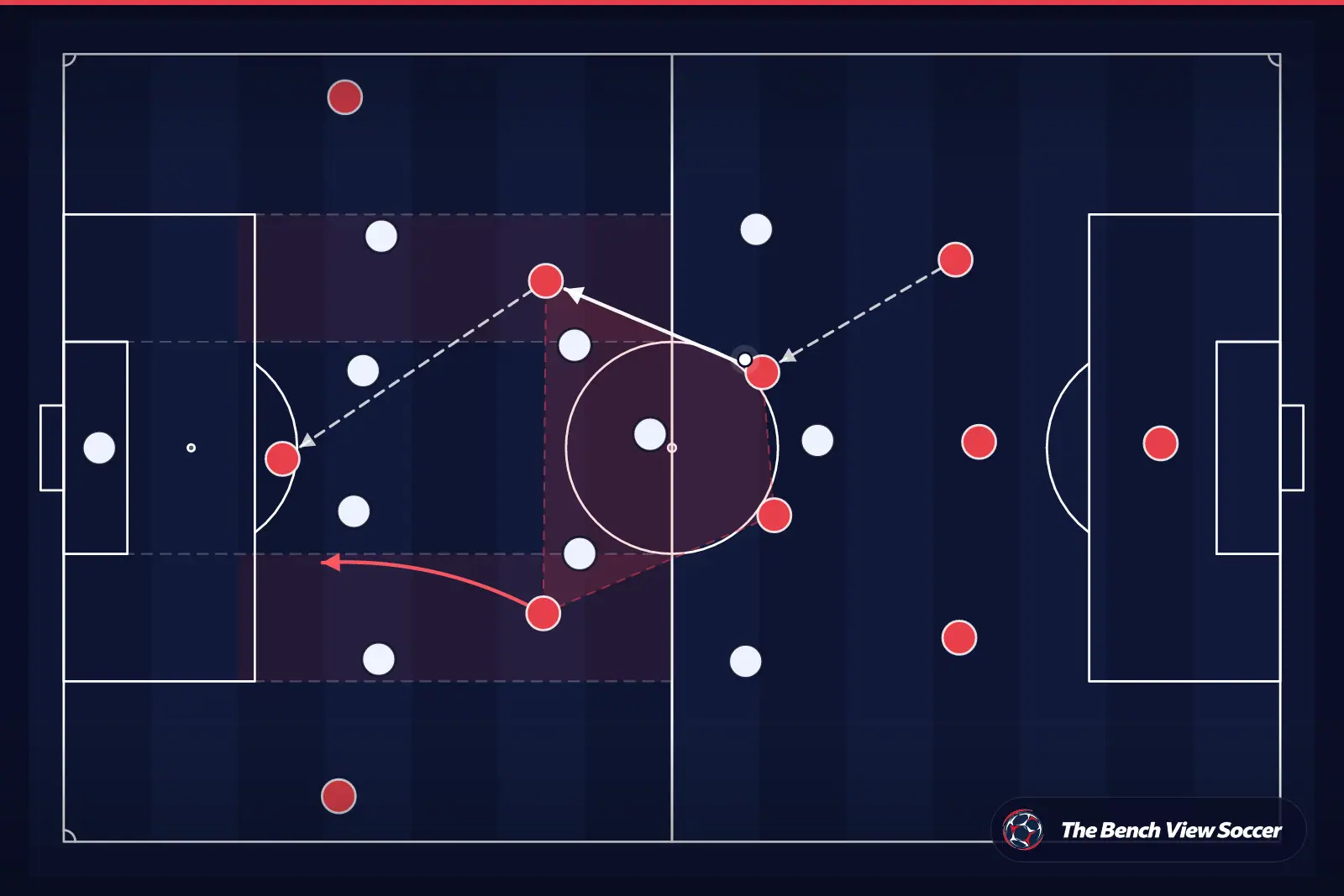
Manchester City create vertical pass lanes through spacing, rotation, and “fixing” defenders. First, they build a stable base in the first phase: a goalkeeper like Ederson plus two centre-backs split wide, while a holding midfielder (Rodri) positions to offer a forward-facing pass. This shape invites the opponent’s first press. City then manipulate that press by placing players on different “lines”: defenders on the first line, midfielders on the second, and attackers on the third. The key is that City rarely stand in a straight vertical column; they stagger their positions so one player is slightly higher, another slightly wider, making it hard for one defender to cover both. To open a lane, a winger (like Jérémy Doku) stays wide to pin the full-back, while a midfielder (like Kevin De Bruyne or Bernardo Silva) drifts into the inside channel to pin the opposition midfielder. With those defenders occupied, a pocket opens between them. City also use third-man combinations: Player A passes to Player B with pressure, and Player B immediately lays it off to Player C who is facing forward. This is how City “break” a midfield line without forcing a risky pass. Finally, they use overload-to-isolate: they gather many players on one side to attract opponents, then switch quickly to a free player on the far side, creating a new vertical lane because the defence shifts late.
Match Examples
A clear example appears in the 2022–23 UEFA Champions League semi-final second leg: Manchester City vs Real Madrid at the Etihad. City create repeated vertical lanes into the right half-space by keeping Jack Grealish wide on the left to hold Dani Carvajal, while Bernardo Silva and Kevin De Bruyne operate between Madrid’s midfield and defence. Rodri stays central as the anchor, allowing the centre-backs to step forward and draw pressure from Madrid’s first line. The key pattern is the third-man: a pressured pass goes into De Bruyne, who sets it back, and the next pass immediately finds a free runner between lines. Another useful reference is Arsenal vs Manchester City in the Premier League 2023–24 at the Etihad, where Arsenal defend with a compact mid-block. City respond by placing Rodri and John Stones in positions that tempt Arsenal’s midfielders to jump out. As soon as an Arsenal midfielder steps, City play behind him into the space, often targeting Phil Foden or Bernardo in the inside channel. You also see it in Manchester City vs Liverpool in the Premier League 2022–23 at the Etihad: Liverpool’s aggressive press tries to block central lanes, so City use wide “bait” passes, then quickly find a vertical pass into the feet of an interior midfielder once Liverpool’s midfield line shifts a step too far. Across these games, the principle stays the same: occupy defenders, create a staggered receiving option, and time the forward pass when the opponent is moving, not set.
Related Concepts & Skills
Training Implications
For coaches, amateur teams, and even viewers trying to “see” tactics live, the best approach is to train the habits that create vertical lanes rather than memorising one pattern. Start with a 4v4+3 rondo (four vs four with three neutral players) in a rectangle: condition it so a goal counts only when the ball is played from one end zone to the other through a central neutral player. This teaches players to look for a forward-facing receiver between lines. Next, add a “third-man” constraint: the pass that breaks the line must be the second pass in a sequence (A→B→C), not a direct risky pass. This builds timing and scanning. For team training, run an 8v6 build-up drill: eight attackers build from a goalkeeper against six pressers. Mark two vertical corridors in the middle and reward entries into those corridors only if the receiver is on the half-turn (body open to play forward). Coach specific cues: the far winger stays wide to pin the full-back; the near interior midfielder checks away then checks in; the holding midfielder stays available behind the ball as a reset. Finally, for matchday application, give players three simple rules: (1) always keep a stagger—never stand on the same horizontal line as your nearest teammate, (2) if you cannot play forward, play to a teammate who can face forward next, and (3) after every pass, move to either open a lane (create an angle) or occupy a defender (pin him). These are actionable, repeatable behaviours that mirror how Guardiola’s City create vertical access without forcing low-percentage passes.
The Bench View app
Don’t just read football — train it
Everything you read here, turned into training you can follow step by step.
Physical training at home
AI daily sessions adapted to your level and position. No equipment needed.
Tactical training courses
Step-by-step courses on positioning, pressing, build-up and decision making.
- 7 days free
- No commitment
- Cancel anytime
Free account: 2 physical sessions + the first tactical course. PRO: 7-day free trial — cancel before day 8 and you pay nothing.