Introduction
A “false nine” looks like a striker on the team sheet, but on the pitch he drops into midfield to manipulate the defence. Fans often first notice it through Lionel Messi at Barcelona under Pep Guardiola, but it shows up in many modern teams: Roberto Firmino for Liverpool under Jürgen Klopp, Harry Kane at Tottenham and later for Bayern München, or Kai Havertz and Gabriel Jesus when asked to connect play rather than live on the shoulder of the last defender. The problem for defenders is simple: if the centre-back follows the dropping striker, space opens behind for wingers to run through; if the centre-back holds his line, the false nine receives between the lines and turns to create. This article explains the most common tactical solutions teams use against deep No.9s, why those solutions work, and what trade-offs they create. The aim is to help you watch matches in the UEFA Champions League, Premier League, La Liga, Serie A, and Bundesliga with clearer “why did the defence do that?” answers.
How It Works
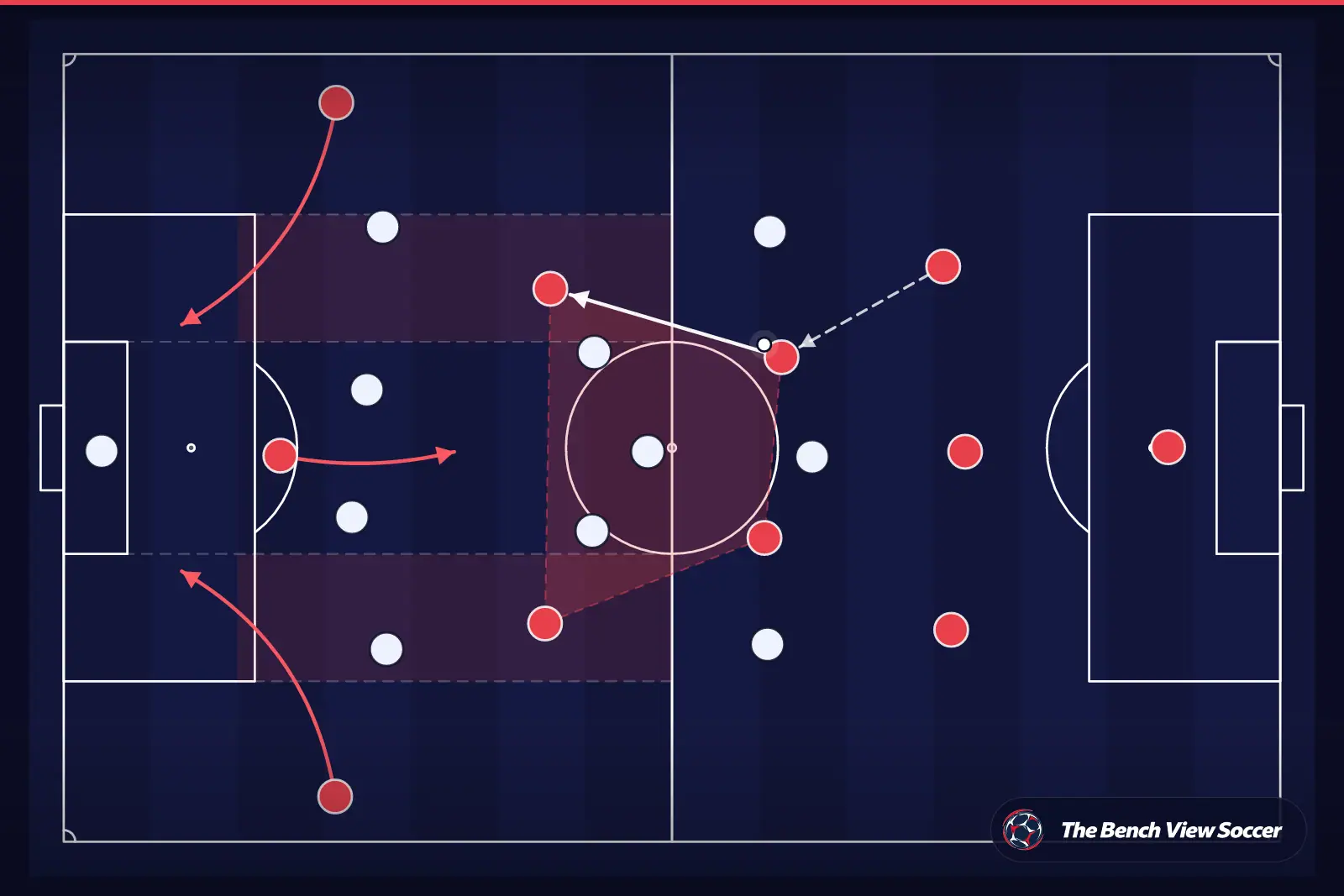
Teams usually defend a false nine through three broad solutions: “pass him on,” “track him,” or “box him in.” 1) Pass him on: the centre-backs keep their line, while a defensive midfielder (the No.6) steps up when the false nine drops. This protects the space in behind and keeps the back four stable, but it requires great timing and communication so the No.6 does not leave a hole in front of the defence. Manchester City under Pep Guardiola often faces this, so opponents try to keep their centre-backs deep and let a midfielder engage City’s dropping forward. 2) Track him: a centre-back follows the false nine into midfield. This can kill the false nine’s ability to turn, but it risks opening the channel behind that defender—especially the “half-space” between full-back and centre-back—so the defending team must cover quickly with the other centre-back sliding across and the full-back tucking in. 3) Box him in: rather than one marker, teams create a small “cage” using a centre-back behind and two midfielders around, forcing the false nine to receive facing his own goal. In all three approaches, a key detail is controlling the runners: false nines are dangerous not only because they drop, but because they trigger winger and midfielder runs beyond them. Good defending therefore treats the false nine as a decoy and prioritises protecting the space behind the line while still preventing easy turns between the lines.
Match Examples
A classic reference is the 2010–11 UEFA Champions League semi-final, Barcelona vs Real Madrid, when Pep Guardiola uses Messi as a false nine and José Mourinho’s Madrid defends with extreme compactness. Real Madrid often keeps the centre-backs deeper and crowds central lanes, aiming to stop Messi receiving cleanly between the lines and to block the immediate through pass to wide runners like Pedro or David Villa. Another clear example appears in the 2018–19 UEFA Champions League semi-final, Liverpool vs Barcelona. With Firmino injured, Liverpool still defends a Barcelona side where Messi frequently drops to connect; Klopp’s team uses aggressive pressure from midfield and closes the central pocket quickly, while the back line stays ready to defend the run in behind rather than chasing Messi too far. In the Premier League, Manchester City vs Liverpool during the 2017–18 and 2018–19 seasons often shows a practical “pass him on” approach: when City’s central forward drops, Liverpool’s centre-backs tend to hold their line while midfielders step in to contest the receive, and Liverpool’s wingers track inside to help block central passes. In La Liga, Atlético Madrid under Diego Simeone frequently demonstrates the “box him in” method against deep forwards: the striker may get touches, but he gets them with pressure from multiple angles, limiting the next pass and keeping Atlético’s back line protected.
Related Concepts & Skills
Training Implications
To prepare a team to defend a false nine, training must build communication, spacing, and decision-making under pressure. Start with a 6v6+2 neutral possession game in a 30x25 metre area: designate one attacker as the “false nine” who is only allowed to receive in a central pocket. Coach the defenders’ rule: centre-backs hold the line unless a clear trigger happens (bad touch, back to goal, or no nearby cover), while the No.6 steps in to engage. Add a scoring condition: attackers score by playing into the false nine and then finding a run behind within three passes; defenders score by forcing a backward pass or winning the ball. Next, run a back-four plus two midfielders vs front three plus two midfielders drill. Freeze play when the false nine drops: ask, “Who presses? Who covers the half-space? Who tracks the runner?” Rotate roles so centre-backs and midfielders learn each other’s responsibilities. Finally, include a transition element: after a regain, defenders have five seconds to find a forward pass, because false-nine teams often counter-press immediately. Concrete coaching points: keep the back line connected (no big gaps between centre-backs), the No.6 checks shoulders before stepping, full-backs tuck in early when a centre-back steps out, and the near-side winger tracks inside to block the return pass into the false nine. Record the session and review two clips: one where the false nine turns freely, one where he is forced back—make players explain the difference in spacing and timing.
The Bench View app
Don’t just read football — train it
Everything you read here, turned into training you can follow step by step.
Physical training at home
AI daily sessions adapted to your level and position. No equipment needed.
Tactical training courses
Step-by-step courses on positioning, pressing, build-up and decision making.
- 7 days free
- No commitment
- Cancel anytime
Free account: 2 physical sessions + the first tactical course. PRO: 7-day free trial — cancel before day 8 and you pay nothing.