Introduction
For many fans, the word “winger” still brings to mind a fast dribbler who stays wide and crosses. But the modern game, especially in the Premier League and Champions League, often flips that picture. The “inverted winger” starts on the flank but attacks inside, usually onto their stronger foot. Mohamed Salah at Liverpool under Jürgen Klopp and Bukayo Saka at Arsenal under Mikel Arteta are two of the clearest examples: both begin wide to stretch the defence, then drive into central scoring zones. This role matters because it changes how a team creates chances. Instead of relying only on crosses, inverted wingers combine through the half-space (the channel between full-back and centre-back), shoot from better angles, and open space for overlapping full-backs. Understanding this position also helps you read matches: you start spotting why a full-back hesitates, why a centre-back steps out, and why the same player can look “quiet” for 20 minutes before deciding a game with one inside run.
How It Works
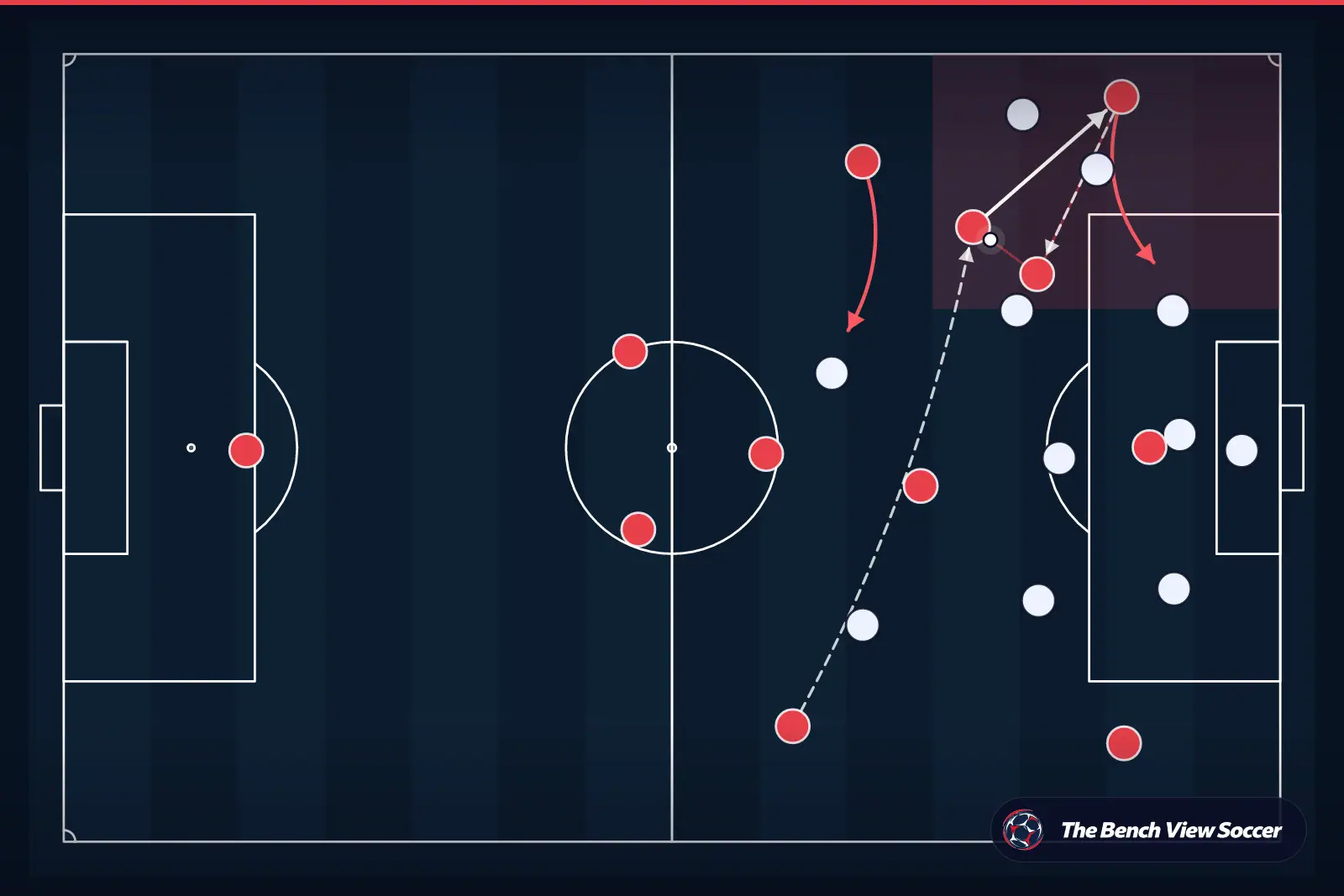
An inverted winger is usually deployed on the “opposite” side to their stronger foot: a left-footed player on the right wing (like Saka) or a right-footed player on the left wing (like Salah). The key idea is simple: they receive wide, then cut inside to pass, combine, or shoot. Tactically, they create three main threats. First, they attack the inside channel to get closer to goal, so their shots come from better locations than traditional wide angles. Second, they overload the half-space: when the winger drifts inside, they can form triangles with the striker and a midfielder (often an attacking midfielder or a number 8), which helps quick one-touch combinations. Third, they manipulate defenders: if the opposing full-back follows inside, the flank opens for an overlapping full-back (Trent Alexander-Arnold at Liverpool, Ben White at Arsenal). If the full-back stays wide, the winger gets room to turn into the box. In possession, the inverted winger often starts “touchline wide” to stretch the back line, then times the inward movement when the ball travels or when a teammate pins the full-back. Out of possession, many elite teams ask them to press: they curve their run to block passes into midfield while still hunting the full-back. The role is not just about dribbling; it is about timing, body shape (receiving on the back foot so you can face inside), and decision-making in tight spaces.
Match Examples
Liverpool’s 2017-18 Champions League run offers a clear Salah blueprint. In the semi-final first leg vs Roma (Anfield, April 2018), he repeatedly starts wide on the right, then drives into the inside-right lane to shoot or slip passes behind the line. His first goal comes from an inside movement onto his left foot, finishing into the far corner—classic inverted winger execution: wide starting point, inside reception, quick shot across goal. Another instructive reference is the 2021-22 Premier League season, where Liverpool often uses Alexander-Arnold’s advanced positioning to hold width on the right at times, letting Salah operate closer to the box; Salah still begins wide to isolate the full-back, then attacks the space between full-back and centre-back when the midfield finds him early. For Saka, Arsenal’s 2022-23 Premier League season under Arteta shows a more structured version. In Arsenal vs Manchester United (Premier League, January 2023 at the Emirates), Saka receives on the right touchline, then repeatedly carries inside to shoot or combine with Martin Ødegaard. His equaliser is a signature pattern: he comes inside onto his left foot and hits a curling shot that defeats David de Gea. In the 2023-24 Champions League group stage, Arsenal’s right side also highlights how Saka’s inward threat creates “two-way” problems: when defenders protect the inside, he can slip the ball wide for an overlap, and when they protect the outside, he attacks the half-space. Across these examples, the common thread is not just goals—it is how the inverted winger forces constant defensive doubt: step out and leave space, or hold position and allow a dangerous inside angle.
Related Concepts & Skills
Training Implications
To train as an inverted winger, focus on repeatable actions rather than flashy highlights. First, build a “receive wide, play inside” habit: set up a cone lane on the touchline, receive a pass with your back foot (right wing: receive on left foot to face inside), take one touch forward, then decide between three options in under two seconds—(a) dribble inside past a mannequin, (b) slip a pass to a central target, or (c) shoot into the far corner. Track success rate and time-to-decision each session. Second, practise the Salah/Saka shot: from the inside-right channel, aim for the far post with a curling left-foot shot (or mirrored on the other side). Use 20 reps each side, focusing on body shape: plant foot points to the near post, hips open to the far corner. Third, train combination play: do a 3-player triangle (winger–midfielder–striker) where the winger passes inside, spins into the half-space, and receives a return pass for a first-time shot or a cutback. Fourth, add a full-back partner: run a pattern where you start wide, carry inside to attract a defender, then release the overlapping full-back; the full-back delivers a cutback to the penalty spot rather than a hopeful cross. Finally, include defensive work: practise curved pressing runs that force the ball down the line (block the pass into midfield with your run). Film 5-minute segments on a phone and review: are you arriving at the press on the opponent’s first touch, and are you showing them away from the centre? These details turn an inverted winger from a dribbler into a tactical weapon.
The Bench View app
Don’t just read football — train it
Everything you read here, turned into training you can follow step by step.
Physical training at home
AI daily sessions adapted to your level and position. No equipment needed.
Tactical training courses
Step-by-step courses on positioning, pressing, build-up and decision making.
- 7 days free
- No commitment
- Cancel anytime
Free account: 2 physical sessions + the first tactical course. PRO: 7-day free trial — cancel before day 8 and you pay nothing.