Introduction
Arsenal under Mikel Arteta often defends with a “high line” — the back four (or back three in build-up) holds a position close to the halfway line instead of dropping toward its own box. For many fans, this can look risky: one fast pass and the striker is through on goal. But Arsenal’s high line is not a gamble for entertainment; it is a structural choice that supports how they attack, press, and control games in the Premier League and the UEFA Champions League. The idea is simple: if you keep the team compact (short distances between defence, midfield, and attack), you can win the ball earlier and attack again before the opponent resets. This also helps Arsenal keep opponents pinned back and allows players like William Saliba and Gabriel Magalhães to defend facing forward, ready to step in and intercept. However, the same approach creates clear danger zones: space behind the defence, bigger responsibility for the goalkeeper, and high punishment when the first press fails. Understanding why it works — and why it sometimes collapses — is key to reading Arsenal matches at a tactical level.
How It Works
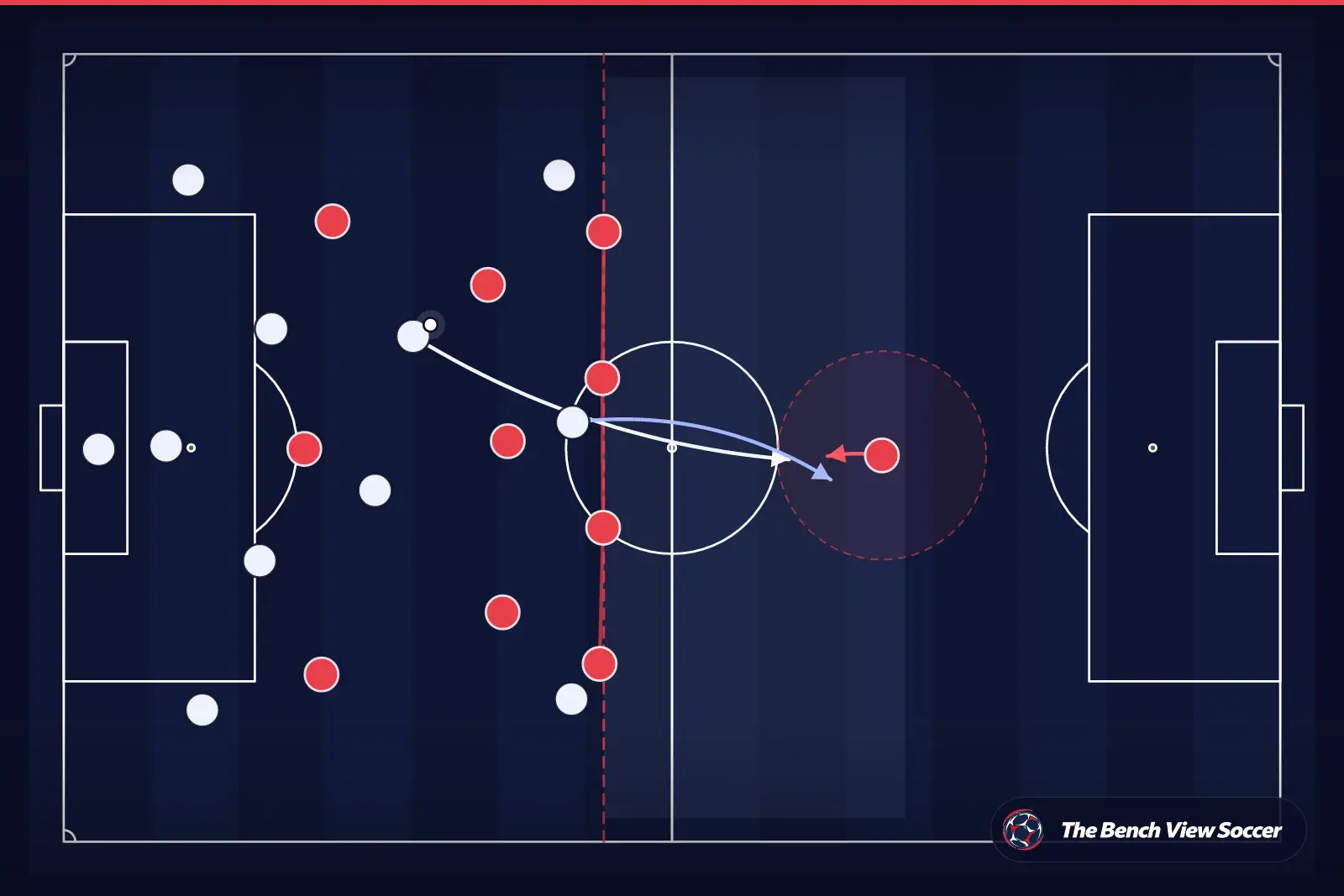
Arsenal’s high line works because it is connected to their pressing and their “rest defence” (the players positioned to stop counter-attacks while Arsenal attacks). When Arsenal builds attacks, the full-backs (often Ben White and Oleksandr Zinchenko, or later versions with Jurrien Timber when fit) step into midfield spaces, and the centre-backs hold a high starting position. This keeps the team compact vertically: the front press from Bukayo Saka, Gabriel Martinelli, Kai Havertz or Gabriel Jesus stays close to Martin Ødegaard and Declan Rice, and those midfielders stay close to Saliba and Gabriel. The benefit is that when Arsenal loses the ball, they can counter-press immediately — meaning they swarm the ball carrier to win it back within a few seconds. A high line also squeezes the opponent’s midfield passing lanes: if the back four drops deep, the opponent has time to receive, turn, and pick passes; if the back four holds high, midfielders feel pressure earlier and often play rushed long balls. Technically, Arsenal also uses the offside line as a weapon. By stepping up together, they invite opponents to play into a narrow timing window: the pass must be perfect and the run must be perfectly timed. This suits defenders like Saliba, who reads passes well and is comfortable in large spaces. But the risks are real and specific. If the press is bypassed with one clean vertical pass (a straight pass into the striker) or a third-man combination (A passes to B, who sets to C running beyond), Arsenal’s defenders suddenly sprint toward their own goal. That is the hardest type of defending because you cannot see both ball and runner easily. The goalkeeper also becomes critical: Aaron Ramsdale and later David Raya act as “sweepers,” starting high to clear long balls and support build-up. If the goalkeeper hesitates, or if the clearance is misjudged, the high line turns from a control tool into an open invitation for counter-attacks.
Match Examples
A clear example of the high line working appears in the 2023–24 Premier League season, particularly Arsenal’s 3–1 win over Liverpool at the Emirates (4 February 2024). Arsenal presses high, keeps the back line near halfway, and uses that compact shape to force rushed Liverpool decisions. The first goal comes from pressure and confusion created by Arsenal’s front line and midfield stepping up together; Liverpool struggles to play out cleanly because there is little space to breathe. Arsenal’s high line also helps them keep Liverpool’s midfield from turning and playing forward early, which reduces the number of dangerous transitions Liverpool thrives on. For the risk side, the 2023–24 UEFA Champions League quarter-final against Bayern Munich (2–2 at the Emirates, 1–0 at the Allianz Arena) shows how elite teams punish small errors behind a high line. Bayern under Thomas Tuchel looks to exploit space with quick forward passes and runners like Leroy Sané. When Arsenal’s press arrives a fraction late, Bayern can play into the channel and force Arsenal’s centre-backs to defend wide and running back. Another Premier League reminder comes from Arsenal’s 3–3 draw at home to Southampton in 2022–23 (21 April 2023). Arsenal tries to stay proactive and high, but repeated moments of poor spacing and loss of duels allow Southampton to access space behind or between defenders. These matches underline an important lesson: the high line is not a single tactic; it is a chain. If one link breaks — press timing, midfield coverage, centre-back decision, goalkeeper starting position — the punishment is immediate and often decisive.
Related Concepts & Skills
Training Implications
To coach a high line safely — whether in a local Indian academy, a college team, or a Sunday group — you need habits, not just instructions. First, build communication and synchronisation: run a 4v4+GK defensive line drill where the back four moves together based on the ball’s position. The coach calls “step” or “drop,” and players must move as a unit while checking shoulders for runners. Keep the distances measurable: aim for 8–12 metres between defenders and midfielders in the defensive phase to stay compact. Second, train counter-pressing in short bursts: use a 6v6 game in a 35x25 metre area where the rule is “win it back in five seconds” after losing possession. This teaches immediate pressure and supports the high line by preventing clean forward passes. Third, train the goalkeeper as a sweeper with decision-making, not bravery alone. Set up a drill where the opposition plays clipped balls over the top; the keeper must decide to come and clear first time, hold position, or retreat. Make the starting position a coaching point: the keeper stands 5–10 metres outside the box when the team is established in the opponent’s half, adjusting based on opponent speed. Fourth, rehearse “protect the centre, show wide” defending: in transition drills (8v6 with two mini-goals for the countering team), coach the nearest midfielder to block central passes while the back line delays and narrows. Finally, teach a clear emergency rule: if the first press is beaten cleanly, one centre-back drops early to protect space behind while the other delays the ball carrier. This simple trigger reduces the number of straight, uncontested runs that destroy a high line.
The Bench View app
Don’t just read football — train it
Everything you read here, turned into training you can follow step by step.
Physical training at home
AI daily sessions adapted to your level and position. No equipment needed.
Tactical training courses
Step-by-step courses on positioning, pressing, build-up and decision making.
- 7 days free
- No commitment
- Cancel anytime
Free account: 2 physical sessions + the first tactical course. PRO: 7-day free trial — cancel before day 8 and you pay nothing.