Introduction
The “false nine” sounds like a trend from the Pep Guardiola era, but coaches keep returning to it because it solves modern problems: compact defensive blocks, aggressive centre-backs, and the need to press immediately after losing the ball. For fans watching UEFA Champions League nights or big La Liga games, it can look confusing: why does the “striker” keep leaving the penalty box? The key is that a false nine still functions as a striker, but in a different way. Instead of living between the centre-backs, he moves into midfield to create overloads, open lanes for runners, and pull defenders out of shape. Real Madrid, Guardiola’s Manchester City, and even international sides use different interpretations depending on the players available. Sometimes it is a playmaker (like Lionel Messi in the past), sometimes it is a midfielder (like Bernardo Silva or Phil Foden), and sometimes it is a forward asked to behave like a connector rather than a finisher. This article explains why coaches still choose the false nine, what it creates tactically, and how fans can spot it quickly in live matches.
How It Works
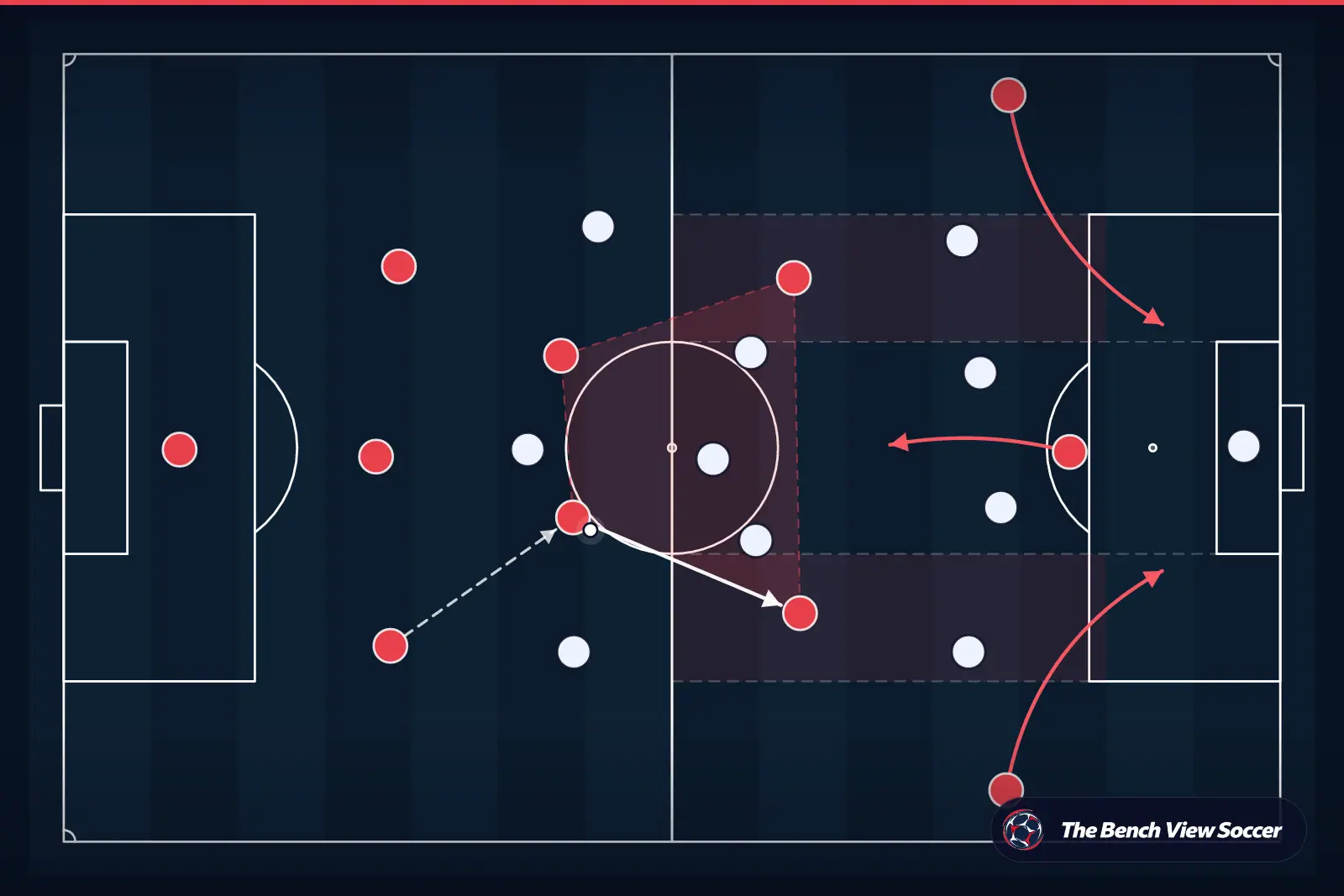
A classic number nine pins centre-backs, receives with his back to goal, and attacks the six-yard box. A false nine starts in the striker’s zone but deliberately drops into the space between the opponent’s midfield and defence. This does three important things. First, it creates a numerical advantage in midfield: if the opposition centre-back follows the false nine, the defending line loses its shape and a gap appears for wide forwards to run into. If the centre-back does not follow, the false nine turns and plays forward like a number 10. Second, it changes the passing angles. Because the false nine stands “in front” of the opponent’s defenders, your centre-backs and pivot midfielders can pass into him more easily, then bounce the ball wide or through the middle. Third, it improves counter-pressing (the immediate press after losing possession). With the striker already closer to midfield, your team can surround the ball faster and keep the opponent pinned in. Coaches vary the details. Guardiola often uses a false nine to maintain control and keep structure in his positional play, so the “nine” becomes a connector who helps City circulate and then arrives late in the box. Carlo Ancelotti has used false-nine ideas more selectively: Real Madrid can use it to free Vinícius Júnior or Rodrygo to attack the space inside, while Jude Bellingham or a dropping forward occupies defenders’ attention. The false nine is not about “no striker”; it is about moving the striker’s reference point to manipulate the opponent’s defensive decisions.
Match Examples
One of the clearest modern references is Barcelona under Pep Guardiola in the UEFA Champions League final, 2008–09 vs Manchester United in Rome. Lionel Messi starts as the central attacker but repeatedly drops into midfield pockets, drawing Nemanja Vidić and Rio Ferdinand into uncomfortable choices. When United’s centre-backs hesitate, Barcelona’s midfielders find Messi between the lines; when a defender steps out, Samuel Eto’o and Thierry Henry attack the channels. The goal patterns show the principle: destabilise the centre, then strike from a shifted defence. A more recent Guardiola example appears with Manchester City using a strikerless look in stretches of the 2020–21 UEFA Champions League knockouts. In the quarter-final second leg vs Borussia Dortmund (14 April 2021), City’s front line rotates constantly, with Kevin De Bruyne, Bernardo Silva, Phil Foden and Riyad Mahrez exchanging roles so the “nine space” is sometimes empty and sometimes occupied by a runner arriving late. Dortmund’s centre-backs cannot simply mark one player; they must pass runners on, which increases decision-making errors. For a Real Madrid-flavoured interpretation, look at the 2023–24 season where Ancelotti often uses Jude Bellingham as a high, roaming attacker in a diamond/midfield-heavy structure (often listed as 4-4-2 diamond). In La Liga matches where Madrid lack a traditional target striker for long phases, Bellingham’s movement into and out of the forward line functions like a false nine: he drops to connect, then times late box arrivals while Vinícius and Rodrygo attack the gaps. The shared lesson across these examples is that the false nine is a tool to force defenders to choose: follow and leave space, or hold and allow turns and through-balls.
Related Concepts & Skills
Training Implications
For coaches and players trying to apply false-nine behaviour in training, focus on movements and timing rather than just “dropping deep.” Start with a 6v6+2 neutral rondo in a central rectangle: assign one neutral as the false nine who must receive on the half-turn (body open), then play forward within two touches. Coach the cues: drop when the centre-backs have the ball and the opponent’s midfield line is flat; stay high when the opponent’s pivot is screening passes. Next, run a pattern drill with three lanes: centre, left, right. The false nine drops to receive from a pivot, sets the ball to a winger or full-back, and immediately spins to either (a) drag a centre-back out or (b) arrive late at the penalty spot. Add a rule: a goal counts double if the final pass is a third-man combination (drop-set-run). Then move to an 8v8 game where the false nine’s team can only score if at least one wide forward makes a run beyond the last line before the shot—this forces players to exploit the space created. For pressing, rehearse a simple “press curve”: when the false nine presses a centre-back, he angles his run to block the pass into the opponent’s defensive midfielder. Set a 5-second counter-press rule after losing possession to build the habit that makes false-nine systems work at top clubs like Manchester City. Finally, use video review: clip three moments where the false nine drops and ask players, “Did the centre-back follow? What run should happen next?” This builds decision-making, not just patterns.
The Bench View app
Don’t just read football — train it
Everything you read here, turned into training you can follow step by step.
Physical training at home
AI daily sessions adapted to your level and position. No equipment needed.
Tactical training courses
Step-by-step courses on positioning, pressing, build-up and decision making.
- 7 days free
- No commitment
- Cancel anytime
Free account: 2 physical sessions + the first tactical course. PRO: 7-day free trial — cancel before day 8 and you pay nothing.