Introduction
Liverpool’s full-backs are not “just defenders” in the modern game. Under Jürgen Klopp, and now in the post-Klopp era where Liverpool still carries many of the same attacking habits, the roles of Trent Alexander-Arnold and Andy Robertson (and their replacements like Conor Bradley or Kostas Tsimikas) are designed to create width, deliver final passes, and pin opponents back. Fans who watch the Premier League often notice one confusing scene: both full-backs stand almost like wingers, while Liverpool’s centre-backs are left with huge spaces behind them. This is not reckless by accident—this is a deliberate trade-off that aims to dominate territory and create repeated chances. This position-guide explains why Liverpool pushes full-backs so high, what patterns they use (overlaps, underlaps, and switching the play), and what risks appear when possession is lost. We will also connect these ideas to real examples from the Premier League and UEFA Champions League, because understanding the “why” is easier when you can remember the “when.”
How It Works
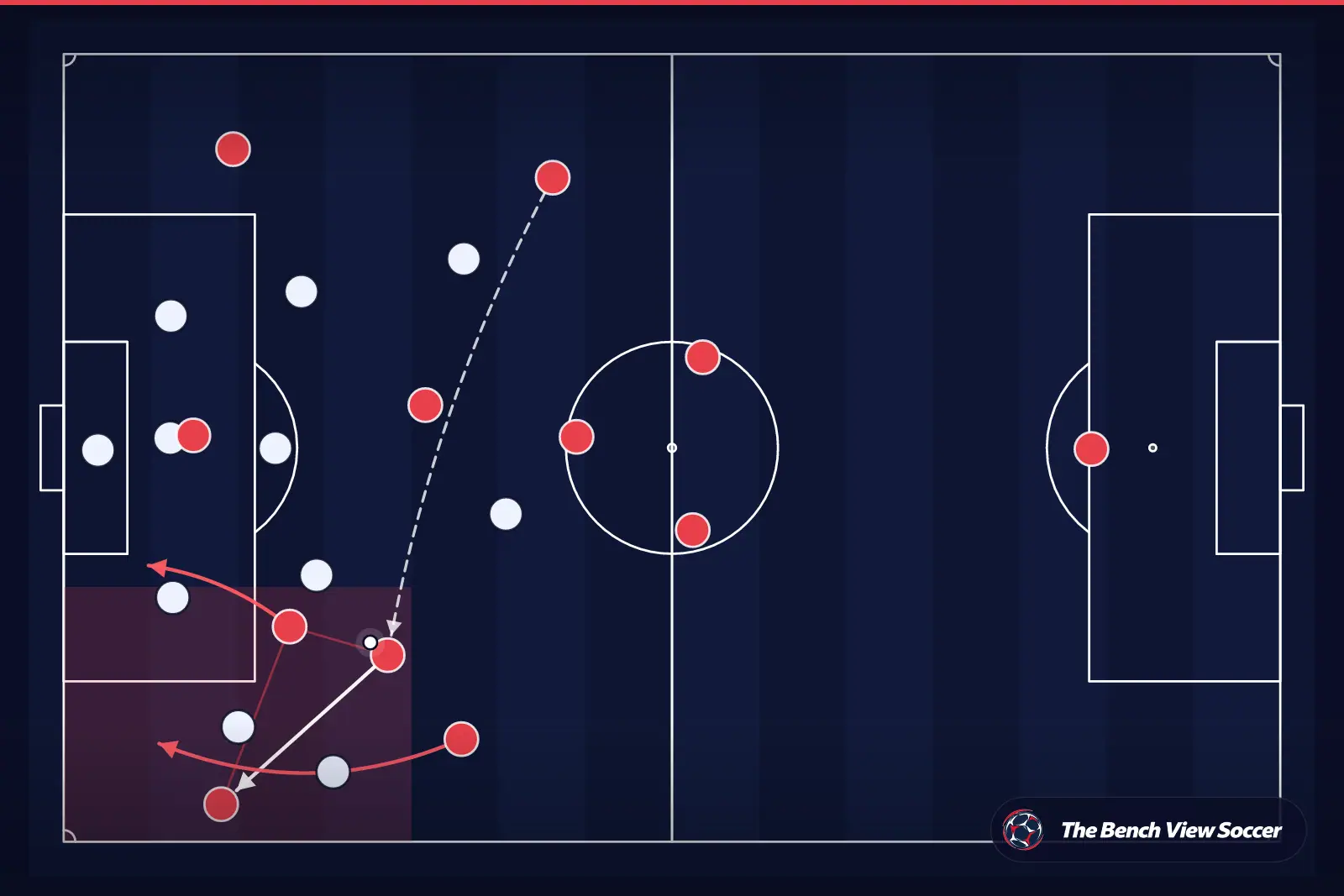
Liverpool pushes its full-backs high for three connected reasons: to stretch the pitch, to create extra attackers without sacrificing midfield numbers, and to improve crossing and cut-back quality. “Width” means using the touchline to make the opponent’s defensive line spread out. When Robertson stays wide on the left, the opposition right-back must decide: follow him outward and open space inside, or stay narrow and allow an easy pass to a player with time to cross. The same logic applies on the right with Alexander-Arnold or Bradley. The moment defenders get pulled wider, gaps appear between centre-back and full-back—these gaps are valuable because they are prime running lanes for forwards like Mohamed Salah, Luis Díaz, Diogo Jota, or Darwin Núñez. An “overlap” is when the full-back runs outside the winger, going beyond him on the flank. This forces the opponent’s wide defender to track a runner and can free the winger to move inside. Liverpool uses overlaps to create 2v1 situations: for example, Salah drifts inside, the right full-back overlaps, and the opponent left-back must choose whom to mark. Liverpool also uses “underlaps,” where the full-back runs inside the winger into the channel closer to the penalty box. This is particularly dangerous when the winger stays wide and pins the full-back, leaving a corridor for the underlapping run. The trade-off is defensive. When both full-backs push high, the back line can temporarily look like two centre-backs alone. Liverpool manages this risk by using counter-pressing: the moment the ball is lost, nearby players press aggressively to win it back quickly. If that press fails, the opposition can attack the open space behind the full-backs, especially with fast wingers. Liverpool’s centre-backs (like Virgil van Dijk and Ibrahima Konaté) must defend large spaces and win “delay” actions—slowing the counter until midfielders recover. The system is powerful, but it depends on coordination: full-back height, midfield positioning, and immediate reaction after losing the ball.
Match Examples
A clear Premier League example is Liverpool vs Manchester City at Anfield in the 2017–18 season (Premier League, January 2018), a match Liverpool wins 4–3. Liverpool’s full-backs push high to support quick wide attacks, and their width helps stretch City’s defensive structure. When Liverpool wins the ball, the first forward pass often goes toward the flanks, where the full-back and winger combine to reach crossing zones. But the same match also shows the risk: when City breaks the counter-press, Liverpool’s defensive line looks exposed, and City’s attackers find spaces to run into. The match becomes an open, high-tempo contest—an extreme version of Liverpool’s trade-off. Another strong reference is Liverpool vs Barcelona in the 2018–19 UEFA Champions League semi-final second leg at Anfield (May 2019), the famous 4–0 comeback. Liverpool’s full-backs provide relentless width and repeated delivery into the box. Robertson’s high positioning pins Barcelona’s right side and allows quick switches to the opposite flank. The most talked-about moment is Trent Alexander-Arnold’s quickly taken corner for Divock Origi’s goal: while it is a set-piece, it highlights Liverpool’s full-back mindset—constant scanning, quick execution, and acting like a creator rather than a traditional defender. For a more recent “defensive cost” example, Liverpool vs Real Madrid in the 2022–23 UEFA Champions League Round of 16 first leg at Anfield (February 2023), which Real Madrid wins 5–2. Liverpool starts strongly, and the full-backs push high to sustain attacks. But when transitions happen, Real Madrid targets the spaces around and behind the full-backs with direct running and fast combinations. Vinícius Júnior’s influence illustrates a key warning: against elite counter-attacking sides, high full-backs must be protected by smart midfield positioning and clean ball circulation—otherwise the same attacking ambition becomes a defensive problem.
Related Concepts & Skills
Training Implications
If you coach, play, or even just analyze matches with friends, you can train Liverpool-style full-back behavior in practical ways. Start with a simple rule in small-sided games (6v6 or 7v7): your full-backs must stay outside the widest attacker when your team has stable possession. This builds the habit of providing width instead of crowding the middle. Add a second rule: a full-back can overlap only after the winger receives and takes a touch inside. That timing cue prevents “blind” overlaps and teaches players to read the winger’s body shape. For crossing quality, run a drill where the full-back receives on the flank, takes one touch forward, and then plays a low cut-back to the penalty spot area rather than a hopeful high cross. Rotate three targets: near-post run, penalty-spot runner, and far-post runner. This mirrors Liverpool’s preference for cut-backs because they create clearer shots. For defensive trade-offs, build “rest defense” habits: whenever a full-back goes high, one midfielder must drop to cover the space behind him, and the far-side full-back must check whether he can stay slightly lower. Make this explicit with a constraint: if both full-backs are in the final third, at least three players must stay behind the ball. Finally, train counter-pressing with a 10-second rule: after losing possession, your nearest three players must sprint to close passing lanes and force the opponent wide. If the ball is not recovered in 10 seconds, the team drops into a compact shape. This teaches the key Liverpool lesson: high full-backs are not “dangerous” if your reaction after losing the ball is fast, organized, and collective.
The Bench View app
Don’t just read football — train it
Everything you read here, turned into training you can follow step by step.
Physical training at home
AI daily sessions adapted to your level and position. No equipment needed.
Tactical training courses
Step-by-step courses on positioning, pressing, build-up and decision making.
- 7 days free
- No commitment
- Cancel anytime
Free account: 2 physical sessions + the first tactical course. PRO: 7-day free trial — cancel before day 8 and you pay nothing.