Introduction
For many fans, the full-back still feels like a “touchline defender”: overlap the winger, cross, then recover. But in modern European football—especially under Pep Guardiola at Manchester City and Mikel Arteta at Arsenal—the full-back often moves inside, almost like a midfielder. This is called an “inverting” full-back: instead of staying wide, the full-back steps into central zones during build-up and possession. It looks strange at first because it breaks the traditional map of positions, but it solves very modern problems: elite pressing, compact defensive blocks, and the need to control transitions (the moment the ball changes teams). In the Premier League and UEFA Champions League, where opponents press aggressively and counter quickly, coaches want more players near the ball to secure possession and immediately protect against counter-attacks. This article explains why full-backs invert, what Pep and Mikel gain from it, where it fails, and what you can learn and train from these ideas.
How It Works
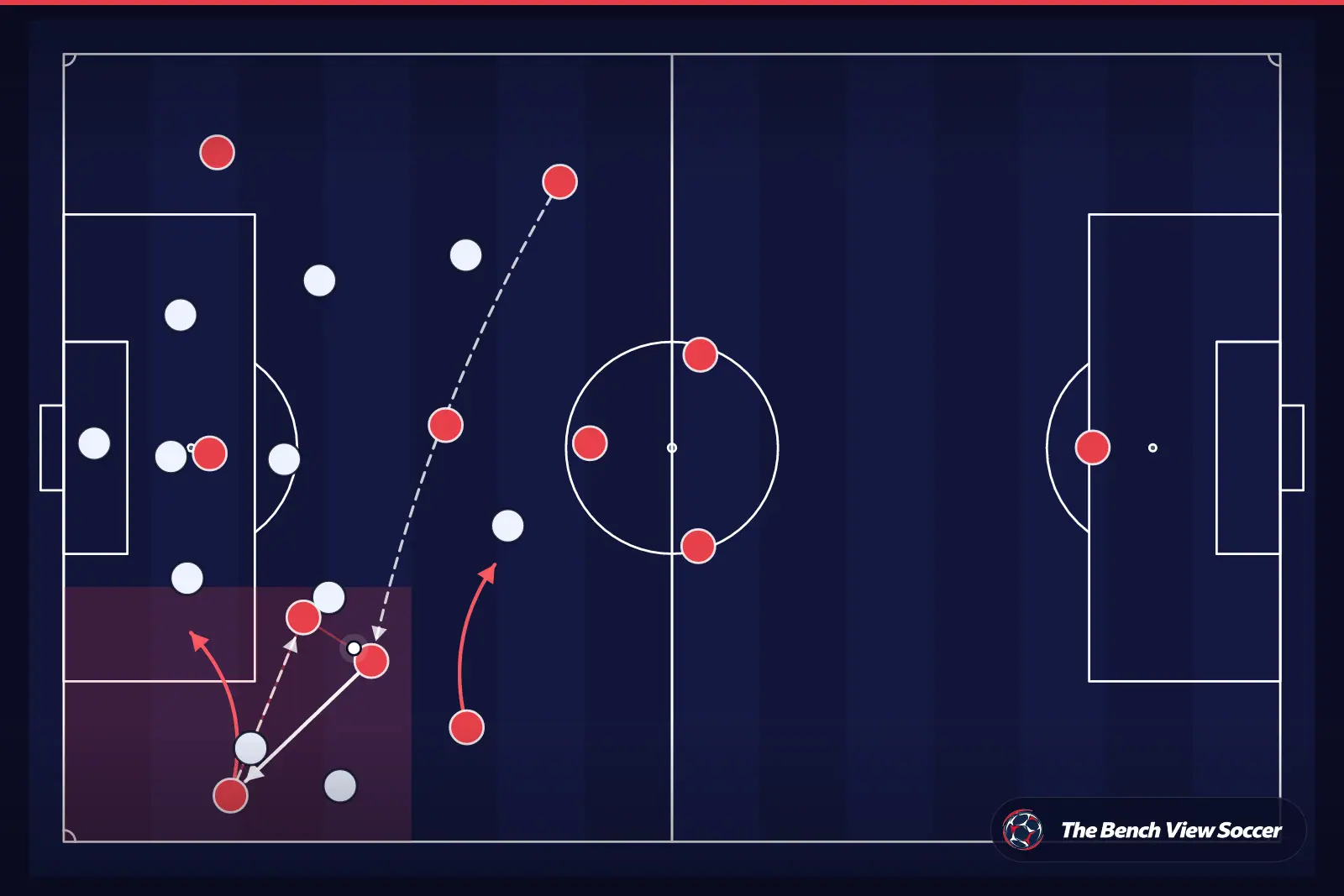
Modern inverting full-backs mainly serve three tactical goals: build-up stability, midfield control, and transition defence. First, build-up: when a team plays out from the back, opponents often press with two or three forwards. If the full-back steps into midfield, the team forms a stronger “rest structure” (the players positioned behind/around the ball), giving safer passing angles and an extra midfielder to beat the press. Second, midfield control: by inverting, the full-back helps create a numerical advantage centrally—like 3v2 or 4v3—so the team circulates the ball, draws opponents in, and then finds a free player. This is crucial in Guardiola’s Manchester City, where the aim is to dominate the centre and access the half-spaces (the channels between central and wide areas). Arteta’s Arsenal uses a similar idea but often ties it to specific patterns: one full-back inverts to support midfield while the other may stay wider or form a back three. Third, protection against counters: when the ball is lost, a central full-back is already close enough to counter-press (press immediately after losing the ball) and block direct passes into strikers. Instead of both full-backs being high and wide—leaving only two centre-backs to defend counters—the inverted full-back adds a “third defender” in central spaces. The trade-off is clear: you may lose natural width and traditional overlaps, and you risk being exposed on the outside if the wide areas are not covered by a winger, a wide centre-back, or a midfielder shifting across.
Match Examples
Manchester City’s 2022–23 UEFA Champions League run shows the inverted full-back logic at the highest level. In the 2023 Champions League final against Inter Milan, City often build with John Stones stepping into midfield from defence, creating an extra central option to play through Inter’s compact 5-3-2 block. This helps City maintain control and also keeps more players positioned to stop Inter’s counters through Lautaro Martínez. In the Premier League, City’s 2023–24 approach frequently uses a full-back stepping inside (whether the role is performed by a natural full-back like Rico Lewis or a hybrid defender) to overload midfield and keep the ball circulating until a gap opens. Arsenal provide a clear Premier League reference point: in the 2022–23 season, Arteta regularly uses Oleksandr Zinchenko to invert from left-back into midfield zones, helping Arsenal progress play and keep Martin Ødegaard and Bukayo Saka higher for attacks. A strong example of how this affects big games appears in Arsenal vs Manchester City in the 2023–24 Premier League (the 0–0 draw at the Etihad): Arsenal’s defensive organisation stays compact, and their build-up often prioritises central security over constant overlapping runs. These matches highlight the core idea: inverting is not a “trick”—it is a response to how elite teams press, defend in narrow blocks, and punish mistakes with fast transitions.
Related Concepts & Skills
Training Implications
If you coach or play (even in local Indian leagues), you can train the inverted full-back idea with simple, actionable habits. First, teach starting positions: your full-back begins wide while the centre-back has the ball, then moves inside only when the ball is secure and a midfielder is available to cover the wide zone. Use a rule in training: “invert on the second pass,” not immediately, so you don’t open the flank too early. Second, run a 6v4 build-up rondo in a rectangle: back line of 3 (two centre-backs + one full-back), two midfielders, and a goalkeeper versus four pressers. Give the full-back a target zone inside; award two points if the team plays through the inverted full-back into a midfielder facing forward. Third, coach scanning: the full-back must check shoulders before receiving inside, because central areas are crowded. Use a constraint—player must call a colour/number shown by the coach behind them before receiving—to force head movement. Fourth, train the covering rotations: when the left-back inverts, the left winger stays wider or the left central midfielder shifts to the touchline. Practice an 8v8 game with a condition: if the full-back goes inside, the winger cannot come inside until the ball reaches the final third. Finally, build transition discipline: in a small-sided game, the moment your team loses the ball, the inverted full-back’s first job is to block the direct pass into the striker (screen the lane), then press. Track this with a simple KPI: count how many times the opposition plays a forward pass within three seconds of your loss—aim to reduce it week by week.
The Bench View app
Don’t just read football — train it
Everything you read here, turned into training you can follow step by step.
Physical training at home
AI daily sessions adapted to your level and position. No equipment needed.
Tactical training courses
Step-by-step courses on positioning, pressing, build-up and decision making.
- 7 days free
- No commitment
- Cancel anytime
Free account: 2 physical sessions + the first tactical course. PRO: 7-day free trial — cancel before day 8 and you pay nothing.