Introduction
If you watch the Premier League, Champions League, or even Europa League closely, you notice a trend: wingers often start wide but then dribble or receive inside, almost like extra midfielders or narrow forwards. This is the “inverted winger” idea—typically a right-footed player on the left or a left-footed player on the right. Modern coaches use it because football now revolves around controlling central zones: the middle of the pitch decides tempo (how fast or slow the game feels) and creates the best shooting angles. A winger who comes inside can threaten the goal with their stronger foot, combine with a striker, and overload midfield all at once. Managers like Pep Guardiola (Manchester City), Mikel Arteta (Arsenal), and Carlo Ancelotti (Real Madrid) use inverted wide players differently, but the motivation is similar: create more central options without losing width entirely. For fans, think of it as turning a touchline runner into a part-time playmaker and part-time goal threat, depending on the phase of play.
How It Works
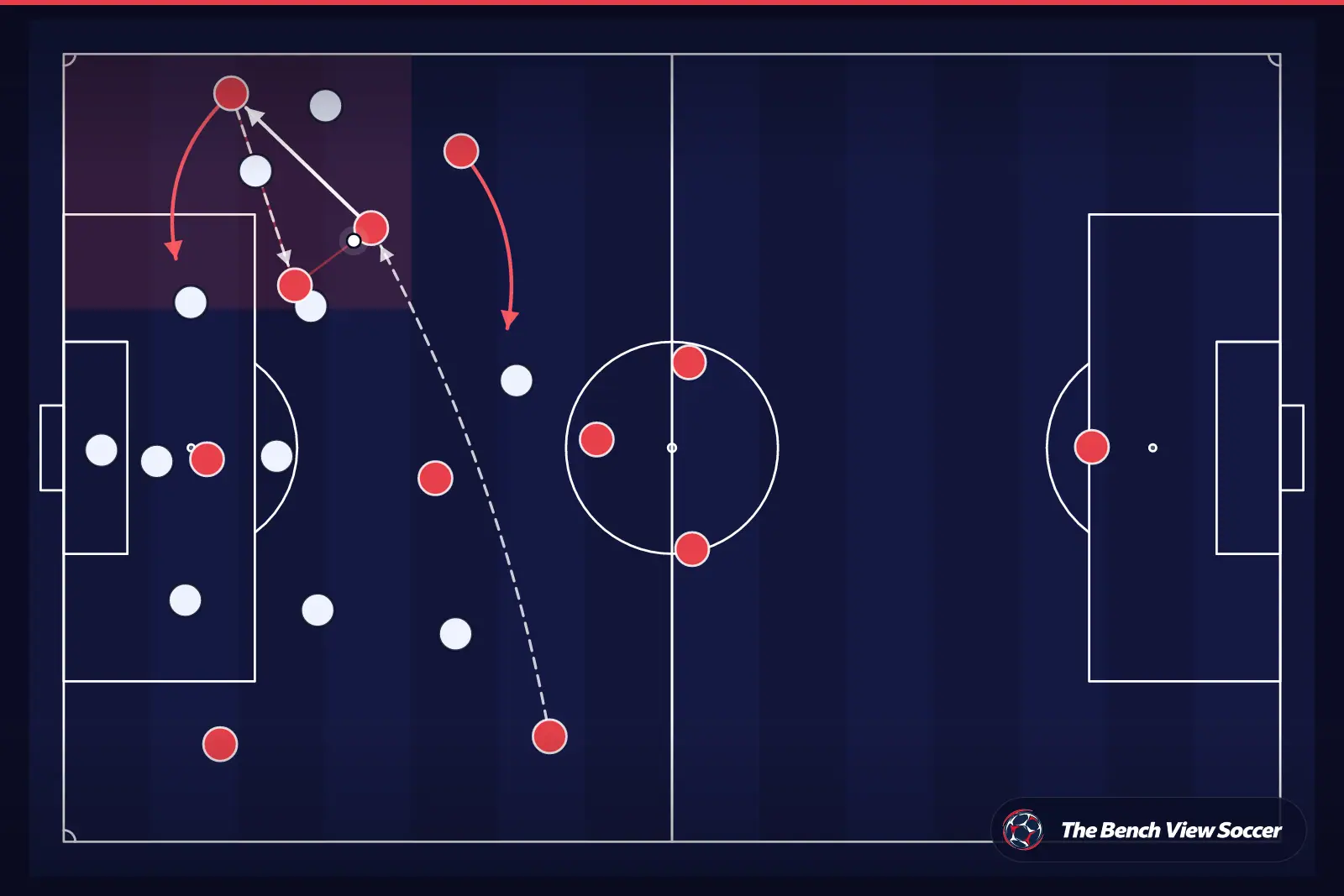
Modern teams invert wingers mainly for two big tactical wins: better shooting angles and better control of midfield tempo. First, shooting angles: when a left-footed right winger (like Mohamed Salah at Liverpool) drives inside, they open the classic far-corner finish across the goalkeeper. The body shape naturally points toward goal, and defenders struggle because they must protect both the cut-inside shot and the pass into the striker. Second, midfield tempo: when the winger moves into the “inside channel” (often called the half-space—the lane between full-back and centre-back), they add an extra central passing option. That helps the team keep the ball under pressure and decide when to speed up (vertical pass, quick combination) or slow down (recycle possession, switch play). This only works if the team still keeps width somewhere. Usually, the full-back provides that width by overlapping (running outside the winger) or underlapping (running inside). Manchester City under Guardiola often uses wide wingers but also inverts them at times; Arsenal under Arteta often asks Bukayo Saka to come inside while Ben White overlaps to stretch the opponent’s back line. Another common pattern is a “box midfield” in possession: two deeper midfielders plus two advanced midfielders/inside forwards form a square. An inverted winger can become one of those advanced central points, which improves ball security and lets the team counter-press immediately if they lose possession. The key detail: inverting is not random dribbling; it is a coordinated movement that changes who holds width, who attacks depth, and who supports the ball to control the game’s rhythm.
Match Examples
A clear example appears in the 2022–23 Premier League season when Arsenal use Bukayo Saka (right side) to receive wide, attract the left-back, then drive inside to combine with Martin Ødegaard. In Arsenal vs Manchester United at the Emirates (Premier League, 22 January 2023), Saka repeatedly moves from touchline to inside-right, allowing White to overlap and pin United’s defensive line deeper. That creates a better shooting lane and also keeps Arsenal circulating the ball in United’s half, controlling tempo for long stretches. In the UEFA Champions League 2021–22, Real Madrid’s run shows a slightly different inversion. Vinícius Júnior often stays wide left to isolate defenders, but on key attacks he carries inside to attack the channel between right-back and centre-back, while Karim Benzema drops to connect play. In the round of 16 second leg against Paris Saint-Germain (Real Madrid vs PSG, 9 March 2022), Madrid’s left-sided movements repeatedly pull PSG’s block out of shape: when the wide player threatens inside, the midfield must collapse, and that opens passing angles for quick central combinations. Liverpool in the 2017–18 Champions League campaign uses one of the most famous inverted winger structures. Salah (right) and Sadio Mané (left) both attack inside aggressively while full-backs Trent Alexander-Arnold and Andrew Robertson provide width. In Liverpool vs Manchester City (Champions League quarter-final first leg, 4 April 2018), Liverpool’s wide forwards constantly enter central lanes at speed, creating direct shooting angles and forcing City’s midfield to defend closer to their own box. The inversion is not only about goals; it also helps Liverpool counter-press immediately because their attackers are already close to central passing routes when possession turns over.
Related Concepts & Skills
Training Implications
To train inverted wingers effectively, coaches must build both decision-making and team coordination, not just dribbling. Start with a 6v6+2 possession game in a rectangle: mark two wide channels and two inside lanes (half-spaces). Give the winger a rule: they must receive wide first, then choose one of three actions within three seconds—carry inside to shoot/pass, bounce a pass to a central midfielder, or release an overlapping full-back. This teaches scanning (checking shoulder), timing, and how to “fix” a defender before moving. Add a finishing constraint: when the winger enters the inside lane, the next action must lead to a shot within five passes. Encourage the classic inverted finish (across goal) and the cut-back pass to a late-arriving midfielder. For team structure, run an 8v7 build-up drill where the full-back’s job is to hold width if the winger comes inside. Freeze the play whenever both winger and full-back occupy the same vertical line; correct spacing so one stays wide and one attacks inside. Include transition moments: if the attacking team loses the ball, require a three-second counter-press in the central zone before retreating. This creates the habit of using inverted positions to win the ball back quickly and control tempo again. Finally, review video clips (even from Arsenal or Liverpool matches) and ask players to name the “trigger” for inversion: a 1v1 isolation, a midfielder free between lines, or a striker dropping to link play.
The Bench View app
Don’t just read football — train it
Everything you read here, turned into training you can follow step by step.
Physical training at home
AI daily sessions adapted to your level and position. No equipment needed.
Tactical training courses
Step-by-step courses on positioning, pressing, build-up and decision making.
- 7 days free
- No commitment
- Cancel anytime
Free account: 2 physical sessions + the first tactical course. PRO: 7-day free trial — cancel before day 8 and you pay nothing.