Introduction
Modern European football makes wingers look different from the classic “touchline hugger” many Indian fans grow up watching. Players like Vinícius Júnior at Real Madrid, Bukayo Saka at Arsenal, and Khvicha Kvaratskhelia at Napoli often start wide but aim to cut inside onto their stronger foot. This is not just flair; it is a repeatable tactical pattern. Cutting inside takes a winger closer to the most valuable zone in football: the central area around the edge of the box, where shots and through passes create the highest-quality chances. Coaches like Carlo Ancelotti (Real Madrid) and Mikel Arteta (Arsenal) build entire attacking structures to help these wingers receive in space, run at defenders, and combine with teammates. But because it is so dangerous, elite opponents also build specific defensive plans to stop it—using body shape, “showing” the winger away from goal, double-teams, and compactness. Understanding both the attacking logic and the defensive responses is the fastest way to read top-level matches in competitions like the UEFA Champions League and the Premier League.
How It Works
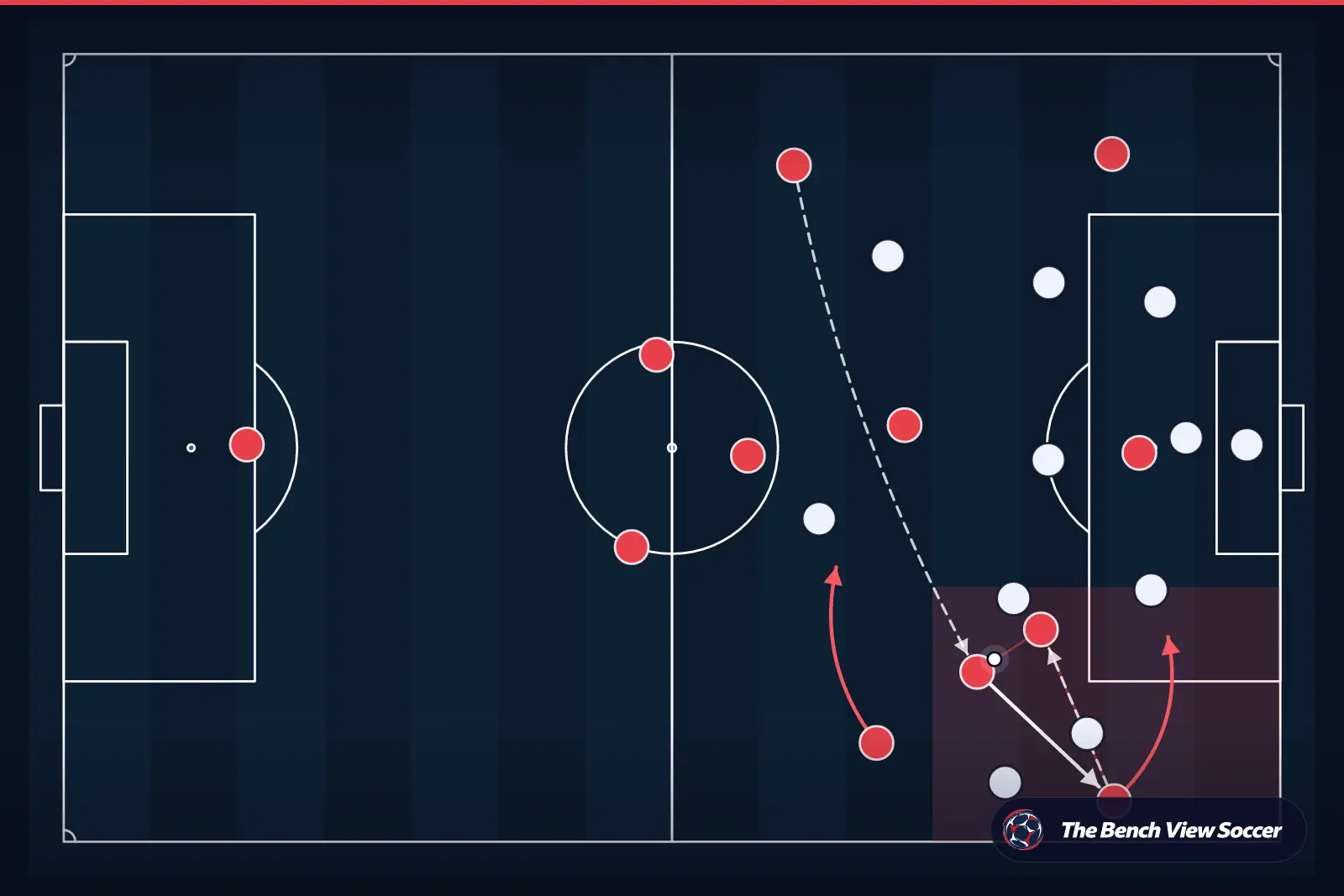
Wingers cut inside because the inside lane offers more options and better outcomes than staying outside. When a right-footed winger plays on the left (Vinícius Júnior) or a left-footed winger plays on the right (Saka), they naturally open their body to face the centre after the first touch. From there, the winger can do three high-impact actions: (1) shoot across goal with the stronger foot, (2) slip a through pass to a striker, or (3) combine with a midfielder between the lines. Teams encourage this by creating width through a full-back or wing-back who overlaps on the outside. That outside runner pins the opposing full-back: if the defender follows the overlap, the winger has space to drive inside; if the defender stays, the overlap creates a crossing lane. Managers also position a central midfielder or attacking midfielder in the “inside channel” to offer a bounce pass—this is why you often see a triangle: winger, full-back, and central midfielder. Defensively, teams try to remove the inside lane first. The full-back’s body angle stays half-turned, inviting the winger toward the touchline rather than allowing a straight line into the box. A nearby midfielder then shifts across to create a second barrier (a “2v1”) at the moment the winger tries to cut. The centre-back also stays ready to step out if the winger enters the half-space, while another defender covers behind to prevent a simple pass into the striker. Good defending against inside-cut wingers is less about tackling and more about controlling space, timing, and support.
Match Examples
In the 2021–22 UEFA Champions League, Real Madrid’s knockout run repeatedly shows how Vinícius Júnior benefits from inside runs and how opponents try to block them. In the Round of 16 second leg vs Paris Saint-Germain at the Santiago Bernabéu, PSG’s defending often aims to keep Madrid’s wide threats in front, but once Madrid’s press and transitions increase, Vinícius receives earlier and closer to goal. The key detail is not only his dribbling; it is where he receives—higher up and with Madrid’s midfield ready to support the inside pass. In the 2021–22 Champions League final vs Liverpool in Paris, Liverpool’s plan under Jürgen Klopp stays compact and protects the middle, but Madrid still finds moments where Vinícius arrives inside the far-post zone to finish. This shows an important point for learners: “cutting inside” is not always a solo dribble into the box; it can also be an inside movement to attack the space behind the full-back. For a clear defensive blueprint, look at Manchester City under Pep Guardiola in the 2022–23 Champions League semi-final second leg vs Real Madrid at the Etihad. City’s shape stays tight, and their right side often prevents Vinícius from receiving with time to turn inward. The full-back engages with controlled distance, and midfield cover arrives quickly, so Vinícius either goes backward or is forced wide into lower-danger zones. In the Premier League, Arsenal’s 2022–23 and 2023–24 patterns around Bukayo Saka show the attacking side of this logic: opponents frequently assign a full-back plus a nearby midfielder to trap him near the line, while Arsenal uses overlaps and underlaps to open the inside lane for Saka’s left-footed actions. Watching these matches with one question—“who provides the second defender or the supporting runner?”—makes the tactical story much clearer.
Related Concepts & Skills
Training Implications
For coaches and players in India trying to develop a “cut inside” winger profile, training must focus on scanning, first touch, decision-making, and coordinated support runs—because the move only works consistently when it connects with team structure. 1) Receiving and scanning drill: set up a wide channel (touchline to edge of box) with a defender and a supporting midfielder. The winger starts wide, receives a pass, and must call out the position of a mannequin/marker behind them before the first touch. This forces head-up habits. 2) Body-shape and first-touch reps: practice receiving on the back foot (furthest foot from the passer) so the first touch points toward the inside lane. Add a constraint: the winger has only two touches before either shooting, passing inside, or playing to the overlapping full-back. 3) 2v2 “trap escape” game: winger + full-back versus full-back + covering midfielder in a small wide zone. The defenders win if they force the winger to the line and stop a cut inside; attackers win by entering the half-space or creating a shot/cutback. Rotate roles so players learn both attacking and defending cues. 4) Finishing patterns: repeat three finishes—across-goal shot from the corner of the box, slip pass to a striker for a first-time finish, and a cutback after beating the defender. Count outcomes, not just attempts. 5) Defensive training to stop it: teach full-backs to approach with a “show outside” stance (hips angled), keep one arm’s distance, and delay until help arrives. The covering midfielder practices arriving on the winger’s inside shoulder at the moment the winger drops the head to dribble—this timing matters more than sprint speed. These are simple sessions, but if you track success rates weekly, players quickly learn when to cut inside and when to release the ball.
The Bench View app
Don’t just read football — train it
Everything you read here, turned into training you can follow step by step.
Physical training at home
AI daily sessions adapted to your level and position. No equipment needed.
Tactical training courses
Step-by-step courses on positioning, pressing, build-up and decision making.
- 7 days free
- No commitment
- Cancel anytime
Free account: 2 physical sessions + the first tactical course. PRO: 7-day free trial — cancel before day 8 and you pay nothing.