Introduction
Arsenal under Mikel Arteta build many of their best chances not from endless crossing, but from “half-space overloads” — clustering players in the channel between the wing and the centre. For fans learning tactics, the half-space is a useful map: it is wide enough to face forward and combine, but central enough to threaten the goal quickly. When Arsenal overload that zone, they force defenders into uncomfortable choices: step out and leave space behind, or stay and allow quick combinations. The result is often a cut-back, a disguised through ball, or a shot from the edge of the box. This approach shows up repeatedly in the Premier League and the UEFA Champions League because it is a controlled way to create high-quality chances without taking huge risks in transition. This article breaks down what the overload looks like, why it works, and how you can spot it live on TV.
How It Works
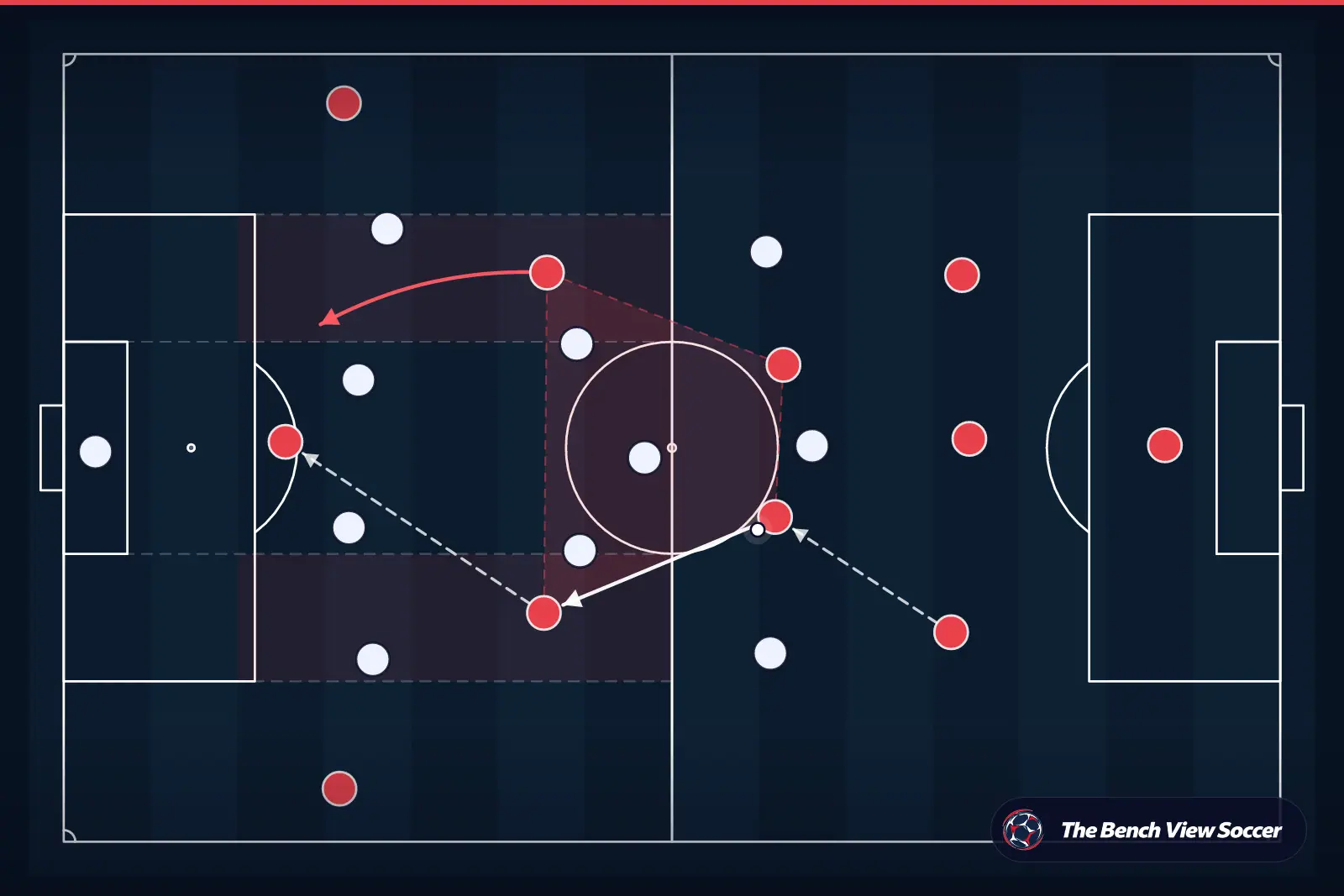
A half-space overload happens when Arsenal intentionally place three (sometimes four) players near one half-space to outnumber the opponent’s local defenders. The most common Arteta structure starts from a 4-3-3 on paper but becomes a 3-2-5 (or 2-3-5) in possession. One full-back, often Oleksandr Zinchenko (when fit), moves inside to form an extra midfielder, while the other full-back holds width. In the right half-space, Bukayo Saka stays wide to pin the full-back, Martin Ødegaard occupies the right half-space as the main connector, and a forward (Gabriel Jesus or Kai Havertz) drops or drifts toward the same channel. Add Ben White’s underlap/overlap and you get a “triangle plus one” around the opponent’s left-back and left central midfielder. The key is spacing: Arsenal keep one player wide, one between the lines (in the gap behind midfield), and one making runs behind. This forces the defender to track two threats at once. When the opponent collapses inward to stop Ødegaard, Saka receives isolated 1v1; when they stay wide to stop Saka, Ødegaard receives in the half-space facing goal. From there Arsenal usually create chances in three ways: (1) a third-man run (player A passes to B, B sets to C running through), (2) a slip pass behind the full-back for a cut-back, or (3) a “bounce and switch” where Arsenal tempt pressure on one side and then quickly move the ball to the far side for a shot or cross. The overload is not only about numbers; it is about making defenders turn their body the wrong way and then attacking the blind side.
Match Examples
In the 2022–23 Premier League, Arsenal’s 3–2 win against Manchester United at the Emirates (January 2023) shows their right-sided half-space habits clearly. Ødegaard repeatedly receives between United’s midfield and defence while Saka pins Luke Shaw wide. When Jesus (before his long injury) drifts toward that channel, Arsenal create moments where United’s left central midfielder hesitates: step to Ødegaard or protect the back line. Those hesitations lead to quick wall passes and cut-backs into the box. Another strong illustration arrives in the 2023–24 UEFA Champions League last-16 tie against FC Porto, especially the second leg at the Emirates (March 2024). Porto defend compactly and try to lock Arsenal outside, so Arsenal respond by placing Ødegaard and a forward in the right half-space with Saka wide, baiting Porto’s midfield line to shift. When Porto compresses, Arsenal look for the disguised pass into the corridor behind the full-back, aiming for a low cut-back rather than a hopeful cross. Even when the chance does not become a goal immediately, the pattern produces repeat entries into the box because it keeps Arsenal’s rest-defence (the players staying back) organised. A Premier League reference from 2023–24 is Arsenal vs Liverpool at the Emirates (February 2024). Liverpool under Jürgen Klopp press aggressively, so Arsenal use half-space overloads to play around pressure: White and Ødegaard combine on the right, Saka holds the touchline to stretch, and the central forward offers a short option. The overload creates either a safe exit pass or a sudden acceleration into the box if Liverpool’s midfield jumps. Watch how often Arsenal’s best entries come after two quick passes in the right half-space followed by a move to the byline for a cut-back.
Related Concepts & Skills
Training Implications
To train half-space overloads in a practical way, build sessions that teach spacing, angles, and timing rather than complicated “set plays.” Start with a 4v3 or 5v4 rondo in the right half-space channel (mark a rectangle between the touchline and the centre circle lane). Give the attacking team roles: one wide player (Saka role), one half-space player between lines (Ødegaard role), one support midfielder (Zinchenko role), one runner (Jesus/Havertz role), and optionally a full-back (White role). The rule: a goal counts only after a third-man action (pass-set-run) or a cut-back from the byline. This forces players to look for the same outcomes Arsenal hunt. Then progress to a directional game: 7v7 with two wide channels and two half-space channels marked. Reward points for receiving in the half-space on the half-turn (body open to the goal) and for creating a byline cut-back. Coach three key details: (1) “Pin and play” — the wide player must stay wide until the moment of combination to hold the full-back; (2) “Different heights” — one player checks short while another runs behind, so defenders cannot mark both; (3) “First touch forward” — half-space receivers practice opening their hips to face goal. Finally, add a transition rule: if attackers lose the ball, they have five seconds to win it back. This links the overload to Arsenal’s immediate counter-press and teaches players to attack without becoming vulnerable.
The Bench View app
Don’t just read football — train it
Everything you read here, turned into training you can follow step by step.
Physical training at home
AI daily sessions adapted to your level and position. No equipment needed.
Tactical training courses
Step-by-step courses on positioning, pressing, build-up and decision making.
- 7 days free
- No commitment
- Cancel anytime
Free account: 2 physical sessions + the first tactical course. PRO: 7-day free trial — cancel before day 8 and you pay nothing.