Introduction
Mikel Arteta’s Arsenal is one of the clearest modern examples of “positional play” in the Premier League. For fans used to watching end-to-end football, Arsenal can look slower at times, but the purpose is very specific: control where the game is played, create predictable passing lanes for teammates, and force the opponent to defend bigger distances. Positional play is not just “keeping the ball.” It is a structure with rules—spacing, occupying zones, and moving the ball to move the opponent—so that when the attack accelerates, Arsenal already has the right people in the right places. In the UEFA Champions League and against top-six rivals in the Premier League, this control becomes a weapon because it reduces chaos and increases repeatable chances. Arteta’s background under Pep Guardiola at Manchester City shows in the organisation, but Arsenal’s version has its own twists: a heavy use of inverted full-backs, a strong five-lane attacking shape, and strict rest-defence to stop counter-attacks. This article breaks down how Arsenal builds up, how they create chances, what roles players like Bukayo Saka, Martin Ødegaard, Declan Rice and William Saliba play, and how you can recognise the patterns on TV. The goal is not to memorise fancy terms, but to help you watch Arsenal and understand why a “simple” sideways pass can be the move that opens the next attack.
How It Works
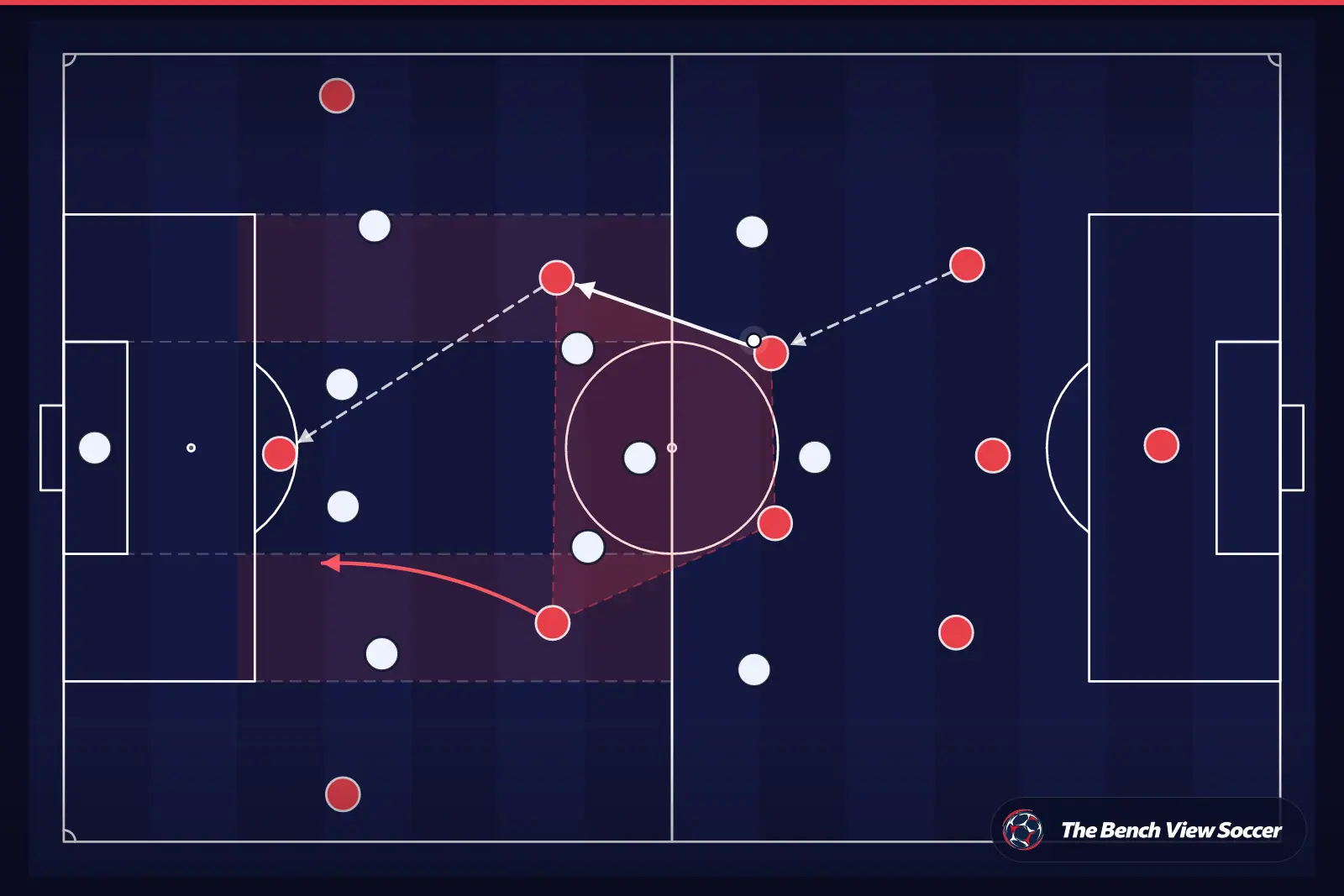
Positional play means the team organises itself to occupy key zones of the pitch so passing options always exist, even under pressure. Arsenal usually attacks with a “five-lane” idea: left touchline, left half-space, centre, right half-space, right touchline. The wingers often stay wide to stretch the opponent, while the two No.8s/No.10s (often Ødegaard and Kai Havertz or Rice depending on the phase) occupy the half-spaces. This matters because half-spaces give better angles to play forward and to combine around the box. In the build-up, Arsenal forms a stable base. The centre-backs (Saliba and Gabriel) stay connected, and one full-back steps into midfield. This is called an “inverted full-back” role: instead of hugging the sideline, the full-back comes inside to create an extra midfielder, helping Arsenal play through pressure. When Oleksandr Zinchenko plays, he often becomes that inside midfielder; when Ben White plays on the right, he may hold wider or step inside depending on the opponent. The goalkeeper (David Raya) also participates, making Arsenal comfortable creating a temporary back three or back four shape to lure the press. The objective is to create a free player. Arsenal does it by attracting pressure on one side, then switching to the other side where Saka or Gabriel Martinelli can receive 1v1. Once the ball enters the final third, Arsenal uses “third-man” combinations: Player A passes to Player B, who sets it for Player C running beyond. Ødegaard is central here because he receives between lines, plays quick one-twos, and angles passes to Saka’s feet or into the channel. Another key is “rest-defence”: while Arsenal attacks, they keep enough players behind the ball (often two centre-backs plus the inverted full-back or Rice) to immediately stop counters. This is why Arsenal can commit numbers forward without becoming open like a transition-heavy team. When it works, the opponent faces a dilemma: stay compact and allow Arsenal to circulate until a gap opens, or press and risk leaving space behind. Arteta’s Arsenal is not about improvisation alone; it is about repeatedly arriving in the same dangerous zones with different ways to enter them: wide isolations for Saka, half-space entries for Ødegaard, and late box runs for Havertz or Rice.
Match Examples
A strong reference point is Arsenal vs Manchester City, Premier League 2023–24 at the Emirates Stadium (the 1–0 win). Against Pep Guardiola’s side, Arsenal still prioritises positional discipline. They do not press recklessly; instead, they keep distances compact in rest-defence and choose moments to jump. In possession, Arsenal often avoids forcing central passes into City’s traps. You can see longer circulations across the back line to pull City’s midfield across, then the ball goes wide to Saka’s side to attack space. The game shows why positional play is also a defensive tool: by keeping structure, Arsenal reduces City’s transition opportunities. Another clear example is Arsenal vs Liverpool, Premier League 2023–24 at the Emirates (Arsenal win 3–1). Liverpool under Jürgen Klopp presses aggressively, so Arsenal uses Raya and the centre-backs to invite pressure and then play around it. Watch how Ødegaard positions himself in the right half-space: he stays available behind Liverpool’s first press, and once he receives, the attack speeds up immediately. Also notice how Arsenal’s wide players pin Liverpool’s full-backs, creating corridors for underlaps and cut-backs. For a Champions League reference, Arsenal vs PSV Eindhoven, UEFA Champions League 2023–24 group stage at the Emirates (the high-scoring win). This match highlights the “five-lane” occupation and third-man runs. Arsenal’s wide players stretch PSV, the interior midfielders receive between lines, and the full-back stepping into midfield helps Arsenal keep constant numerical superiority in central zones. The goals come less from random crosses and more from structured entries: switches of play, quick wall passes, and runners arriving into the box from midfield. Across these matches, the repeating idea is consistent: Arsenal creates chances by controlling spacing first, then accelerating through combinations once the opponent is unbalanced.
Related Concepts & Skills
Training Implications
If you want to apply Arsenal-style positional play in your own games—whether in college football, local clubs, or weekend groups—focus on structure and simple rules rather than copying every movement. Start with spacing: in small-sided games (6v6 or 7v7), mark five vertical lanes with cones and set a rule that your team must keep at least one player wide on each side and one player in a half-space. This teaches players to “occupy zones” instead of chasing the ball. Next, train the build-up under pressure. Run a 5v3 rondo (keep-away) where the five attackers include a goalkeeper and two centre-backs, mirroring Arsenal’s first phase. Add a constraint: you can only play forward after completing three passes, and the forward pass must be into a designated “midfield box.” This builds patience and encourages scanning. Teach the receiving player to open their body (receive side-on) so they can play forward quickly—this is a key Ødegaard habit. For third-man patterns, set up a triangle drill: Player A passes into Player B (back to goal), B lays off first-time to Player C running beyond a mannequin/defender. Rotate roles and demand timing: C starts moving as the pass travels to B, not after. Then add a defender who can intercept to force realism. Finally, train rest-defence. In an 8v8 game, create a rule: whenever your team attacks, at least two players must stay behind the ball in central positions, and one must be ready to counter-press for five seconds after losing possession. Coach the idea that preventing counters is not only the defenders’ job; it is a team responsibility. These simple, repeatable constraints build the habits that make positional play work: spacing, patience, quick combinations, and protection against transitions.
The Bench View app
Don’t just read football — train it
Everything you read here, turned into training you can follow step by step.
Physical training at home
AI daily sessions adapted to your level and position. No equipment needed.
Tactical training courses
Step-by-step courses on positioning, pressing, build-up and decision making.
- 7 days free
- No commitment
- Cancel anytime
Free account: 2 physical sessions + the first tactical course. PRO: 7-day free trial — cancel before day 8 and you pay nothing.