Introduction
Liverpool’s modern attacking identity is often described as “wide and fast,” but the real lesson for fans learning tactics is how Liverpool use wide forwards to stretch opponents while still attacking through the half-spaces. The half-spaces are the vertical channels between the central lane and the touchline; they matter because they give you better angles to pass, shoot, and combine than staying glued to the wing. Under Jürgen Klopp in the Premier League and UEFA Champions League, Liverpool consistently create a dilemma: if the opposition full-back stays narrow to protect the centre, Liverpool’s wide forward receives wide and runs at the defence; if the full-back goes wide to close the winger, a gap opens inside for a midfielder, an overlapping full-back, or a forward moving into the half-space. This article breaks down how that stretching effect works, why it is so hard to defend, and what patterns you can watch for the next time Liverpool play.
How It Works
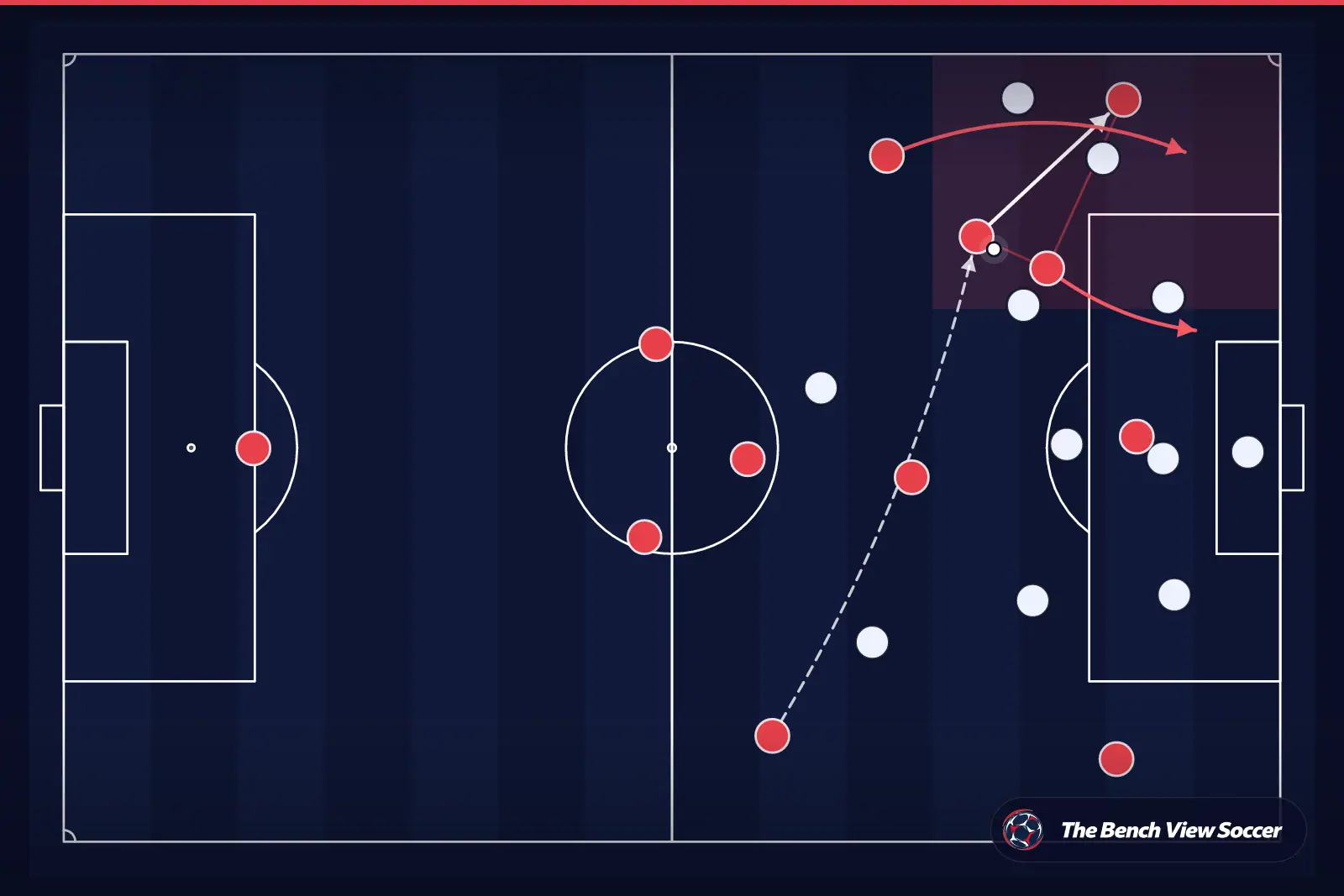
Liverpool stretch opponents using two connected ideas: width to pin the back line, and half-space occupation to attack the gaps that width creates. In Klopp’s classic 4-3-3, the wide forwards (think Mohamed Salah and Sadio Mané historically, or the current rotation of Luis Díaz, Cody Gakpo, Diogo Jota) start wide enough to force the opposing full-backs to make a choice. When the winger stays near the touchline, the opponent’s back four spreads wider. That extra spacing is the “stretch.” Now the half-space becomes the main entry point: a midfielder steps into it (often the right-sided No.8) or the forward drifts inside to receive on the blind side (the side defenders can’t easily see while facing the ball). The full-backs then support the pattern: Trent Alexander-Arnold often delivers from the right with diagonal passes or early crosses, while Andrew Robertson attacks the left channel with overlaps to keep the opposition wide. The key is timing. Liverpool do not just stand wide; they shift the ball quickly, then one player occupies the half-space at the moment the back line is pinned. This creates common outcomes: a cut-back from the byline, a through pass into the inside channel, or a shot from the half-space where the goal angle is strong and the defender is not set.
Match Examples
A clear reference point is Liverpool vs Manchester City, Premier League 2017–18 (4–3 at Anfield). Klopp’s Liverpool repeatedly create danger by pulling City’s full-backs wide and then attacking the inside channels with diagonal runs. Salah and Mané start wide to receive, which forces Kyle Walker and Fabian Delph to open their body position toward the touchline. When that happens, Liverpool’s next pass often targets the half-space run behind City’s midfield line, creating transitions where the defender is isolated and the centre-backs are stretched apart. Another useful example is Liverpool vs Barcelona, UEFA Champions League semi-final second leg 2018–19 (4–0 at Anfield). Even without Salah and Roberto Firmino, Liverpool keep width high, pin Barcelona’s back line, and then attack half-space gaps with runners arriving from deeper positions; the famous quick corner works because the defence is fixated on central zones and loses the reference of who is arriving in the half-space near the near-post corridor. A third example is Liverpool vs Manchester United, Premier League 2021–22 at Anfield (4–0). Liverpool’s wide threats fix United’s back line, while movements into the half-spaces create cut-backs and third-man runs (a pass to a player who then sets it for a third runner). Across these matches, the repeated theme is that Liverpool’s width is not the final goal; it is the tool that opens the half-space for the decisive action.
Related Concepts & Skills
Training Implications
To train this concept, you want drills that teach players to “hold width, then attack the half-space on a cue.” Start with a 7v7+2 neutral possession game in a rectangle, but mark two half-space lanes with flat cones. Rule: a goal counts only if the final pass enters a half-space lane before the shot/finish. This forces players to recognise the half-space as a target zone, not just the wing. Next, run a pattern-play sequence on each side: (1) winger receives wide with back to goal, (2) full-back overlaps to pin the defender, (3) inside midfielder or forward makes a timed half-space run, (4) winger either slips a through pass inside or sets back for a diagonal switch. Coach the timing: the runner moves only when the opposing full-back is “pulled” toward the touchline. Add a defender and progress to 3v3 on the flank plus one arriving midfielder, rewarding cut-backs from the byline and low crosses from the half-space. Finally, include a transition rule: if the defending team wins the ball, they get 5 seconds to counter into mini-goals. This teaches “rest defence” positioning—one midfielder holds central cover while wide players attack—mirroring how Liverpool stretch teams without becoming easy to counter.
The Bench View app
Don’t just read football — train it
Everything you read here, turned into training you can follow step by step.
Physical training at home
AI daily sessions adapted to your level and position. No equipment needed.
Tactical training courses
Step-by-step courses on positioning, pressing, build-up and decision making.
- 7 days free
- No commitment
- Cancel anytime
Free account: 2 physical sessions + the first tactical course. PRO: 7-day free trial — cancel before day 8 and you pay nothing.