Introduction
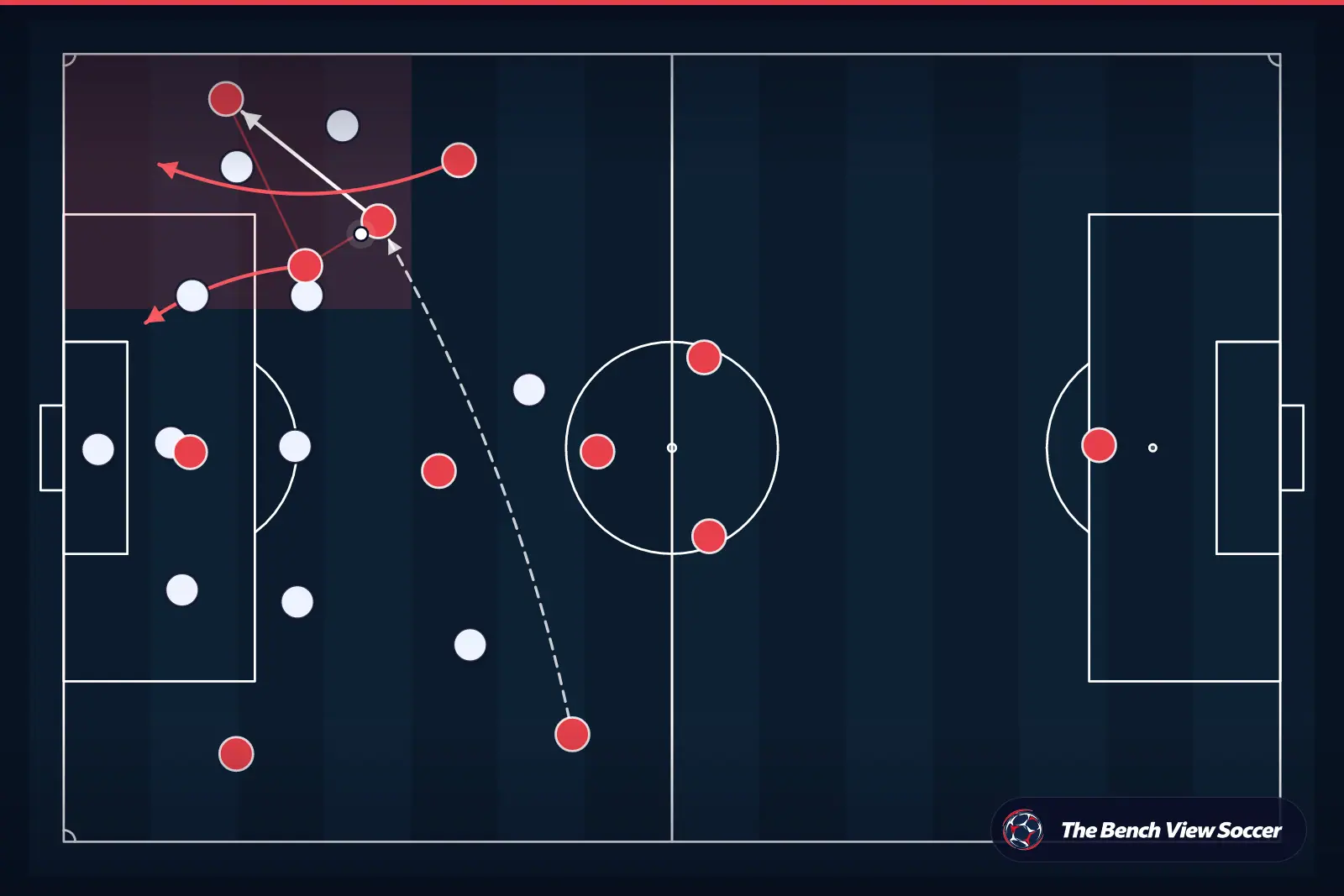
Manchester City under Pep Guardiola regularly faces the hardest problem in modern football: low blocks. In the Premier League and the UEFA Champions League, opponents like Everton, Brentford, Inter, and Atlético Madrid often defend with many players behind the ball, protecting the centre and daring City to cross. City’s answer is not just “use the wings,” but a very specific method: wide overloads. A wide overload means City intentionally places more players than the opponent in one wide corridor, usually near the touchline, to create a spare man (an extra passing option) and force defenders to make uncomfortable choices. For fans new to tactics, think of it like creating a local 4v3 or 3v2 in one corner of the pitch, so the ball can either progress down the line, cut inside, or switch to the far side. This article breaks down how City builds these overloads, what movements make them work, and why it is so hard to defend when executed at Guardiola’s level.
How It Works
City’s wide overload starts from their build-up structure. In many Guardiola seasons, City forms a 3-2 base in possession: three players secure the back line (often two centre-backs plus a fullback tucking in, or a goalkeeper like Ederson supporting), while two midfielders hold central access. From there, City pushes wingers high and wide, pinning the opponent’s fullbacks. The overload is created when additional players arrive to the same side: a fullback (like Kyle Walker or previously João Cancelo) steps forward, a central midfielder (Kevin De Bruyne, Bernardo Silva, İlkay Gündoğan in earlier seasons) drifts into the channel, and a “false nine” or striker (Phil Foden, Julián Álvarez, or Erling Haaland as a reference point) positions to occupy centre-backs. The key is role separation. One player provides width on the touchline, one player provides a support angle behind the ball, and one player occupies the half-space (the lane between fullback and centre-back). City then uses quick triangles and third-man combinations. A third-man move means Player A passes to Player B, who immediately sets the ball for Player C running into space; the defender tracks the ball and loses the runner. When the opponent shifts numbers to stop the overload, City often attacks the “exit”: a switch of play to the far-side winger or a cutback to the top of the box. Wide overloads are not only about crossing; they are about creating a moment where the defence is stretched sideways, then exploiting the gap that appears either behind the fullback, between defenders, or on the far side.
Match Examples
A clear reference point is the 2022-23 Premier League season, when City wins the title and later completes the treble under Guardiola. In several home matches against deep blocks at the Etihad, City uses Bernardo Silva and Kevin De Bruyne to overload one wing while Jack Grealish holds width on the left. The pattern is consistent: Grealish stays high and wide to pin the right-back, while Bernardo or De Bruyne arrives to create a local triangle with a fullback and a central midfielder. The opponent’s wide midfielder is forced to choose: stay compact inside and allow City progression down the wing, or jump out and open a passing lane into the half-space. Another strong example comes from the UEFA Champions League 2022-23 knockout rounds, where City’s wing-focused combinations repeatedly set up cutbacks rather than hopeful crosses. Against a compact European opponent, City attracts pressure near the touchline, then releases a runner into the box or finds a far-post option after switching. This is why Guardiola values players like Grealish: he protects the ball, invites defenders, and gives time for teammates to arrive. In the Premier League 2023-24 season, City often leans on wide overloads to create entries for Haaland. When the opposition centre-backs stay tight to him, City’s wide play aims to force a fullback or wide midfielder to over-help, and that slight delay opens either a cutback lane for a late-arriving midfielder or a low cross into Haaland’s movement. Even when City does not score directly from the overload, the repeated threat gradually pins the opponent deeper, increasing City’s control and the number of shots from high-quality central zones.
Related Concepts & Skills
Training Implications
For coaches and players (including Indian youth setups) wanting to replicate City’s wide overload principles, the focus should be on spacing, angles, and decision-making rather than copying star-player skills. Start with a simple 4v4+2 rondo in a wide channel (about 20x15 metres). The two neutral players act as City’s support options: one behind the ball (like a holding midfielder) and one in the half-space. Coaching point: the wide player must stay on the touchline until the last moment to “pin” the defender; if they drift inside too early, the defence becomes compact again. Next, run a pattern drill for third-man combinations: A (fullback) passes to B (wide winger), B sets back to A, and C (midfielder in half-space) runs behind the fullback’s shoulder for the through pass. Rotate roles every 3-4 repetitions. Add a defender after players understand timing, then add a second defender to force a switch of play as the “exit option.” Finally, create a game-based exercise: 7v7 with wide channels marked. Award two points for a goal created from (1) a wide overload (at least three attackers involved in the channel) followed by (2) a cutback or a switch within five seconds. This builds the habit City shows: overload to attract, then exploit the gap quickly. Use video clips from Manchester City in the Premier League or Champions League to show what “good width” and “good support angles” look like before training, so players understand the why, not just the pattern.
The Bench View app
Don’t just read football — train it
Everything you read here, turned into training you can follow step by step.
Physical training at home
AI daily sessions adapted to your level and position. No equipment needed.
Tactical training courses
Step-by-step courses on positioning, pressing, build-up and decision making.
- 7 days free
- No commitment
- Cancel anytime
Free account: 2 physical sessions + the first tactical course. PRO: 7-day free trial — cancel before day 8 and you pay nothing.