Introduction
An inverted winger is a wide attacker who plays on the “wrong” side: a right-footer on the left wing or a left-footer on the right. The simple idea is to receive wide, then drive inside toward goal, usually onto the stronger foot. For fans used to thinking “wingers cross, strikers finish,” inverted wingers explain why modern Premier League attacks look more like waves of runners and rotations than straight-line wing play. Two of the best case studies are Mikel Arteta’s Arsenal and Pep Guardiola’s Manchester City, both in the Premier League and UEFA Champions League. Both sides use inverted wingers to enter central areas, create better shooting angles, and combine with midfielders and full-backs. But they do it in clearly different ways: Arsenal often build a direct connection from wing to box with timing and isolation, while City often treat the winger as one piece in a larger positional structure that controls space and tempo. Understanding these differences helps you read matches, predict patterns, and appreciate why certain players fit certain systems.
How It Works
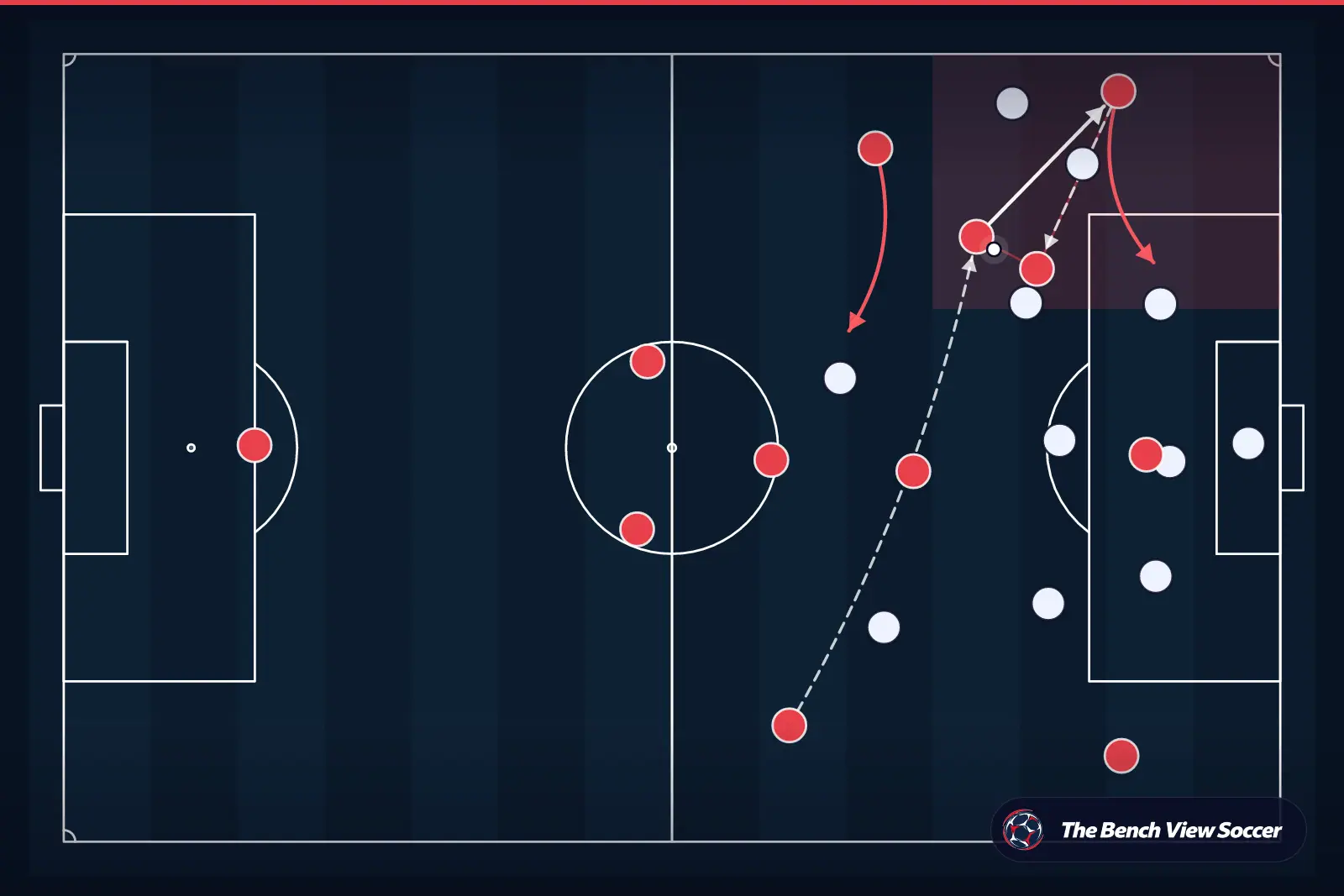
At a basic level, an inverted winger offers three core threats: (1) an inside dribble that draws defenders and opens the flank for an overlapping full-back, (2) a diagonal run into the box for cut-backs or shots, and (3) a short combination option in the “half-space” (the channel between the wing and the centre). Arsenal’s use is strongly linked to isolations and vertical speed. Under Arteta, the left side typically features Gabriel Martinelli (or Leandro Trossard) holding width early, then sprinting inside when the ball arrives, while Bukayo Saka on the right receives to feet and attacks the full-back 1v1. Arsenal often form a 2-3-5 in possession: two centre-backs, three behind the attack (including an inverted full-back like Oleksandr Zinchenko), and five across the front line. The inverted winger becomes a direct goal threat, with the far-side winger attacking the back post. Manchester City under Guardiola uses inverted wingers more as “space managers.” In many matches, City’s wingers (Phil Foden, Jack Grealish, Bernardo Silva, Jérémy Doku) stay wide longer to stretch the back line, even if they are inverted-footed. The inside movement happens later, often after City have fixed the opponent’s shape with patient circulation. City also use “underlaps” (a runner going inside the winger) from midfielders like Kevin De Bruyne or from full-backs, while the winger pins the full-back. When City’s winger does invert, it is frequently to create a passing triangle and free a central player, rather than to immediately shoot. The difference is not that one team likes dribbling and the other does not; it is about timing. Arsenal’s inverted wingers often attack earlier in the move, while City’s inverted wingers often attack after the opponent has been stretched and tired by repeated positional pressure.
Match Examples
Arsenal example: Arsenal vs Liverpool, Premier League 2023–24 (4 February 2024). Watch how Bukayo Saka, as the right-sided inverted winger (left-footed on the right), receives wide and then immediately drives inside to threaten goal, especially when Arsenal win the ball and transition quickly. Arsenal’s structure encourages Saka to attack the gap between Liverpool’s left-back and left centre-back, while Martinelli on the opposite side looks to sprint inside for the far-post run. The key tactical point is speed of intention: the winger’s first touch often points toward the penalty area, not toward recycling possession. Arsenal example: Arsenal vs Manchester City, Premier League 2023–24 (8 October 2023). In this match, Arsenal’s wide players spend long periods waiting for the right moment because City’s control limits transitions. When the moment comes, the inverted winger’s role becomes about shot creation from the inside channel rather than constant crossing. The deflected goal highlights how Arsenal search for inside shooting lanes rather than only wide deliveries. Manchester City example: Manchester City vs Real Madrid, UEFA Champions League 2023–24 quarter-final second leg (17 April 2024). City’s wingers largely maintain width to pin Madrid’s full-backs while the central players circulate to probe. The inverted action appears as delayed movements: the winger comes inside to combine, then the space outside is attacked by an overlapping or an underlapping run. This match shows Guardiola’s preference for controlling where the opponent stands before the winger attacks the inside. Manchester City example: Manchester City vs Manchester United, Premier League 2023–24 (3 March 2024). City’s wide players, especially on the left, often hold the touchline to create 1v1s, but the real danger arrives when the winger’s inside dribble pulls midfielders inward and opens a cut-back lane. The inverted winger here is not only a shooter; he becomes the first domino that shifts the opponent’s block, allowing City’s midfield to arrive into the box in waves.
Related Concepts & Skills
Training Implications
For coaches and players in India trying to learn the inverted winger role, train the timing and decision-making, not just the “cut inside and shoot” habit. Start with a 1v1 corridor drill: mark a 12x18 metre channel near the touchline, place a defender, and require the winger to take the first touch either down the line or inside. Score two ways: (a) a shot after cutting inside through a mini-gate at the top of the box zone, or (b) a pass to an overlapping runner who crosses first time. Rotate roles every 90 seconds so players learn both attacking and defending. Add a triangle combination pattern to mimic City: winger wide, midfielder in the half-space, full-back behind. The sequence is pass to winger, bounce inside to midfielder, then either a return to the winger for a delayed inside dribble or a through pass for an underlap. Put a constraint: the winger must hold width for two seconds before moving inside, teaching delayed inversion. To mimic Arsenal’s directness, run a transition game: 6v6 plus two neutral wide players (the wingers). On winning the ball, the team has eight seconds to attack. The winger’s coaching points are concrete: open body to see inside, first touch forward, and decide within two touches—shoot, slip a runner, or recycle. Finally, include defensive work: teach the inverted winger to press the opponent full-back from outside-in, using the touchline as an extra defender, and to track back into the half-space when the ball is on the far side.
The Bench View app
Don’t just read football — train it
Everything you read here, turned into training you can follow step by step.
Physical training at home
AI daily sessions adapted to your level and position. No equipment needed.
Tactical training courses
Step-by-step courses on positioning, pressing, build-up and decision making.
- 7 days free
- No commitment
- Cancel anytime
Free account: 2 physical sessions + the first tactical course. PRO: 7-day free trial — cancel before day 8 and you pay nothing.