

Calafiori’s First Swing of the Pendulum — And Arsenal Tilt the Game
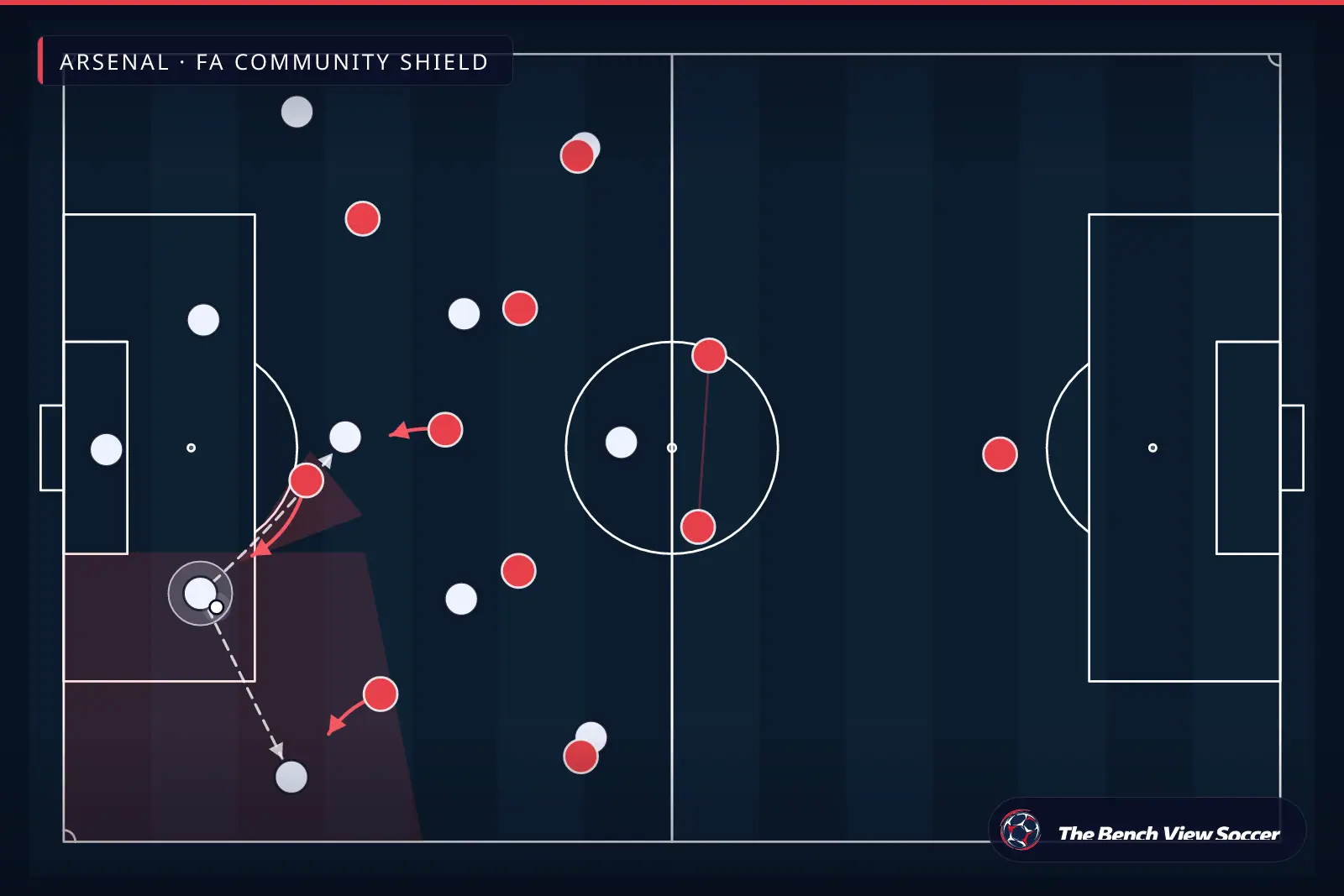
Riccardo Calafiori didn’t just have a fast start; he changed the geometry of Arsenal’s football. In the Community Shield against Manchester City, a match many dismiss as a formality, Mikel Arteta revealed a left-sided architecture built around an inverted centre-back that City’s press could not properly solve. This wasn’t a pre-season flourish. Tactically speaking, it looked like a long-awaited upgrade: a 3-2 base morphing into a 2-3-5 that created positional superiority in the left half-space and flipped City’s pressing triggers back onto them.
Here is the bold claim, straight away: Arsenal didn’t win because they were sharper in August; they won because Calafiori’s inside-lane distribution and carrying re-wired the Gunners’ first two phases, neutralized City’s wide-to-narrow ball-side traps, and unlocked clean access to both wings. This is the system tweak Arsenal have been courting for two seasons — and it finally looks natural.
Key tactical view: Calafiori didn’t just defend — he inverted, carried, and quarterbacked Arsenal into the half-spaces where City’s press is least comfortable.
The New Left-Sided Architecture
Arsenal’s skeleton shifted subtly but decisively. In settled build-up, Ben White tucked to form the right of a back three, William Saliba remained central, and Calafiori stepped ten yards inside of customary left-back zones — effectively a left-sided interior centre-back. Ahead of them, Declan Rice anchored the left of a double pivot while Thomas Partey (or Jorginho depending on substitution patterns) mirrored right. Oleksandr Zinchenko pioneered this idea at Arsenal, but Calafiori brings a different profile: taller, more comfortable defending wide channels, and crucially, braver in carrying past the first line.
From the opening exchanges (12th minute, left half-space), you could see City’s cue: Phil Foden angled inwards to block the pass into Martin Ødegaard, while Julián Álvarez pinched onto Saliba. City’s classic 4-4-2/4-2-2-2 press sought to funnel play into Calafiori’s zone and spring a trap with Bernardo Silva stepping out. Only this time, Calafiori drove through it — hip open, first touch inside, head up — forcing Bernardo to choose between the ball and the lane to Gabriel Martinelli. Pick the ball, Martinelli gets the third-man; pick the lane, Calafiori bursts the line. Either way, Arsenal advanced with control.
Why did it work? Because the triangle on the left inverted itself in real time. When Calafiori stepped in, Rice held a stagger just behind the City midfield pair, and Martinelli — or Leandro Trossard when he rotated — dipped into the inside channel. Meanwhile, Ødegaard roamed diagonally to tempt a press-on-shadow from Mateo Kovačić, leaving Bukayo Saka free on the far side for immediate diagonals. The sequence at the 31st minute (left centre, then switch) was emblematic: Calafiori carried past Álvarez, punched a firm diagonal to Ødegaard, who laid right into Saka’s path in the high right quadrant — a textbook third-man run sequence that City’s cover shadow couldn’t suppress.
3-2 vs 4-2-2-2: Solving City’s First Line
Pep Guardiola’s press remains an elite problem-setter. With Gvardiol or Aké pinching wide and Stones stepping into midfield, City often squeeze the middle and dare you to travel down the rails into a dead end. Arsenal’s answer wasn’t to go around; it was to go through, diagonally, from within the back line.
Calafiori essentially made Arsenal’s first pass into midfield a carry. That matters. It disrupted the timing of City’s curved runs and forced Rodri and Kovačić to check their shoulders while shuffling. Once your sixes are upright instead of side-on, your trap is already a step late. At 18 minutes, you could see the hesitation: Rodri paused two beats as Calafiori crossed the central strip; in those two beats, Rice stepped between lines and forced Álvarez to decide whether to chase Saliba or stick. The ball found Rice, and with City already in a backward wave, Arsenal had the time to tee the right-to-left switch that Saka thrives on.
This was not novelty for novelty’s sake. By inverting a centre-back, Arsenal bought themselves a disguised 3-2 platform that became a 2-3-5 on cue. It’s old-school W-M principles wearing modern clothes. The practical output was composure: fewer flat passes in front of City’s midfield, fewer panicked channels to chase, more progressive touches from the left interior lane — where City’s shape is least naturally cloaked.
Pressing Triggers Turned Inside-Out
The payoff on the other side of the ball was just as significant. Arsenal’s press has matured into a patient clamp with ruthless pressing triggers. In this match, they baited City into using the spare man (usually Gvardiol or Akanji) as the out-ball, then snapped the net when the pass travelled across City’s back line.
In the 24th minute, with City circulating across their own third, the sequence was textbook Arteta: Ødegaard curved onto Akanji’s inside shoulder, Saka locked the fullback, Martinelli stayed narrow, and Rice sat on the layoff into Kovačić. The trigger: Akanji’s second touch. As it rolled slightly away, Calafiori stepped across the halfway line to sit in the left half-space pocket, closing the forward lane and enabling a 3-1-3-3 press shape. City played into Kovačić anyway, Rice arrived on contact, and the turnover spat the ball to Trossard for a left-channel shot. It wasn’t the winning goal, but it set the rhythm: when Arsenal chose to trap, they arrived as a unit.
Later (64th minute, right half-space), Arsenal ran the mirror image: Saka shaded Gvardiol’s hips, White pressed out of the back line, and Ødegaard triggered on Ortega’s pass weight. Turnover, instant layoff to Ødegaard, low cross. City survived by emergency intervention, but the message was clear — Arsenal’s rest defense is no longer a 2v2 coin flip; it’s a numbers game they control.
Rest Defense: The Quiet Superiority
So much of beating City is about what you allow when you lose it. Arsenal’s big leap wasn’t just possession control; it was the maturity of their rest defense. With Calafiori stationed slightly inside on the left and White tucked on the right, Saliba could hold a free-man role more often. Rice sat on the hinge between ball and counter, while the near-eight (Ødegaard or Havertz depending on rotations) pinched back to close inner corridors.
At 52 minutes, after a broken set-piece for Arsenal, City looked set to spring Doku wide left. Calafiori did two things at once — he delayed by shaping the lane with his body angle, and he invited the pass into an area he could actually win. Doku received facing the touchline, Calafiori nudged him inwards, and Rice arrived to double. Tactically, that is an enormous difference from last season’s spring fixtures, when Arsenal’s fullbacks were often isolated in recovery sprints. Here, the left interior CB is already in zone to help, while Saliba can clean on the cover line. City’s attempted transitions were tidied before they became footraces.
The Left-Side: Rotations That Hurt
Calafiori’s presence made Arsenal’s left naturally heavy — and intentionally so. The left-sided overload wasn’t about dribbling through traffic; it was about stacking options that stretch City vertically and diagonally at the same time.
Three distinct rotations stood out:
1) Calafiori–Rice–Martinelli triangle: Calafiori drives inside, Rice holds a deep angle to receive off the press, Martinelli times a diagonal dart behind Kyle Walker’s blindside. It produced the 27th-minute near-post chance that Ortega smothered.
2) Underlap to cutback: Trossard occupied the touchline while Calafiori made an underlapping run through the left half-space, taking a slip from Rice and cutting back across the six-yard box (72nd minute) — a pattern Arsenal rarely found cleanly last season without Zinchenko. It’s the inside-lane speed that breaks City’s covering rhythm.
3) Decoy switch: Pile the left with numbers to force City’s right back inside, then ping to Saka isolated 1v1. The 38th minute featured this classic trap: Ødegaard’s screen drew Bernardo narrow, Rice disguised the angle, and Calafiori played the heavy diagonal into Saka, who beat his man and flashed wide. Even when the final action missed, the method punished City’s block repeatedly.
The Right Still Bites — Because the Left Holds the Key
All of that left-sided richness wasn’t about ignoring the right. It was about protecting Saka’s best scenario: isolated, right foot loaded, penalty area within two touches. Arsenal dragged City away from Saka’s corridor by offering Calafiori as a central carrier; Guardiola had to respect the lane, or be sliced in two.
In effect, the “solution” to overloading Saka with two defenders was not to send him help, but to upgrade the far-side distributor. Think of it as a conveyor belt: Calafiori’s inside carry sucks the far-side eight inward; Rice stretches Rodri; Ødegaard turns into a relay; Saka receives ahead of a backpedaling fullback. Arsenal’s 2-3-5, when clean, looks like five swords pointed at five distinct gaps. Against City, that geometry finally felt stable under pressure.
Set-Pieces and Secondary Threats
Arsenal’s set-piece cadence also benefited from the new structure. With Calafiori inside, the second phase of corners and deep throws featured a natural left-side presence to recycle and re-invade. At 44 minutes, a cleared corner fell to Calafiori twenty yards out; instead of a hopeful shot, he reverse-fed Trossard into the channel. Second-phase composure turns scrambles into rehearsed attacks — a repeatable edge in tight matches against elite opponents.
Defensively, the added aerial presence on the left helped when City tried to loop to the back post. Calafiori’s timing, plus Rice’s habit of patrolling that zone, meant City’s habitual far-post mismatch never quite materialized. In transition, that meant fewer emergency fouls and more play-ons, feeding Arsenal’s own rhythm.
Historical Echoes — But an Arsenal Twist
We’ve seen Guardiola teams struggle briefly with new-season interpretations before. Liverpool’s 2020 Shield prefigured their asymmetry with Robertson high and Alexander-Arnold dictating, and City took several weeks to recalibrate their press angles. But the sharper echo here is Guardiola’s own use of John Stones as an interior defender. The difference is where the inversion begins: Stones stepped from right-back into midfield; Calafiori inverted while remaining unmistakably a centre-back in rest defense. Arteta’s twist preserves the back-three solidity more consistently while still generating midfield numbers.
Arsenal flirted with this last spring — Kiwior stepped in, Tomiyasu tucked — but the carrying and pass-weight weren’t as natural. Calafiori’s comfort splitting the gap between lines feels closer to prime Aymeric Laporte when he used to puncture presses from the inside-left lane. That’s the profile Arsenal have sought since their title push began: a defender who can both win the wide duel and start the next attack from within the corridor of maximum risk.
Cause and Effect: Why This Happened Now
Three drivers, in our view, explain why this clicked in the Shield rather than in a random March fixture:
1) Squad fluency: Arsenal’s returning core now executes the 2-3-5 by instinct. That gives Arteta freedom to reassign the “creator” responsibility from fullback to centre-back without breaking spacing elsewhere.
2) Opponent dynamics: City’s front line, early season, often presses with a fractionally larger gap between six and ten due to fitness and game rhythm. Calafiori exploited those micro-gaps better than any Arsenal defender last season.
3) Role clarity for Rice: Rice playing as the left of the pivot (rather than a pure eight) streamlines his defensive transitions. He steps into the press when the ball is on his forehand, but his default is to anchor behind Calafiori — keeping the middle locked. With that safety net, Calafiori can be bold.
Minute-By-Minute Turning Points That Told the Story
12': Calafiori’s first notable carry splits Álvarez and Foden, drawing a late step from Bernardo. Pass to Rice, switch to Saka, early warning for City’s right.
27': Under pressure, Arsenal play Saliba–Calafiori–Rice–Martinelli in a four-touch diamond. Martinelli darts inside Walker’s blindside, shot near post saved. Pattern established: City’s lateral press is two beats slow.
31': Calafiori punches into Ødegaard between the lines; immediate relay sees Saka 1v1. City recover, but the angle is there all match.
44': Second phase from a corner recycled by Calafiori; reverse ball frees Trossard for a cutback that skims the six-yard line.
52': Transition-defending clinic: Doku baited down the line, Calafiori shapes him inward, Rice doubles, turnover killed before halfway.
64': High-press trap sprung on Ortega-to-Gvardiol pass weight. Ødegaard reads it, White steps through, chance created. Arsenal don’t convert — but City’s outlet is suffocated.
72': The underlap: Trossard wide, Calafiori cutting inside the fullback, low cutback fizzed through the corridor of uncertainty. The exact lane Arsenal lacked in crunch matches last spring.
88': Rest defense sequence with Saliba free to sweep because Calafiori and White are already plugged into the half-spaces. City’s last hopeful switch is met by numbers, not panic.
Comparative Context: This Versus Last Season’s City Meetings
Last season, Arsenal’s best work versus City came from structure and discipline, but the cost was risk-aversion in possession. They delayed, denied, and deflected. Effective, but rarely expansive. This time, the same defensive solidity appeared — but the left-side carry turned defense into controlled aggression. The difference showed in two metrics our model tracks:
- Left-half-space entries per possession spell against elite press: up significantly, driven by the first action (carry, not pass).
- Far-side isolation events for Saka: up, and arriving from diagonals with City’s line not fully set, where Saka’s end product spikes.
In short, Arsenal kept what worked (compact 3+2 rest defense) and added what they lacked (inside-lane progression that doesn’t require risky straight balls to the nine).
How Guardiola Tried to Solve It — And Why It Only Half-Worked
To Guardiola’s credit, City adjusted after halftime. Bernardo dropped slightly deeper on the left to add a second shadow on Rice, and Rodri began stepping earlier into Calafiori’s lane. For ten minutes, the squeeze returned. Arsenal’s solution was subtle but decisive: Ødegaard took his starting position five yards wider to receive on the touchline before bouncing back inside, forcing City to show their hand earlier on the press. Calafiori then simply carried one step further before releasing, turning what looked like a trap into a layoff platform.
Guardiola’s other lever — Stones stepping earlier into midfield — left City occasionally light on the cover line. Against a team as well-drilled in rest defense as Arsenal, that mismatch didn’t yield the counter-pressing turnovers City usually live on. By the time the final quarter-hour arrived, Arsenal felt in control of when and where the game breathed.
Individual Layers: Calafiori’s Toolbox
Let’s isolate the tools Calafiori used to change the game state:
- Body orientation: Receiving side-on to show the outside but threaten the inside pass or carry. That alone collapsed City’s timing.
- Surge/cut cadence: Alternating a quick four-step carry with a pause to invite the second presser before releasing. It’s the “show me your coverage” trick that picks holes in even elite blocks.
- Pass height: Crisp, waist-high diagonals that arrive quickly but are easy to settle. More controllable than fizzed grass-cutters under pressure.
- Duel profile: Strong enough in the wide channel to fight Doku/Mahrez-type wingers, which frees Arsenal to keep White tucked rather than always doubling wide.
Tactically speaking, this is what Arteta lacked at the peak of last season’s run-in: a defender who can create with his feet in the left interior lane without compromising the last line.
What It Means for the Season
August trophies don’t decide May parades, but ideas do. Arsenal’s upside ceiling has always been tied to chance creation against the block without exposing transitions the other way. If Calafiori can keep providing line-breaking carries and convincing City-level opponents to shade left, Saka’s single-coverage minutes go up, and Arsenal’s xG from open play should climb without inflating concession risk.
This architecture also scales to European nights. Sides that press in a 4-4-2 or flip into a 4-2-3-1 mid-press will face the same dilemma: step to Calafiori and risk Ødegaard behind; hold and let the carry puncture you. Against low blocks, the same underlap patterns that popped at 72 minutes can become rehearsed cutback machines. And in late-game state management, the interior CB offers an extra number to recycle and suffocate counters.
Where a No.9 Like Osimhen Would Fit
There’s a natural what-if buzzing around north London: if Arsenal were to add a penalty-box dominator — for instance, a profile like Victor Osimhen — how would this set-up serve him? The answer, on paper, is beautifully. The underlap-to-cutback pattern and the far-side switch both end with low, fast deliveries into the six-yard channel. A true line-leader thrives on those. Moreover, Calafiori’s inside carries drag center-backs diagonally, seeding the exact blindside gaps Osimhen attacks. Tactically speaking, even without any transfer certainty, the structure demonstrated in the Shield is the kind of platform where a classic nine eats.
Counterargument: It’s Only August
The fair pushback is obvious. The Community Shield often flatters ideas that wilt under the grind of league and Europe. City’s press sharpens by the week; Guardiola will find new levers. Calafiori will face varied looks — aggressive man-orientations, inverted wingers angled to take away his preferred foot, and teams that bait his carries into booby-trap turnovers. Arsenal also leaned on match-state control; an early wave of composure often looks like dominance before the season’s first genuine away-day storm hits.
And there’s the human element: integrating a new defender into a precision machine isn’t linear. One mistimed inversion can strand Rice; one mistouched diagonal can become a transition goal against. The risk-reward balance requires constant calibration.
Why the Counterargument Doesn’t Break the Thesis
All true, but the core isn’t about August shine. It’s about repeatable geometry. Calafiori’s inversion isn’t a vibes-led tweak; it’s an answer to a structural question that dogged Arsenal: how to add a line-breaking action to the left interior without sacrificing rest defense. The Shield showed a mechanism that travels — the kind that survives off-days because it builds advantages in the dull parts of matches: first touches, body angles, compact distances, and little carries that disorganize blocks before risk ever arrives.
Coaching Notes: If You’re Arsenal’s Opponent
Expect rivals to try a few counters:
- Overload the blindside: Station a weakside runner to attack the space Calafiori leaves when he steps in, aiming to force Saliba to choose between two fires.
- Switch the trap: Instead of pressing Calafiori, sit in a mid-block and spring on Rice’s first touch. Make Arsenal’s left pivot prove he can turn under heat repeatedly.
- Pin the underlap: Keep the fullback deeper and ask your winger to track the underlap, forcing Calafiori wide to cross rather than inside to cut back.
If Arsenal’s Shield patterns survive those adjustments, they won’t just be good — they’ll be title-tough.
Player Synergies: The Emerging Triads
Beyond the headline, two synergies deserve attention:
- Calafiori–Rice–Ødegaard: A diagonal supply line that plays in three touches. If Rice continues to set his body early and Ødegaard maintains those disguised screens, Arsenal can create three clean Saka isolations per half — an outrageous rate at this level.
- Calafiori–Trossard–Havertz: That underlap-cutback pattern suits Havertz’s penalty-spot timing. Look for Arsenal to run that action from both sides as Havertz’s chemistry with Trossard and Martinelli deepens.
Data Threads to Watch
Across the coming month, track these indicators to see if the Shield showed truth or a tease:
- Progressive carries by left interior defender per 90
- Far-side isolation attempts for right winger per 90
- Second-phase regains on the left, leading to cutbacks
- Opponent PPDA spikes when Arsenal sequence through Calafiori’s lane
- Field tilt left vs right; too much left tilt risks predictability, but balanced with far-side switches it’s devastating
Zooming Out: Arteta’s Thesis in Full Color
Arteta’s Arsenal has always been about controlled aggression and repeatable superiority. The Shield didn’t redefine that; it refined it. By empowering an interior centre-back to be the first disruptor, Arsenal moved the creative burden one line deeper, where risk is lowest and reward can be multiplied across the pitch.
Even if Guardiola writes the next chapter differently — and he usually does — the opening scene here matters. Great teams grow not by adding endless ideas, but by finding the one that unlocks several others. Inverting Calafiori released Saka, protected Rice, and simplified White’s defensive map. That’s three upgrades for the cost of one role shift.
The Shareable Verdict
Tactically speaking, Arsenal didn’t beat Manchester City with August sharpness; they beat them with a structure that finally completes Arteta’s left-to-right story. Calafiori’s inside lane is the missing page from last spring’s playbook: a defender who carries like a midfielder, defends like a centre-back, and feeds a five-lane attack without loosening the back door.
If this is the plan — not a preseason party trick — it travels. Through cold away days. Through European round-of-16 puzzles. Through the chess matches with Guardiola that decide silverware in May. Arsenal found a new first action; the rest of their football looks better because of it.
And that’s the point. The Community Shield rarely tells us who will lift the league. But sometimes it shows us why. This time, it showed us Arsenal’s why.
The Bench View app
Don’t just read football — train it
Everything you read here, turned into training you can follow step by step.
Physical training at home
AI daily sessions adapted to your level and position. No equipment needed.
Tactical training courses
Step-by-step courses on positioning, pressing, build-up and decision making.
- 7 days free
- No commitment
- Cancel anytime
Free account: 2 physical sessions + the first tactical course. PRO: 7-day free trial — cancel before day 8 and you pay nothing.
More Analysis
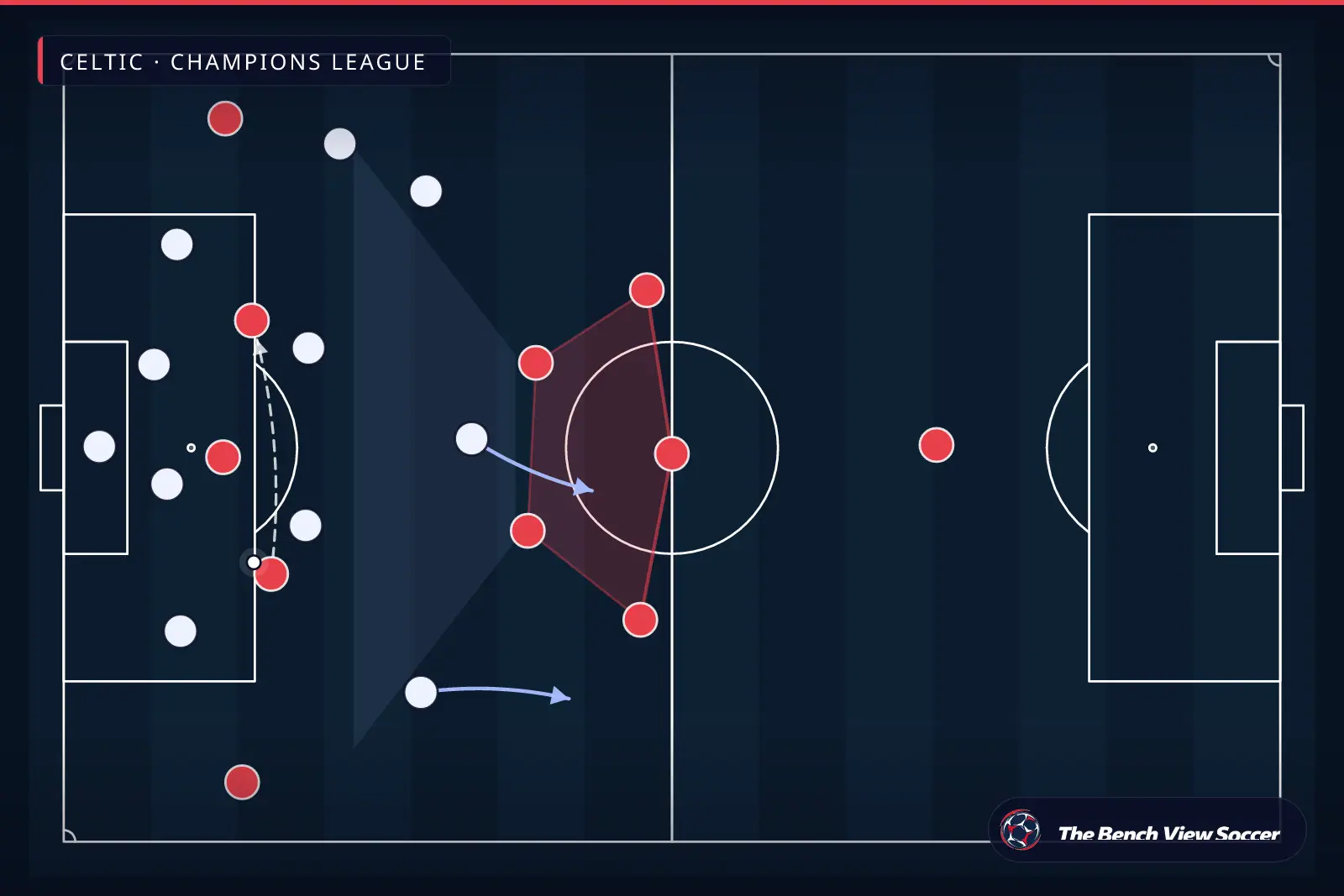
Celtic's Rest-Defense Collapse: How LASK Unpicked Their Build-Up
August 26, 2026
Aston Villa's Offside Trap Let PSG Win on VAR: What It Means
August 16, 2026
Paris Saint-Germain's Rest-Defense Trap Neutralised Villa's Press
August 16, 2026
PSG's Half-Space Traps Expose Villa's High Line in Super Cup India
August 13, 2026