

The VAR Moment That Told the Whole Tactical Story
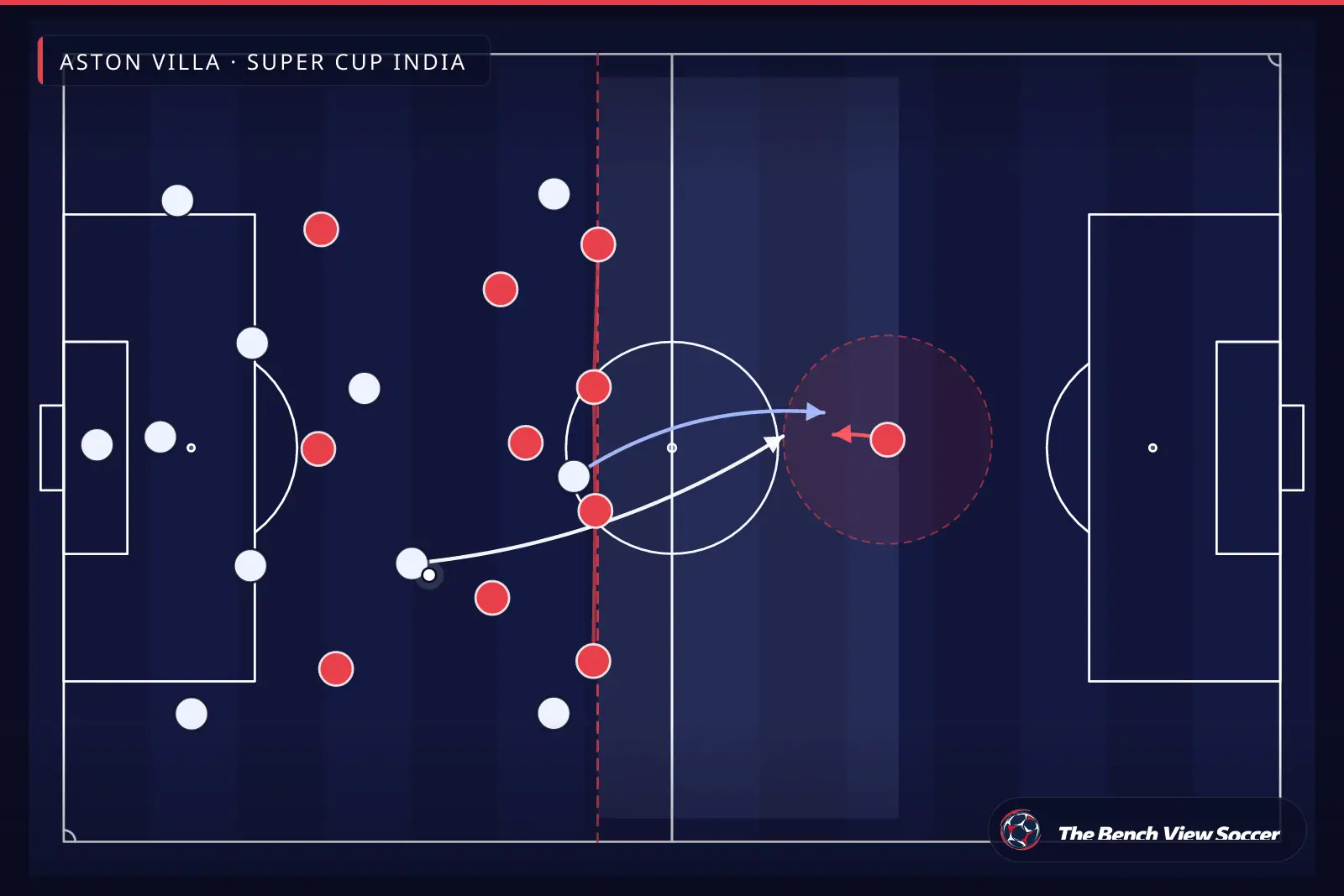
The trending clip is everywhere: a tight offside check, lines drawn, seconds stretching. Désiré Doué wheels away, and after a long VAR look, the goal stands. PSG beat Aston Villa in the Super Cup, but the truly instructive moment wasn’t the technology — it was the geometry. Tactically speaking, Aston Villa’s offside trap is a feature, not a bug of Unai Emery’s model, and this game showed exactly how a brave high line can be both a force multiplier and an Achilles’ heel when confronted by Luis Enrique’s spacing and timing. The real story of the night? The millimetres that VAR adjudicated were created by metres of positional superiority before the pass was even played.
That’s the bold claim: Villa didn’t lose to VAR; they lost to the timing PSG engineered to beat a high line that’s designed to squeeze the game and starve opponents. The frame-by-frame verdict merely confirmed what the structural choices had already decided.
“In our view, the goal wasn’t stolen by pixels — it was earned by patterns: wide spacing, third-man runs, and a high line daring the perfect pass.”
How Emery’s High Line Sets a Trap — And Why PSG Were Built to Spring It
Emery’s Aston Villa compress the field as a habit, not a gamble. The team’s defensive identity revolves around a synchronized high defensive line, aggressive step-ups from the centre-backs, and wingers who tuck in to form narrow lanes of resistance. Out of possession, it looks like a 4-4-2 or 4-4-1-1 mid-to-high block, but the distances are the giveaway: the back four living near the halfway line, the distance between lines just tight enough to suffocate the ball-carrier. The payoff is twofold. First, transitions can be launched from advanced zones after recoveries. Second, opponents must play higher-risk passes to reach the last line.
The trap element is subtle but powerful. Villa invite vertical passes and then burst into motion: a full-back steps, the near-sided winger drops into a cover shadow, and the centre-back snaps up into contact as the line jumps together. The best description is mechanical sympathy — the whole unit moves with one lever. When it works, Villa look like they’re stealing ground with every action, baiting a through ball and then punishing the premature run. Against domestic opposition last season, this produced a churn of offsides and hurried shots from poor angles.
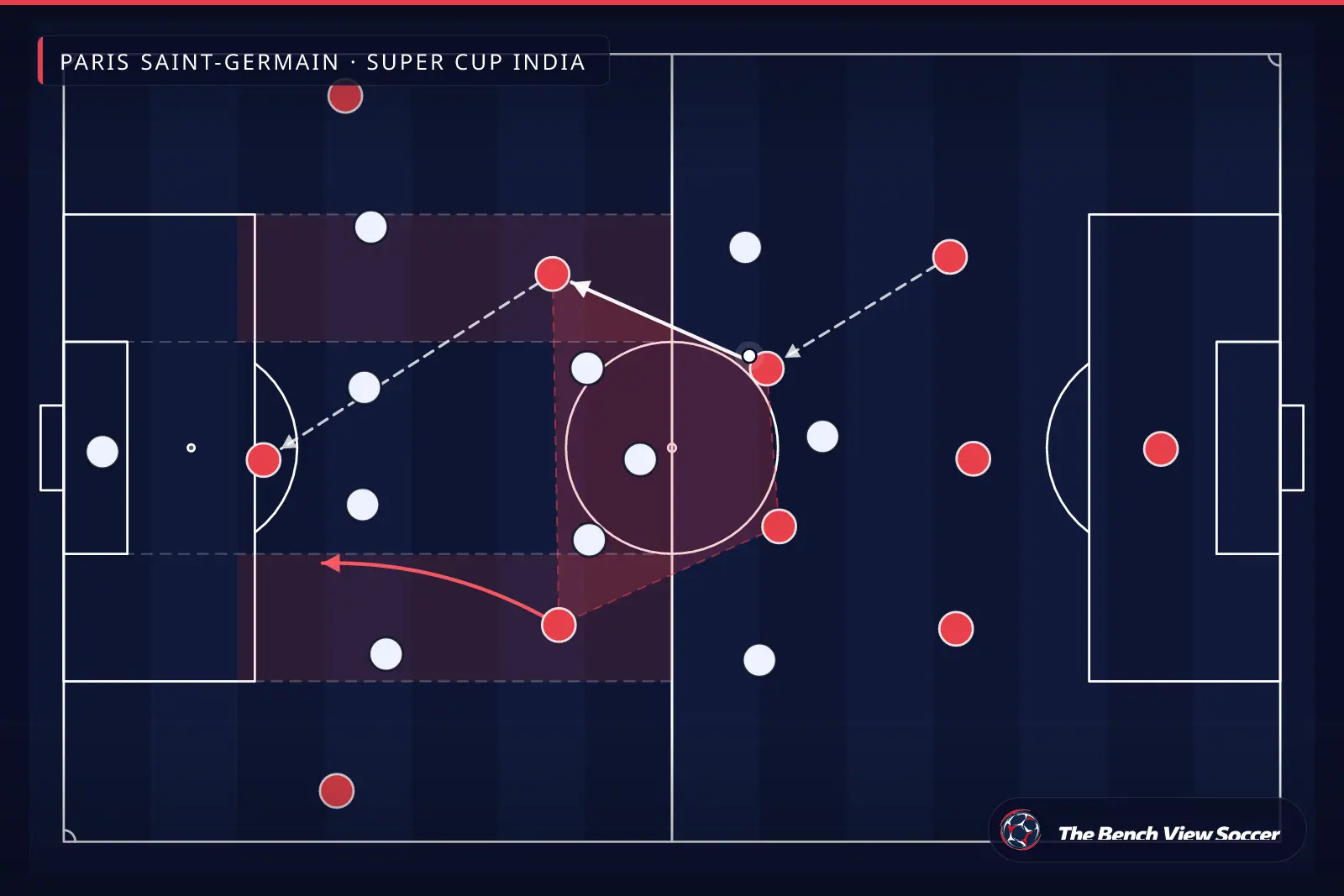
PSG under Luis Enrique ask different questions. In possession they morph into a 3-2-5 or 2-3-5 depending on which full-back inverts, with brutal width and interior half-space occupancy from flexible forwards. Where many sides attack a high line by simply running in behind, PSG unspool the trap with move-and-countermove on the flanks: stretch the line to the touchline, pin the full-back with a false decoy, and time the blindside run inside the channel the instant the centre-back leans forward. It is not just speed; it’s sequencing.
The Doué Pattern: From Touchline to Half-Space, Then Through
Rewatch the winning sequence and freeze it two passes earlier. PSG had the ball on their left, but the decisive cue came on the right as Doué drifted from outside to inside. That micro-rotation forced Villa’s right-back to choose: stay wide with the winger or tuck to keep compactness with the centre-back pairing. PSG thrive on that indecision. With Villa’s line set at near-halfway height and the weak-side centre-back holding a shallow angle, Doué started level and moved late — a run that seems small but becomes massive when matched with a perfectly weighted pass from the far-side interior.
This is the modern version of the classic offside-beating move. The first pass is sideways to draw the block; the second is backwards to freeze the defenders’ hips; the third is vertical, and that’s where the third-man run — a player not involved in the first two actions — arrives on cue. Against a side as synchronized as Villa, you don’t win the offside margin with your first movement. You win it with your third.
Minute-by-Minute Mechanics: The Little Levers That Shifted the Game
In the 65th-minute sequence that led to the VAR-awarded goal, the cues were textbook Enrique. The ball rotated through PSG’s left interior, out to the left-back, and then back inside — a pressing trigger for Villa to “jump.” As the right-sided player for PSG (Doué) crept inside the right half-space, the far-side centre-back of Villa glanced across and took a half-step up to hold the line. That was the decisive half-step. Villa’s full-back hesitated to release the wide player; the line’s micro-stagger meant the pass trajectory did not need to thread a needle — just arrive before the collective reset. The offside trap lives or dies on half-steps. PSG manufactured two of them at once.
Two other moments, one early (12’) and one late (78’), hinted at the same flaw. Early on, PSG ran a mirror action on Villa’s left, with the winger staying wide to pin the full-back and the interior cutting across the centre-back’s shoulder. The pass was overhit, but the shape was telling. Late on, when Villa pushed for an equaliser, PSG again found the right half-space with a bounce pass out of pressure, and a late dart forced Emi Martínez to sprint out and sweep. You could almost draw a training drill from those three plays.
Villa’s Positional Structure: Brave Build-Up, Compressed Rest Defense
Villa didn’t come to sit. In possession, they created a classic Emery box midfield: the nominal full-back on one side tucking in to form a temporary double pivot, the far full-back advancing to high-and-wide, and two narrow attacking midfielders operating between lines. The effect is a 2-2-2-4 or a 3-2-2-3 depending on how you label the inversion. The benefit is central presence; the cost is exposure if the turnover occurs as the full-back is transitioning forward.
What was notable here was the quality of their rest defense. Against a team that wants to explode into grass, Villa’s counter-press shape — typically two plus two behind the ball — was compact and assertive. Several times in the first half, they shut down what looked like promising PSG breaks by squeezing the carrier toward the touchline and winning the second duel. This is why Emery trusts the high line: it is not a daredevil act but a holistic system, and the best evidence is how quickly Villa recovered their defensive posture after risky passes. The project is coherent.
Madjo’s Emergence: The Youngster Who Bent the Game State
The other trending headline — the ‘hugely impressive’ Villa teen Madjo — deserves more than a footnote. Tactically speaking, his presence changed the geometry of both teams. As a front runner, Madjo attacked the spaces outside the centre-backs, driving into channels that forced PSG’s rest defense to fan out. When a teenager can receive under contact, slip the first challenge, and carry at diagonals, it creates the kind of momentum that a high-line side craves. On three separate sequences, he curved his press to shut one lane and trap the ball on the touchline; on two others, he checked to feet and rolled into the right half-space, demanding a foul or a collapse.
This is not a matter of raw speed. The standout trait was decision timing — when to run, when to pin, when to recycle. Against a possession structure that likes to lull you with passes, Madjo gave Villa a release valve and an attacking trigger. In our view, that’s why Villa stayed in this contest tactically: they could always threaten the space PSG kept behind their advanced interiors, and they did it without losing the compactness that underpins Emery’s approach.
How Madjo Complicated PSG’s Build-Up
PSG’s first phase is designed to look calm. A back three slides, the pivots step and drop, the wingers stay chalk-on-the-boots. But a teenager refusing to give easy outs can break patterns. Madjo’s curved presses blocked access to the six while simultaneously nudging the ball-carrier toward Villa’s prepared trap on the flank. When PSG were forced into the predictable outlet, Villa’s near full-back stepped to engage, the winger dropped onto the pivot, and a centre-back cushioned the first duel to keep the second ball winnable. This siphoned tempo out of PSG’s build-up just enough to make every chance they created feel precious — which is exactly why that one late run and that one tight VAR call loomed so large.
Why the Margins Broke PSG’s Way: Sequencing, Not Speed
It’s tempting to explain the difference at this level as individual pace. But the Doué goal and the other near-misses came from sequencing rather than sprinting. PSG repeatedly decoupled Villa’s back four from their midfield pressure by setting small rhythm traps — a sideways pass that invited a press, a back pass that invited a line step, then the vertical punch into the half-space. By the time the ball went forward, Villa’s back four were reacting to a stimulus the attackers had already anticipated. That is the essence of positional play versus a high line: create your advantage two passes before the decisive one.
Consider the body-shape clues. Villa’s line relies on defenders staying ‘square-plus’ — shoulders half-turned, ready to open and run. PSG’s interiors were patient in freezing those hips. The winning run happened because the far-sided defender committed his weight forward to hold the line at the exact instant the ball was released. Two metres upfield at release becomes two boots ‘onside’ by the time of contact. VAR lines adjudicate outcomes; structure orchestrates them.
The Historical Echo: How Elite Sides Exploit Brave Lines
We’ve seen this movie. Think of City versus Liverpool in the high-line era — how the best solution to a synchronized back four is not merely a faster runner but better occupation of the five vertical lanes. Or consider Bayern under Flick pulling back-fours apart by having a winger roll inside the full-back’s blindside while the nine delays his run to act as the third man. Even Emery’s own Villarreal used similar patterns against Bayern and Juventus in Europe: draw the block, delay the release, then rush the last line with a late runner.
What makes PSG under Enrique tricky is their tolerance for slow-cooking the advantage. Many sides facing Villa try to hit the first gap at top speed; PSG are content to spend 15 passes rehearsing a future opening. That patience shifts the cost-benefit of the high line. Over 90 minutes, the trap will catch plenty of runs, but the one that slips free will be the product of intentional, repeated set-ups — the very kind that are most likely to be onside by a whisker and therefore stand after review.
Emery’s Calculus: Keep the Line, Sharpen the Timing
So what’s the fix? Not an overhaul. The logic of Villa’s line remains sound. The first adjustment, in our view, is the synchronization between the far-side centre-back and the near-side full-back on wide rotations. Too often in this match, the full-back was left with a slow decision: hold the touchline marker or pass him on. A pre-agreed cue — for instance, the winger tracks one step deeper for one beat longer — buys the centre-back the fractional pause needed to prevent the premature step-up. This is coaching in centimetres.
Second, the keeper’s starting position. Martínez is among the best sweepers in Europe, but even for him, one or two metres higher at the moment of the sideways-backs pass can turn a threaded ball into a 60–40 footrace instead of a 50–50. Goalkeeper depth is the quiet friend of a high line; it narrows the legal window for the attacker to collect and turn.
Third, the weak-side pivot’s responsibility. In Villa’s box midfield, the weak-side six can slide into the back line for a beat — not to form a permanent back five, but to absorb the exact kind of across-the-shoulder run that undid them here. Many elite sides accept a temporary ‘tilt’ into a 2-3-5 out of possession when the ball is on the far flank, with the far-side midfielder becoming a hybrid defender. The aim is not numbers deep; it’s angles covered.
PSG’s Side of the Ledger: Rehearsed Chaos, Clinical Margins
Give PSG their due. This wasn’t a smash-and-grab. Their shape consistently opened the right doors: wide wingers to stretch, interiors ready to rebound into the pockets, a nine or false nine who understood when to stay and when to go. On the goal, the decisive virtue wasn’t volume of chances but the quality of one — the best kind of chance against a high line is the one arrived at late, on the defender’s shoulder, with just enough time to control and finish but not enough for the trap to rearm.
Notably, PSG’s positional superiority came without sacrificing control. Their rest defense (the two centre-backs plus a pivot) was in place for most of Villa’s counters, and when Madjo broke through, recovery angles appeared fast. That speaks to a team drilled to face high-line teams by being one themselves: nothing reveals your own risk management like forcing the opponent to test it.
Cause and Effect: Why the VAR Call Felt Inevitable
Strip away the emotion of the review and the symmetry is hard to miss. A high line seeks to win by daring the perfect sequence; a possession side seeks to discover that sequence by controlling the preconditions. The reason the VAR check felt like destiny is that PSG had already ironed out the variables Villa usually manipulate: they fixed the width, staggered the interiors, and rotated out of Villa’s pressure instead of into it. When the final ball arrived, the odds were already skewed toward a legal, late run. That it needed technology to confirm is beside the point; these matchups are designed to converge on razor edges.
There’s also the human element. Offside traps demand total certainty — a collective willingness to step in unison despite the cost of getting it wrong. That mental load grows across minutes when the opponent keeps probing the same spots without obvious reward. By the time the killer move arrives, the defenders have performed the same reaction dozens of times. The one time a heel lags or a hip turns the wrong way, a season’s worth of rehearsals can’t save you. That’s not failure; it’s the tax of a courageous idea.
What This Means for Villa’s Season Trajectory
This defeat, if we can even label it that in a Super Cup context, doesn’t dent Villa’s direction. If anything, it sharpens the picture. Emery’s side is built to play big teams on equal terms by owning space rather than ceding it. The lesson here is calibration. Against elite positional play, the trap must be taught with added layers — weak-side tilts, deeper keeper starts, and the winger’s one extra beat of defensive discipline on the far side. Those are tweaks, not rewrites.
Offensively, the Madjo subplot is a headline for the season ahead. If a teenager can stretch the pitch and give Villa a second-ball platform against PSG’s control, Premier League opponents will face a shape that can pin you high and punch quickly. That balance — box midfield to keep the ball, high runners to threaten beyond — is exactly how Emery’s best teams have reached their ceiling.
And then there’s the psychological dividend. Playing a high line against a team as good at finding edges as PSG and conceding on a knife-edge decision is part of the growth curve. The next time Villa face a side with comparable spacing, they’ll carry knowledge from painful frames: when to wait half a second longer before stepping, when to trust the keeper behind, when the winger must prioritize depth over the counter spring.
Zooming Out: The VAR Conversation We Should Be Having
It’s easy to turn the narrative into a referendum on VAR. That misses the football. The question isn’t whether technology ruins joy; it’s whether teams understand that, against brave high lines, the coin-flip plays have to be engineered, not chanced. PSG engineered theirs. Villa often engineer the opposite at the other end. The footballing truth is that VAR disproportionately rewards groups who can repeat the same spacing until the exact legal window opens. If you want the call to go your way, build the conditions that make the call a formality.
Coaches will quietly register another point: camera angles and line-drawing feed a sense of determinism, but the path to those snapshots is coachable. Every training ground in Europe now rehearses the same rotations: winger pins, interior times, nine checks and goes, far-side back shoulder. What separates the best is not the idea but the discipline to do it in the 65th minute with legs tired and brains buzzing. PSG did. Villa will, too.
A Thoughtful Counterargument
There is an honest counterview worth dwelling on. Super Cup fixtures in August live in strange physiological territory. Players carry uneven training loads; managers experiment with structures; young talents — like Madjo here — change game states simply by being unknown quantities. Perhaps the right conclusion isn’t that Villa’s line was ‘found out,’ but that both teams were 85% versions of themselves and a razor call decided the rest. In that reading, you don’t over-index on a one-off pattern; you bank the reps, you praise the teenager, and you move on.
That counterargument matters because Villa’s sample size against truly elite positional play remains small compared to their Premier League rhythm. Likewise, PSG’s joy against a synchronized high line depends on sustainable chemistry in their front five, not guaranteed in early-season matchups. Small samples fool big conclusions.
Why We Still Come Back to the Tactics
And yet, the reason to anchor this story in structure rather than storylines is that the football matched the outcome. Villa dared the margins. PSG hunted them. The decisive action arrived through the precise patterns that both staffs preach. From Doué’s late, inside-to-outside movement to the pre-pass that froze Villa’s hips, the tape reads like a coaching clinic for and against the high line.
For Villa supporters, the actionable takeaway isn’t to abandon the trap that has elevated the club. It’s to refine it. Micro-details — a half-step less aggressive on the far side, a keeper two metres braver, a winger one beat more diligent — add up. And with a teenager like Madjo emerging as a legitimate counterweight on the other end, Villa have fresh levers to turn matches their way without sacrificing identity.
Final Verdict
Tactically speaking, this was not a game decided by VAR so much as a game designed to be decided by it. Villa’s high line and synchronised offside trap squeezed PSG into taking only the most precise entries. Enrique’s spacing and third-man runs eventually found the legal window. The teen spark up front proved Villa can stretch elite rest defenses. In our view, that adds up to a healthy diagnosis: the idea is right; the calibration needs a notch.
Call it the new reality of big-match margins. Play brave, and you’ll live on edges. Build your patterns, and you’ll harvest them. On this night, PSG did both a fraction better. For Aston Villa, the next step is to keep the line — and coach the centimetres that turn a VAR check into a flag raised early, an angle denied, and a signature win earned.
The Bench View app
Don’t just read football — train it
Everything you read here, turned into training you can follow step by step.
Physical training at home
AI daily sessions adapted to your level and position. No equipment needed.
Tactical training courses
Step-by-step courses on positioning, pressing, build-up and decision making.
- 7 days free
- No commitment
- Cancel anytime
Free account: 2 physical sessions + the first tactical course. PRO: 7-day free trial — cancel before day 8 and you pay nothing.


More Analysis
Celtic's Rest-Defense Collapse: How LASK Unpicked Their Build-Up
August 26, 2026
Arsenal's Calafiori Inversion Exposed City's Press: What It Means
August 16, 2026
Paris Saint-Germain's Rest-Defense Trap Neutralised Villa's Press
August 16, 2026
PSG's Half-Space Traps Expose Villa's High Line in Super Cup India
August 13, 2026