

PSG’s win in Super Cup India wasn’t about talent—it was about geography
The moment that trended was the headline-friendly duel: the surge of a hugely impressive Aston Villa teenager, and the counterpoint of a cool, surgical answer from PSG’s wide creator—Doue—who effectively muted the noise. But the louder truth lives between the lines. Tactically speaking, this Super Cup India final was decided not by touchline emotion or a single flash of brilliance; it was decided by how Paris Saint‑Germain owned the half-spaces, and how Aston Villa’s celebrated high defensive line finally met a structure that refused to rush, refused to force, and repeatedly set traps that unraveled it.
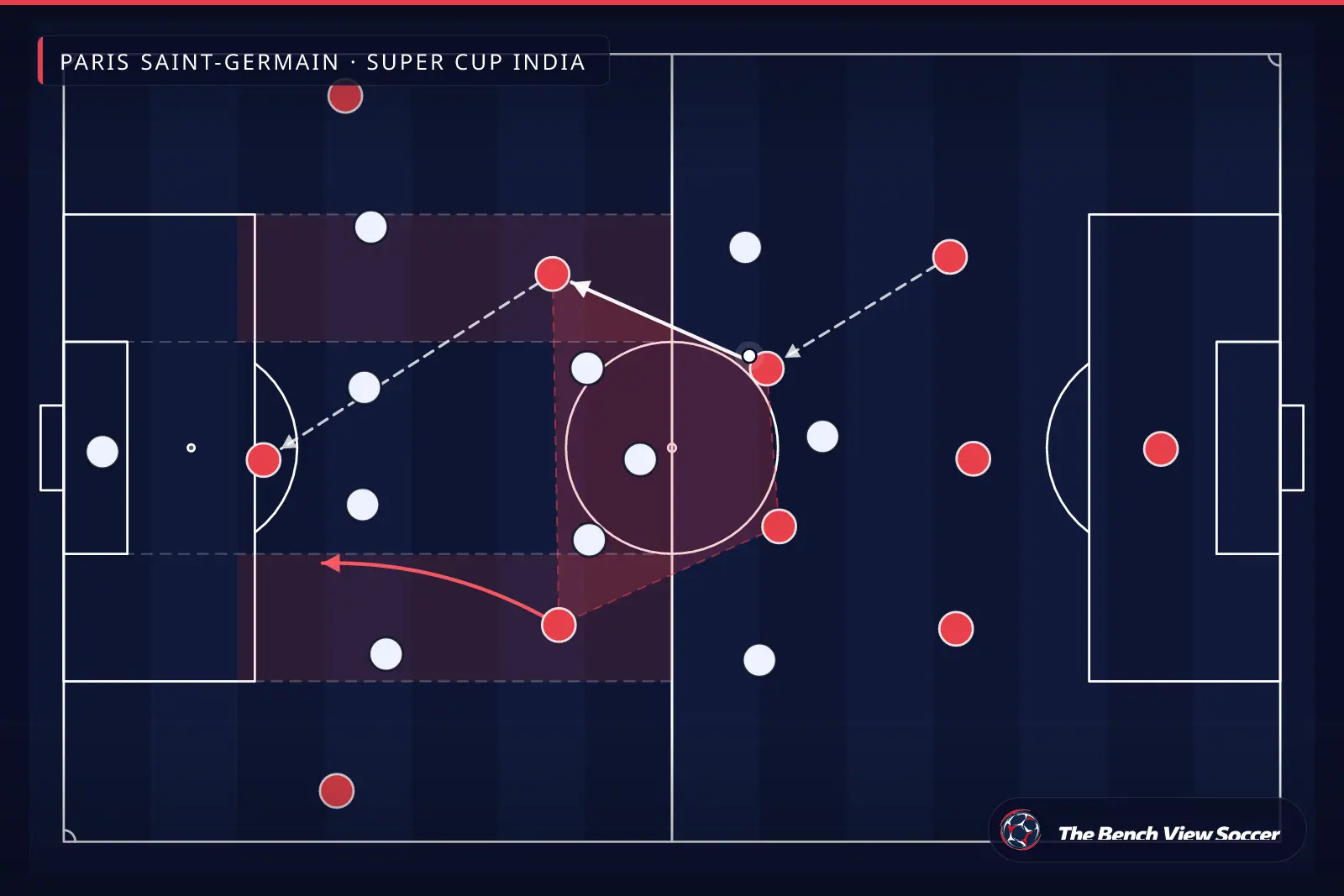
PSG didn’t just beat Villa; they won the map. By staging attacks in the half-spaces and timing diagonal releases against the high line, they turned Villa’s greatest weapon into a liability.
That is the analytical thesis of this game. The headlines shout about the protagonists—Doue silencing Madjo‑mania as PSG beat Villa to lift the trophy—but the tactical story is richer: Paris baited, paused, and pounced. Villa pressed, squeezed, and then got pulled too thin. In our view, this was a classic case of a possession team winning with positional superiority, not raw possession numbers—of mastering the where and when, rather than the how much.
The structure: why PSG found time where Villa wanted space
Villa’s off-ball identity has, in recent seasons, hinged on a compact mid‑to‑high 4‑4‑2 out of possession: the two forwards screen passes into the pivot, the wide midfielders tuck to deny the interior lanes, and the back line holds an aggressive height to compress the pitch and spring an offside trap. When it works, opponents suffocate. But every high line has a paradox: it begs to be attacked behind, yet it survives by delaying the timing of those runs and controlling the quality of the pass that releases them.
PSG’s first big win of the night was psychological: they refused to supply that early, hopeful clip in behind. Instead, they built a 3‑2 rest-defense platform in early possession—one full-back inverting next to the pivot, the far full-back staying narrower than the touchline—to anchor the center while inviting Villa’s first press. By keeping the ball in front and slightly to the side of Villa’s first block, PSG manipulated cover shadows, then slipped the ball into the right or left half-space via short, patient wall-passes.
Two details made it hum. First, PSG set a pressing trigger of their own: a deliberate backwards or square pass from the half-space to a center-back drew Villa’s second line forward. Second, once that second line bit, PSG immediately looked for a third‑man run from an interior—often behind Villa’s ball‑side winger—forcing the Villa full-back to choose between stepping toward the carrier or guarding the sprint behind. That one decision started a cascade that PSG exploited all evening.
Doue vs. the left channel: how control can look like a quiet night
The social clip will show Doue’s decisive involvements—the switches fielded on the run, the disguised diagonals, the catches of blindside movement. But the deeper value of his performance was less about a single action and more about control. Stationed nominally on the right but operating mostly in the right half-space, he kept Villa guessing by alternating two simple pictures: receive to feet on the inside shoulder (invite the full-back inside), or receive on the outside shoulder (pin the full-back wide). Either way, he made sure PSG’s interior 8 could post between lines to become the third man.
Villa tried to respond by shifting their near-side 6 across to crowd the lane. Yet every time that happened, PSG mirrored with a short horizontal switch—five to twelve meters, not a big diagonal—that re‑opened the vertical seam. The rhythm was mature: one touch to hold the lane, one touch to wall, then the disguised vertical to a runner on the weak shoulder. It’s exactly the sort of cadence that a high line hates, because the back four are trained to hold until the pass is set. PSG kept the pass un-set until it was too late.
Defensively, Doue’s diligence without the ball mattered just as much. Villa’s teenager, Madjo, threatened to tilt the match with aggressive carries and pressing intensity from the inside-left lane. Each time Villa tried to isolate that side, PSG doubled early: the full-back tight to contact, Doue tracking the underlap to turn 1v1s into chaperoned 2v2s where the angles favored the defender. Tactical fouls? Yes—smart ones in non-dangerous zones. But mostly, it was about shape: keep the runner outside your cover shadow, refuse the slip pass inside, and funnel into help.
How Villa’s high line was baited—and why it hurt more as the game matured
There are two classic ways to beat a high line: 1) lightning transitions that attack space before it organizes, and 2) measured possession that disorganizes the high line’s reference points before going over it. PSG chose door number two. They rarely went long from a standing start. Instead, they staged their long balls as the final pass of a short-passing chain, so the back four’s decision to squeeze or drop always came one beat late.
This is where the half-space matters. Wide-to-wide diagonals ask a lot of execution. Half-space-to-channel diagonals are shorter, later, and more punishing when mistimed. PSG repeatedly used the right half-space as a launchpad to the left channel and vice versa. Because Villa’s wingers were tasked with screening the pivot, their starting positions were often too narrow to protect the half-space once PSG played around the first forward. That left Villa’s full-back no clean reference: step in to block the wall-pass, and the winger runs beyond; hold the width, and the interior slips inside on the blindside.
The cumulative effect is visible in behavior rather than a single moment: tug-of-war movements in Villa’s last line. One center-back stepping to compress, the partner half-stepping to guard the clip, the full-back glued to a winger who might or might not come short. That micro-asymmetry is all an elite passer needs to thread a late diagonal on the striker’s second movement. And if the pass doesn’t come? PSG were content to recycle and make Villa repeat the sprint and recover cycle, which gradually erodes a high line’s coordination.
The Madjo spark—and how PSG removed the oxygen
In our analysis, the most compelling Villa spells came through Madjo’s energy. His instincts are obvious: receive in the left half-space on the half-turn, accelerate diagonally at the right center-back, and force the defender to show either inside (onto the stronger foot) or outside (toward a trailing full-back). When Villa could find him early—especially after regains—they looked capable of puncturing PSG’s rest-defense, which had one occasional flaw: the near pivot sometimes jumped too early toward the ball, leaving a temporary void behind.
But PSG learned quickly. They changed the angle of their immediate counter-press after turnovers: instead of swarming straight at the ball-carrier, the closest midfielder arced his run to occupy the passing lane into Madjo first, then arrived on the ball. That small tweak forced Villa’s first post-recovery pass to go sideways, not inside. And once Villa’s first touch after regaining possession was sideways, PSG’s compact 3‑2 behind the ball was set, with a clear reference for the next duel.
As the match settled, Madjo found himself receiving further from goal and with Doué and the right-back ready to crowd the space. The teenager still offered bright moments—one or two clean first touches under pressure, a press that forced a rushed clearance—but PSG placed a lid on the most dangerous pattern: the immediate inside-left half-space carry into the box. You could feel the timeline compress. Early on, Madjo had steps to turn. Later, he had fragments of a turn. That’s the difference between a shot assist and a reset pass.
Set traps, not set pieces: PSG’s clever pressing triggers
Because most headlines frame Villa’s off-ball aggression, a quieter subplot deserves attention: PSG’s press. It wasn’t relentless volume; it was targeted. They set a pressing trigger for Villa’s short build-up: when the ball traveled back from Villa’s full-back to the near-side center-back under mild pressure, PSG jumped as a unit. The front line curved runs to take away the switch; the near interior leapt to the six; and the weak-side winger pinched in to anticipate the emergency flat pass across the box. It produced turnovers in zones that are often safe for Villa—between their box and the byline—because they normally manage to outnumber there.
These are not movie-trailer moments; they’re coaching clinic slides. But they matter. A tactical diagram of PSG’s mid-to-high press in this match would show a distinct emphasis: do not chase the first pass into a corner; shape the body to invite the back-pass, then explode on the return. Against a high-line team that likes to draw you forward to find the second line, turning them around in their own third is extra punishing; their whole spacing is designed to face your goal, not to face theirs.
Why the half-spaces keep deciding games like this
There’s a historical symmetry here. Over the past half-decade, we’ve seen elite European sides weaponize the half-space as the safest launchpad against compact blocks and high lines alike. When Manchester City have beaten intense presses, they did it by building triangles that keep the ball just inside the winger’s press line and just outside the central midfielder’s reach. When Bayern under various coaches have dismantled high blocks, the terminal pass rarely starts on the touchline; it starts at that 12-15 meter width from the touch, where the team can still play both sides of the defender’s hips.
This Super Cup India final fits that pattern. PSG didn’t need to overwhelm Villa with sheer chance volume; they needed to control the locations that force defenders to run diagonally while facing their own goal. The diagonal run is the defender’s nemesis: the body wants to run one way and look the other. Add a late-arriving third-man from midfield and you’re drawing recovery lines, not defending zones.
Micro-actions that swung the balance
Body orientation in the first touch
PSG’s front players, notably Doue, repeatedly took the first touch with hips opened 45 degrees to the inside. It sounds tiny; it’s everything. That angle shows the overlapping full-back to the defender while still threatening the split pass inside. Villa’s full-back paused, and in that half-second the layoff arrived to the interior and the diagonal run was on. Lose the half-second against an orchestrated structure and you lose the duel.
Pinning with width, playing through the center
Contrary to stereotypes, PSG used width primarily to pin—not to cross. By keeping the far winger on the last line, they fixed Villa’s far full-back deep, which stretched the horizontal distances in the back four. That extra meter or two turned interior passing lanes from tight to survivable. When they finally went wide, it was to arrive in the box, not to swing early balls.
Timing the last pass early rather than late
Against a high line, the fashionable coaching point is to wait for the last moment. PSG inverted it: deliver the ball a fraction earlier, before the line’s drop command. Because Villa coordinate the drop on the passer’s set touch, playing the diagonal just as the passer is receiving—rather than after the touch—is devastating. It’s a pass made from the receiver’s preparation touch, not the establishment touch, and it beats the cue.
Where Villa were good—and where they’ll feel frustrated
Villa were never out of this contest in terms of belief or bite. Their best phases came when they collapsed PSG’s double pivot with aggressive front-two pressing angles, preventing the easy split into the six and forcing PSG to find the full-back earlier than they wanted. On those occasions, Villa’s ball-near winger did an excellent job smashing the trap shut from the outside, producing rushed touches and a few field-tilting throw-ins and turnovers.
They also retained a clear threat on set plays, drawing PSG’s line lower than usual and forcing a second ball or two that asked serious questions. More broadly, the integration of youthful energy—symbolized by Madjo—into Villa’s front five offered a different rhythm from the experienced core: faster releases, braver carries, earlier shots. In an otherwise methodical tactical fight, those pulses of chaos kept the match from becoming one-way traffic.
But frustration will focus on spacing. The distances between Villa’s back four and the double six—especially when the near-side six shuffled wide—became too large for too long. When your identity is a high line, the midfield has to be a ceiling, not a mezzanine. Too often it was the latter: close enough to see the danger, too far to touch it. Against elite half-space operators, that’s fatal.
The coach’s board: what an adjustment might look like
If you freeze-frame Villa’s build-out sequences that went wrong, a pattern emerges: the near full-back receives under pressure with inside closed, the ball travels back to the center-back, and PSG pounce. Two countermeasures suggest themselves for Villa in future fixtures of this profile:
- Stagger the double pivot vertically. Instead of both sixes parallel, drop the far-side six five meters deeper and two meters narrower. That gives the back-pass receiver a protected bounce option and complicates PSG’s curved pressing line.
- Widen the starting position of the ball-near winger by one or two meters. It’s counterintuitive for a narrow block, but it protects the half-space against the first inside wall-pass, forcing PSG to go truly wide earlier, where Villa’s sideline press is happier.
For PSG, the self-critique is subtler. They occasionally left the far side unguarded in rest-defense, trusting speed to bail them out. Against an opponent with a more polished diagonal switch, that can turn a controlled game into a shootout. The elegant solution is to peg the far interior five meters deeper during sustained attacks—still available between lines if the ball flips, but close enough to step on the counter’s first inside option.
Comparative context: this game belongs to a lineage
We’ve seen this movie before, with different jerseys. Think about recent matches where a possession-side turned a famous high line into an uncomfortable jog. The methods rhyme: half-space occupancy, third-man runs, delayed diagonals, rest-defense that stifles the first counter, and discipline to avoid the tempting early clip behind. What sets PSG’s execution here apart is how calm it was. There was no compulsion to rush or to prove superiority in verticality. They starved Villa of timing, not just of space.
And in the individual micro-battle that trended—Madjo’s electric promise vs. Doue’s authority—that lineage holds too. The game often flatters the carrier in the edit, but the craft frequently sits with the controller, the player who prevents the opponent from entering his favorite escalator. Doue’s night, tactically speaking, was a masterclass in escalation denial.
What it means for the season
For PSG, the implications are strategic. If you can disarm a high line without surrendering your positional principles, you carry a transportable blueprint into continental nights. Many top opponents will press you high and dare you to either go long in panic or slow down to a crawl. Mastering the middle option—slow the opponent, accelerate the pass—translates. It also reduces volatility. You don’t need to create 25 chances if you can create the right three, delivered with the run-timing you want and the zone you choose.
There’s also a personnel note. If this version of PSG continues to extract composure and control from wide-half-space creators like Doue, the squad calculus shifts. You can pick combinations around him that emphasize balance: one pure runner to stretch, one interior lock-picker, one ball-winning pivot. The team ceases to be hostage to a single type of chance creation and can instead choose the channel based on the opponent’s weakness.
For Villa, there’s no need for existential panic. Their high line and aggressive block have powered genuine progress. But at higher rungs, the margins are about tempo cues and coverage details. The staff will almost certainly double down on automations for the drop timing and on re‑tightening the distance between sixes and center-backs when the block is tilted. On the ball, continuing to platform talents like Madjo is essential; he stretches games vertically and emotionally. The next step is ensuring his best actions arrive closer to the box, which means earlier, cleaner first passes after regain.
Counterargument: was this just a one-off with preseason vibes?
We should acknowledge, tactically and contextually, a reasonable caveat. The Super Cup India setting can introduce variables—travel, climate, schedule compression—that color execution, especially for a side like Villa whose model demands synchronized sprints and repeated recovery runs. If the line looks a step slow, is it system or circumstance? Moreover, single-match trophies can swing on micro-variance: the timing of one offside call, the fraction of a second on a release pass, the snap of a defender’s calf at the wrong moment. There’s a fair reading that says: on another day, Villa catch PSG’s rest-defense with one extra vertical and we’re telling a different story.
But our view holds even under that counterweight. The patterns PSG used—the half-space staging, the third-man mechanisms, the press triggers on the back-pass—are resilient concepts, not coin flips. Villa’s best minutes came when they temporarily broke those chains; PSG’s control returned as soon as the chains re‑formed. That’s system over variance.
Player spotlights beyond the headlines
Doue, the tempo magnet
In our analysis, Doue’s most underrated skill is tempo capture. He doesn’t just receive; he assigns speed to the possession. When PSG needed to wait one more pass to draw the line, he waited. When the angle demanded early release, he delivered from the preparation touch. That duality—wait without stalling, accelerate without rushing—separates line-breakers from line-arrangers. The latter wins finals.
Madjo, the escalator
For Villa, Madjo’s value is in escalations. He turns dead air into contestable danger. Even in a game where PSG solved the puzzle, he hinted at answers Villa can build on: first contact under duress, brave body orientation to the inside, and a willingness to thread the shot or layoff at the top of the box. The next evolution is reading when the first touch should be protection rather than provocation. Against a trap-savvy opponent, provoking at the wrong angle feeds the predator.
The sequence that explains the whole night
Picture a sequence late in the game-state, emblematic rather than chronological. PSG circulate right to left across the back three. Villa’s block shifts, disciplined. PSG play into the left half-space; the near winger arrives tight, forcing a bounce to the center-back. That’s the trigger. PSG’s near interior sprints beyond the winger into his blindside, the wide player holds width to pin the full-back, and Doue, rotated to the weak side, starts his diagonal run on the far center-back’s blind shoulder. The bounce returns to the center-back, the pass is delivered early from the preparation touch, and the diagonal finds the far run. Villa’s line tries to spring the trap—but it’s half a beat late, because the cue was beaten. Two touches later, Paris are arriving, not crossing, and Villa’s recovery is a sprint facing their own goal.
That’s the architecture of the match distilled into a single storyboard: a trap sprung on a trap, timing as the currency, the half-space as the bank.
Lessons for coaches and analysts
- Against a high line, design your release around late diagonals from the half-space, not early crosses from touchlines.
- To defeat a narrow second line, commit to short horizontal switches that tug the sixes across before you play through.
- Defensively against a dangerous carrier like Madjo, arc the first counter-press run to take away the inside lane before arriving on the ball. It buys structure time to reset.
- If you want to trigger a coordinated press, key it to the back-pass under mild pressure, not the first pass into the corner. Make the opponent’s safety valve the danger zone.
What we’d show on a tactics board tomorrow
We’d draw three panels. Panel one: PSG’s 3‑2 shape in build with the right full-back inverted, the left full-back narrow, and both interiors staggered—one above the line, one between lines. Panel two: the back-pass trap, with the front three’s curved runs removing the switch and the near interior springing to the six. Panel three: the diagonal release from the half-space into the weak-side channel, with arrows marking the winger’s pin and the third-man’s timing. No photographs, no glamour—just geometry and tempo.
The decisive, shareable verdict
In the global glare of Super Cup India, PSG didn’t merely beat Aston Villa; they solved them. The half-spaces were not just lanes—they were levers that moved Villa’s best weapon out of position. Doue was the hand on that lever, tactically speaking: slowing the game to speed it up, locking one door to open another, and tamping down Madjo’s fires without ever looking frantic. Villa stay a superbly coached, fiercely coherent high-line machine. But here, their line met an opponent that could turn timing into tactic. And when timing is the game, the team that writes the rhythm wins the night.
The Bench View app
Don’t just read football — train it
Everything you read here, turned into training you can follow step by step.
Physical training at home
AI daily sessions adapted to your level and position. No equipment needed.
Tactical training courses
Step-by-step courses on positioning, pressing, build-up and decision making.
- 7 days free
- No commitment
- Cancel anytime
Free account: 2 physical sessions + the first tactical course. PRO: 7-day free trial — cancel before day 8 and you pay nothing.
More Analysis
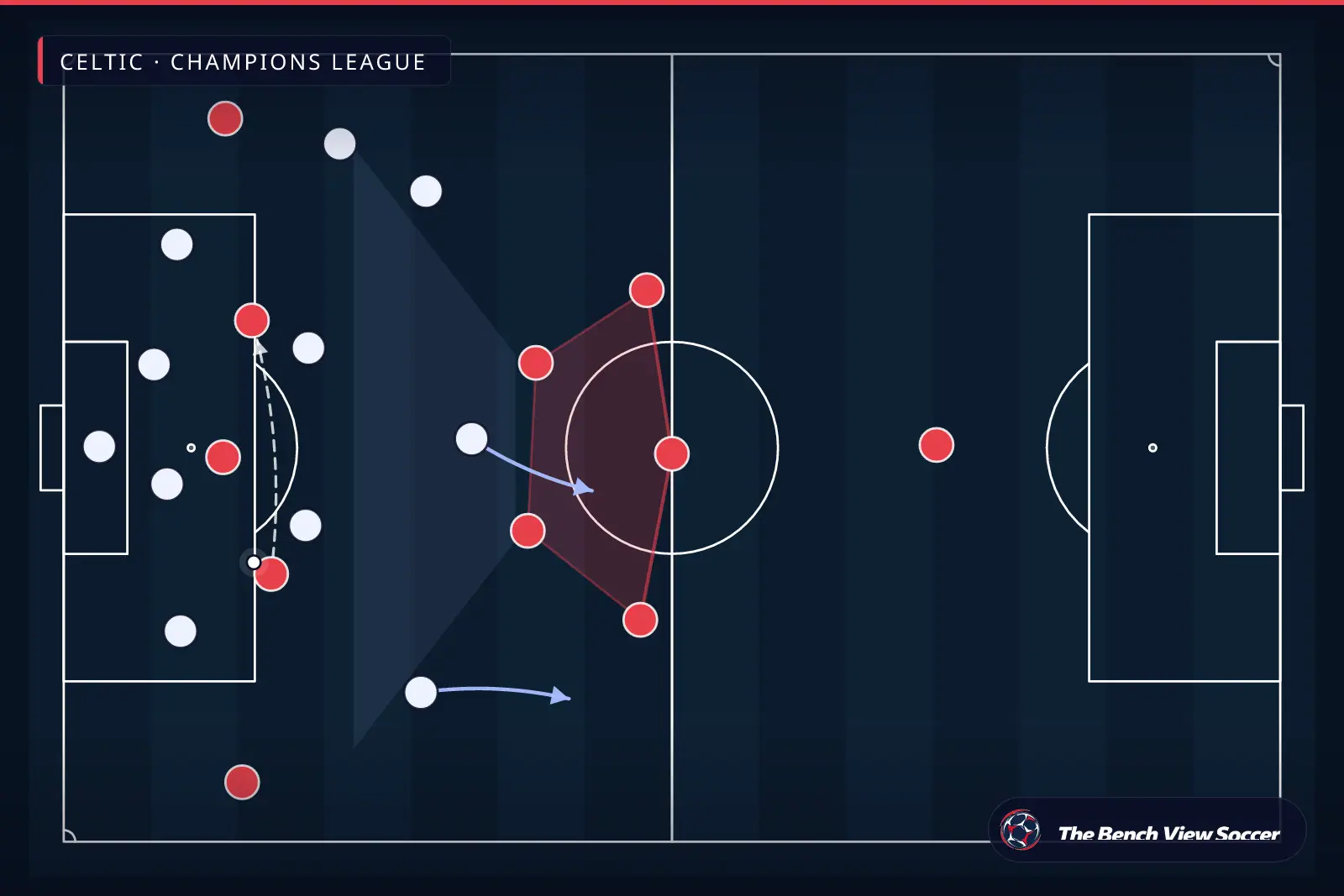
Celtic's Rest-Defense Collapse: How LASK Unpicked Their Build-Up
August 26, 2026
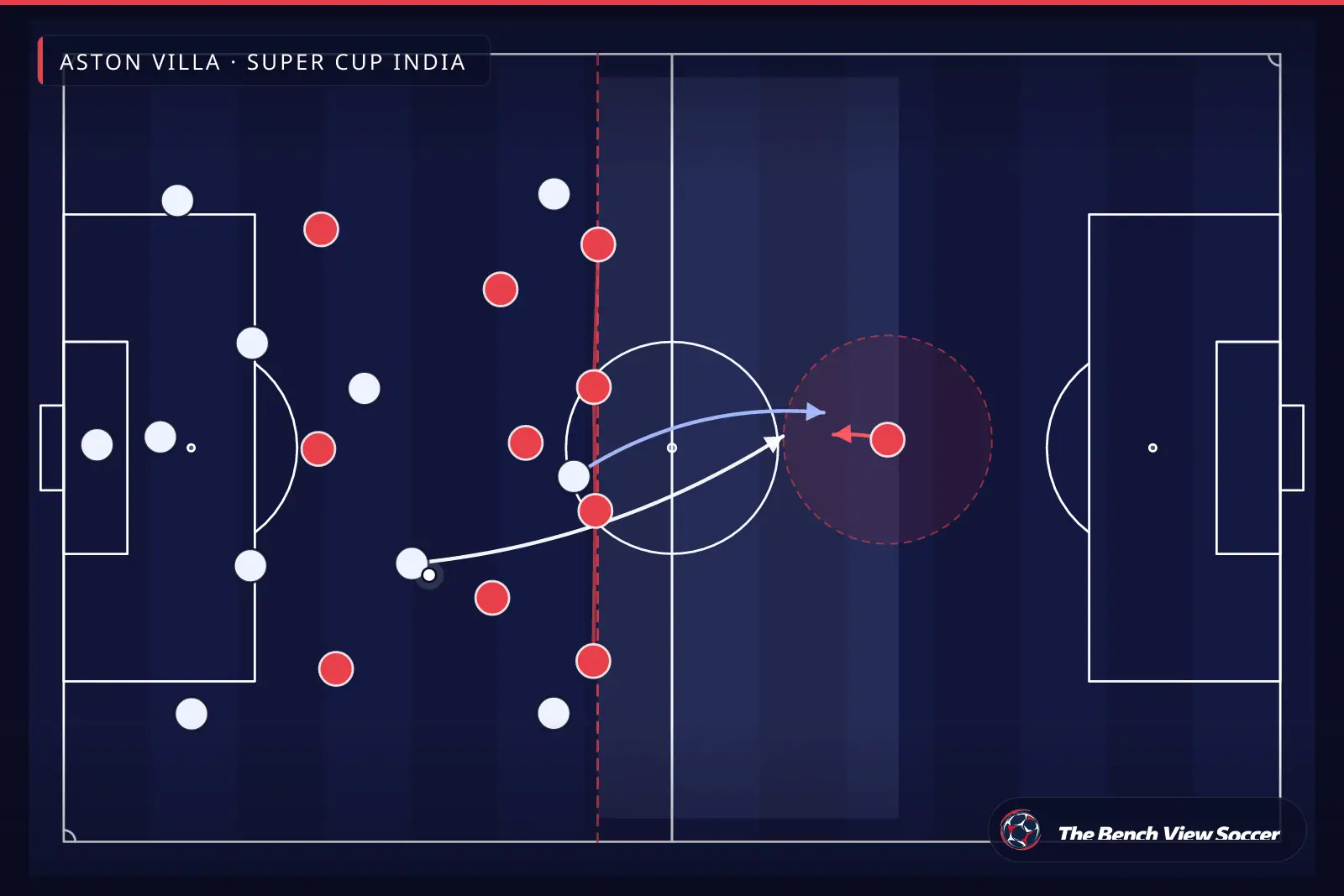
Aston Villa's Offside Trap Let PSG Win on VAR: What It Means
August 16, 2026
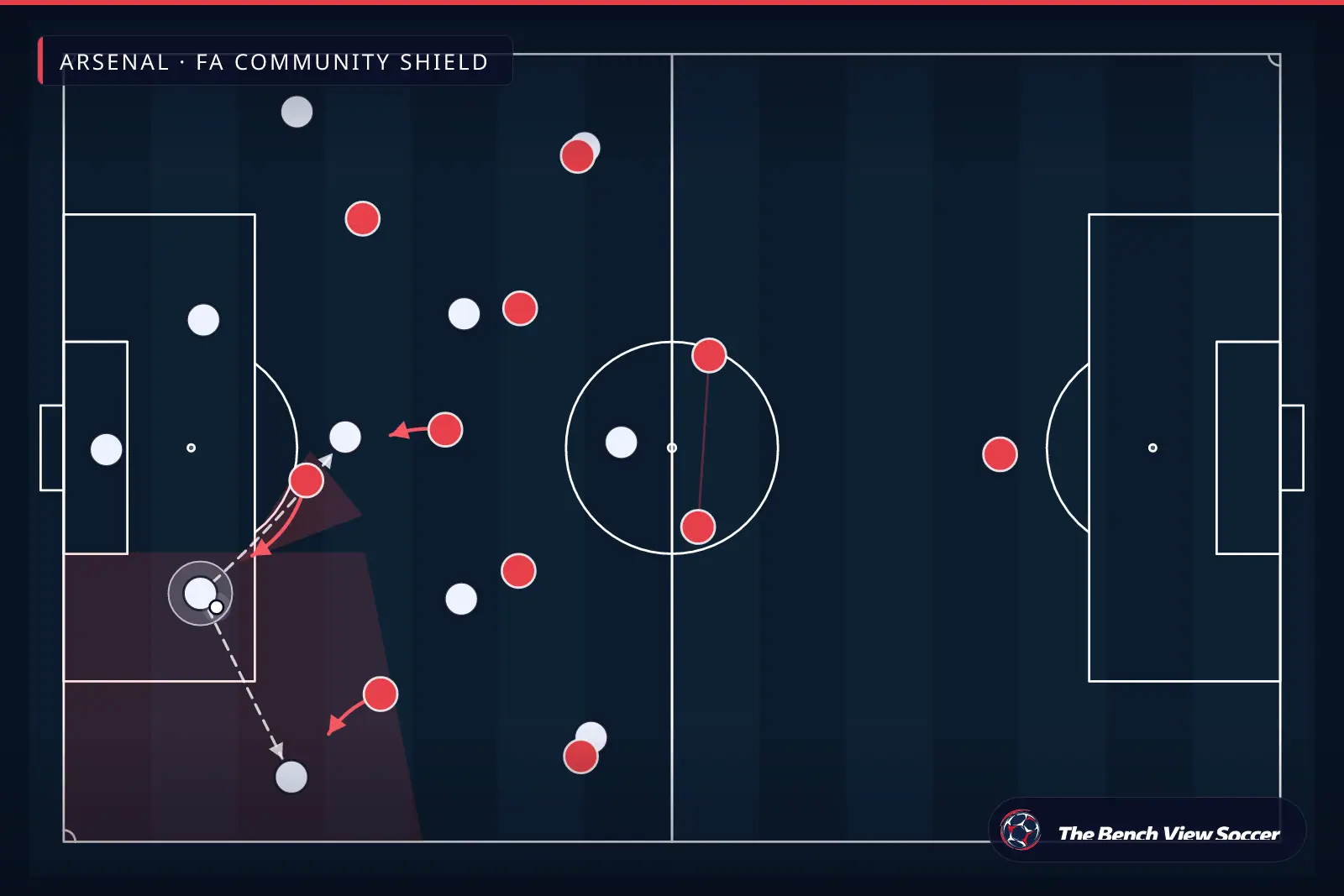
Arsenal's Calafiori Inversion Exposed City's Press: What It Means
August 16, 2026
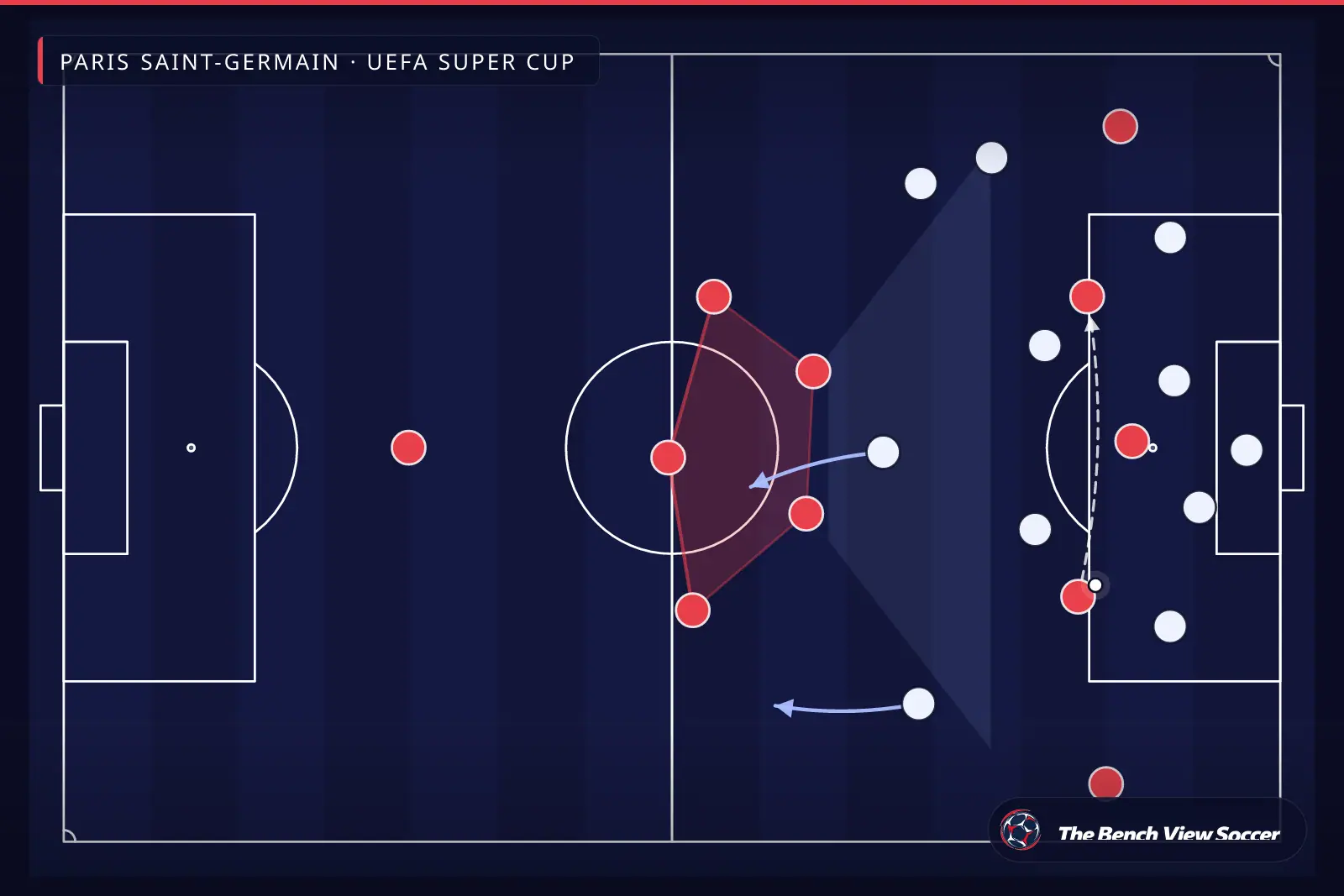
Paris Saint-Germain's Rest-Defense Trap Neutralised Villa's Press
August 16, 2026