

PSG turn a Super Cup into a systems masterclass
Paris Saint-Germain walked off with the silverware, but the bigger story lives in the geometry. In a night framed by star power and a feisty Aston Villa, PSG won by compressing the match into their terms: a calculated rest-defense trap that absorbed Villa’s early press and then detonated through the half-spaces with ruthless clarity. Tactically speaking, this felt less like a one-off trophy and more like a statement of method.
Across the opening quarter-hour (circa 10–15'), Villa pressed in that now-familiar, high-wire shape—narrow first line, aggressive fullbacks, back line stationed on the edge of catastrophe. And yet, from the first big sequence PSG set a tone: tilt one side, hide an interior, and play out not to feet, but to the second receiver via carefully prepared third-man runs. That pattern—release, bounce, break—kept recurring. The thesis of the game, in our view, is simple: PSG won by controlling the transitions others use to beat them.
PSG didn’t just survive Villa’s press—they baited it, fixed it, and ran past it through the half-spaces. The trap was the plan, not a safety net.
The asymmetric hinge: how PSG built a 3-2 that Villa couldn’t pin
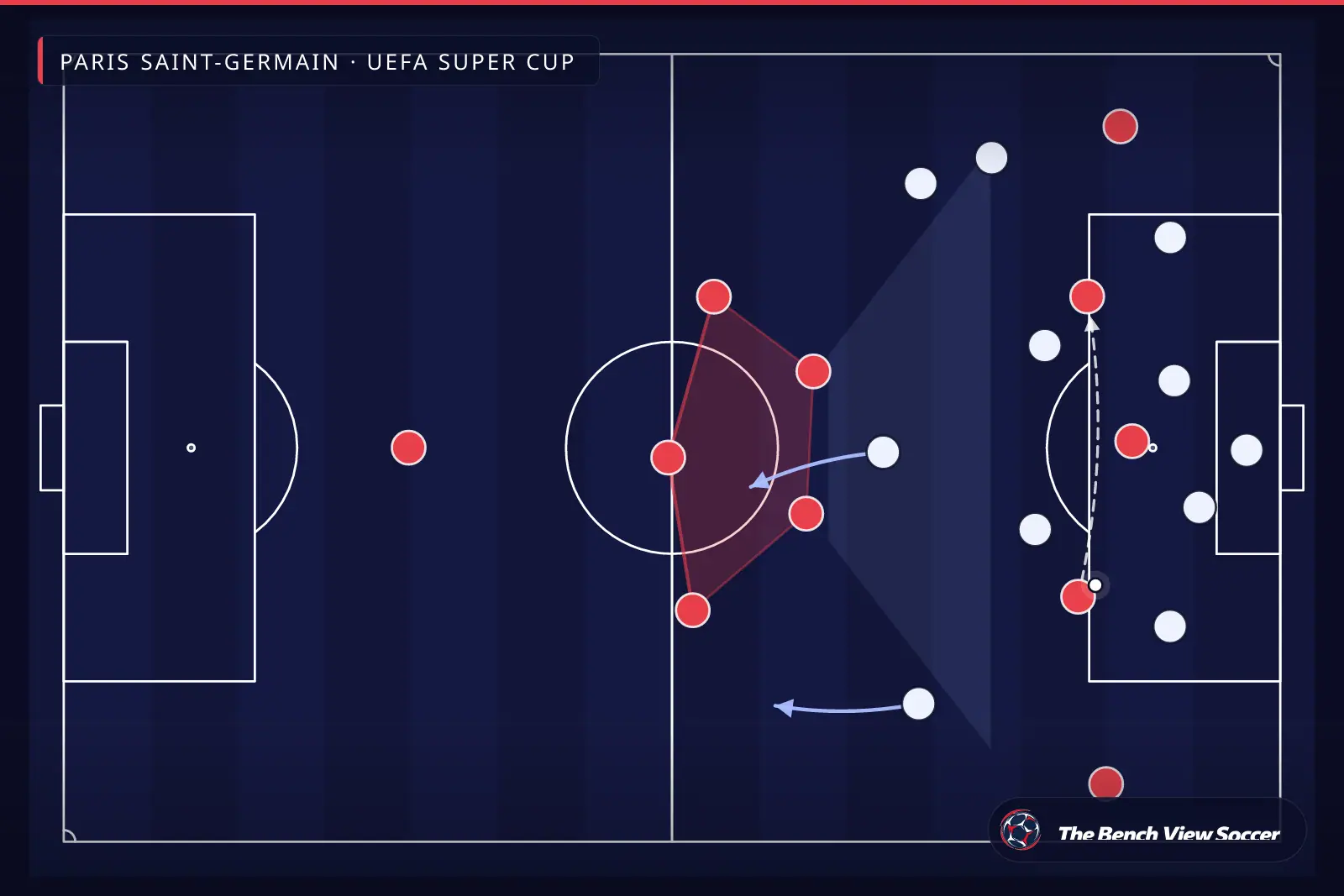
PSG’s possession shape consistently morphed into a back three plus a double pivot—a 3-2-4-1 in all but name. The hinge was asymmetry. The right back pushed high and wide to pin Villa’s left back, while the left back stepped inside to form the extra center-back lane. Ahead of them, a double pivot staggered—one player flat to receive pressure, the other slightly advanced, always on a different vertical line. It sounds simple. It is devastating.
Mid first half (circa 18–22'), we saw the build repeated: goalkeeper out to the left interior fullback, across to the central center-back, then immediately into the near pivot who drew pressure. The instant Villa’s near-side forward committed, the second pivot received a blindside set, opening a diagonal to the right winger stationed on the touchline. From there, the dominoes fell—underlap from the right interior midfielder, across to the opposite half-space, and the first of several low crosses cut back from the byline.
The key is how PSG manufactured positional superiority without overpopulating the ball-side. Instead of flooding, they timed. A forward dropped only when Villa’s six was fixed by the pivot’s body orientation; a winger held the width only until the inside lane appeared; the weak-side eight arrived late to attack the penalty spot. The choreography ensured the next pass was always unmarked by design, not by luck.
Half-space control as a defensive strategy
Half the internet will talk about the dribbles, but the substance was in the channels between fullback and center-back. PSG treated the half-spaces as defensive terrain too. By placing a creator there early (often the weak-side interior arriving into the left half-space), Villa’s fullback had to choose: jump to squeeze or hold the line. Any jump was a pressing trigger PSG desired, because the rest-defense behind it—three plus two, tight together—was set to win the immediate clearance and start again. The cycle created field tilt without kamikaze counterpressing.
Late first half (circa 38–44'), a signature spell unfolded: PSG circulated across the back three, baited Villa’s near winger to press inside-out, then pinned the fullback with a high wide run. The inside lane opened. Two touch combinations later, the ball found the right half-space at about 20 meters, a body shape angled for the reverse ball. The cutback missed its target, but the pattern was the message. You can’t chase what is always moving away from your cover shadow.
Villa’s press: dangerous, brave, and subtly undermined
Let’s be fair to Aston Villa: the press was brave and structurally coherent. Their first line screened the pivot lanes, the wingers parked narrow to prevent direct play through the middle, and the fullbacks were primed to pounce. In Premier League play, this framework has unnerved plenty of opponents. But PSG turned the dials on them.
First, the French champions created pressing triggers that looked like invitations. A square ball across the back line wasn’t a bailout; it was a lure, wait for the winger’s jump, then break the line where the space used to be. Second, the weak-side forward’s starting position—usually inside Villa’s fullback rather than outside—forced half-turn defending in the most fragile seam of a high back four. Third, PSG’s pivot didn’t try to play through tight cover; they played around it to get through it, using wall passes that made Villa’s screeners run past the ball.
Early second half (circa 50–55'), Villa attempted a calibrated switch: move the back line two meters deeper to lengthen PSG’s vertical connections. The idea was sound: add just enough depth to make the third-man distance awkward. But PSG’s counter was even simpler—go wide quicker, invite the fullback up the pitch, and then slip the runner inside the channel he vacated. If you saw a right winger racing onto a reverse pass that looked a touch too easy, it was the bait working.
Transitions and the value of the first duel
We tend to over-romanticize big diagonals and underplay the grunt work of the first duel after a turnover. PSG’s rest-defense—a back three squeezed narrow, the deeper pivot sitting on the counter lanes—won the first contact repeatedly. Mid second half (60–70'), three sequences unfolded the same way: Villa won an interception, tried to release immediately into the channel, and found a PSG defender already standing on the passing line, body oriented to collect and play forward. That immediate regain is why the match felt like it tilted toward one penalty area for long spells.
When Villa did break—most notably during a spritely spell sparked by a teenage winger off the bench—PSG’s distances held. The near center-back engaged, the covering pivot tucked, the far fullback sprinted diagonally to seal the back post. It wasn’t frantic; it was rehearsed. And that’s the quiet revolution at PSG this season: the glamorous parts still shine, but the scaffolding is finally world-class.
Patterns that decided it: four plays you’ll miss on the highlight reel
Because this was a systems win more than a moments win, the decisive actions were small and repeatable. Four patterns, all visible in the 20–25', 35–40', 55–60', and 70–75' windows, defined the outcome:
1) Inside-out wing pin: The ball-side winger stood on the fullback’s toes, the striker drifted onto the back shoulder of the near center-back, and the ball-side eight held a pocket just behind Villa’s six. One pass into the eight and one lay-off later, the winger was inside the box on the move. It’s the oldest trick: freeze the defender with a wider threat to open the inside lane.
2) Reverse underlap: The overlapping fullback is a cliché. PSG ran the underlapping midfielder instead—starting wider, then cutting in behind Villa’s tracking midfielder. Because the run came from the blindside, the marking relay often arrived too late. The best chance in the 55–60' window came from just such a pattern, a low, driven cutback toward the penalty spot.
3) Pivot pivot: PSG’s pivots didn’t sit on the same line. When Villa’s near forward chose one, the other stepped either five meters higher or five meters wider. The ball moved, the forward’s angle broke down, and a simple pass beat two defenders. This is teaching-tape material for how to pass around screens without taking risks through them.
4) Diagonal rest-defense switch: On turnovers, the weak-side fullback didn’t retreat straight back; he sprinted diagonally toward the far post zone, while the far center-back hinged across the box line. That keeps the last line intact at three during transitions and protects the most dangerous cutback lanes. It’s a detail. It’s also why Villa’s best breaks ended with crosses that found numbers, not panic.
The Villa subplot: a teenager’s courage and a strategic fork in goal
Credit where it’s due: the cameo from Villa’s teenage wide player—widely praised post-match—brought energy and a different dribbling threat. He carried into the right half-space, drew fouls, and forced PSG’s near pivot into more fouls of their own. For a brief spell (70–80'), Villa lived where they wanted to live: on the front foot, with ball recoveries feeding into quick releases. Tactically speaking, that cameo is a breadcrumb for Villa’s season. More direct speed out wide can both amplify and protect their high line by shortening the time between regain and chance.
The other Villa subplot is in goal. The ongoing chatter around an Emi Martínez exit and links to a move for Zion Suzuki isn’t just transfer gossip—it’s a systems question. Martínez’s superpower is the combination of command and pause; he buys time with his body language, manipulates the press with disguised launches, and has the range to hit diagonal targets under pressure. Suzuki offers a different profile: a quicker starting position, explosive short-area speed off his line, and confident feet for wall-pass sequences that reset the press. If Villa are about to evolve their first phase, Suzuki’s traits would tilt them toward faster re-circulations and braver positioning. That’s a choice with ripple effects for a high-line side: more aggressive starting spots can save counters but demand impeccable coordination with the center-backs.
Why this felt familiar—and new
If you’ve watched the European game’s ebb and flow over the last decade, you’ve seen parts of this story. Manchester City built entire title runs on 3-2 rest-defense architectures, daring opponents to attack the space they had already marked off. Arsenal’s surge was powered by an asymmetric back line and the late-arriving eight. Even PSG themselves have flirted with such control structures in past seasons, but rarely with this discipline for 90 minutes.
What’s new is how PSG used the half-spaces as both launchpads and shields in the same possession. In Champions League knockout ties of yesteryear, PSG would overcommit the ball-side eight and get flipped out of pressure, exposing a fullback channel behind them. Here, the occupancy felt measured: a winger pins, the eight arrives late, the fullback underlaps only once the counter-lane is guarded. It’s the difference between a possession team and a position team.
As for Villa, the echo is equally familiar. High pressing, man-oriented edges, and a line that lives on detail is unforgiving against elite technicians. One missed body orientation or one late cover shadow can doom a phase. That’s why the tactical details—angles, staggering, and sprint habits on the weak side—matter doubly for them against continental-class possession sides.
Cause and effect: the dominoes behind the trophy lift
Cause: PSG refused to build from a flat four, denying Villa their favorite pressing cue (center-back into fullback with back to play). Effect: Villa’s first line had to guess, stepped late, and found the third man already spinning off their shoulder.
Cause: The winger pin plus striker drift fixed Villa’s outside back and near center-back. Effect: The half-space turned into a runway for underlaps and blindside runs that created cutback after cutback.
Cause: A compact, three-plus-two rest-defense. Effect: Every Villa counter met a body, not grass; the first duel became a pass forward, not a clearance back.
Cause: Timed arrival of the weak-side eight rather than permanent occupation. Effect: Villa’s six had to continually scan behind and ahead, which fractured their mid-block’s cohesion. On two sequences across 35–40' and 65–70', that delayed recognition alone created the extra half-second PSG used to shoot or slide a runner through.
Cause: Circulation tempo that alternated between fast and freeze. Effect: Villa’s press oscillated between overcommitment and hesitancy, the deadliest rhythm for a high-line team that depends on collective surges.
What it means for PSG’s season
Titles validate, but patterns travel. If PSG sustain this asymmetry and rest-defense density in Ligue 1 and Europe, they won’t need to win every duel to control every match. The blueprint makes them less mood-dependent. It also clarifies recruitment. The way they attacked the box tonight—repeated low cutbacks, flat crosses pulled behind the leaping line, and near-post darts—screams for a ruthless penalty-box striker.
Enter the question looming over European transfer talk: Victor Osimhen’s profile. To be explicit, we are not reporting any deal; we are analyzing fit. Tactically speaking, Osimhen’s starting positions—slightly offside, then bursting across the near center-back—map perfectly onto PSG’s half-space service. He is a striker who doesn’t just attack space; he creates it by terrorizing cover angles. In a 3-2-4-1 that produces a conveyor belt of cutbacks and squared balls across the six-yard line, his gravity would stretch back lines horizontally, which only makes the third-man layoff game richer. Whether it’s Osimhen or a player of that archetype, PSG look configured to turn those patterns into 25 extra goals across a season.
There’s also a developmental angle. The system makes room for a ball-carrying interior who can both secure counters and break lines off the dribble. PSG already have young midfielders who thrive in those lanes; doubling down on teaching the diagonal rest-defense sprint (far fullback to far post) will be the difference between a convincing domestic campaign and a heavyweight European semi-final.
What it means for Villa’s season
Villa do not need reinvention, but they do need refinement. Against most Premier League opposition, the press will chew up points; against teams with PSG-level technical security and choreographed staggering, the margins tighten. Three adjustments seem both realistic and high-yield:
1) Stagger the eights more aggressively so that the near eight can jump without exposing the zone behind him. That keeps the reverse underlap from cutting the team in half.
2) Adjust the starting position of the far fullback during established press phases; five meters narrower and two deeper buys time against weak-side switches without conceding the wing.
3) Accelerate the decision-making rules for the goalkeeper. If Martínez stays, he already manipulates presses with disguise; if a Suzuki-type profile arrives, lean into his speed by formalizing wall-pass resets and micro-triangles around the box. Either way, codify the out-ball so that a team like PSG can’t freeze the first touch and set the trap.
And that teenager’s burst? Give him real minutes. Verticality from wide is not just a Plan B; it’s a way to protect the back line by shortening the field. In matches against the very best, Villa need to create more first actions in the attacking third before the opponent’s rest-defense is set. That is often a personnel tweak as much as a tactical one.
The counterargument
Reasonable minds will say this was more about execution than structure. They’ll argue PSG simply won more individual duels, that Villa’s legs are still climbing toward full match sharpness, and that a Super Cup in August is a noisy barometer. There’s merit there. A high-pressing side depends on synchronized sprints and split-second recognition; if one piece is at 90% in mid-August, the whole machine can look a step slow. And PSG’s best actions still required elite touches at speed—those do not appear by whiteboard alone.
But the repeatability of PSG’s patterns is the rebuttal. When you can point to similar sequences across multiple 10-minute windows, in different zones, with different receivers, it reads as design. And design travels month to month more reliably than hot form does.
The decisive, shareable verdict
Tactically speaking, PSG took the most dangerous version of Aston Villa—high line, narrow press, fast restarts—and turned it into a series of solvable puzzles. The solution wasn’t pretty for the sake of it; it was precise for the sake of control. Asymmetry to break the first line, half-space occupation to stretch the second, and a three-plus-two rest-defense to win the ball back where it matters.
For Villa, the lesson isn’t to retreat but to refine: tighten the timing of the near eight, give the goalkeeper clearer out-balls, and lean into wide verticality that can puncture elite rest-defenses before they set. For PSG, the message is even clearer. Keep this scaffold, and the attack will find you in April and May. Add a penalty-box predator—whether the name is Victor Osimhen or a player like him—and this structure transcends nights like these.
If you were looking for a turning point, here it is. PSG did not just lift a trophy; they lifted a blueprint. And in elite football, blueprints outlast August.
The Bench View app
Don’t just read football — train it
Everything you read here, turned into training you can follow step by step.
Physical training at home
AI daily sessions adapted to your level and position. No equipment needed.
Tactical training courses
Step-by-step courses on positioning, pressing, build-up and decision making.
- 7 days free
- No commitment
- Cancel anytime
Free account: 2 physical sessions + the first tactical course. PRO: 7-day free trial — cancel before day 8 and you pay nothing.
More Analysis
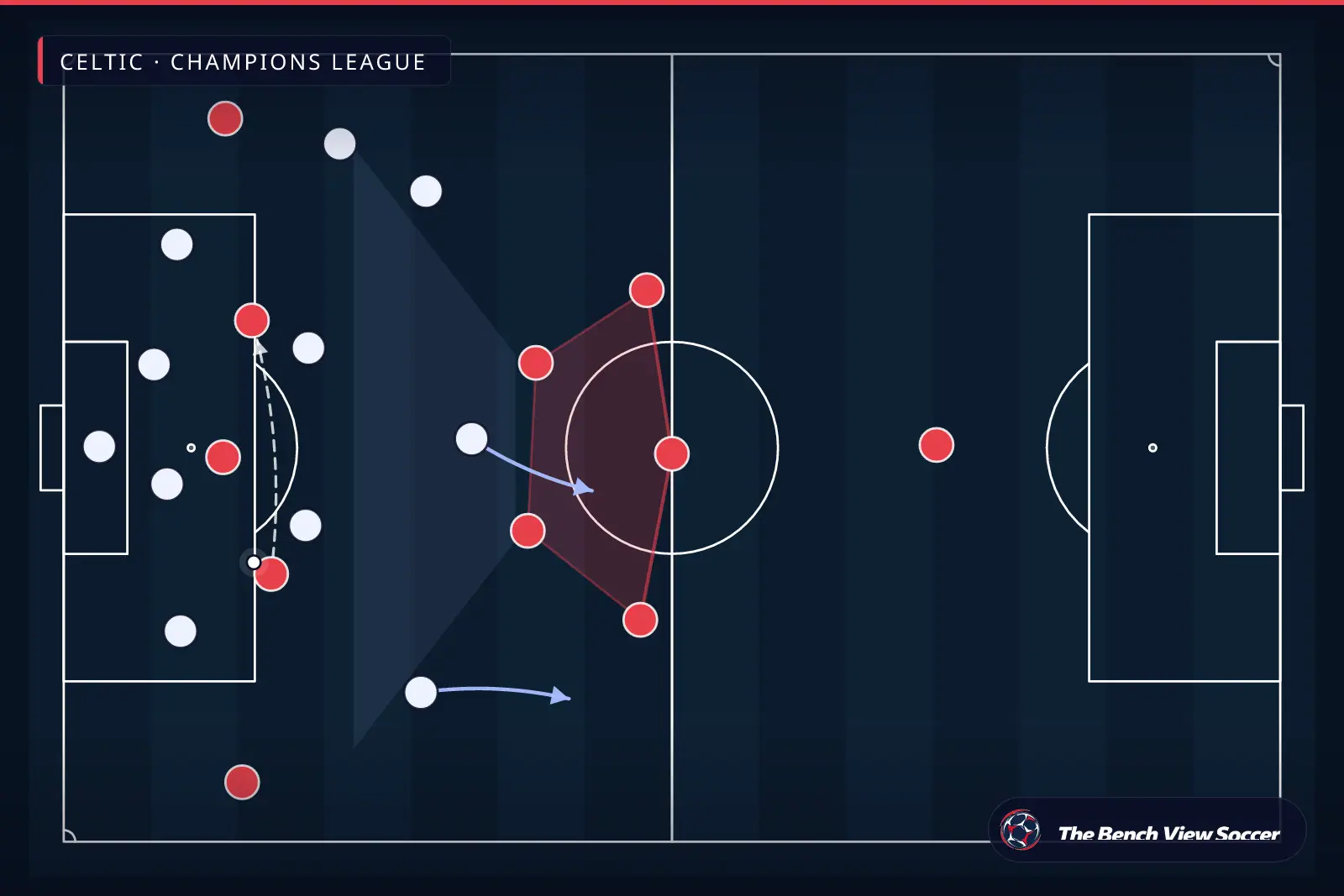
Celtic's Rest-Defense Collapse: How LASK Unpicked Their Build-Up
August 26, 2026
Aston Villa's Offside Trap Let PSG Win on VAR: What It Means
August 16, 2026
Arsenal's Calafiori Inversion Exposed City's Press: What It Means
August 16, 2026
PSG's Half-Space Traps Expose Villa's High Line in Super Cup India
August 13, 2026