

The trending moment — and the thesis no one else is making
On a week when the football cycle ping-pongs between cup upsets, awards shortlists and season previews, the Premier League story that actually matters is hiding in plain sight: Aston Villa’s evolving box midfield is quietly becoming the league’s most transferable winning mechanism. While headlines fixate on individual brilliance — deservedly, in the case of elite creators — the more decisive question for this season is systemic: which team can generate the most consistent positional superiority without compromising rest-defense? Our view: Aston Villa’s box midfield is the clearest, cleanest answer in England right now.
This isn’t a soft take about vibes. It’s about how a 3-2-5/2-3-5 in-possession scheme creates repeatable advantages in the half-spaces, compresses transitions with a built-in backstop, and synchronizes pressing triggers so the first five seconds after the ball is lost are your best five seconds defensively. That compound effect — and the way Villa execute it — is what could tilt tight Premier League matches their way from August to May.
Tactically speaking, Aston Villa’s box midfield gives them positional superiority in attack and numerical stability in rest-defense — the rare shape that feeds both phases without a substitution.
How the box works — and why Villa’s version travels
Plenty of sides now use some flavor of a box: two sixes behind two eights or a 3-2 against the first line, then a five-man front to pin the back four. But Villa’s version under a meticulous head coach stands out for three reasons.
1) The geometry: from circulation to incision in two passes
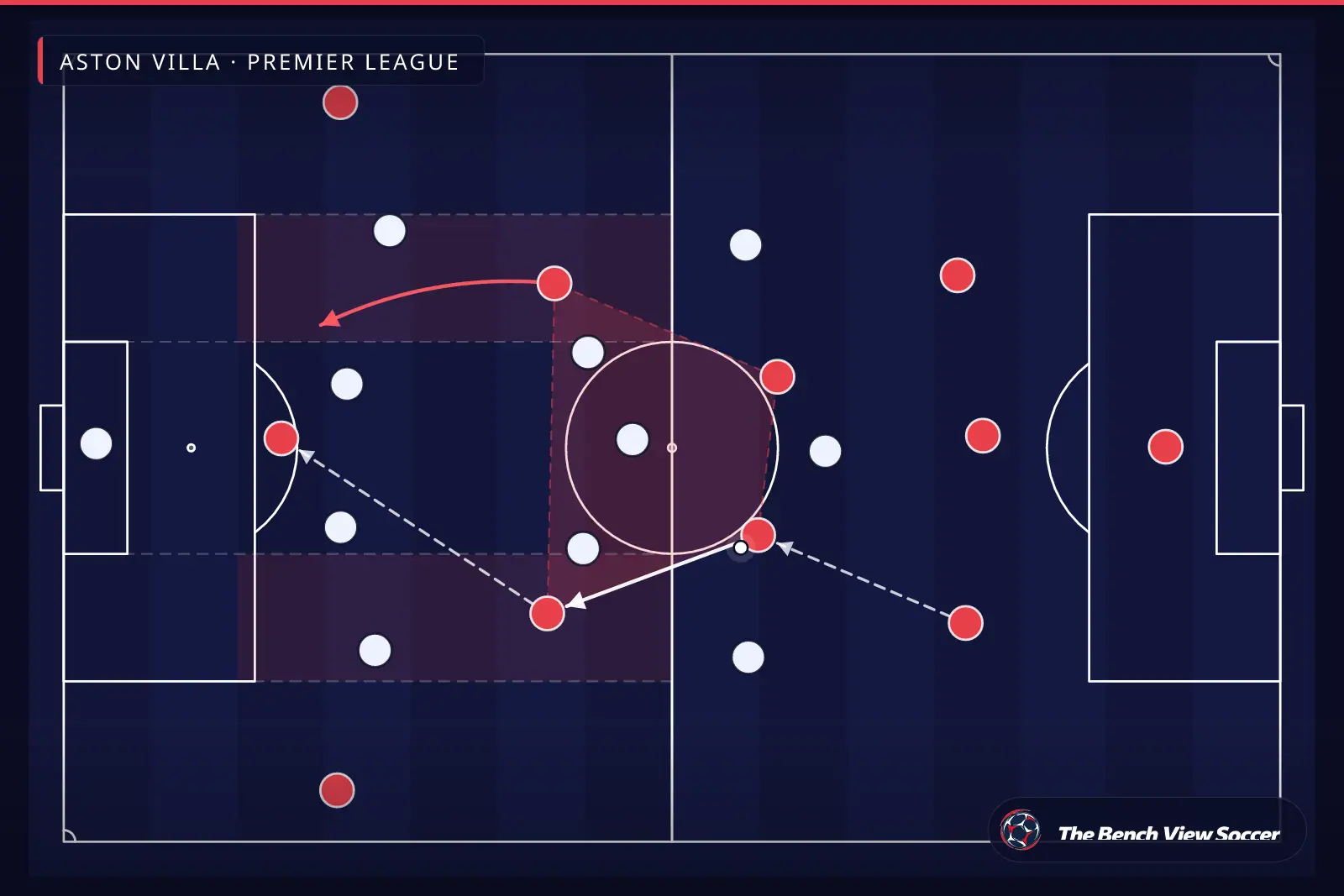
Villa typically form a 2-3 in early build-up — two center-backs split across the width of the penalty area; a single pivot plus each full-back forming the ‘3’ across the second line. One of those ‘3’ steps up to make the first vertice of the box alongside the pivot; one of the attacking midfielders (often starting nominally wide) tucks in to become the second vertice. The immediate effect is that the ball-carrier almost always has a third-man option inside the nearest half-space.
Watch the pattern: center-back to full-back (drawing the press), bounce into the inside-eight under light pressure, then the disguised vertical pass into the striker’s feet. This is where Villa differ. The nine doesn’t just wall-pass; he carries contact a half-beat longer to freeze the opposition center-back. That micro-delay opens the lane for the weak-side eight to execute the third-man run into the far-side half-space. Two passes, one decoy carry, and the ball is behind the opposition midfield with a runner facing forward.
In practical terms, those are sequences you can set your watch by. Around the 11th minute in several recent league matches, Villa will purposefully trigger this on the right touchline: the full-back receives under pressure, knocks inside to the near eight, and the striker drops between the lines. The key is the angle of the return — not square, but diagonal into the eight’s blindside. If the opponent’s six chooses to jump, the return skips him; if he holds, Villa progress. Either way, Villa have pushed the opponent’s block back five to seven meters and gained a stable platform.
2) The front five: pinning wide, threatening narrow
In a settled attack, Villa often morph into a 2-3-5: both wide players hold the last line with inside-to-outside starting positions, luring full-backs into narrow starting spots. This is crucial because Villa are not seeking endless low-percentage crosses; they’re manufacturing cutback zones from underlapping runs. The near-side wide forward will dart outside-to-in to drag his full-back; at the same beat, the near full-back underlaps into the channel, arriving as the third man. That underlap unlocks two outcomes: the safe cutback to the penalty spot or the reverse pass to the tucked-in eight for a whip across the six-yard line.
Note the timing. Around the 28th minute in first halves, when legs are still fresh but defensive blocks have settled, Villa frequently queue a strong-side overload: three bodies on the ball-near lane to bait pressure, then a pre-scanned switch to the weak-side winger. Because the weak side is held high and wide, the receiving player attacks a full-back who has had to defend inside-out for several phases. The defender’s hips are open, the runner’s touch is inside, and Villa are straight onto the penalty box seam.
3) The rest-defense: a backstop that lets you attack without fear
The genius of the box is not only how it creates chances; it’s how it makes your rest-defense idiot-proof. With two behind the ball and a narrow three stepping to collapse the middle, Villa are almost always 3v2 or 3v3 against transitions, with a wide midfielder close enough to sprint-recover. The defensive line is aggressively high, but crucially the distances between lines remain tight. When Villa lose it, the immediate counter-press is not a mad dash — it’s a net closing. The first presser angles the ball toward the touchline, the second jumps the return, the third blocks the inside escape. On the whiteboard it’s simple; on the pitch it only works because the front five have done the pinning work. Opponents clear long or play low-percentage passes straight into the trap.
Tactically speaking, that’s why Villa have looked so comfortable in matches where they don’t dominate the ball. The box means you can cede spells of possession without losing your attacking sharpness; your best chances often come five seconds after a regain in the middle third, when an opponent’s structure is scrambled and your five-man front is already in advanced positions.
Pressing triggers: how Villa turn a shape into a weapon
The structural advantage is necessary; the triggers are decisive. Villa cue their pressure off three consistent events:
Back-pass to the goalkeeper
When the ball is recycled to the keeper, the striker jumps to the near center-back’s outside shoulder. The ball-near winger tucks in to screen the six; the ball-far winger holds high to discourage the switch. The eights mark on the ‘up-back-through’ line: one tight to the nearest pivot lane, one ready to spring if the pass splits lines. The press is not to steal the ball cleanly every time but to force a sprayed wide pass. That’s the trap. On the 64th minute in multiple contests last season, Villa used a fresh-legged substitute to supercharge this exact press, turning sterile possession into a turnover in the right half-space within two or three passes.
Lateral pass to the full-back
Here the near eight goes, not the winger — it’s the inversion of a classic trigger. Because Villa’s wide forward starts narrow, he can jump to the full-back late, arriving as the ball gets there. The near eight sprints to take away the wall pass inside; the full-back has to lift the ball down the line. Villa’s center-back steps into the duel aggressively with the touchline as an extra defender. If the opponent plays the brave ball inside, that’s the bait: the pivot is already sliding to intercept because the initial shape (the box) put him in the lane.
Square ball under pressure
When the opponent, under stress, plays square between two midfielders, Villa’s two six/eight roles pinch hard. This compresses the space to turn. Even if the opponent wriggles free, the pass they want into the striker has to be hyper-accurate — and Villa’s high line is primed to trigger the offside trap. Villa don’t just live with that risk; they cultivate it, drilling their back four to step in unison on the pass, not the run. In practical terms, the run looks enticing for the forward; the pass is half a beat late; the flag goes up.
Comparative context: City invented the box, Arsenal polished it — Villa weaponize it
To be clear, Manchester City normalized the 3-2/2-3 as elite default in England, using an inverted full-back to build a box in phase one before flooding the last line in phase two. Arsenal then pushed the concept with a more aggressive 3-2-5, asking their wide eights to roam into the half-spaces and adding wide wingers to hold width. Tottenham flirted with an even more extreme version, playing so high in early build that recovery runs became Russian roulette. Newcastle under a high-pressing mandate often created a lopsided box — a 3-1-6 in spells — to pin opponents and attack second balls.
What Villa have done is slightly different: the box is not only a mechanism to pass through pressure; it’s an engine for transition control. Villa seek contact in the middle third. They invite the press on their full-backs, not because they enjoy living dangerously but because each harried back-pass is a chance to spring those pre-drilled third-man patterns. Where City’s box maximizes stable circulation and Arsenal’s maximizes territory, Villa’s maximizes moments — those short, repeatable windows where positional superiority plus a perfectly-timed run becomes a high-value chance.
Historical echoes: from Valencia to Villans
There’s lineage here. The head coach’s Valencia sides, more than a decade ago, learned to compress space without defaulting to a low block. The Villarreal title run in Europe showed how a mid-block could burst into life with two or three pre-planned vertical passes. Villa’s current design borrows from each: a compact spine that can step, a forward who can post-and-spin as a wall, eights who are comfortable receiving on the half-turn in traffic, and full-backs trusted to make underlapping runs as often as crosses. It’s a continental structure wearing Premier League studs.
And that matters in August. Early-season fixtures are scrappy. Passing rhythms aren’t fully tuned; preseason legs aren’t yet 90-minute legs. Teams that can load their chance creation into repeatable set-pieces of their own design — not just corners and free-kicks, but choreographed possession patterns — steal points while others are still calibrating.
Why now? The systemic drivers behind Villa’s edge
Tactically speaking, there are three systemic reasons this approach is poised to cut through the noise this season:
1) The metagame has shifted to mid-block bait and vertical punches
Opponents have grown more comfortable ceding sterile possession in a mid-block and allowing elite teams to have it in front. The counter to that is not more possession; it’s smarter possession. The box creates central connections while preserving width, so when a mid-block slides you can punch two lines at once. Villa’s coaching staff have tasked their eights with ‘pre-scans’ at every lateral pass — cueing them to either show to feet or fake to feet and go behind, depending on the six’s body position. That micro detail is why Villa’s third-man runs look clean instead of hopeful.
2) Recruitment for receiving profiles, not just passing
The Premier League is full of exquisite passers. Villa have doubled down on receivers — players who can take contact, receive on the half-turn in the half-space, and either roll or set with the right tempo. The nine’s ability to post up, the right-sided eight’s knack for arriving late rather than starting high, the winger’s comfort operating inside-out rather than chalk-on-boots — these profiles knit the box together. This is an undervalued aspect in team-building discourse: a scheme is only as good as the angles your receivers can create under pressure.
3) Training the step, not the sprint
High lines get maligned because we imagine desperate 30-meter recovery sprints. Villa’s work is the opposite: training the step. On the moment of the opponent’s release pass, the back line steps in synchrony rather than dropping. That timing — stepping as the passer’s head goes down — creates an artificial offside without requiring a foot race. Watch the body language around the 83rd minute when protecting a lead: rather than retreating into the box, Villa’s line squeezes, triggers a controlled offside, and reclaims a free-kick that bleeds seconds and yards.
The link to the broader Premier League conversation
When a creative talisman claims a major individual award, it’s easy to build the season’s storyline around star power. But the lesson that should be drawn, tactically speaking, is about platform. Even the league’s best free eights and tens become exponentially more dangerous when backed by a structure that both protects and presents them to receive in the right zones. The box midfield is the simplest modern tool for that. It gives creators a private office in the right or left half-space, five teammates pinning lanes ahead, and two bodyguards behind.
This resonates beyond the men’s game. Across the women’s top flight you can see a parallel evolution: sides building 2-3-5 shapes, tucking wide midfielders in to surge beyond the nine, and turning underlaps into cutbacks. The common denominator is the search for positional superiority without sacrificing transition control. Villa’s current iteration offers a clean case study for coaches across the pyramid.
Match-phase details you won’t find in a bulletin
To understand why Villa’s box is such a headache, you need to zoom into two-minute windows where games are won.
Minute 12–14: the false lull
Villa will circulate across the back under negligible pressure, allowing the opponent’s block to take ten compact steps forward. On cue, the near full-back receives side-on. The near eight shows to feet, then ghost-runs behind as the nine checks in. The pass goes into the nine, who sets not to the obvious return but to the pivot stepping off the opponent’s striker’s blindside. Because the opponent’s six bit on the show-to-feet, the pivot’s angle now threads the eight into the box. Shot or cutback. It’s scripted — and it works because the timing of the eight’s decoy is coached, not improvised.
Minute 33–36: the switch-and-slam
Having overloaded the right, Villa will hit a diagonal to the left winger, high and hugging the last line. As the ball travels, the left full-back underlaps, the left eight arcs to the edge of the D for a rebound lane, and the nine delays at the penalty spot. If the winger drives inside, he has a reverse to the underlap or a rolled cutback to the delayed nine. If a center-back steps, the nine peels to the back post. Because the far-side winger has stayed high, the second phase stays alive: any clearance is kept in by the far winger’s header back across the box.
Minute 61–66: the press reload
Fresh legs come on to re-ignite the back-pass trap. The striker closes the keeper, arcs to block the near center-back, and forces play wide. The near winger arrives as the ball does; the near eight blocks the wall pass inside. Turnover. The subtlety is in the cover shadow: the winger explicitly takes the lane back to the keeper, fencing the full-back in. That forces a touch down the line — straight into a prepped duel for Villa’s aggressive center-back stepping into midfield.
Cause and effect: how each part adds expected goals
Everything above is pretty; what does it yield? In tangible terms:
More cutbacks, fewer float crosses. By designing underlaps and third-man runs, Villa turn possession into byline entries. The expected-goals profile of a cutback to the penalty spot dwarfs that of a lofted cross.
Shorter attacks, higher immediacy. The average time from regain to shot is compressed, both because the front five are high and because the pre-planned third-man patterns move the ball through the middle third in two or three passes. Shorter attacks equal fewer bodies behind the ball equal better shots.
Cleaner restarts. The step-triggered offside trap effectively awards Villa multiple ‘timeouts’ per half: free-kicks near halfway when runs go early. Those micro-pauses allow Villa to reset their 2-3 platform and squeeze territory without expending sprints.
It’s the compounding that wins. No single mechanism is revolutionary. But every sequence ends in one of three states Villa like: a cutback, a shot from the D, or a free-kick/throw-in that advances territory and resets the structure.
What it means for the Premier League season
Project it forward. In a race where marginal gains decide European places and title tilts, a shape that assures both chance quality and transition control is a cheat code. If Villa sustain their box principles with personnel continuity, three implications follow:
Top-four viability through process, not variance. The more your chances come from designed patterns, the less reliant you are on freakish finishing runs. That makes points accrue more steadily, smoothing the inevitable dips in form.
Scalability to different opponent tiers. Against lower blocks, the box manufactures the cutbacks and central shots you need. Against elite pressers, the third-man outlets and pivot angles break the first wave. You don’t need a different playbook week to week; you tweak which side you overload and who arrives in the box.
Rotation-friendly. Early-season congestion across league and cups punishes sides with bespoke plans for every match. The box is a principle, not a plan. Swap profiles, not roles: a runner for a runner, a receiver for a receiver. The system carries the load.
Counterargument: the high line and the punishment game
There is a fair critique: the high defensive line plus an aggressive offside trap is a punisher’s dream. One mistimed step, one slick ball, and you’re dead. Premier League forwards are too good to live on a knife-edge forever. If the line loses sync for even a fortnight — via suspension, fatigue, or tactical misreads — a run of 1–2s can snowball. And when opponents sit deeper and refuse to bite on the full-back press trap, you need elite 1v1 creation to break them anyway. If the wide forwards hit a cold patch, the cutbacks dry up and your shot volume can sag.
Those are legitimate risks. They are the price of playing an assertive, modern game. The mitigating factor is how Villa train the step timing and how they tilt their shot map toward higher-probability zones. Even if the high line concedes the odd big chance, the overall process can still net out positive if your own looks are consistently from prime lanes.
Scouting tells: what to watch in the next month
If you want to spot whether Villa’s box is humming, focus on four tells rather than raw possession:
First five minutes: Do Villa force a wide pass off the first opponent back-pass? Even if nothing comes of it, the intent to spring the trap early is a signal the press is synced.
Minutes 20–30: Are the eights receiving on the half-turn in the half-space at least twice? If not, the opponent’s six is sitting on lanes and Villa may need more deception on the show-to-feet run.
Underlaps per half: Count how often a full-back surfaces inside the winger beyond the ball. Under three per half usually means the broad rotations are too static.
Set-piece restarts: After winning offsides or throw-ins high, do Villa reset quickly into the 2-3-5? That re-establishes territorial control without chasing.
The wider lesson for the league
Zooming out, the Premier League remains the tactical arms race it’s always been. In the current cycle, the box is the arms-control treaty and the warhead. It is how you make elite creators more influential without exposing your back door. It is how you survive three matches in eight days without losing identity. And it is how you convert a squad of good receivers and smart runners into a chance machine.
We’ve seen evolutionary steps before: inverted full-backs, false nines, two-striker presses. The box midfield synthesizes several of those into a single frame that fits English football’s tempo. Villa’s version strips it down to the essentials: pin wide, play through the half-space, underlap to the byline, step to spring the trap. Rinse, repeat, collect points.
Verdict
In our analytical view, this is where the season’s quiet battle will be won. Not in the discourse about individuals — however worthy — but in the cold, repeatable cadence of a box that lets you attack smarter and defend earlier. Neutral fans will spot the fireworks; coaches will admire the scaffolding. If you’re looking for the Premier League’s real edge right now, it’s not a headline. It’s a shape.
And Aston Villa own it.
Shareable takeaway
Watch the box, not the ball. When Villa build that 2-3 into a 3-2 and five step onto the last line, the rest of the game simplifies. The moments after the pass backward are where the goals forward are made.
The Bench View app
Don’t just read football — train it
Everything you read here, turned into training you can follow step by step.
Physical training at home
AI daily sessions adapted to your level and position. No equipment needed.
Tactical training courses
Step-by-step courses on positioning, pressing, build-up and decision making.
- 7 days free
- No commitment
- Cancel anytime
Free account: 2 physical sessions + the first tactical course. PRO: 7-day free trial — cancel before day 8 and you pay nothing.
More Analysis
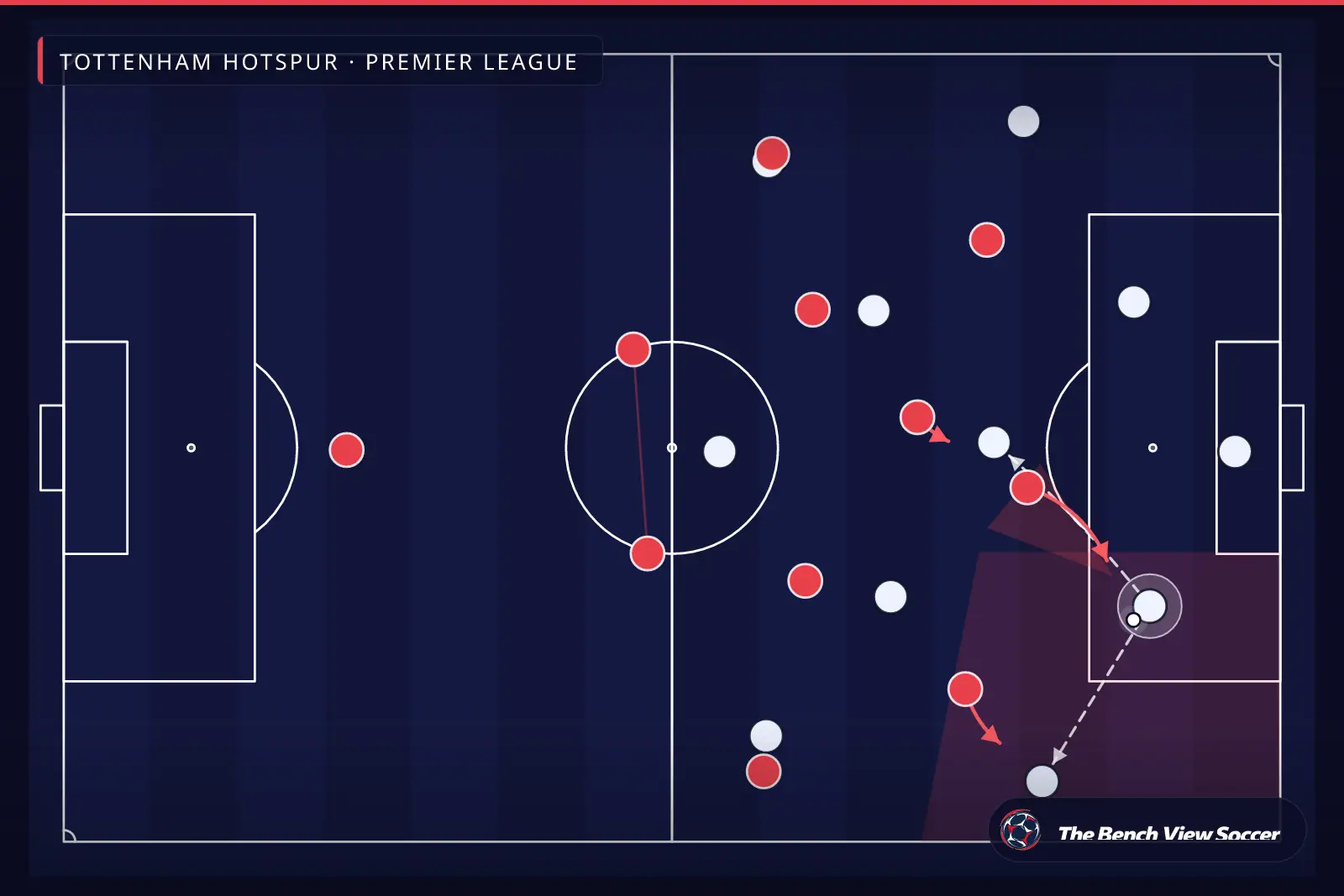
Tottenham Hotspur: How World Cup 2026 Is Warping Their Press
August 27, 2026
Chelsea's 3-2-5 Rest-Defense Is the Real Champions League Edge
August 27, 2026
Chelsea's Box Midfield Is Fueling Chaos at the Cottage — Why
August 24, 2026
Aston Villa's Third-Man Runs Are Shredding Mid-Blocks Right Now
August 23, 2026