

The Trending Moment — and the Real Story Behind Aston Villa
Team sheets drop, timelines light up, and everyone fixates on who’s fit for Brighton vs Aston Villa. That’s the surface layer. The real story — tactically speaking — is the machine beneath the names: Aston Villa’s third-man run factory. In our view, Villa are the Premier League’s clearest demonstration of how to turn a high defensive line, aggressive pressing triggers, and right-half-space occupation into a conveyor belt of clean box entries. It’s not just good football; it’s a system that manufactures time advantages on demand.
Here’s the bold take. Villa’s season will pivot on a single mechanism: the capacity to create, disguise, and repeatedly access third-man runs in the half-spaces, particularly on the right, and to do so immediately after carefully choreographed pressing traps. If that engine keeps purring, mid-blocks won’t survive them; if it sputters, their high-wire act looks exposed. The headlines today point to “team news” — but the underlying phenomenon is a game model that compresses risk into opportunity.
Analytically speaking: Aston Villa’s edge is their fusion of a high defensive line and ruthless, right-half-space third-man runs — a repeatable pattern that turns the chaos of pressure into the clarity of free finishes.
The Blueprint: How Villa Manufacture Time Advantages
Villa’s framework blends continental positional principles with English tempo. The contortions of today’s positional play — triangles, pins, guard-rails — are all here, but executed at a faster beat.
1) The Rest-Defense and the Ladder
Start with the foundation. Villa build around a tight, aggressive rest-defense — the protective shape that sits behind the ball to kill counterattacks before they start. Typically, that’s a back line squeezed toward halfway, with the near-side full-back tucked and the far-side full-back positioned to sweep, while a screening midfielder hovers in front to win first or second contacts. This creates what players call the “ladder”: a compact, staggered set of rungs the ball can climb rapidly if recovered.
Why does that matter? Because third-man runs are only lethal if the pitch is compressed. Force your own line high, keep pass distances short after the regain, and suddenly the pass-and-go sequence needed to free a runner becomes a three-touch drill: recover, set, release.
2) The Narrow Front Three and the Box Midfield
In possession, Villa often morph into a narrow front three to pin centre-backs and full-backs simultaneously. The nominal wingers start inside; the striker occupies the last line; and the two advanced midfielders — or a single No. 10 with a high No. 8 — float between lines. Behind that, Villa toggle between a double pivot and a situational box, depending on the opponent’s press. The point is to gain positional superiority between the lines and on the blindside of the nearest 6.
Once the front five are fixed and narrow, space blooms in the channels. That’s the invitation for underlapping runs from the full-back or shuttling 8, a pattern Villa exploit with almost metronomic timing.
3) The Third-Man Principle, Weaponised
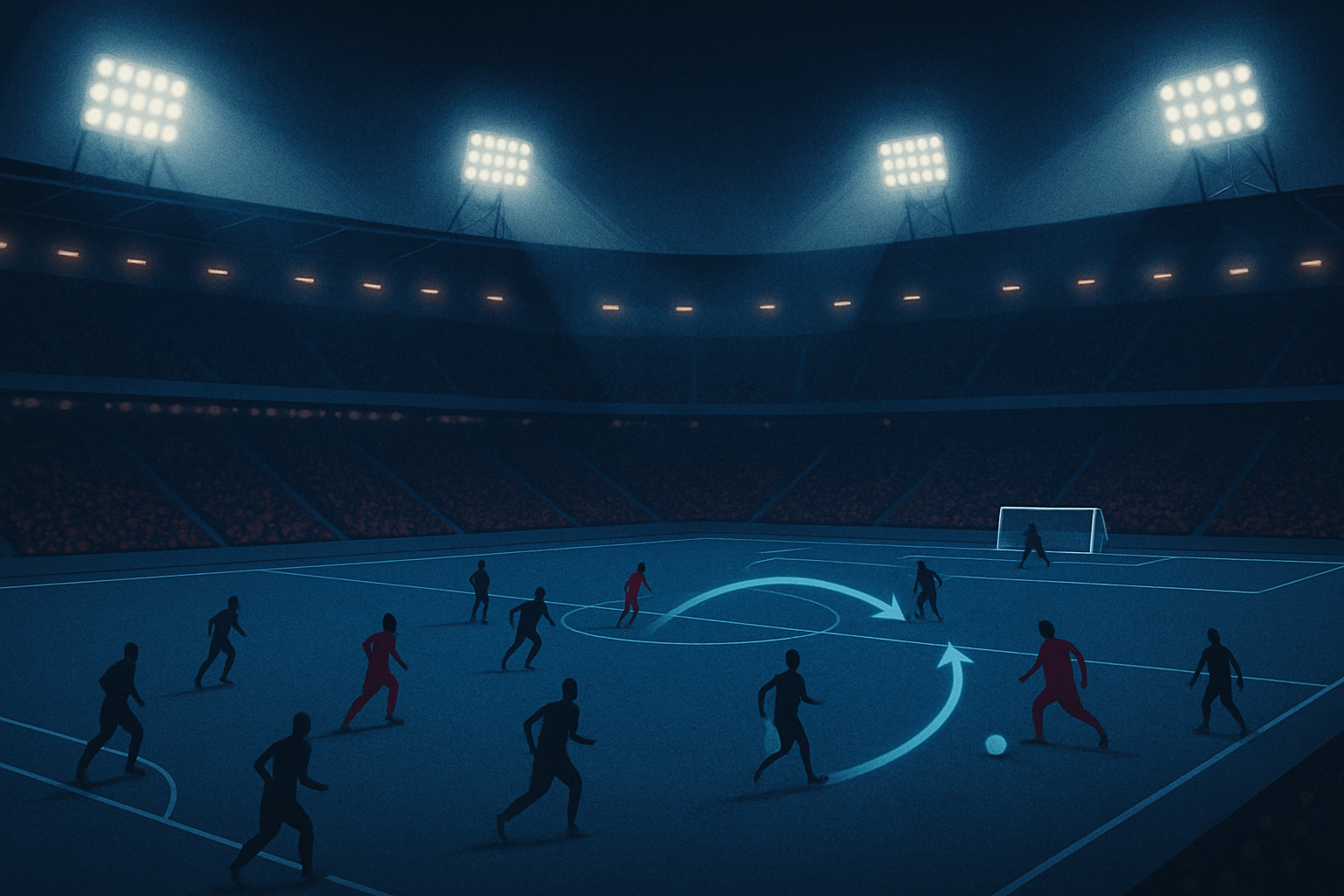
At its purest, a third-man run is simple: Player A draws pressure and plays to Player B, who one-touches into the path of Player C’s blindside run. The genius of Villa’s version lies in the trigger. They do this not only when the structure is neat but precisely when it looks messy — right as the opponent think they’ve sprung a counter. Villa want that first press to arrive, then they step onto the loose ball, turn, and hit the vacated corridor with a runner already at full speed.
Because their half-spaces are pre-occupied by inside forwards and 8s, the third-man is almost always in that lane. Right half-space in particular: it’s where Villa’s progression rhythm feels most polished. Set, bounce, slip. If you’re a centre-back stepping out to help, you’re already a step late.
Pressing Traps: The Hidden Assembly Line
Most teams press. Villa choreograph. The triggers are classic — backward passes, lateral touches toward the sideline, or a receiving full-back with a closed body. But the geometry is premeditated to generate third-man opportunities on the turnover.
The Outside-to-In Funnel
Against a possession side like Brighton, Villa tend to show the pass wide, then fire the trap. The near winger arcs his run to block the lane inside, the striker curves to screen the pivot, and the near 8 sprints to lock onto the full-back’s first touch. The full-back thinks safety lies down the line — exactly where Villa’s own full-back steps in to duel. Two touches later, the ball is central with a Villa red-shirted 10 facing play and a right-sided inside forward ripping beyond the last line. The third man is already moving as the trap is sprung.
Back-Pass Whistle
A backward pass to the goalkeeper is Villa’s green light. The winger angles the run to force a hurried switch, the striker jumps to the centre-back’s blindside, and the weak-side 8 creeps up the ladder. If the opponent clips long, Villa’s back line — trained to hold impossibly high — trusts the timing of the offside trap. If it’s a short, panicked pass to the full-back, see above: the funnel closes, the regain arrives, and the third-man pattern unlocks the weak shoulder of the closest centre-back.
This is the piece many miss: Villa rehearse what happens five seconds after the regain more intensely than the regain itself. Win it, set it, run behind. The choreography is as much about the post-press as the press.
Right Half-Space, Right Now
Why the right half-space as the primary launchpad? Three reasons.
1) Natural Footedness and Passing Angles
With a right-footed centre-back stepping in to pass and an inside-right forward starting between the lines, the body shapes align for quick one-touch wall passes. The ball travels outside-to-in faster, and the through-lane mirrors the runner’s angle, reducing touches.
2) Blindside Against the 6
In many Premier League mid-blocks, the holding midfielder shades left to guard the more creative opposing 8. Villa position their own right 8 on that 6’s blind shoulder. One bounce pass, and the 6 is turned. Now a centre-back must step — a timing mismatch Villa thrive on.
3) The Offside Trap as Emotional Pressure
Villa’s high defensive line isn’t only a defensive tool; it’s emotional pressure. Opponents fear the verticality behind them and instinctively drop a step. When Villa then steal the ball, those defenders are already breaking their line, and the third-man runner is onside purely because the back four are in retreat. It’s psychology as much as geometry.
Case Study Lens: Why Brighton Is the Perfect Petri Dish
Brighton’s principles — rotate the 6, lure pressure, play the third line — make them brave and brilliant. But they also create the exact invitations Villa seek.
How Villa Have Previously Hurt Brighton
Historical context matters. In previous meetings, Villa repeatedly exploited Brighton’s baited central build-up with mirror-image traps: accept the invite, jump the pivot lane at the last second, and attack the outside centre-back’s blindside with an inside forward. Even when Brighton adjusted by forming a back three, Villa countered by pinning all three and releasing a runner from midfield. The Watkins-era thrashings of Brighton were headline moments not because of finishing spikes alone but because Villa’s regain-to-run blueprint short-circuited the Seagulls’ best patterns.
Expect similar today. When Brighton’s left-back receives facing his own goal, Villa’s near-side winger will cut the return to the centre-back, the striker locks the 6, the near 8 pounces. If the turnover comes central, the bounce to the right 8 is on, and the third-man dart slices between left centre-back and full-back. Brighton’s solution must be ruthless first touches and immediate diagonals beyond Villa’s strong side — otherwise they’ll be caught in the trap’s teeth.
Build-Up and Chance Creation: Not Just Transitions
It’s tempting to paint Villa as a pure transition team. That’s unfair and tactically incomplete. Their positional possession also primes the same third-man mechanism, just from slower starting points.
Staircase Passing
Villa construct “staircases” down the right, stacking a full-back, an 8, and an inside forward on different vertical rungs. The ball travels from centre-back to full-back to 8 to inside forward — and then the return pass is the trigger. The full-back underlaps, the inside forward sets to the 8, and the third man is lancing behind the full-back into the half-space channel. If the back line drops early, the cross is on; if they hold, the cutback lane materialises at the penalty spot.
Rotations to Hide the Runner
The best third-man runs are invisible until the last stride. Villa achieve this by stacking two players on the same line, then splitting at the pass. The defender’s eyes shift to the receiver; the runner ghosts in behind. It’s choreography meant to exploit that single human limitation: you can’t watch ball and man at the same time.
Set-Pieces as System Continuity
Villa’s refinement extends to dead balls, where their routines mirror open-play ideas. Near-post crowds create back-post isolations; blockers act as faux receivers, and the third-man concept reappears as a delayed far-post runner arriving late for rebounds. The connective tissue is consistency: whether from open play or a corner, the first action is a lure, the second is a set, and the third is the kill.
Historical Context: How Villa’s Pattern Fits the Modern Game
Third-man play is older than positional play discourse. Dutch sides in the 1970s used it to escape pressure; Guardiola codified it with interior triangles; Klopp turned it into a transition weapon; Nagelsmann accelerated it with verticality. Villa’s modern twist lies in the union of a daring rest-defense with immediate depth runs from inside forwards, performed at Premier League pace and without over-committing the box early. They don’t flood the area; they time it. Think of it as a Guardiola mechanism executed with Klopp’s tempo and an Italian set-piece coach’s eye for detail.
When Villa hammered Brighton in a headline-grabbing meeting several seasons ago, pundits lauded a hot striker. Tactically, the decisive factor was more systemic: Villa dragged Brighton into wide duels, forced panicky back passes, then marauded through the half-spaces with third-man darts. Fast forward to now, and the same idea has matured into a club-wide language.
Cause and Effect: Why the System Works
1) Spatial Compression Creates Decision Debt
By holding the line high, Villa shrink decision time for opponents. Every touch is a choice made under duress. Errors increase. That’s the cause. The effect is structured chaos: the ball pops loose where Villa expect it, and pre-programmed lanes open for the runner already on his bike.
2) Role Clarity Underwrites Repetition
Villa’s roles are unambiguous. The near winger presses inside shoulder. The striker screens the 6. The near 8 jumps first touch. The full-back wins or blocks the line. Because the structure is clear, the run becomes muscle memory. And as any coach will tell you, third-man runs only appear “instinctive” after thousands of rehearsals.
3) Diagonal Body Shapes Beat Straight Lines
From back to front, Villa tilt their receiving angles. Centre-backs open to the far side; 8s half-turn; inside forwards show square then pivot. Why? It shortens the pass, lengthens the defender’s turn, and widens the through-lane. It’s micro, but it’s decisive. Third-man runs live in these millimetres.
How Opponents Try to Solve It — And Why It’s Hard
The countermoves are predictable: sit deeper to kill space behind, or jump man-to-man to kill the bounce pass. Deep blocks blunt runs, but hand Villa sustained possession — and their staircase patterns still create cutbacks. Go man-to-man, and Villa stack and spin: two players occupy one defender, split on the set, and the third man is free again.
The Brighton-Specific Counter
For Brighton, the best answer is early, bold diagonals behind Villa’s near-side pressure — especially if the 6 can turn first time. Switch the point quickly, and you can catch Villa’s high line mid-step. But that requires near-perfect first touches and nerve. One heavy control, and the trap closes.
What This Means for the Season
Zoom out. In a season where fixtures pile up and legs get heavy, repeatable mechanisms matter. Villa’s third-man engine is repeatable. It doesn’t demand a permanent purple patch from a single finisher; it demands synchrony. The advantage is resilience: even when the touch deserts a forward, the team will still arrive to the same spots, again and again.
Ceiling Case
If Villa maintain their high-line discipline and the right half-space remains a production zone, top-four control isn’t an outlier projection — it’s the default. Add in a set-piece edge and a habit of scoring first through pressure, and the game states tilt in their favour. Lead early, compress more, counter the counters: it’s a flywheel.
Floor Case
When the line loses synchrony — one full-back deep, a centre-back late, the screen missing — the offside trap becomes an open door. Tactically speaking, the very aggression that feeds third-man runs can be punished by quick, direct balls into the channels. If that creeps in, Villa may find themselves managing too many high-variance matches.
Training Ground to Match Day: The Micro Details
Rehearsing the Post-Press
Villa’s most distinctive training emphasis, in our analysis, is that “second five seconds”: the beat immediately after the turnover. The regaining player has two options, not five. Set inside, or play the wall pass. The third-man runner has already moved with the presser’s cue. This limits cognitive load. Players aren’t hunting for the “best” pass; they’re executing the best rehearsed one.
Codifying the Language
Communication is semiotic. A winger pointing to feet may actually be the decoy; the third-man is reading the presser’s hips, not the passer’s finger. Villa reduce chit-chat and prioritise body-shape reads. Opponents hear shouts; Villa’s cues are silent.
Against the Low Block
When teams turtle, Villa don’t abandon their identity. The runs continue, but the delivery shifts from ground splits to dinked angles into the channel, followed by cutbacks. The underlapping full-back becomes crucial here, as the inside forward pins the centre-back instead of running beyond him.
Comparative Lens: Who Else Does This — and How Villa Differ
Manchester City generate third-man runs from structured five-lane occupation; Liverpool sprint the channels after counter-press regains; Arsenal’s left 8 darts behind for cutbacks. Villa borrow from all of them but add a bolder average line height and a higher tolerance for risky inside passes before the set. The risk is the point: bait the bite, win the duel, race the lane. Few sides have the stomach to live this high for 90 minutes; Villa seem to relish it.
Women’s Side Echoes: A Club-Wide Language
While names and specifics evolve season to season, Aston Villa Women have also leaned into similar mechanisms in recent WSL campaigns: narrow forward starting points, underlaps from the full-back line, and third-player combinations to break mid-blocks. This isn’t a copy-and-paste scheme so much as a shared grammar: bait pressure wide, bounce inside, run the blindside. Club-wide alignment accelerates learning — academy to first team, men to women — and that continuity is an underrated competitive edge.
A Counterargument Worth Hearing
There is a credible critique: teams learn. Film rooms catch patterns. If opponents sit in a 5-3-2 with a locked back five and a single-pivot screen, the right half-space lane shrinks. Add an aggressive keeper sweeping behind, and Villa’s favourite run looks less appetising. Meanwhile, the cost of the high line is non-trivial: one misread on a back-shoulder run becomes a one-v-one. Over a long campaign, those coin flips can erode margins.
That’s fair. The rejoinder is twofold. First, Villa don’t need the lane open every time — only often enough that opponents can’t step freely. Second, the same patterns that beat a mid-block morph into cutback creation against a deep block. The execution bandwidth is built in; it just flexes to the game state.
Fine-Tuning for the Next Phase
Left-Side Mirroring
To avoid predictability, Villa can sharpen a mirrored left-side pattern: a left centre-back stride-in, a midfield set, and a delayed third-man dart behind the right-back. That not only splits scouting attention but also opens switch-and-sprint finishes for the right interior arriving late.
Keeper Distribution as a Decoy
When opponents refuse the press, the goalkeeper’s clipped passes to the full-back can act as built-in traps: the moment the full-back receives, the winger is already moving inside to bounce, and the third-man is sprinting across the front of a flat-footed 6. Opponents think they’ve stopped Villa’s press; they’ve only changed where it starts.
Rotational Depth
Because the mechanism is role-based rather than player-dependent, fresh legs can slot in without the overall geometry suffering. The club’s recruitment profile should continue to prioritise shuttling 8s with timing, inside forwards with wall-pass feet, and full-backs comfortable stepping into midfield. The player is the pattern — and the pattern is the player.
Minute-Detail Scenarios to Watch vs Brighton
12th minute zone, left touchline: Brighton’s left-back receives facing his goal. Villa’s right winger curves to block the inside. The back-pass gets nervy. Villa pounce. One-touch set to the right 8. Third-man dart splits left centre-back and left-back. Low cross, near-post flick, chaos.
64th minute shape, right half-space: Villa stack the right 8 and inside forward on the same line. Ball goes into the inside forward’s feet. He lays off blind into the 8’s run. The full-back underlaps to pull the marker; the centre-back hesitates half a beat. Through-ball threaded. Finish across the keeper.
78th minute reset, after a long Brighton spell: Villa regain from a high clearance. Instead of settling, they go: centre-back to keeper to right full-back to 8 — all in two-touch. The third-man sprints beyond the line as the 8 drops it around the corner. Opponents track the ball; Villa track the space.
What Success Will Look Like in the Data
Without getting lost in spreadsheets, the signatures will be obvious even to the eye:
- More shots within 8–12 seconds of regains in the middle and attacking thirds.
- Repeated box entries from the right half-space with square pull-backs to the penalty spot.
- Opponents flagged offside more often as Villa hold their ladder and spring counters.
- Low xG shots conceded but a higher share of high-value transitions against — the accepted risk of the high line.
The Shareable Verdict
Strip away the team news frenzy and you see a club that has turned a theory lesson into a habit. Aston Villa don’t just talk third-man runs; they live them. Their courage is in the compression — a line so high it suffocates, a trap so tight it predetermines the next pass, and a runner so well-timed he feels invisible until he’s celebrating.
In our analytical view, that is the Premier League’s most watchable cause-and-effect chain right now. If the right half-space remains open even a few times per match, Villa will keep shredding mid-blocks. If opponents shut it, Villa’s mirrored patterns and set-pieces still feed the scoreboard. This isn’t a fad; it’s a factory.
And that’s why, as Brighton and Villa square off under the floodlights of a news cycle, the most important names aren’t necessarily on the teamsheet. They’re the silent co-authors of Villa’s season: Rest-Defense. Pressing Trap. Third-Man Run.
Learn those three, and you’ll understand why Aston Villa feel built for the grind ahead.
The Bench View app
Don’t just read football — train it
Everything you read here, turned into training you can follow step by step.
Physical training at home
AI daily sessions adapted to your level and position. No equipment needed.
Tactical training courses
Step-by-step courses on positioning, pressing, build-up and decision making.
- 7 days free
- No commitment
- Cancel anytime
Free account: 2 physical sessions + the first tactical course. PRO: 7-day free trial — cancel before day 8 and you pay nothing.
More Analysis
Tottenham Hotspur: How World Cup 2026 Is Warping Their Press
August 27, 2026
Chelsea's 3-2-5 Rest-Defense Is the Real Champions League Edge
August 27, 2026
Aston Villa's Box Midfield Is the Premier League's Real Edge
August 26, 2026
Chelsea's Box Midfield Is Fueling Chaos at the Cottage — Why
August 24, 2026