

The moment and the thesis
The World Cup 2026 hangover has arrived on club pitches, and it looks nothing like the typical early-season rust. It looks like a press that starts bright and then bends, a block that looks joined for 30 minutes and then frays across the half-spaces, and a front line that chases one cue too many before the dominoes start falling in transition. Tottenham Hotspur, tactically speaking, are the case study of the moment: a team built on proactive control whose pressing triggers and rest-defense are being warped by a once-in-a-generation calendar shock.
We’re not here to relitigate schedules or summarize headlines. We’re here to ask and answer the tactical question that will define Tottenham’s first months of 2026–27: how do you keep a high press without breaking your own shape when post-tournament fatigue shifts every decision by half a step?
Our view: Tottenham don’t need to abandon their identity. But they must re-code it—tightening trigger definitions, shortening pressing distances, and making possession itself the rest phase. If they don’t, the post-60-minute window will keep inviting exactly the sort of transitions their structure was designed to prevent.
What the World Cup actually did to the press
There are two overlapping realities after a summer like World Cup 2026 followed by transcontinental preseason travel: physiological lag and cognitive lag. The physiological part is familiar—shortened off-season, uneven freshening between players who went deep in the tournament and those who didn’t, and delayed peak repeat-sprint ability. The cognitive part is subtler and more tactical: pressing is choreography. Millisecond delays in reading a goalkeeper’s body shape or a center-back’s touch cascade into chain reactions.
Tottenham’s game model demands that the front three compress the first pass, the eights squeeze the return lane, and the fullbacks pinch inside to deny the vertical split—classic modern principles. In August, though, you frequently see the first action (press the CB) arrive on time while the second action (cover the interior lane) is a beat late. When that happens, the back line hesitates: step to hold the line and you open the channel; drop to protect depth and you disconnect the block. Either choice is structurally expensive against Premier League tempo.
That’s the calendar’s tactical tax: not that players run less, but that the distance between your first and second defender in a pressing action grows from five meters to eight. At elite levels, those three meters decide whether you take the ball on the third man’s blind side or watch it get punched through your empty half-space.
Why Tottenham are the bellwether
Tactically speaking, Spurs under a high-possession, high-field-position model bet on three pillars:
- Early regains via strict pressing triggers (GK-to-CB passes, back-foot touches, aerial lay-offs).
- Squeezed rest-defense: inverted fullbacks or narrow eights holding inside lanes to kill counters at source.
- Relentless occupation of the half-spaces to maintain positional superiority and create third-man runs.
When players return unevenly from international minutes and long-haul flights, the first pillar still flickers—pressing instinct doesn’t vanish. It’s the second and third pillars that show strain. The compactness that makes Spurs’ rest-defense so effective relies on synchronized advances by the first and second lines. If the winger’s press arrives but the near-side eight is a beat late pinching the half-space, the fullback faces a terrible decision: hold the inside lane and concede the switch, or jump to the ball and leave the channel. Both are valid reads. The problem is the indecision itself.
Where the gaps are appearing
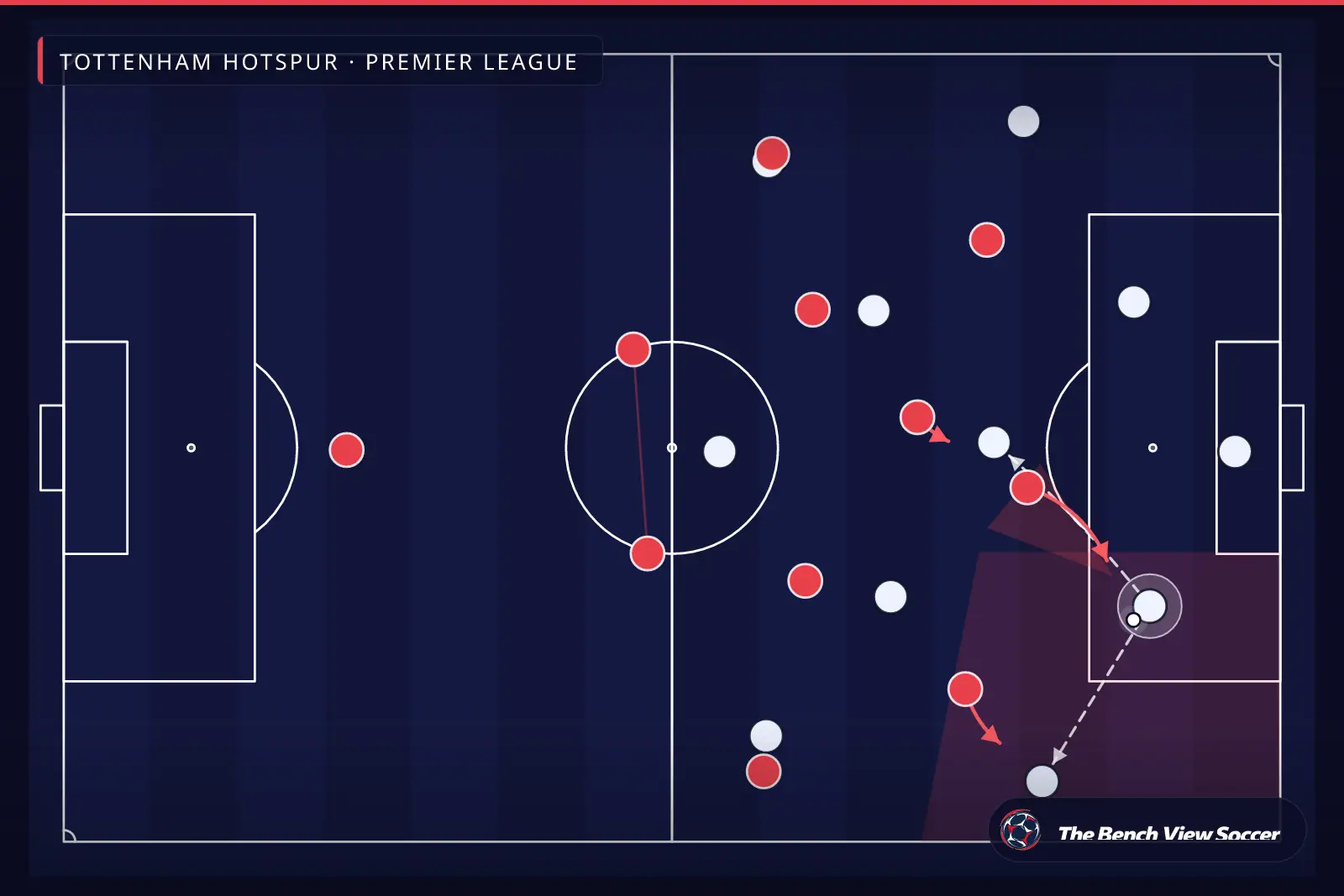
Watch Spurs’ shape around the hour mark in early-season fixtures and count the times the near-side half-space becomes an express lane for the opponent’s third-man runner. The pattern is consistent:
- The press is triggered by a center-back receiving on his back foot on Spurs’ right.
- The Spurs winger angles his run to show play inside (correct).
- The opponent’s pivot drops to receive; Spurs’ near-side eight arrives a fraction late.
- The inverted fullback stays narrow to protect the line-break (sound principle).
- The opponent uses a one-touch bounce to the third man in the right half-space behind Spurs’ eight.
- Now the fullback has to step; the channel to the touchline is open; the far center-back gets pulled across; the weak-side winger is too wide to protect the far half-space if play is switched quickly.
It’s not that the system is wrong. It’s that the synchronized compression is a fraction off. In a normal August, you calibrate that in three matches’ worth of load. In a post-World Cup August, those calibrations take longer because the group shares fewer training reps at common intensity and the neuromuscular freshness that turns intentions into first steps isn’t yet even across the XI.
The tell-tale minutes: 55–75
In multiple early-season matches across the league you see an intensity curve that undulates rather than spikes. For Spurs, the tell is in the 55–75’ window: the pressing wave still forms, but the counter-press (five-second regain principle) loses a yard. That’s when opponents start playing through the first trap and force Tottenham’s rest-defense to cover more space with fewer bodies. Shots conceded may not skyrocket, but the transitional threat grows—particularly from switches that land in the far half-space where Tottenham’s shape has thinned to maintain initial width.
Again, these are micro-shifts. But elite football turns micro into macro. If the front line covers three fewer synchronized meters in minute 65 than in minute 15, the whole game model needs a contingency.
Newcastle as the contrast class
Newcastle United have lived at the other end of the adaptation spectrum in recent seasons: a high-intensity identity that learned to layer a pragmatic mid-block without losing its teeth. The lesson for Tottenham is not to imitate a formation, but to copy the strategic sequencing:
- Start with a controlled mid-block to keep defensive distances short when legs are least certain.
- Identify specific pressing triggers to surge in coordinated bursts rather than pressing continuously (e.g., backward pass to the fullback on the touchline, square ball from pivot to center-back under body pressure).
- Refresh the front line preemptively at 55–65’ to reignite the counter-press window.
- Accept that protecting the half-space with bodies now creates more value than pinning the last line with numbers in certain game states.
The point is not that Newcastle have it solved for 2026–27—no one does two weeks after a World Cup summer—but that staging your intensity is the only credible bridge between identity and reality. Spurs can keep their high field position and ball dominance while sequencing their pressing waves instead of asking the same three forwards to carry 90 minutes of synchronized initiations in late August.
Historical parallels that actually explain today
We’ve seen versions of this before, and it usually shows up in teams who live by a press:
- Post-2010 summer, several high-possession sides struggled out of blocks with late-game transitions, then clicked by October when roles and recovery converged.
- Post-2014 and 2018 tournaments, pressing managers often faced the same tradeoff: protect identity or protect legs. The ones who leaned into staged pressing and rest-with-the-ball structures landed higher by spring.
- The 2022 mid-season World Cup was its own beast, but the December–January drop-off revealed how fragile counter-press is without consistent distances. Teams who compressed their 10-yard lanes and stopped chasing into corners recovered first.
The throughline: a tournament summer amplifies small errors in spacing. If your game model lacks a built-in low-energy version of your press, the first month after a global tournament will punish you.
The cause-and-effect chain for Spurs
Tottenham’s match model asks for three non-negotiables that fatigue disrupts most:
1) Body shape in the first line: Wingers must curve presses to show play into predefined traps. When legs are heavy, the curve straightens—opponents go around rather than into the press.
2) Inside cover by the near eight: The eight’s arrival time into the screen turns a 3v3 into a 4v3; be a beat late and the pivot sees the vertical. This is the most visible “calendar” effect right now.
3) Weak-side compactness: Spurs’ rest-defense thrives when the weak winger tucks in early. Fatigue tempts him to stay wider for the next transition; opponents switch faster than he can recover, and the far half-space becomes a runway.
These aren’t system flaws; they’re system sensitivities. World Cup 2026 shortens recovery, lowers rep counts in training, and reduces the number of shared rehearsals at match tempo. That’s why tactical drift shows up in late-game distances, not in chalkboard drawings.
Concrete fixes Tottenham can implement now
1) Recalibrate the first line from hunter to herder
Instead of pressing to win the ball immediately, Spurs can press to shepherd for 15–20 minutes at a time. That means the front three angle to force play to one side without jumping the third pass unless three specific cues align (poor touch, back to goal, no inside bounce). It’s a tiny concession in ambition that pays back in compactness. The benefit: the second line stays connected and the fullbacks don’t face as many 2v2s in open space.
2) Prioritise the half-space over the touchline in rest-defense
With uneven legs, the most dangerous pass you can concede is the vertical into the half-space. The touchline pass buys time; the half-space pass destabilises your center. Lock the interior first: keep the weak winger narrower, ask the near-eight to live five yards tighter to the pivot, and give up some immediate wing pressure. Your CBs can defend crosses; they can’t help if the ball pins your pivot in central chaos.
3) Codify a delayed counter-press
Spurs’ default is fast counter-press on any turnover. Early in the season post-World Cup, restrict counter-press attempts to a “negative-touch” trigger: only jump if the opponent’s first touch moves away from pressure. Otherwise, drop two steps, re-form the block, then spring on the next cue. This reduces fruitless sprints that stretch distance between units and saves legs for the regains that carry real threat.
4) Substitution as tactical choreography, not reaction
Plan the 55–65’ window as a system refresh, not a punishment or reward. Swap at least one winger or an eight specifically to relaunch the counter-press. Even a marginal speed upgrade in one lane re-synchronises the chain. Pre-scheduled change-ups also reassure starters that the demand curve respects the calendar—psychology underpinning physiology.
5) Possession as oxygen: tempo locks and two-pass rules
Introduce five-minute “tempo locks” after restarts and at the start of each half where the principle is simple: no risk verticals unless at least two players are facing forward and the six is behind the ball. This isn’t about caution; it’s about building oxygen into the game script. Spurs can still be vertical, but on their terms, and with their shape ready for the next loss of possession.
6) Rotations that change distances, not just names
Don’t just rotate personnel; rotate tasks. If the right winger has carried the burden of curving presses inside for 50 minutes, switch his side or ask the nine to take the primary curve for the next sequence. Changing the geometry of effort can reset legs without sacrificing quality.
7) Set-pieces as rest-defense insurance
On corners for, leave three back in a triangle rather than two on the halfway line. Yes, it costs you one body in the box, but it buys you coverage if the clearance turns into a transition. In August after a tournament summer, that trade skews positive because you can’t afford long retreat runs that tear your block apart.
The micro-details that decide the macro-outcome
When we say “shorten distances,” we mean very specific, coachable shifts Tottenham can make this week:
- First-line distance: front to second line 8–10 meters, not 12–14. If the six can touch the back of the nine with an extended arm in the defensive phase, the chain is primed.
- Lane ownership: the near-eight owns the half-space to the top of the box; the winger owns the outside lane to the fullback; the fullback stays connected to the center-back first, touchline second.
- Body orientation: When the opponent’s CB opens to the field, the pressing winger’s hip should show touchline, not middle—unless the pivot is fully screened. Save those extra three meters of curve for moments that meet your triggers.
These details reduce how often Spurs have to turn a single late step into a 30-meter emergency recovery. Over 90 minutes, that’s how you translate identity into points when your calendar is stacked against you.
How this shapes Tottenham’s season arc
Short term (August–September): Expect opponents to target Spurs’ far half-space after switches in the last half-hour. Points will hinge on whether Spurs can stage their pressing waves and keep their weak-side winger narrow enough to delay the switch. Clean sheets may be rarer, but controlled concessions—shots from poor angles rather than central breaks—are achievable with compactness tweaks.
Medium term (October–December): As training loads even out and repeat-sprint ability normalises, Tottenham can reintroduce longer high-press sequences. By then, the habit of staged pressing will give them an extra change-up against opponents who prepared for 90 minutes of the same structure. Squads that embraced this adaptation after past tournament summers typically climbed from late single digits in early autumn to top-four-calibre form by winter.
Long term (spring): The dividend for not chasing August’s idealized game lies in April’s legs. If Spurs codify a low-energy version of their identity now, they’ll have two switchable modes in the run-in: a herding press for control and a hunting press for chaos. Title-winners elsewhere have lived on that toggle.
What this means for individuals
Front three: The best early-season Spurs forward won’t be the one with the most dribbles; it’ll be the one who curves his press with economy and wins back the ball on the second wave. This is selection criteria: pick the winger who reads triggers cleanly over the one who wins a footrace in August.
Eights: Your minutes go from box crashers to screen artists. The most valuable action is a two-yard shuffle that closes the vertical when the press starts. If you can’t arrive on time, you must start closer. That’s a tactical selection too— pick profiles that love traffic.
Fullbacks: Inverted or not, your summer job is to ignore bait on the touchline when the interior isn’t secure. If the far eight isn’t tucked, you stay home. That conservatism is what saves your center-backs’ legs and your goalkeeper’s angles.
Benchmarking against the league
Across the Premier League, the most resilient teams post-World Cup 2026 will share three traits:
- A defined “Plan B press” that all players can recite, with fewer, clearer triggers.
- A rest-defense that over-protects the half-space until full match rhythm returns.
- A substitution plan that’s proactive in the 55–65’ window and bold again at 75’ if the game state demands a second wind.
Clubs that combine those with smart set-piece risk management will ride out the first six weeks with fewer late concessions. Spurs can be among them—if they recalibrate now.
The calendar constraint you can’t coach away, and the one you can
You cannot coach away shortened off-seasons, uneven player loads, and long-haul commercial tours. That’s structural. But you can coach toward a shape that acknowledges it: tighter distances, narrower weak sides, fewer speculative counter-presses, and staged pressing windows. The upside is not just fewer transitions conceded; it’s better attacking possessions built off cleaner regains in zones you actually want to attack from, i.e., the interior half-spaces 25–35 meters from goal.
The counterargument
The strongest pushback comes from identity purists: Spurs were built to drown opponents in pressure, not to shade into a mid-block and let the game breathe. Water this down in August and you risk losing the edge that makes the system sing by October. Also, early-season small samples can lie; two hot finishing days against you and the diagnosis becomes narrative.
There’s truth here. Tactical identity is fragile if you compromise the very behaviors that define it. But the adaptations we’ve outlined aren’t compromises; they’re load-aware expressions of the same idea. Showing play into a trap remains the point. We’re just advocating you demand the spring only when the cues stack in your favor, and you protect the interior by default until repeat-sprint ability and rehearsal reps catch up. In our view, that’s identity-preserving, not identity-diluting.
Training ground translation
Spurs can get to this version quickly with simple practice edits:
- 7v7+3 possession with a five-second delayed press rule to condition patience before the jump.
- Wave pressing: three 45-second presses, one 45-second herd, repeat—so players feel sequencing in their lungs, not just on the whiteboard.
- Half-space denial drills where the weak winger starts ten meters narrower than usual, then times his release on a coach’s cue. Teach the instinct to start safe, expand late.
- Set-piece rest-defense walk-throughs focused on exit shapes, not just delivery and first contact.
None of this abandons the core; it refines it for a calendar Tottenham cannot control.
Tactical milestones to watch in September
Supporters can spot progress with a trained eye. Look for:
- Fewer opponent entries into Spurs’ half-spaces between minutes 55–75.
- More recoveries by Spurs’ eights within ten meters of the center circle, signaling narrowed distances.
- A visible choice to herd on some goal-kicks rather than commit the nine and both wingers at once.
- Earlier winger substitutions and immediate counter-press success in the next 3–5 minutes—your confirmation that the refresh was timed, not reactive.
What this means beyond Tottenham
This isn’t a Spurs-only story. The global calendar has made first months after big tournaments a live-fire exam in tactical humility. Teams that deny the calendar end up teaching it a lesson they don’t want: your system won’t run if the legs that power it are two beats behind the idea. Teams that adapt on purpose tend to be back at full expression by the time the table starts making sense.
The shareable verdict
Tottenham don’t need to press less after World Cup 2026—they need to press smarter: herd first, spring only on stacked cues, and treat possession as oxygen while the calendar clears. Do that, and August’s frayed half-spaces become October’s launch pads.
Tactically speaking, this is the fork in the road. If Spurs accept that the calendar is a constraint to be designed around, not a fate to moan about, they’ll look like themselves sooner than their rivals. That’s the real edge after a World Cup summer—and it lives in the three meters between your first presser and your second.
The Bench View app
Don’t just read football — train it
Everything you read here, turned into training you can follow step by step.
Physical training at home
AI daily sessions adapted to your level and position. No equipment needed.
Tactical training courses
Step-by-step courses on positioning, pressing, build-up and decision making.
- 7 days free
- No commitment
- Cancel anytime
Free account: 2 physical sessions + the first tactical course. PRO: 7-day free trial — cancel before day 8 and you pay nothing.
More Analysis
Chelsea's 3-2-5 Rest-Defense Is the Real Champions League Edge
August 27, 2026
Aston Villa's Box Midfield Is the Premier League's Real Edge
August 26, 2026
Chelsea's Box Midfield Is Fueling Chaos at the Cottage — Why
August 24, 2026
Aston Villa's Third-Man Runs Are Shredding Mid-Blocks Right Now
August 23, 2026