

Trending moment, decisive takeaway: why Aston Villa were unpicked in India
Super Cup India delivered the spectacle football fans crave: full-throttle, modern European football under lights, with Premier League darlings Aston Villa going toe-to-toe against a star-laden PSG. The headlines will tell you PSG took the trophy. The buzz on social will rightly swoon over a hugely impressive Villa teenager—Madjo—fearlessly taking the fight to seasoned internationals. But the bold, tactical truth is this: Villa didn’t lose because of youth or rust. They lost because their celebrated press trap met a box midfield designed to attack its blind spot—the weak side.
In our view, PSG didn’t just beat Villa; they beat Villa’s structure. By baiting the first line with extreme goalkeeper involvement and releasing switches from their interior box, PSG ripped open the far channel, repeatedly isolating Villa’s full-back in impossible fields of fire. This was not a friendly quirk. It was a familiar stress test on Unai Emery’s high line that elite opponents have circled in red ink since Villa’s rise began.
Tactically speaking, PSG didn’t defeat Aston Villa’s intensity—they defeated the far side: bait the press on one wing, switch through the box, and arrive free on the opposite flank before Villa’s rest-defense can slide.
How PSG baited the trap: the box midfield as a release valve
Let’s get specific. Villa’s out-of-possession shape still leans into a narrow 4-4-2/4-2-2-2 press, with wingers pinching in to protect central lanes and the front two tasked with curving runs to shade passes into the pivot. It’s a scheme that eats timid build-up for breakfast. The pressing trigger remains crisp: a backpass to the goalkeeper or a square ball under pressure. Villa then jump—aggressively: centre-forward angles to force outside, ball-side winger locks the full-back, ball-side eight steps to screen the near 6, and the back line holds a high, proud line, trusting the trap.
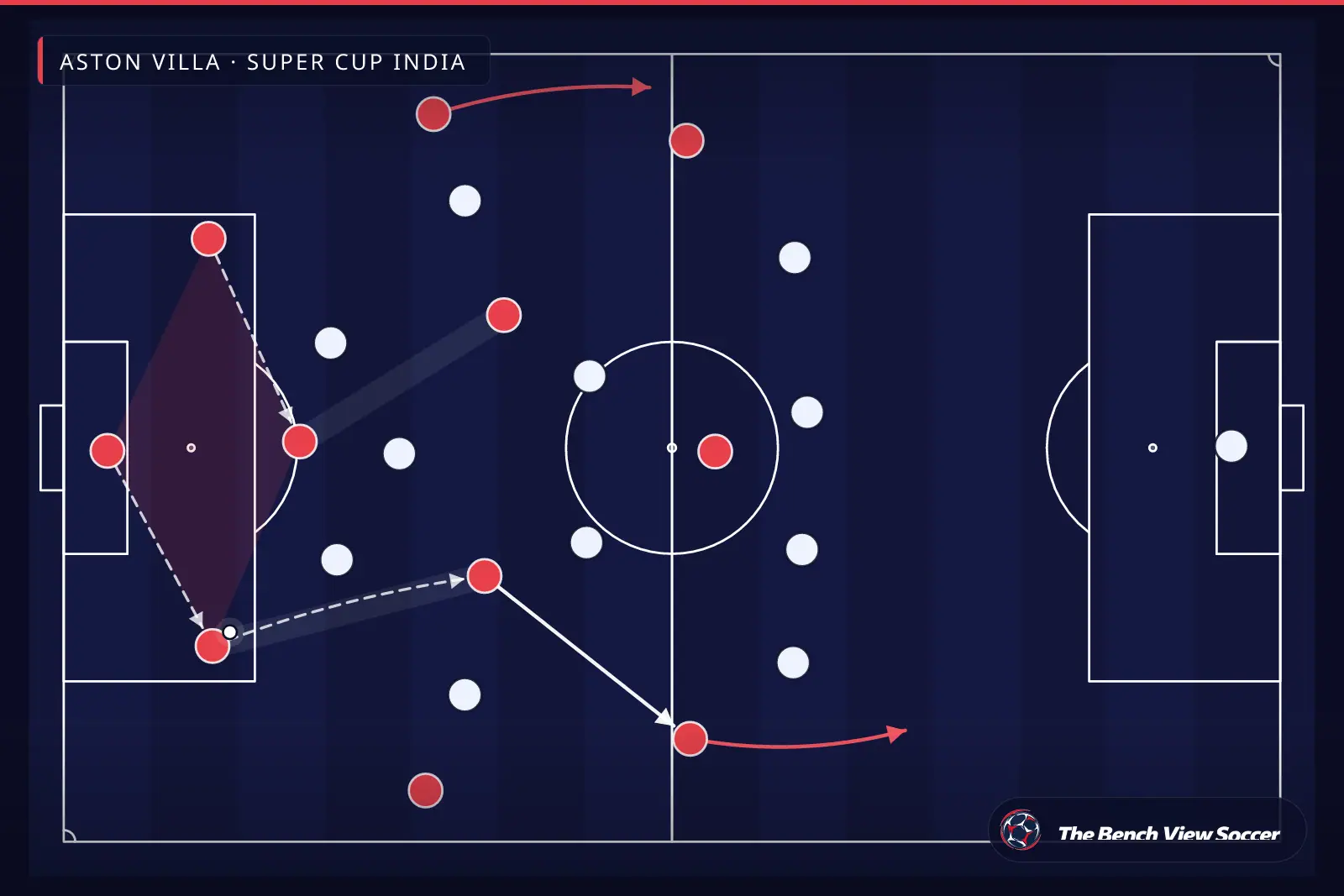
PSG’s solution was to play chicken with that trigger. Their goalkeeper took an extra touch. Then another. The split centre-backs drew Villa’s nine into a cover-shadow that felt productive—until the near full-back slipped inside to create a temporary back three and the nearest midfielder dropped into the same line as the pivot: a classic box midfield (3-2) in early build. That interior box matters. With two interior connectors beneath Villa’s first line, the third-man pass was always alive. The far No. 10 sat on Villa’s double pivot shoulder. The near winger held the chalk to widen Villa’s full-back. And the trap—compelling, aggressive—suddenly had to defend a third corridor.
The 12th minute: a textbook escape
12th minute, right half-space: Villa spring the trigger off a backpass to the PSG keeper. The nine curves left, the right winger jumps to the full-back. PSG’s inside-right, sitting as the low 10, drags Villa’s right eight up a yard and bounces to the pivot. One touch later, the pivot fires a flat diagonal to the far 10, stationed between lines on the left half-space. Villa’s far winger is narrow by design; their far full-back is tucked to keep the back four compact. Result: a 2-v-1 unfolds on the far flank before the slide can complete. PSG don’t score—but they don’t need to. The pattern is installed.
When the bait becomes the blade
Across the first half, PSG reran that scheme with minor tweaks. Sometimes the far switch came via the centre-back zipping a 40-yard laser into the far touchline. Sometimes the goalkeeper clipped into the far winger after a feint inside. The mechanism didn’t change: provoke Villa’s stagger, then punish the weak-side space at pace. Villa’s press is at its best when distances are short and the counterpress bites within two passes. In India’s humidity and at preseason tempo, the distances grew. In the 28th minute, we saw the underbelly again: PSG froze Villa’s nine by faking a pass through the six, popped into the inverted full-back, then sprayed. Villa’s back four retreated on the spin; their far eight turned late; a cutback skidded across the six-yard box untouched. Warning amplified.
The weak-side story: switches, stagger, and a 41st-minute punishment
Every high press has a blind spot. For Villa, it is the interval between the far-side winger (narrow to protect the pivot) and the far full-back (tucked to compress the back four). Elite sides aim for that seam with timing and width. PSG’s box guaranteed the timing; their wingers supplied the width.
41st minute, left channel: PSG go short from the goalkeeper, centre-back to pivot, and immediately spin it back to the keeper under token pressure—exactly the pass that makes Villa jump. The nine bites. The ball zips to the right-sided centre-back, who drives a diagonal to the left touchline. Villa’s right-back is still shifting. The far winger has no choice but to close the interior lane to the 10, leaving the direct line open. One take, one layoff, and PSG are around the corner. The pull-back finds a late-arriving midfielder at the spot. Net ripples. The weak-side switch, from bait to blade, completes the cut.
This was not about brilliance on the dribble; it was about accelerating the ball faster than Villa’s defensive block could travel. Where some Premier League sides lose nerve and recycle, PSG kept breaking the line of engagement with insistence. In the span from the 35th to the 45th minute, they completed four such diagonals—too many for a line that needs horizontal control to function.
Madjo’s cameo: a teenager’s movement that bent PSG’s rest-defense
Now, about that teenager. Madjo didn’t just “impress”; he changed the geometry of Villa’s attack. Stationed primarily as a centre-forward but happy to fan into the right half-space, he repeatedly offered the third-man run Villa’s midfield craves when oppositions sit in a 2-3 rest-defense. In the 29th minute, he dropped onto PSG’s right centre-back, bounced a one-touch into Villa’s advancing eight, and immediately spun behind into the channel. The return didn’t come—but the picture did: if Villa can find him on that blindside burst, they flip the game’s transitions.
53rd minute: exactly that image. Madjo peels into the right half-space, the ball-side eight underlaps, and a one-two sends the teenager streaking into the box. The angle proves tight; the finish skims past the post. But tactically, it matters: PSG’s 2-3 rest-defense had to widen, opening central progression for Villa’s inverted winger on the next sequence. Later, in the 72nd minute, Madjo triggers a pressing trap of his own—sprinting at the goalkeeper off a heavy touch. He doesn’t win the ball but forces an immediate clearance into touch. Visible, contagious energy. More importantly, scalable movements.
What set Madjo apart wasn’t pace alone; it was timing. He ran from the blind shoulder of the full-back at exactly the moment Villa’s eight engaged PSG’s near pivot. That is the moment many back-fours release the far centre-back to step—and where a sharply timed diagonal can break the last line. In a night that exposed Villa’s far-side issues, their own teenager’s mastery of those far-side moments was the most instructive bright spot.
Cause and effect: why Villa’s high line looked a step slow
So why did this happen, and why in this way? Three interacting factors:
1) Distance control in the back four. Villa’s horizontal distances in the line grew to 13–15 metres between centre-back and full-back on the far side during transitions. For a team that hunts aggressively up the pitch, those gaps are invitation letters. Tighten to 8–10 metres and the weak-side switch meets a body; leave it 15, and you’re defending a foot race facing your own goal.
2) The far-eight’s starting position. Emery’s system often holds the far eight high to preserve counter-pressing presence. Against PSG’s box, that far eight needs to drop five yards earlier—arriving, not reacting, to the switch. Too often, Villa’s far eight was still in the inside channel when the diagonal had already flown, making the recovery a 25-metre shuttle rather than a 10-metre shuffle.
3) Goalkeeper engagement at the wrong angle. Villa’s press is lethal when the striker’s angle shadows the pivot. PSG countered by pinning the striker centrally with the goalkeeper showing a tempting line, then replaying it through the interior box. That small detail—the keeper as decoy controller—forced Villa’s nine to choose between sprint and shade. In India’s conditions, sprint won early; shade needed to win instead.
Historical echoes: the Villa pattern opponents remember
If you followed Villa’s 2023–24 emergence, you’ll know this pattern. The emphatic opening-day defeat at Newcastle in 2023 was powered by diagonals to the weak side and counter-attacks that started centrally and spat out wide. In Europe that same season, opponents who could switch early—Legia Warsaw among them—repeatedly found ways to arrive in Villa’s box with a runner free at the far post. The reason wasn’t quality; it was geometry.
Emery’s brilliance has been to transform Villa through positional superiority: a 2-3-5 with inside wingers pinning centre-backs, eights attacking half-spaces, and full-backs underlapping to overload central corridors. The trade-off is clear: when the rest-defense reads 2+3 horizontally and the wide winger stays high, the far side requires impeccable coordination. Most Premier League sides don’t have the bravery or build-up quality to test it repeatedly. PSG do—and did.
Sequence-by-sequence: the middle third where the match was lost
Let’s stitch together the critical sequences.
18th minute, right wing: Villa’s press wins a throw after a forced PSG clearance. Good. From the restart, Villa build left-to-right across the double pivot, drawing PSG’s front line into a narrow block. The invitation is to punch the inside lane. Villa take it—but the underlap arrives before the pass, closing the angle. PSG regain, find their goalkeeper, and here comes the trap: inside to the pivot, out to the full-back, back to the goalkeeper, hold… then ping 50 yards to the far winger. Villa’s far full-back is alone. He delays well, but the second wave arrives and PSG fire a low shot that Villa’s keeper palms aside. Different minute, same maths.
64th minute, central-to-left switch: Villa compress PSG on the right, eight and winger corralling the channel. PSG’s near 10 drops diagonally, creating a third-man line into the pivot. Ball zips inside, two touches later it’s on the left chalk again. Cutback to the penalty spot, blocked. If you felt déjà vu, so did Villa.
77th minute, the near miss that underlined the fix: Villa anticipate the weak-side hit, with the far eight already shading wide before the goalkeeper releases. The diagonal still comes—but this time the far eight arrives on the catch, converting a 1-v-1 into a 2-v-2. PSG recycle, the crowd roars in appreciation of the duel, and Villa spring back down the right. That single pre-rotation from the far eight shrank the problem by half. It’s the coaching clip Emery will recycle on Monday.
India matters: pace, humidity and the slide of the block
This wasn’t played at a sleepy preseason tempo. The Indian crowd—Premier League obsessives from Kolkata’s ultras to Bengaluru’s blue brigades—demanded speed. Both teams obliged. But physics in August subcontinent air takes its toll. When you ask a block to cover 60 metres horizontally at high frequency, fatigue indexes spike, slide timings lag by half a beat, and a high line starts looking like hubris rather than bravery.
PSG leaned into that reality. Their goalkeeper delayed, again and again, to draw the press and stretch Villa’s reactions. Their centre-backs took the risk of the square ball under pressure because the payoff was getting Villa’s far eight to wait half a second too long. In pre-season conditions, half a second becomes a lane.
What Emery tweaks next: from rest-defense to far-side pre-rotation
There are clean, coachable solutions here that don’t neuter Villa’s identity.
1) Far-eight pre-rotation: Ask the far eight to start three yards wider when PSG (or similar) settle into a box. That slight pre-tilt shrinks the diagonal window and speeds up the slide. It also preserves the counterpress, because the far winger can then stay higher without leaving the full-back naked.
2) Back-four distance control: Drill 8–10 metre horizontal gaps with “travel on the pass” cues. Villa’s centre-back must step toward the far half-space as the goalkeeper shapes to kick, not after the ball is gone. That anticipatory step turns a chase into a duel.
3) Rotate the rest-defense into a 3-2 on cue: When the opponent’s full-back inverts to help form a back three, mirror the shape. Drop a pivot between centre-backs earlier to create a 3-2 rest-defense, ensuring the far full-back can release to the winger sooner without ripping the line.
4) Pressing angle on the goalkeeper: Demand shadow control over sprint. If the nine shows the line through the pivot rather than lunging at the ball, PSG’s bait loses flavour. Shade the six, force the long kick under pressure, and suddenly that diagonal hangs rather than zips.
5) Lean into Madjo as a pressing anchor: The teenager’s timing makes him an ideal first presser when the opponent seeks to stage play with the goalkeeper. Start him on the centre-back’s inside shoulder, let him trigger on the keeper’s second touch, and cue the near eight to lock the bounce. If he starts wide, give him the “go on the backwards touch” rule to close the triangle and trap the near pivot.
Personnel wrinkles: the human side of the geometry
Emery’s system amplifies players who thrive in tight spaces and understand underlaps. That also means the far full-back needs instincts borderline telepathic with the far eight. If summer business or rotation has paired a new full-back with a new centre-back, the timing will be off. That’s not a character flaw; it’s chemistry. The fix is reps and clarity.
At the other end, Villa can weaponise Madjo’s profile in two ways: as a pressing nine in the opening phase to disturb the orchestrated box, and as a wide half-space runner late in games when opponents go to a 2-3 rest-defense. Either way, he forces centre-backs to respect depth, buying the midfield a yard—the most precious commodity against elite rest-defenses.
PSG’s blueprint going forward: Champions League relevance
From PSG’s perspective, the takeaway is not the trophy; it’s the transferability of the box-to-switch concept against high-pressing elites. Champions League knockout football often comes down to how cleanly you can move the ball from bait to weak side under pressure. PSG looked composed, rehearsed, and ruthless in that specific art. They will meet teams this season that press even better than Villa. But the shape—the gk-influenced 3-2, the dual 10s separating markers, the wide winger pinning the far full-back—scales upwards.
It also hints at a maturing patience: using the goalkeeper as an extra outfield player not to pass for passing’s sake, but to stress the opponent’s distances and force structural concessions. That’s continental football, and it travelled well to India tonight.
For Villa: this can still be a springboard
Results rarely matter in pre-season hardware. Patterns do. And this pattern is coachable. Emery has already shown a capacity to adjust without abandoning principles—tucking a full-back inside, rotating a pivot back to form a three, or flipping the wing orientation to find a new angle on the half-space. In Premier League terms, the lesson will be timely: opponents who cannot maintain PSG’s quality or consistency will struggle to reproduce this stress test. Those who can—think the league’s pressing aristocrats and Europe’s knockout regulars—now have fresh film to mine.
Practically, this means Villa’s opening months should double down on far-side communication reps and rest-defense triggers. When those are tuned, the benefits flow the other way: with a locked-in far side, Villa recover and attack against a spread opponent, meaning their own switches into the arriving wide forward will land against a backpedalling line. That’s how this team scores in waves.
A note for India’s football community: what to watch next
For ISL watchers across Goa, Kochi, Kolkata and beyond, bookmark the “weak-side story.” It is as relevant in the Indian Super League as it is under Champions League lights. When Bengaluru FC or ATK Mohun Bagan push wingers inside to squeeze space, opponents who can bounce through a double pivot and hit the far winger early will fashion the best chances. The vocabulary—half-spaces, third-man runs, underlaps—can feel continental. The principles are universal: compress on one wing, hurt on the other; defend narrow, get punished wide; attack central lanes, finish at the back post.
Kolkata’s deep football culture understands this intrinsically—decades of derby wisdom have taught East Bengal and Mohun Bagan that crowds rise for switches that beat a press. Tonight’s Super Cup India action simply exported that theatre with European actors. The knowledge stays here. Indian players and coaches can, and increasingly do, operate in these exact dynamics.
Counterargument: it’s just pre-season… right?
Caveats are fair. It’s August. Fitness is uneven. Travel bites. Rotations splice chemistry. Villa fielded youngsters—including Madjo—against Champions League veterans, and PSG may be weeks further along in conditioning. Some of Villa’s spacing slack is not a tactical flaw but a preseason tax. One match never defines a season.
But we’d counter with two points. First, the pattern precedes this match; it mirrors issues Villa faced at the start and heart of their 2023–24 journey. Second, the fix is not a personnel revolution—it’s a handful of distance, angle, and timing details. The upside of a systemic issue is that it has a systemic solution.
The verdict: the far side decides how far Villa can go
Strip away the noise and you’re left with a simple, high-level football truth: high presses don’t die because they’re too brave; they die because the weak side can’t keep up with the ball’s speed. PSG authored a masterclass in accelerating play from bait to blade, using a box midfield to open the diagonal and a goalkeeper to distort angles. Villa, meanwhile, offered a teenage forward who looked born to sprint into those same diagonals the other way.
Tactically speaking, Aston Villa’s Super Cup India loss is less a warning siren and more a calibration tone. Close the far-side seam, pre-rotate the eight, control the back-four distances, and keep unleashing Madjo’s third-man timing. Do those things, and the next time a European heavyweight tries to bait the trap, Villa will spring it—and finish the night lifting hardware in front of a crowd that already loves their ambition.
Shareable verdict? Here it is: Fix the far side, and Villa’s ceiling rises with it.
The Bench View app
Don’t just read football — train it
Everything you read here, turned into training you can follow step by step.
Physical training at home
AI daily sessions adapted to your level and position. No equipment needed.
Tactical training courses
Step-by-step courses on positioning, pressing, build-up and decision making.
- 7 days free
- No commitment
- Cancel anytime
Free account: 2 physical sessions + the first tactical course. PRO: 7-day free trial — cancel before day 8 and you pay nothing.

More Analysis
Manchester City: How Gakpo Unlocks Pep’s Left Half-Space Engine
August 25, 2026
Liverpool's Inverted Trent Unlocks Salah vs Newcastle's Press
August 23, 2026
Liverpool's Salah Succession Plan: How Yankuba Minteh Fits Slot
August 21, 2026
Hull City, Fulham and Ipswich: How the Box Midfield Changes Them
August 18, 2026