

Trending moment: three previews, one tactical story
Everyone is publishing their Premier League previews. The headlines are racing through Hull City, Fulham and Ipswich in quick succession, and the temptation is to stack depth charts and guess finishing positions. We’re not doing that. The tactical thread tying these three together is stronger—and more interesting—than the transfer rumours or the bookmaker odds. The bold claim: this mid-table and newly elevated cohort is converging on the same structural fix for a league defined by pressure. They’re moving to a box midfield in possession, using a hybrid back three to build, and winning games through rest-defense rather than flair. In our view, this is the real story of Premier League 2026–27 outside the title race: three clubs attempting to bend game state and field geography with the same geometry.
Analytically speaking, Hull City, Fulham and Ipswich will live or die by how consistently they can form and protect the box midfield—because in the Premier League, structure is the new star player.
That may sound abstract. It isn’t. The shape—3-2 in the first two lines, 2-3 ahead—compresses distances, hardens the counter-press, and shortens the passing route into dangerous zones. It’s how you survive the Premier League’s relentless pressing without elite dribblers in every lane. And all three clubs are leaning in.
Why the box midfield now? Cause and effect in a high-pressure league
Across the division, out-of-possession intensity is up; triggers are better rehearsed, and the first line of pressure arrives sooner. Defenders are being asked to receive with shoulders closed and make perfect first touches under fire. If you try to build in a flat 4-3-3 with a high single pivot, you end up with 30-meter gaps to your wingers and passes that feel like 50-50s. The box midfield—two at the base, two between lines—solves three problems at once:
1) It grants immediate positional superiority around the ball. One pass beats two lines if your interiors are offset in the half-spaces.
2) It creates natural third-man runs. When the striker pins the center-backs, the far interior can crash the lane on a blindside cue.
3) It upgrades rest-defense. With three behind the ball and a short triangle around the loss point, transition risk is pre-managed, not reacted to.
In practice, you’ll see the same choreography repeating: the full-back steps inside to form the 3, the far full-back stays a touch deeper to flatten counters; the ‘10’ drops next to the eight to complete the square; the winger holds width but times underlapping runs to break the last line. If it looks the same across teams, it’s because the constraints are the same. The Premier League punishes open shapes and sloppy spacing. The box is the antidote.
Hull City: the vertical box and the long-route release
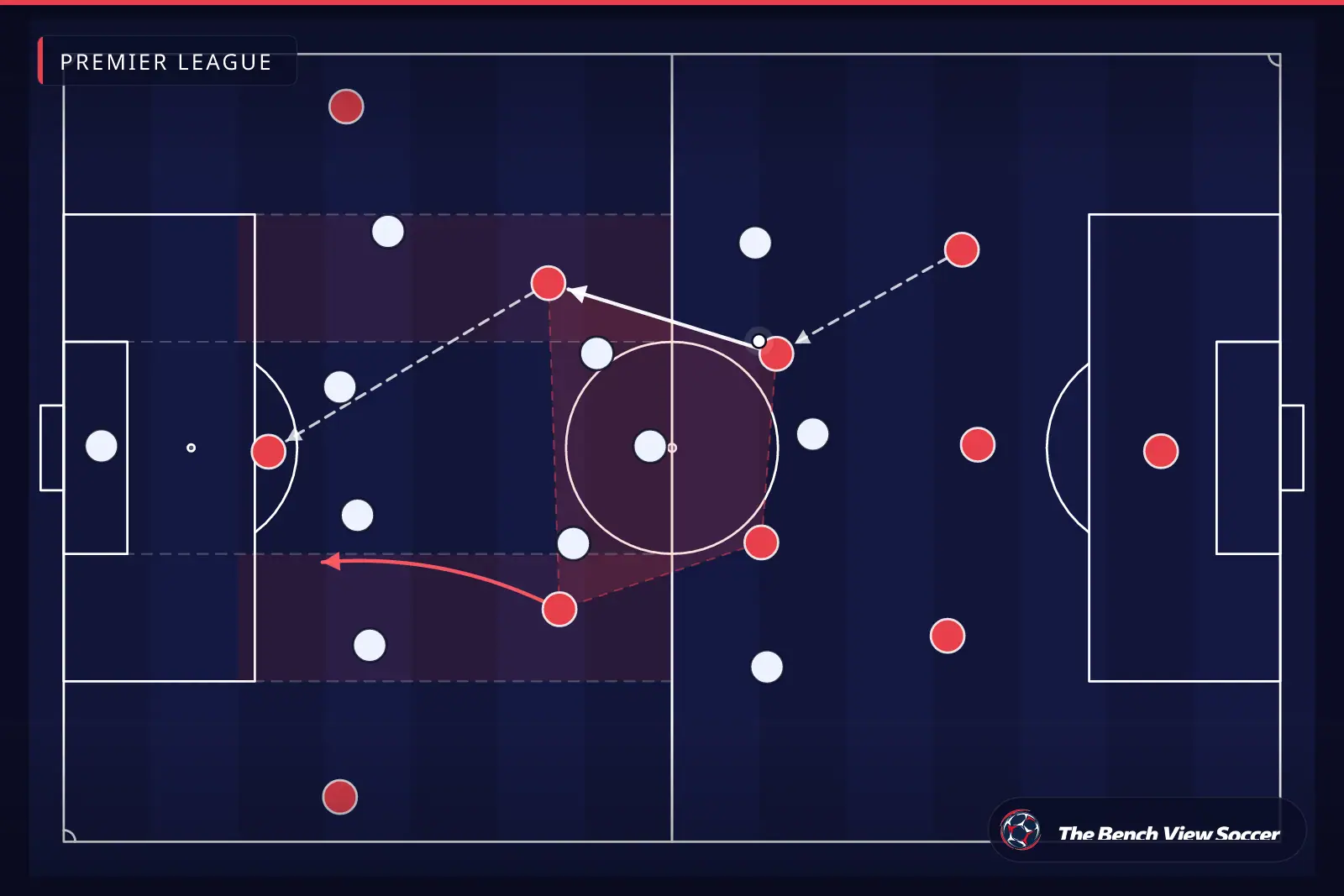
Tactically speaking, Hull’s promise is verticality written into the shape. In possession, think 3-2-2-3: a left back inverts to form the 3, the double pivot staggers (one high in the right half-space, one low screening), and the front three stretch with a winger outside and a narrow far winger ready to underlap. The intent is clear: manipulate the opponent’s first line by fixing them, then pass through to the near interior on the half-turn.
Pressing triggers and the three-lane launch
Hull’s out-of-possession plan should build directly from that geometry. Expect them to press selectively off wide cues. The first pressing trigger: an opposition center-back receiving on the back foot with body closed to the touchline; that’s when the winger jumps, the nine screens the return lane, and the near interior cheats high to jump the ‘free’ six. If Hull win it there, they immediately activate a three-lane launch—near winger bursting into the channel, the nine showing for a wall pass, far interior attacking the penalty spot.
Illustrative sequence (64th minute, right half-space): the right-sided interior checks short to receive, draws the full-back, then bounces to the overlapping center-back stepping from the back three. The nine spins out, drags a center-back, and the far interior darts between full-back and center-back. One clipped pass into the corridor of uncertainty. That’s not improvisation; that’s the box midfield creating a passing-lane escalator.
Rest-defense: from habit to weapon
Hull’s biggest upgrade will be how they guard the counter. With a hybrid 3 behind the ball, the near pivot closes the inside lane, the far pivot screens the first pass, and the free center-back plays sweeper to protect the space behind the full-back who inverted. This is where the box wins the Premier League margins. You’re not sprinting 50 meters backward; you’re stepping forward to re-press with an eight-meter regain.
Coaching detail to note: watch the distances between the pivots and the near center-back when Hull lose the ball. If that triangle is tight (7–10 meters per side), they’ll suffocate counters. If it stretches (12+ meters), teams will play around or through them. On broadcast, you’ll literally see the regain come from the first two steps, not a recovery sprint. That’s system, not effort.
Set-plays as structure insurance
Clubs targeting consolidation often bake goals into set-pieces. Hull can use the box to improve dead balls: the two interiors sit on rebounds, the double pivot forms a counter-foul screen. Second phases matter in the Premier League; a clean rest-defense on corners can be worth five to eight points over a season, because it keeps you out of 0–1-to-0–2 avalanches.
Where it could stall
Counterargument for Hull: if rivals force them wide early and deny the interior receive, the build can calcify into sterile horseshoes. The inverted full-back can become a spare man who does nothing but pass sideways; the nine can get isolated. If the far interior doesn’t time the blindside run, the front five looks like a straight line—football’s cardinal sin in chance creation. The correction? Reassert the verticality: bounce faster, run earlier, and accept the ugly wall pass to drag center-backs out of their shell.
Fulham: the box as a control mechanism
Fulham’s version of the box is more about tempo and control. Their shape reads 4-2-3-1 on TV graphics but flips to a 2-3-2-3 with the near full-back stepping in and the ‘10’ dropping alongside the eight to make the square. Unlike Hull’s directness, Fulham aim to keep the ball moving side-to-side until a pressing mistake opens the channel. The key is patience with purpose.
Box-building mechanics
Positional details matter. The near pivot must stand on the opponent’s shadow line—close enough to receive but hidden from a straight press. The ‘10’ doesn’t just drop; they offset by a few meters to the opposite half-space to create a diagonal lane for the center-back’s punch pass. When Fulham get this right, you’ll see the ball flow into the interior, laid off to the pivot, then immediately fired into the winger for a 2v1 on the full-back, with the underlap primed.
Illustrative sequence (38th minute, left half-space): center-back splits the nine with a punch pass into the ‘10’; instant bounce to the near pivot; winger holds width to pin the full-back; underlapping full-back sprints beyond to cross the face. The action looks simple. The timing is not. The box creates the first pass; the choreography makes it an attack.
Pressing traps: funnel, then spring
Fulham out of possession should choose their moments. The trap is classic: bait the pass to the opposition full-back, angle the press to show the line, and lock the touchline. The pivot’s job is to cut the inside half-space; the winger curves to remove the back pass. If the opponent tries to play inside, the near interior pounces from the blindside. Recoveries won here aren’t just turnovers—they’re immediate, high-value entries into the box because the far interior has already rotated into a striker lane.
Game-state intelligence
Fulham have historically toggled tempo well, and the box enhances that. At 1–0 up, the back three in rest-defense allows them to compress the pitch without fear; the pivots can step a few meters higher knowing they’re shielded. At 0–1 down, the same structure lets them overlay an extra runner through the interior without sacrificing cover—think of shifting one pivot to join the front five in extended possession. In both cases, the shape builds the scenario rather than requiring wholesale formation changes.
Where control becomes caution
Counterargument for Fulham: the box can drift into handbrake football if the ‘10’ receives too deep and becomes a third pivot. Then you get five in the back line of attack and not enough penalty-area entries. The fix is vertical occupation—keep one interior on the last line, even if it means longer spells without touches. If the far interior doesn’t stress the center-backs, control won’t translate to chances.
Ipswich: automated rotations, Premier League proofing
Ipswich arrive with some of the most clearly drilled patterns in the country. Their Championship success wasn’t fluke; it was repetition. The box is the next logical step. In possession, it’s a neat 3-2-2-3 with rapid, small-space combinations geared toward springing the wide forward behind the line. Out of possession, they’re happy to show you the touchline and trust their sprint distances.
Automations and the half-space escalator
What marks Ipswich’s approach is the pre-programmed nature of the moves. The box here is less about pausing the game and more about pre-activating third-man runs. Watch the far interior’s starting position: five meters inside the channel, shoulder checked, waiting for the nine’s layoff cue. When the nine pins and bounces, the far interior explodes through. The near full-back’s inversion creates the lane by pinning an extra midfielder.
Illustrative sequence (27th minute, right half-space): near pivot receives under pressure, one-touch to the ‘10’, who bounces to the nine; the far interior has already begun the run before the ball reaches the nine. One-touch flick and they’re away. It looks like telepathy; it’s really timing drilled until it’s muscle memory.
Transition elasticity
Ipswich will need elasticity in transition to survive the early Premier League weeks. The box gives them that. When they lose it, the near pivot sprints diagonally to shut the inside lane while the far pivot takes three retreat steps then pauses—counterintuitive, but smart—because the second ball often lands at 12–15 meters. That pause wins regains. Meanwhile, the spare center-back angles to the wide channel their full-back just vacated. If those three steps are precise, Ipswich short-circuit the league’s quickest counters.
Set-pieces and the second wave
We should expect Ipswich to leverage set-plays heavily, with the box sitting in the perfect rebound lanes. The two interiors hover top of the box; one hits cut-backs, the other guards central exits. That second wave produces some of the cleanest shots a team like Ipswich will see against top-six low blocks, where the first cross gets headed out but the second action breaks structure.
Risk: exposure in the channels
Counterargument for Ipswich: all this automation can leave them vulnerable if an opponent flips the angle quickly. When the near full-back inverts, the channel behind is thin; if the spare center-back’s starting position isn’t aggressive, diagonal balls will isolate them 1v1. That’s where the Premier League difference bites—rivals will hit those passes at speed. The counter is not dropping deeper; it’s sharpening starting positions and body shapes so the first step is forward, not sideways.
Historical context: when shapes changed the league’s middle
This isn’t the first time geometry re-wrote the mid-table. Wolves’ 2018–19 back three locked games at their tempo. Sheffield United’s 2019–20 overlapping center-backs stole points by surprising established patterns. Brentford in 2021–22 weaponised set-plays and rest-defense to live with anyone. Brighton under De Zerbi redefined build-up distances and the rhythm of baiting presses, dragging opponents into traps they couldn’t see. None of those teams had the league’s best individual talent. All had the league’s cleanest spacing. The box midfield is this cycle’s iteration: a universal tool calibrated for a league where five yards of spacing beats five million pounds of wages.
What’s similar now is the balance of surprise and sustainability. Early-season opponents will recognise the box but will still struggle with the sequencing. It’s not enough to spot an inverted full-back; you have to kill the third-man run, which means anticipating something two passes away. That’s why these structures work best for the hungry middle—they reward teams that train patterns, not just moments.
Mechanics that make or break the box
1) The double pivot’s height
The first mention of a double pivot conjures control, but the trick is staggering: one sits to receive and screen; one steps to engage the opponent’s six. If both sit, you get sterile possession; if both step, transitions slice you. The sweet spot is a soft 2-1 relationship with the interiors: the higher pivot is close enough to bounce attacks; the lower pivot is close enough to foul cleanly in a loss.
2) The winger’s timing
Box teams love inverted wingers, but the key is their movement off the ball. Arrive late, don’t stand early. If the winger occupies the half-space too soon, the full-back never gets drawn, and the underlap has no corridor. If the winger holds chalk and then darts inside as the interior receives, the back line panics. That panic is where goals live.
3) Third-man principles
Every pass in the box aims at a third-man run. The first is a decoy, the second is an angle, the third is the penetrate. If you’re watching at home, pause your mental frame one pass before the line-break. The player who breaks the line rarely starts in the lane—they arc into it from a blind shoulder. That is by design. Coaches script that arc in training, and box teams win by landing it on time.
4) Rest-defense distances
Tactically speaking, rest-defense is only as good as the distances at the moment of loss. Top sides win the ball back in three seconds because their nearest three are within eight meters of each other and their body orientations are forward. If Hull, Fulham and Ipswich keep those distances, they will live in positive territory. If they stretch to 12–15 meters, they’ll live on structural fouls and yellow cards.
5) Switching the switch: when to go wide
The box seduces teams into thinking central is always best. It isn’t. The timing of the switch is the trap-spring. Two central bounces often pull the far full-back narrow. That’s the cue to clip to the far winger and race the underlap before the line resets. The switch is an end, not a reset.
What it means for the Premier League season
Here’s how it plays out if the shapes stick and the coaching details land:
- Against high-pressing elites, these teams can create clean exits by using the interior as a one-touch wall. Expect fewer panicked long balls and more structured releases into the winger’s lane. That alone turns survival matches into 50-50s for 60 minutes.
- Against deep blocks, the interiors become needle-threaders. It’s less about dribbles, more about tiny angles to move the low block five meters at a time until a cut-back appears. Watch for the late far-post runs from the far interior; that’s a staple goal in box teams.
- In transition matches against peers, rest-defense prevents the game from tilting into chaos. That keeps matches in the 0–0 to 1–0 bands longer, where set-pieces and second phases decide nights. Discipline equals points.
Hull’s ceiling in this paradigm is clarity: win games by turning regain zones into launch pads. Fulham’s is control: climb by compressing games into their tempo. Ipswich’s is surprise: catch established teams flat-footed with pre-programmed runs and set-piece second waves.
The one big counterargument
Let’s confront the pushback. “Everyone’s doing the box; the league will adapt.” True, shapes spread fast in the Premier League. Coaches will instruct their sixes to sit on the near interior; wingers will split to threaten the channels behind the inverting full-back. If rivals time their diagonals, they can pull the spare center-back into no-man’s-land and make the re-press look naive.
Our view: this only kills the box if teams treat the shape as the tactic. The shape is scaffolding. The real edges live in micro-details—body orientation on the first touch, the exact moment a nine spins, the cue that triggers the far interior’s run, the foul timing that kills a transition without a card. When those micro-details are sharp, the box holds against the adaptation cycle. When they’re not, the adaptation eats it in three weeks.
How to watch it unfold, minute-to-minute
Broadcast tells that reveal success or struggle
- First touch of the near interior: if they open to the field (hips angled at 45 degrees), the lane is live. If they trap with closed hips, the press wins. You can spot this in one camera cut.
- Distance from near pivot to nearest center-back at the moment of loss: eight meters or less is healthy; 12+ meters equals transition risk.
- Number of third-man triggers in the first 20 minutes: if the nine is bouncing and spinning and the far interior is running twice per five minutes, the box is functioning.
- Underlap arrival times: underlapping runs need to arrive in the box as the ball does, not after. Late arrivals are a symptom of a passive box.
Minute-mark examples to look for
- 12th minute, left half-space: a full-back inverts, receives, and plays a punch pass into the ‘10’. Does the nine immediately set the wall and spin? If yes, the near center-back will be pinned and the far interior’s lane opens.
- 33rd minute, right channel: opposition clips a switch toward the winger behind the inverting full-back. Does the spare center-back start wide enough to meet it on the front foot? That single decision predicts the season’s transition health.
- 61st minute, low block: the box cycles and recycles for 40 seconds. Watch for the pivot’s disguised reverse to the underlap. That’s the moment that turns sterile possession into a cut-back chance.
Training ground to table: why these three can make it stick
None of this works without consistent coaching reps. The benefits of the box are cumulative: the more fixed the starting positions and the more automatic the cues, the less mental bandwidth players spend solving the puzzle in real time. That’s the advantage for Hull, Fulham and Ipswich—clubs committed, tactically speaking, to drilling patterns that live beyond any one star’s form. In a league where fixtures compress and recovery windows shrink, that’s not just elegant; it’s practical.
What’s more, the personnel demands of the box are modest but specific: one center-back comfortable stepping into midfield; a wide player who can run off the ball all game; a pivot who can both foul smartly and disguise a pass; a nine who loves the dirty work of bouncing and spinning without always receiving the glory pass. You don’t need five £70m artists; you need six players who love timings and distances.
Predicted tactical arcs
Hull City’s arc
Expect early-season volatility followed by a tightening curve. When the box’s rest-defense distances click, Hull will start nicking 1–0s off high-turnover goals and shutting down counters in their weakest periods. Their set-plays will matter disproportionately—look for second-phase goals with interiors stationed top of the area. The stretch goal is converting mid-block regains into box entries without an extra touch.
Fulham’s arc
Fulham should look the most stable week-to-week. The question is chance volume. If the interiors maintain vertical occupation and the underlaps arrive on time, their shot map will tilt to the penalty spot. If not, possession will swell without threat. The box is their throttle; turning control into incision will define their season ceiling.
Ipswich’s arc
Ipswich will shock a few established sides with scripted third-man patterns and then face the adaptation wave by late autumn. The answer won’t be abandonment; it’ll be layering more disguise onto familiar cues—double movements on the far side, delayed underlaps, and feints in the double pivot to freeze pressers for half a beat. If they hit those layers, their spring run will look like a second wind, not a fade.
The bottom line
The Premier League is a geometry problem disguised as a sprint race. Hull City, Fulham and Ipswich are choosing the same ruler and compass: the box midfield on a hybrid 3-2 platform with disciplined pressing triggers, purposeful underlapping runs, and non-negotiable rest-defense. Tactically speaking, that’s the right bet. It won’t make headlines like a marquee signing, but it will erase losing streaks, steady game states, and nudge coin-flip matches their way.
There will be days when the box looks sterile and the switch comes one pass too late. There will be afternoons when a diagonal shreds the inversion. But over 38 matches, patterns beat moments. And this is the pattern to watch.
Verdict: the mid-table’s tactical arms race is here, and the box is the weapon. If Hull, Fulham and Ipswich commit to the micro-details—the distances, the angles, the timing—they won’t just survive the Premier League’s pressure. They’ll reshape it from the middle.
The Bench View app
Don’t just read football — train it
Everything you read here, turned into training you can follow step by step.
Physical training at home
AI daily sessions adapted to your level and position. No equipment needed.
Tactical training courses
Step-by-step courses on positioning, pressing, build-up and decision making.
- 7 days free
- No commitment
- Cancel anytime
Free account: 2 physical sessions + the first tactical course. PRO: 7-day free trial — cancel before day 8 and you pay nothing.
More Analysis
Manchester City: How Gakpo Unlocks Pep’s Left Half-Space Engine
August 25, 2026
Liverpool's Inverted Trent Unlocks Salah vs Newcastle's Press
August 23, 2026
Liverpool's Salah Succession Plan: How Yankuba Minteh Fits Slot
August 21, 2026
Nigeria's Vertical-Run DNA: How Osimhen Shapes Every Game Plan
August 14, 2026