

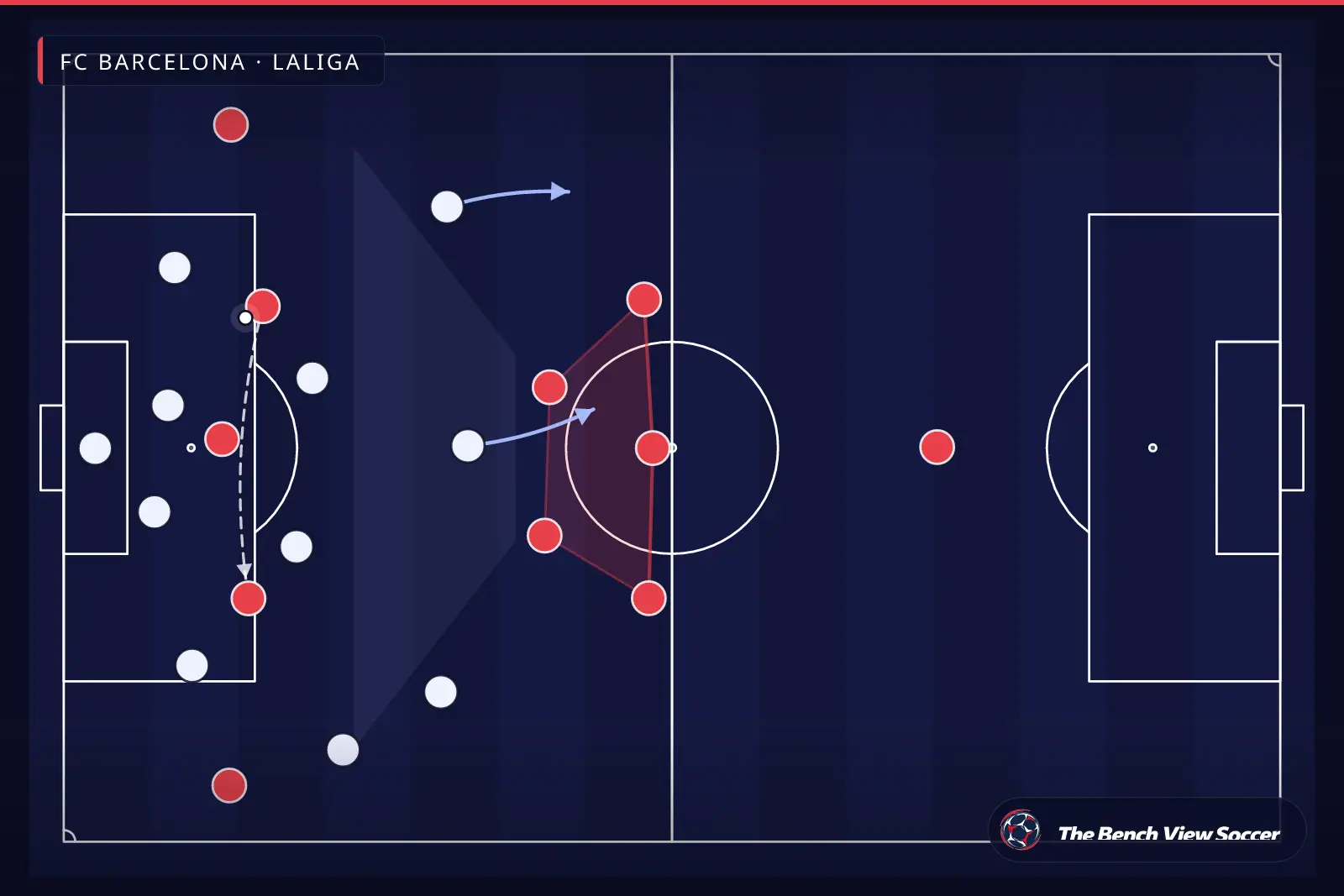
Trending moment, bold thesis: FC Barcelona choose structure over superhero defending
Ronald Araújo to Liverpool is the headline; FC Barcelona’s risk is the story. In our view, Barcelona’s decision to let their most devastating 1v1 defender depart is not a surrender of defensive quality but a deliberate, structural bet: the club is prioritising a cleaner rest-defense and collective spacing over elite emergency defending. It’s a pivot from winning duels to preventing duels.
That choice reframes the next era at Montjuïc and beyond. Rather than bending the system to leverage Araújo’s extraordinary recovery pace and ball-wins in wide isolation, Barcelona appear intent on designing a game model that minimises those isolations entirely—shorter distances between lines, more secure occupation of the half-spaces, and a ball circulation that reduces the number of transitions they have to survive. The question for 2026–27 is not whether Barcelona replace Araújo like-for-like; it’s whether they replace the situations that made him essential.
Barcelona aren’t replacing a player; tactically speaking, they’re replacing a problem—the repeated wide 1v1s that defined too many of their big nights.
Why this happened: the structural pressure points Barcelona chose to solve
At peak Araújo-era Barcelona, one tactical truth kept repeating: Barça’s idea (positional domination, ball progression, layered occupation) was frequently decoupled from their rest-defense. They built with elegance, then defended with adrenaline. The space behind the advanced right-back, the gap between the pivot and right centre-back, the time it took for the near-side winger to spring back—those creases formed the stage where Araújo thrived. Elite in the back pedal, ferocious in the tackle, almost unfair in shoulder-to-shoulder duels, he often turned red-alert moments into yellow ones.
Barcelona, however, seem to have decided that living at yellow alert is not a sustainable Champions League strategy. What wins LaLiga volume games—defensive heroics and individual interventions—often falls short in Europe when the press is broken by the best. The choice is philosophical: tighten your spacing so you’re defending fewer long runs in wide channels; accept slightly less brute-force domination in the duel to gain a better platform in the structure.
In that context, moving on from Araújo—especially with a centre-back stable that now includes profiles comfortable in build-up under pressure—looks less like the loss of a totem and more like the removal of a tactical magnet that pulled the entire block deeper whenever transitions loomed. Without the safety net of an outrageous fireman, you are compelled to keep fewer fires.
From Araújo-at-right-back to a truer back four: the evolution
One of the defining wrinkles of the last Barcelona cycle was Araújo being used at right-back in marquee games to man-mark elite left-wingers. It was a rational hack: when facing a high-velocity dribbler in space, place your best 1v1 stopper directly on the runway. That solution, while effective on its own terms, had systemic costs. It blunted the right flank’s contribution in build-up and required compensatory mechanisms—an underlapping interior, an inverted full-back on the far side, and heavy reliance on the right-sided eight for width management—that sometimes made Barcelona predictable when the first plan stalled.
The current bet looks different. Rather than tasking the back line with bespoke assignments by opponent, Barcelona are signalling a return to a more symmetrical right side: a true centre-back at RCB comfortable stepping into midfield lanes, a right-back who can invert as needed, and a right winger whose backward pressing is a pressing trigger rather than an emergency brake. It’s the difference between planning for the opponent’s best action and pre-empting that action by your own positioning. The model shifts from elite 1v1 defending to elite positional superiority.
What that looks like in build-up: a 3-2 that locks the floor
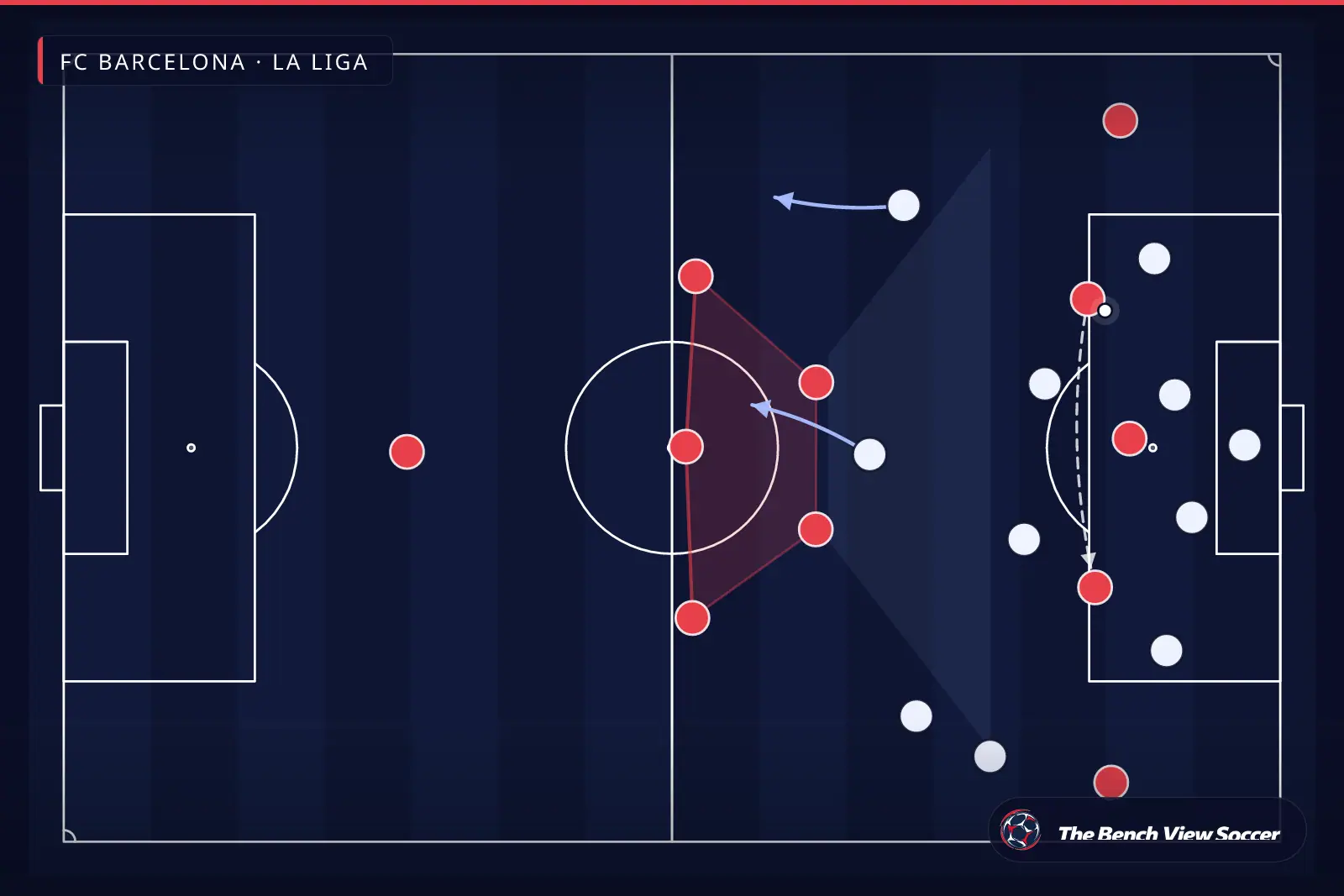
Expect Barcelona’s first phase to harden into a consistent 3-2 shape: the weak-side full-back tucking in to form a back three, the double-pivot forming a barrier in front, and the eights pinning the next line with third-man availability. The purpose is not just progression. It is insurance. When the ball turns over, the 3-2 is already present to suffocate the first pass out. That’s rest-defense by design: deny the immediate out-ball, funnel the play into pre-set traps, and shrink the field so you don’t need recovery sprints to the corner flag.
With Araújo, Barcelona could afford to stretch in search of verticality because he could erase the punishment. Without him, they will choose their verticality—timed third-man runs, wingers pinning rather than vacating, and a pivot that protects the launchpad rather than joining it.
Cause and effect: how personnel profiles make the plan viable
None of this works unless the remaining and emerging pieces fit. Barcelona’s centre-back room has quietly become more homogenous on the ball and more communicative in the line. That matters. In a back four that defends the box in a zonal cascade, you want centre-backs who slide as a pair, who value angles over chases, who break lines with their passing so the middle third doesn’t collapse into duels. The current profiles are less thunderbolt and more metronome: quicker to hold the line than to abandon it, quicker to step five metres than to run 40.
On the right touchline, the bet also implicates the winger. The first backward press is now a system lever. Rather than a winger turning late to chase a full-back who’s already running, the winger will sit on the passing lane earlier, forcing the opponent back inside toward Barcelona’s double pivot. That inside funneling removes the scenario Araújo solved so often: a winger receiving on the touchline in a 1v1 with a full field to attack.
Pressing triggers: earlier, narrower, smarter
Watch how Barcelona set their pressing traps in the first 15 minutes of games. The near-side eight’s body shape will tell you everything. If his hips are oriented toward the opponent’s full-back, he’s baiting the release. If they’re squared to the six, he’s closing the inner lane. In the new model, expect the eight to deny the inside to inside pass more aggressively. The trap is triggered when the ball is telegraphed to the touchline—sprint, compress, win the throw-in. It’s low drama, high probability, and it reduces the long run-ups that made Araújo’s speed a match-winner.
Set-pieces also reveal the trade. Araújo was a dominant aerial defender. Without his presence, Barcelona must reweigh zones and matchups. The compensation is structural: cleaner first contact zones due to better initial positions, a higher line on free-kicks to compress the delivery space, and more players ready for second balls rather than marking individually into the six-yard box.
Lessons from history: when Barcelona last downshifted from a duel-winner
This is not unprecedented. When Carles Puyol’s era waned, Barcelona recalibrated around Gerard Piqué’s distribution and Sergio Busquets’s orchestration. The team didn’t replace Puyol’s charisma in the duel; it replaced the contexts that asked for it. Similarly, Javier Mascherano’s move from midfield to centre-back was less about winning 1v1s than about reading and arriving early. The best Barcelona teams, tactically speaking, have always been better at pre-empting than reacting.
Beyond Catalonia, Bayern’s post-Alaba rebuild moved away from a hyper-mobile back line to a shape-first defensive phase; Real Madrid’s post-Varane adaptation leaned harder on collective distances and Thibaut Courtois’s dominance of the area. Elite squads frequently choose structure over individual fail-safes once the fail-safes become the plan. Barcelona’s current move feels like that inflection point.
What Araújo becomes at Liverpool—and why that matters to Barcelona’s bet
Liverpool inherit the very superpower Barcelona are choosing not to build around: an apex 1v1 defender who loves defending the halfway line with three attackers spinning behind him. With Virgil van Dijk’s command at LCB and a high back line as the default, Araújo slots into a system that can actually maximise his box defending and channel duels. He will fight aerials, step into midfield on diagonals, and race into cover when Trent Alexander-Arnold inverts. In other words, Liverpool can create the high-wire acts that Araújo ends with applause; their pressing ecology needs that firebreak.
That’s not a criticism of Barcelona. It’s the crux of the divergence. One club’s principle is to maintain a high tempo of transitions and trust elite duel-winners to mop up the residues. The other’s is to decelerate the game into repeatable, low-variance phases. Barcelona can respect Araújo’s excellence while acknowledging that the next version of their team has to be less dependent on chase-backs and last-ditch tackles. The irony: by sending Araújo into a league that celebrates duels, Barcelona may prove their own model by contrast—fewer duels at home, more duels for him abroad.
The hidden benefit: passing geometry and the right-sided chain
With Araújo, the right touchline sometimes sacrificed build-up precision for defensive insurance. You saw conservative positioning from the right-back role and fewer inside diagonals hit through the right half-space. In the new chain, anticipate an RCB comfortable splitting the first line with firm verticals and a right-back who can invert into a pivot lane without leaving a canyon behind him. That geometry improves the feed into the right-sided eight and striker’s pin, enabling cleaner rotations—an underlapping run from the eight becomes a feature rather than an emergency pattern.
Why does this matter? Because Barcelona’s attack has often stalled when the right side became a cul-de-sac. With a more assertive right interior and a right centre-back who plays to feet under pressure, the winger can hold width higher and time diagonal darts in behind. The whole phase becomes less about whether the touchline duel is won and more about whether the timing triangle is executed. That is how you convert possession into territorial control without repeatedly seeing your back four defending 50 metres of grass.
Game-state management: fewer firefights, more compression
Barcelona are betting on compressing games earlier and gentler. Instead of long stretches of end-to-end exchange that leave centre-backs backpedalling, expect quicker consolidation after losing the ball: immediate five-yard sprints forward by the double pivot, the near-side full-back stepping inside the lane to deny the straight ball, and the winger closing the outside to outside pass. Every micro-action trades space for time—less room for the opponent to accelerate, more time for Barcelona to reset their line. Araújo used to buy time with a sliding tackle; the new model buys time with a body shape.
In practice, this will look like slightly fewer direct counter-press tackles and more forced clearances that Barcelona can recycle. Supporters may interpret fewer Hollywood tackles as softness. Tactically speaking, it’s the opposite. It’s control.
Risk ledger: what Barcelona lose, what they must compensate, what they gain
What they lose
- A true eraser against straight-line pace. When an opponent isolates your right channel and knocks it past, Araújo was as safe as elite football offers.
- Aerial dominance on both posts during set-pieces. He didn’t just win first balls; he organised second contacts.
- Psychological deterrence. Wingers felt him before they beat him. That matters in big nights.
What must be compensated
- Set-piece rigour. Expect Barcelona to tweak their zones: more aggressive front-line blockers, a clearer assignment for the runner attacking the penalty spot, and meticulous work on second-ball lanes.
- Box defending in cut-back scenarios. With no Araújo tracking the late runner as a super-reactor, the near-side pivot’s accountability rises. He must arrive earlier to the edge of the box to block the low pull-back.
- Transition choice architecture. The eights must be a half-step more conservative in counter-pressing gambles to avoid exposing the right channel to two-pass release sequences.
What they gain
- Predictable spacing. A back four that moves as a line is harder to separate with drag runs; fewer dog-leg sprints after broken plays.
- Cleaner right-side progression. A true RCB who lives in the half-space lane will feed the right eight and winger more reliably under pressure, reducing forced long diagonals.
- A harder ceiling for Champions League phases. Europe punishes emergency defending. Barcelona’s path back goes through prevention, not heroics.
Comparative lens: how this compares to other elite rebuilds
Manchester City’s Rodri-era defensive control wasn’t built on duels at the last line; it was built on a midfield that killed transitions before they started. Bayern under Hansi Flick thrived on winning the ball back in five seconds, but their later iterations leaned into line management and rest-defense as their athlete pool changed. Real Madrid’s Champions League runs combined individual goalkeeping brilliance with a line that rarely sprinted backward in panic because their front five collapsed passing lanes at source.
Barcelona’s move is different in flavour but similar in spirit. The core idea: reduce the number of things that can go wrong. That’s the competitive edge at the very top—limiting error volume, not just increasing error correction capacity.
Tactical tells to track in the opening months
1) The right-back’s average position
If the right-back’s starting position is consistently narrower by five to seven metres, you’ll know the plan is live: create a quasi-back-three early in possession, keep the rest-defense scaffolding built at all times, and prevent the vacuum that wide counters love.
2) The right eight’s backward pressing distance
Measure the first five steps after a turnover. If he turns and sprints inside-out immediately—cutting off the lane into the channel rather than chasing the full-back—Barcelona are funnelling transitions into their traps instead of toward the touchline 1v1 that Araújo used to dominate.
3) The striker’s pin versus the weak-side centre-back
By holding the far centre-back, the striker keeps the opponent’s back four stretched laterally, opening the lane for the right eight to receive on the half-turn. That is the feed that makes Barcelona’s controlled verticality work and reduces chaotic, 50-50 counters.
Scenario planning: the big games where the choice will be judged
- Against dribble-heavy left wings: The classic test—can Barcelona prevent isolation rather than win it once isolated? Expect early doubling strategies and delayed full-back releases, with the pivot cheating two metres toward the right to pre-empt through-balls down the channel.
- Against back-to-goal strikers: Without Araújo’s raw duel dominance, the centre-backs must front more confidently and rely on the near-side pivot to sweep. The reward: win the ball 30 metres higher, where one vertical pass starts your attack.
- Against counterpunching mid-blocks: The whole point of the new plan is to starve these opponents of transition diets. Watch the shot volume conceded from counters; if it dips, the philosophy is working, even if highlight tackles disappear from the reel.
What it means for player development and recruitment
Barcelona’s defensive academy pipeline will have its brief: produce centre-backs and full-backs who move first and duel second. The selection criteria tilt toward anticipation, scanning, and passing angles rather than raw recovery speed. Recruitment mirrors that. Expect the next right-back signing to be tactically bilingual—capable of inverting into midfield and defending the touchline without permanent babysitting from the RCB. The next centre-back will be judged as much by how many touches he takes under pressure as by how he sprints in chase.
Midfield recruitment flows from the same philosophy. If you choose prevention over reaction, your six—and possibly your eight—must love ugly metres. They must absorb first contacts, stall transitions half a second longer, and live for interceptions rather than tackles. This is how structure becomes culture.
The Premier League mirror: why Liverpool’s gain clarifies Barcelona’s identity
Liverpool’s high-line ecology, with Virgil van Dijk setting the depth and their wingers activating the press on the second pass, is a natural habitat for Araújo. He doesn’t just plug gaps; he anticipates movement patterns that the Premier League repeats weekly—flat balls into channels, early diagonals to the far post, and quick, vertical one-twos around the corner. In that environment, his range is amplified. Barcelona can appreciate this without regret. If anything, his success there will be proof that they made a clear choice: when you can’t outbid England’s duel-obsession, out-think it by reducing the duel count at home.
Counterargument: you don’t let elite 1v1 defenders leave at their peak
The dissenting case is powerful. Champions League ties are decided by tiny ruptures. When a winger skips past your full-back in minute 64 and heads for the byline, there is no system—only the defender who meets him there. Araújo has repeatedly met them and won. From that vantage, sending him away is removing your safety net on the one night you might need it most. In set-pieces, his absence is arithmetic: one fewer dominant header, one more mismatch. Leaders are not just diagram pieces; they’re voices when the stadium shakes.
We take that seriously. There will be games—especially away in Europe—when the match tilts toward chaos. Without Araújo, Barcelona risk living and dying by their control. If they lose it for ten minutes, the climb back is steeper.
Our response
Control, however, is not a vibe; it’s a repeatable craft. Over a season, the teams that control the type and location of duels fare better than those who win the most duels in random places. Barcelona are betting that their structural gains—cleaner rest-defense, better spacing, improved right-side circulation—will reduce those ten-minute storms to two-minute squalls. When you reduce the weather, you reduce the need for a lightning rod.
What to watch next: on-pitch proof points
- Early-season PPDA and counter-shot volume. If Barcelona’s passes allowed before a defensive action tick up slightly while counter-shot volume drops, that’s success by design: fewer frenetic presses, better-organised blocks, less helter-skelter defending.
- Right-flank possession chains. Count the number of three-pass sequences that end with a right-half-space reception facing forward. That is the lifeblood of the new model: proactive occupation instead of reactive sprints.
- Set-piece re-architecture. Who takes Araújo’s back-post and near-post responsibilities? Look for clearer role assignments: one screen, one zonal attacker of the penalty spot, one free runner for second balls.
- Game management after going 1–0 up. With Araújo, Barcelona could sit five metres deeper and trust the chase. Now, they should stay five metres higher and trust the shape. How often they maintain territory with the lead will measure cultural buy-in.
The broader European context: market dynamics and identity
In a window where elite No. 6s and duel-monster defenders attract record outlays, Barcelona’s move feels like an identity play. Rather than chase scarce profiles at premium prices, they’re consolidating a model that turns average traits into collective advantage. That’s coherent squad-building: where you spend (midfield control and right-back versatility) and where you save (redundant duel-winners) must align with how you want to play.
The payoff isn’t immediate sheen; it’s seasonal stability. If Barcelona hold their average defensive line two metres higher and concede two fewer direct transitions per game, the compounding effect across 50 matches is profound. Titles are not only won by fireworks; they’re won by removing booby traps from your own floor plan.
Verdict: Barcelona’s brave bet is the right one—if they live it every minute
Tactically speaking, Barcelona’s willingness to part with an elite emergency defender in Ronald Araújo reads as a declaration of faith in structure. It is bold because the highlight reel will miss him. It is fair because the data of elite football rewards those who need fewer miracles, not those who produce more of them.
The caveat is discipline. This plan fails if old habits creep back—full-backs sprinting into the last line at the wrong trigger, eights chasing lost causes, pivots arriving late to the cut-back lane. It succeeds if Barcelona compress games into repeatable states: a right side that progresses without panic, a block that slides rather than chases, a rest-defense that turns transitions into throw-ins.
In short: Barcelona didn’t just change a centre-back; they changed the canvas. If they paint within the new lines, this will read as a season-defining masterstroke. If not, every wide sprint they face will echo a name now wearing red in England.
The Bench View app
Don’t just read football — train it
Everything you read here, turned into training you can follow step by step.
Physical training at home
AI daily sessions adapted to your level and position. No equipment needed.
Tactical training courses
Step-by-step courses on positioning, pressing, build-up and decision making.
- 7 days free
- No commitment
- Cancel anytime
Free account: 2 physical sessions + the first tactical course. PRO: 7-day free trial — cancel before day 8 and you pay nothing.

More Analysis
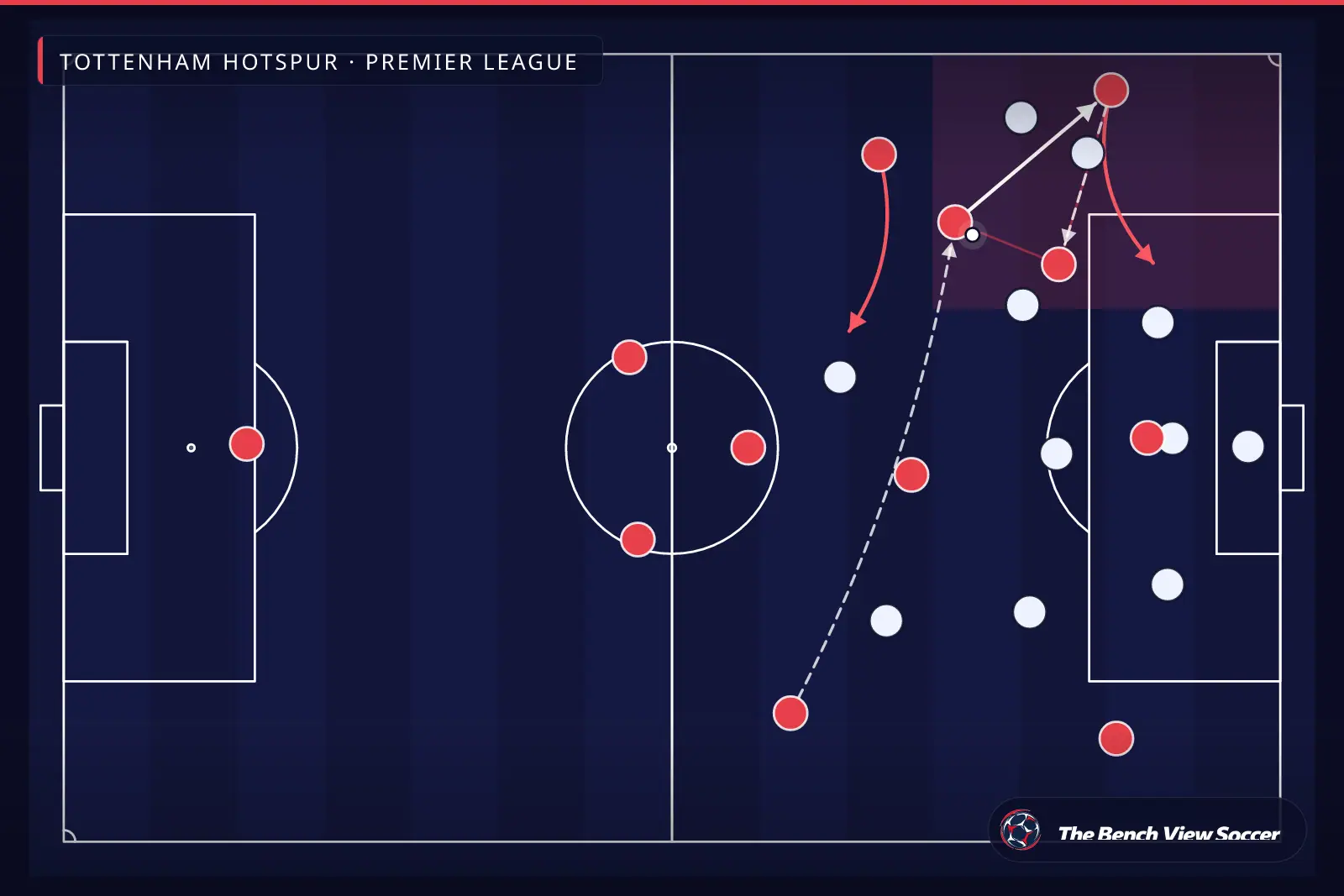
Tottenham Hotspur: Why a Gakpo-Style Inverted Winger Unlocks 3-2-5
August 25, 2026
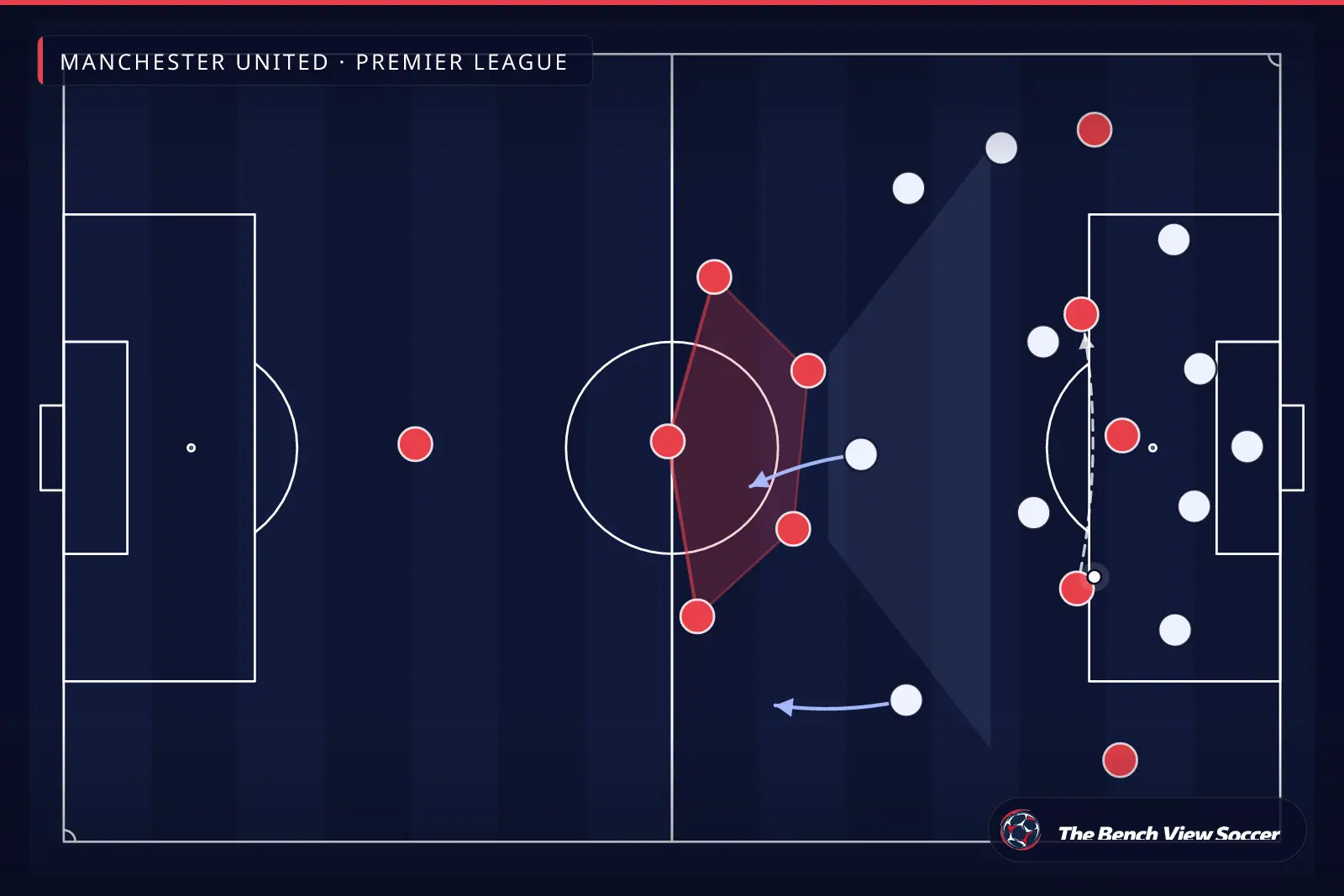
Manchester United's Baleba Move Fixes Their Rest-Defense Gap
August 22, 2026
Rodri to FC Barcelona: How the Pivot Reinvents Rest-Defense
August 19, 2026
Benfica's Inverted Right-Back Plan Made Dedić a £30m Upgrade
August 18, 2026