

The trending moment — and the tactical thesis Spurs fans should care about
Tottenham Hotspur are suddenly part of a live transfer conversation with a very specific flavor: a left-sided attacker whose best work happens between the lines. The headlines talk about names; the tactical story is about profiles. And tactically speaking, the punchline is simple and bold: Tottenham’s possession game under Ange Postecoglou will level up if they add a Gakpo‑style inverted winger who can live in the left half‑space, receive on the turn, and trigger third‑man runs within a 3‑2‑5 structure. It’s not just about goals; it’s about how Spurs build, press, and protect transitions — all in one move.
Ignore the noise for a second and look at the geometry. Postecoglou’s Spurs are at their best when they dominate the lanes that are hardest to defend: the channels between center‑back and full‑back, and the strip of grass in front of the opposition’s holding midfielder. That’s exactly where a Cody Gakpo‑type forward thrives. The right player plugged into that slot changes how Tottenham progress, how they collapse on rebounds, and how they defend the instant possession turns. That’s why this rumor is resonating — because the profile answers a structural need that’s been bubbling under since day one of the Ange era.
In our view, the real upgrade for Tottenham isn’t “more goals from the left wing” — it’s a left inside forward who lets Ange’s 3‑2‑5 finally work like a five‑man front, not a four‑plus‑one.
Where Spurs are right now: the skeleton of Ange‑ball
Postecoglou’s Tottenham play with aggressive principles that are consistent regardless of personnel: a proactive high line, brave build‑up, and a five‑lane attacking shape. In possession, they toggle between a 2‑3‑5 and 3‑2‑5 depending on how the full‑backs behave. The left‑back (often Destiny Udogie) frequently steps inside to join the pivot, creating the 3‑2 base that underpins everything. On the right, Pedro Porro often pushes higher or underlaps, giving Spurs an asymmetry that opponents struggle to read.
From there, the front five aim for positional superiority: one player in each lane (left wing, left half‑space, central 9, right half‑space, right wing). The key is not just who stands where, but who manipulates defenders. When Spurs are humming, you see the 8 or 10 occupy the blindside of the 6, a wide forward pin the full‑back, and an underlapping full‑back dive into the box at precisely the moment the block shifts.
That’s the theory. The practice shows a subtle, recurring gap on the left. Too often, the winger stretches wide to open the lane — which is good — but doesn’t consistently step inside to act as a connective hub when Spurs get into the red zone. The result is a lot of good approach play that resolves into hurried crosses or a reset rather than a clean cutback. Tottenham can swarm, yes. But the left half‑space specialist who can be a wall pass, a shot threat, and a counter‑press trigger in one body — that’s the missing piece that turns pressure into inevitability.
The left‑side conundrum: threat versus connection
Under Postecoglou, Tottenham’s left flank has toggled between width and incision. When the left winger hugs the chalk, he stretches the line, which improves the angles for James Maddison (or the left interior) to step on the ball. But without an interior forward on that side who can receive on the half‑turn, tight to the penalty area, Spurs often end up attacking around the block rather than through it.
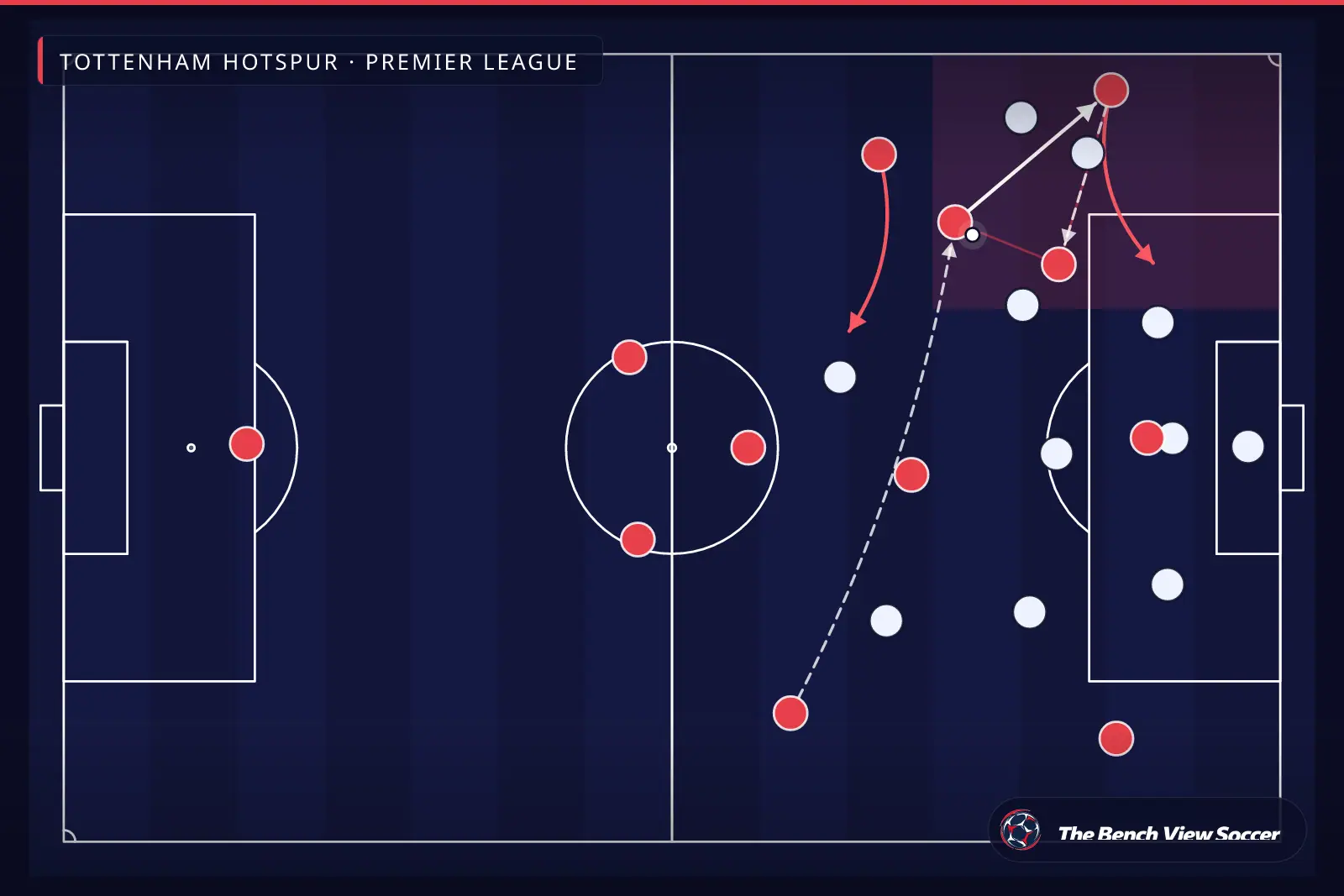
We’ve seen flashes of how it should look. The classic example came at Old Trafford in January 2024: the 46th minute equaliser, built down the left half‑space from a cutback that found Rodrigo Bentancur in stride. That move — a winger receiving inside the full‑back, drawing a center‑back, then tearing the ball back across the grain — is the Tottenham pattern that should be their bread and butter. What’s missing is the repeatability: the same action, delivered ten times a match, not two.
What a Gakpo‑style inverted winger actually changes
There’s no need to guess. The blueprint is well known: a right‑footed left inside forward who loves starting from the channel and finishing central. But the crucial value of a Gakpo‑style profile in this Spurs team isn’t “cut inside and shoot.” It’s the micro‑actions he automates that fit perfectly into Ange’s concepts:
1) Back‑to‑goal lay‑off in the left half‑space. When the ball is fizzed into that lane, a Gakpo‑type forward can bounce it first time to the oncoming 8, or swivel to attack the seam. That first touch under pressure turns static possession into a dynamic three‑man combination.
2) Diagonal carries that distort the back line. Starting left and driving toward the penalty arc forces the near‑side center‑back to step. That’s the exact trigger for the center‑forward to dart across the weakside CB, and for Udogie to underlap into the box. One carry, three runs, five defenders spinning.
3) Automatized third‑man runs. This is the Ange staple: Player A plays into Player B to release Player C. An inverted left forward who understands this rhythm means Maddison (or the left interior) can play wall passes to release Udogie or the 9 beyond. It upgrades Spurs from good patterns to relentless patterns.
4) Counter‑press from the front. Because the starting positions are narrower, the moment Spurs lose the ball, the inverted winger is already within tackling distance of the opponent’s 6 or near‑side CB. The first five seconds become Tottenham seconds, squeezing the exit and forcing a panicked hoof into a ready 3‑2 screen.
5) Rest‑defense insurance. In Ange’s 3‑2‑5, rest‑defense lives or dies by the two behind the ball plus how quickly the nearest forward drops. A Gakpo‑style winger is known for his work in the counter‑press lanes — curving the press to show the ball outside, then pouncing on the heavy touch. That means fewer 50‑yard defensive sprints for the center‑backs, and more attacks launched from 35 yards out instead of 75.
The rotation map: who moves when the left inside forward moves
To visualise the impact, imagine a simple triangle on the left: the inverted winger high and narrow; the left interior (often Maddison drifting) a step deeper; Udogie tucked inside, ready to burst. The ball goes into the winger’s feet. He pins the full‑back, teases the center‑back to step, and either:
– Lays back to Maddison, who then slides Udogie in on the underlap;
– Spins and carries diagonally, creating the lane for the 9 to run across the near‑post and for the far‑side winger to crash the back stick;
– Plays a disguised reverse pass back into Udogie’s path for a one‑touch cutback.
This is not theory; it’s the chain that elite 3‑2‑5 sides repeat until opponents crack. Tottenham already execute versions of it. They simply need it on demand — and under Ange, the demand is every attack.
Case studies — the moments that preview the fit
Old Trafford, January 2024: the 46th‑minute pattern
Spurs’ equaliser in the 46th minute away to Manchester United is a textbook example of what the left half‑space should yield. The left winger received in the channel inside the full‑back, squared up the CB, and then cut the ball back across the line for Bentancur to stride onto. The principles were perfect: pin, pull, cut back. A Gakpo‑style forward gives you that pattern every other possession, because his default is to operate in that pocket rather than staying outside for the switch.
Tottenham 2–1 Sheffield United, September 2023: the late‑runner logic
The dramatic finish against Sheffield United — Richarlison in the 98th, Dejan Kulusevski in the 100th — showcased something deeper than limbs: Spurs’ insistence on flooding the box with late movement from the half‑spaces. The right half‑space delivered the winner, but the logic mirrors what Tottenham want on the left: controlled entries into the area, then low‑cut deliveries towards late runners who hit through a scrambled block. An inverted left winger multiplies those deliveries from the other side and, crucially, adds a second‑wave counter‑press shape to trap the clearance.
Chelsea chaos, November 2023: why rest‑defense matters
The 1–4 against Chelsea was unique — Spurs played with a high line even when down men — but it highlighted a structural point: if the ball‑side forward is wide and detached, transition protection frays immediately on loss. An inside left forward shortens the distances, letting Spurs’ 3‑2 rest‑defense bite quicker. That doesn’t change the red‑card arithmetic of that wild night, but it’s an instructive lens for regular 11‑v‑11 football: narrower starting points mean fewer catastrophic transition gaps.
The Wolves problem: mid‑block magnets
Teams like Wolves have frustrated Tottenham by clogging the middle and baiting early crosses. The antidote is not more crossing; it’s more manipulation before the cross. An inverted left winger forces the near‑side 6 and CB to duel in the same five‑meter box. Even if the cross still comes, it’s now a grounded cutback after two defenders have been unbalanced, rather than a floated ball to a set line. Same lane, radically different probability.
Historical context — Spurs have danced with this idea before
If this all sounds familiar, that’s because a younger Tottenham under Mauricio Pochettino solved similar problems with different names. Back then, it was Dele Alli ghosting from the left half‑space while Christian Eriksen threaded angles and Son Heung‑min attacked that same seam with diagonal runs. The Son–Dele–Eriksen triangle was, in its prime, a precursor to today’s five‑lane domination: one tight connector, one late runner, one vertical threat.
Zoom out further and you see the lineage across Europe. Manchester City’s evolution toward a permanent 3‑2‑5 included Jack Grealish and, later, Josko Gvardiol combining on the left to control the half‑space without ceding width. Liverpool added a similar flavor when Cody Gakpo arrived: less of a chalk‑on‑boots winger, more of a connector and box arriver, comfortable as a false nine or an inside forward. The shared theme is obvious: decide where you want to win the ball after you lose it, and place your forwards accordingly. In elite teams, the left inside forward often doubles as your first counter‑pressing midfielder.
Postecoglou’s football aligns with that logic. His Celtic sides were relentless about inside forwards arriving into the box while the full‑back underlapped. At Tottenham, with superior individual quality and a league that punishes sloppy rest‑defense, the detail matters even more. The player profile at left inside forward either amplifies the plan — or blunts it.
Why this is happening now: the cause‑and‑effect chain
Three systemic factors make a Gakpo‑style profile feel urgent for Tottenham:
1) Opponents have adapted to Ange’s width first. Early in the era, teams respected Tottenham’s wingers by dropping off. More recently, they’ve stepped higher at full‑back to suffocate the first pass, daring Spurs to find a central solution. Without a natural inside connector on the left, Tottenham sometimes accept the dare by going around again. That keeps possession; it doesn’t break blocks.
2) The 3‑2 base needs a vertical 10 out of possession. Spurs’ two behind the ball can be elite at cleaning up when the third presser behind them is timely. If the left forward is welded to the touchline, the angle of counter‑press is too long, and the first duel is lost. An inside left forward collapses the triangle and gives Spurs the “+1” they need at the spill.
3) Squad balance tilts right. Tottenham’s right side often builds faster because Pedro Porro can both overlap and underlap, and Kulusevski loves operating in that right half‑space. The left can feel more static unless Udogie or the left 8 breaks the line. A left inside forward relocates the gravity center so the opponent can’t shade their shape to the Spurs right without paying a price.
Pressing triggers: the defensive value of an attacking profile
Because Tottenham want the ball back immediately, the forward line must be designed to defend in reverse. That’s where the left inside forward’s off‑ball intelligence is gold. The pressing triggers are clear:
– Back‑pass to the opposition left‑back: curve the run to block the line to the 6, show the touchline, and pounce on the heavier touch.
– Square ball from the 6 to the RCB: jump the passing lane from the blindside, using the proximity of Spurs’ left interior to trap from the inside‑out.
– Goalkeeper heavy touch on his weaker side: initiate the sprint to force a rushed clearance toward Spurs’ strong‑side aerial duel.
A Gakpo‑type forward, comfortable closing from narrow to wide and then re‑entering the half‑space, turns those triggers into near‑standard turnovers. The instant the regain happens, Tottenham now have an attacker already facing goal, five touches from a shot or a squared pass, not a winger arriving late from the chalk.
Build‑up subtleties: from 2‑3‑5 to 3‑2‑5 and back again
Inside forwards don’t just matter high up. They also change how the first two lines feel pressure. When the left winger stands inside the full‑back, the opposition’s near‑side 8 must choose: track the interior forward or jump to Spurs’ pivot. Either way, Tottenham win a free man. If he tracks, Bissouma (or the left pivot) receives and punches forward. If he jumps, the left inside forward can drop to show feet, link one‑touch, and roll the block.
That cycle forces the opponent’s defensive midfielder to slide early, which opens the central pocket for the 9 to drop without being swamped. Tottenham’s center‑forward then becomes a wall for a bounce‑and‑spin pattern, and the far‑side winger has an extra beat to crash the back post — exactly the timing you want to convert ground crosses rather than looping headers.
Chance creation: the cutback factory Spurs want to be
Under Ange, Tottenham’s best chances come from low deliveries pulled back to the penalty spot or the edge — not from floated crosses. The left inside forward is the foreman of that factory. By receiving between the lines rather than on them, he arrives at the byline with defenders square and the goalkeeper pinned to the near post. The cutback now has multiple targets: the late 8 at the spot, the 9 at the near, and the far winger at the back post.
Rewind to that Old Trafford equaliser in the 46th minute: the reasons it worked are the reasons an inside left forward is priceless — not the name on the team sheet. And those reasons are repeatable: angle of reception, body shape, and the discipline to release the ball across the grain. Tottenham’s current roster can perform these actions; a Gakpo‑style profile simply makes them the default setting.
Finishing and box occupation: Son, the 9, and the left inside forward
There is a hidden upside here: an inside left forward is good for the No. 9. With the left forward drawing a center‑back inside, the 9’s movement across the line becomes lethal. He can:
The Bench View app
Don’t just read football — train it
Everything you read here, turned into training you can follow step by step.
Physical training at home
AI daily sessions adapted to your level and position. No equipment needed.
Tactical training courses
Step-by-step courses on positioning, pressing, build-up and decision making.
- 7 days free
- No commitment
- Cancel anytime
Free account: 2 physical sessions + the first tactical course. PRO: 7-day free trial — cancel before day 8 and you pay nothing.
More Analysis
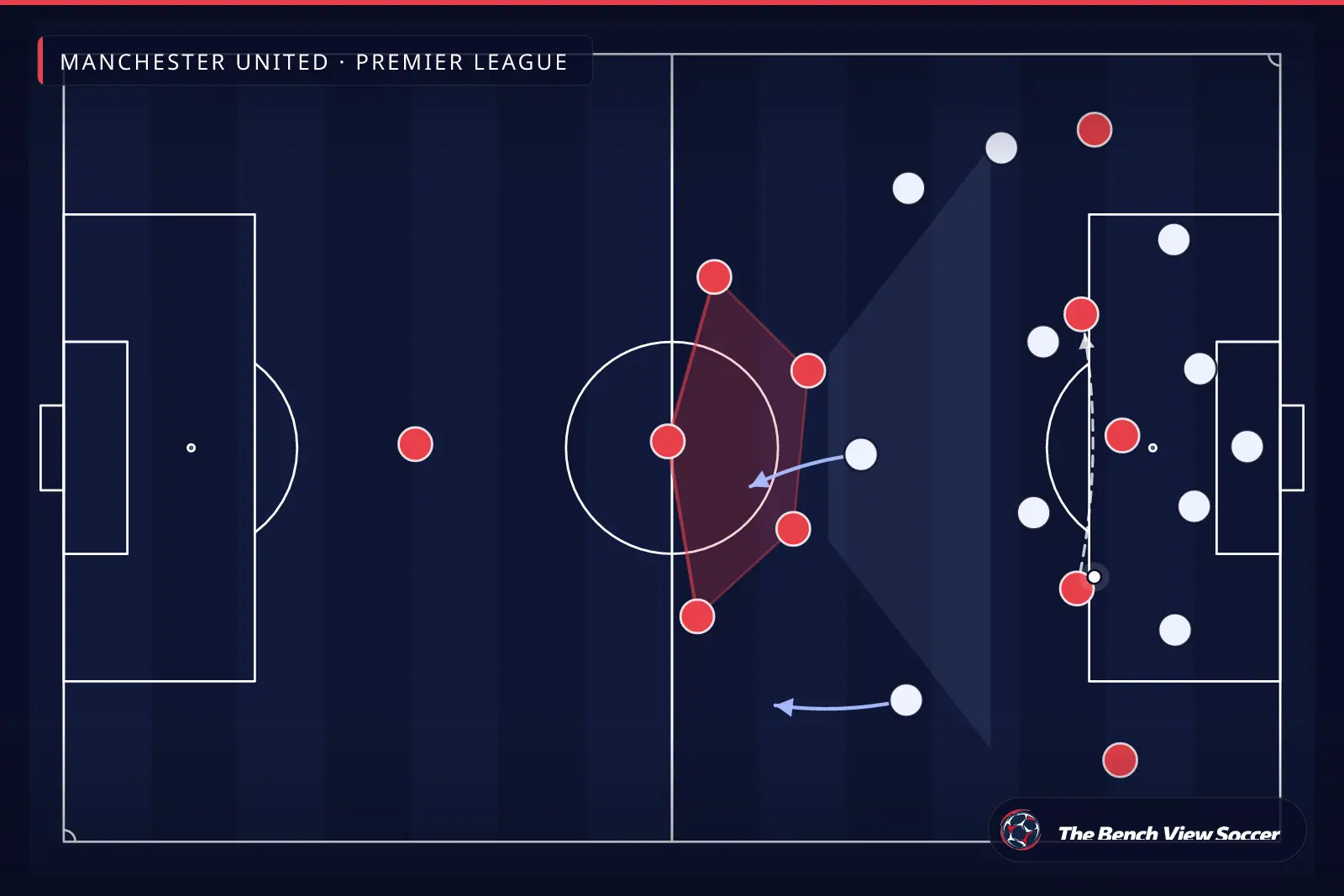
Manchester United's Baleba Move Fixes Their Rest-Defense Gap
August 22, 2026
Rodri to FC Barcelona: How the Pivot Reinvents Rest-Defense
August 19, 2026
Benfica's Inverted Right-Back Plan Made Dedić a £30m Upgrade
August 18, 2026
Manchester City's Rest-Defense Without Rodri: The Real Test Ahead
August 18, 2026